


MHSA(Q&)A: Historian Ron Pesch
April 16, 2012
 When we receive a question on the history of MHSAA athletics that we can't answer on the spot, Muskegon's Ron Pesch is the first person we seek out for help.
Pesch took the reins as Michigan's chief high school sports historian during the mid 1990s after the retirement of legendary MHSAA record book originator Dick Kishpaugh and has contributed to various efforts and publications across the state.
One of his latest projects is the awarding of "retro" Mr. Basketball Awards. The first Hal Schram Mr. Basketball Award was given by the Basketball Coaches Association of Michigan in 1981 to Lansing Eastern's Sam Vincent. Three seasons ago, BCAM -- with research work by Pesch -- began awarding retro winners for the previous decades beginning with the 1920s. This winter, BCAM honored retro winners from 1922, 1932, 1942, 1952, 1962 and 1972.
Click to read more about those winners and the finalists recognized last month. Also, click for links to the previous retro winners. The retro Mr. Basketball project will last seven more seasons. Pesch explains more below.
How did you come up with rewarding a “Retro” Mr. Basketball?
The project came out of a conversation I had with (BCAM executive director) Tom Hursey at the basketball finals back in '99. Together, we hatched an approach honoring the state's past basketball greats. He let me run with it, while he worked on getting a subcommittee launched to make the selection.
How do you dig up all of this nomination info?
Between votes, I work on digging out the details. My initial target list always begins with all-state teams - if, of course they exist. All-tournament teams for the early years also serve as a starting point -- if they exist. Best I can tell, the Detroit Times, the Free Press and the News have all named all-state squads, at various points, back to about 1935. The Associated Press and UPI came to the game much later - somewhere around the early to mid 1960s. I then work on creating a crosstab on the players selected, noting the "teams" on which they were named (Class A 1st team, Dream Team, Class C 3rd team), and try to find quotes detailing their games. The result is really a reflection of the times and the history of newspaper reporting.
In early years, we can struggle to uncover a player’s first name, let alone his class in school. And statistical coverage of a player's abilities was very limited. It's simply the way things were back then. Everyone in town knew King Lewis, or Red Cherry, or Young Jacks. And the final box score only contained points, fouls, substitutions, as they were all you really needed to know about the game. But by visiting the state library in Lansing, and looking at a cross-section of newspapers, you can usually dig out what you need.
Do you collect from other sources as well?
Another source is high school yearbooks. Some resources have started to emerge online. I also tap into the MHSAA site and make contact with ADs around the state, asking for their assistance on digging out details - especially class in school. Like the current program, only "seniors" are considered for the award. Mid-year graduates can create a challenge, but the rule currently in place is a player is considered a nominee in the year in which he was last eligible for the state tournament. In other words, if you graduated in January or February of 1943, you would be considered for the 1942 ballot. It appears that a similar approach was used in selecting all-state teams.
|
Year |
Player |
High School |
Age |
Height |
Weight |
Year |
DFP |
DN |
DT |
AP |
UPI |
Tourney |
|
1971 A-1 G. |
Frank Tanana, Jr. (C) |
Detroit Catholic Central |
17 |
6-3 |
170 |
Sr. |
A1 |
A1 |
A1 |
A1 |
||
|
1971 A-1 C |
Tom McGill |
Flint Northern |
17 |
6-3 |
190 |
Sr. |
A1 |
DM |
A1 |
A1 |
||
|
1971 A-1 F. |
Lindsay Hairston |
Detroit Kettering |
17 |
6-9 |
203 |
Sr. |
A1 |
DM |
A1 |
A1 |
||
|
1971 A-1 F. |
Campy Russell |
Pontiac Central |
18 |
6-7 |
190 |
Sr. |
A1 |
DM |
A1 |
A1 |
That cross-tab table will help establish a list of nominees. A consensus first-team pick is an obvious candidate. When only a single all-state team is available, I'll do what I can to look up all-conference teams or all-area teams from around the state to see who else might be considered. While life after high school is not a considered when trying to pick a winner, a player who emerges as a star in college or in the pros may emerge as a candidate when you see his details in a local paper.
Bios are assembled from the newspaper reports, detailing as much as we can find on high school player's career. I'll tap into a variety of resources including old team histories when available. When needed, I'll toss out request to reporters, old and new, around the state. Local librarians and historians are another wonderful resource.
How does voting work?
Between sessions of the Boys Finals, the committee assembles to hash out a final ballot, and to make a selection. I don't vote, but I may guide the conversation and provide any additional details when needed, reminding members that we're focusing on their high school careers. The process is certainly imperfect. But the committee approach prevents the process from becoming a popularity contest. These guys have the benefit of watching many of the players play. And, like the current Mr. Basketball program, they sometimes surprise. But that's what makes it fun. And, of course, stirs the pot. It gets people talking about the history of basketball in this state.
Is there a theme to MHSAA basketball that has remained constant over the years?
For me the greatest thing about the basketball tournament is that it assembles a wide range of folks who want to see players they've heard about in action. And the process, for the most part, hasn't change since the 1920s. While the style of the game has changed, winning a title is much the same as it was back when our great-grandfathers played: You gotta get through the tournament. And only four trophies are awarded.
These guys were the "Magic" of their day. I'm hoping we never forget that.
Manton, Buckley Prepped for Final Week
March 17, 2017
By Dennis Chase
Special for Second Half
TRAVERSE CITY – History repeated itself Wednesday night.
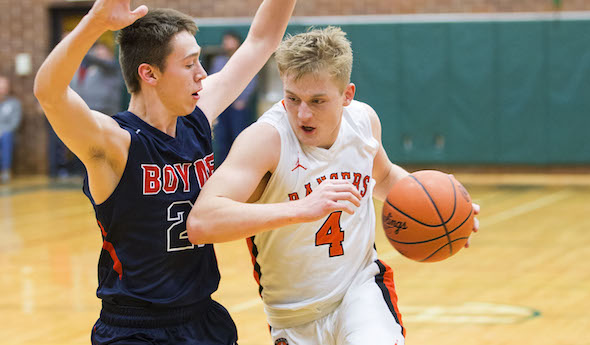
 Down four midway through the fourth quarter, Manton rallied for an edge-of-your-seat 47-46 win over Boyne City in the MHSAA Class C Regional Final at Houghton Lake.
It was Manton’s first Regional title since 1998, when the Rangers topped Boyne City, also at Houghton Lake.
“It’s interesting how things work out,” said Manton coach Ryan Hiller, who was a star player on that 1998 squad.
The Rangers next will face Negaunee on Tuesday in Petoskey.
Manton is one of two Wexford County teams marching on to the Quarterfinals. Unbeaten Buckley upended Suttons Bay 56-37 for a Class D Regional crown at Traverse City Central.
It was Buckley’s first Regional championship since 2010. The Bears will meet Wyoming Tri-unity Christian on Tuesday in Cadillac.
“Let’s do it,” said Bears coach Blair Moss, who starts five underclassmen. “This is fun. I told the kids, ‘This is something you’ll remember the rest of your lives. Let’s not waste it.’ I’m not worried about next year because you never know what will happen next year. Let’s do it right now.”
While Manton players, coaches and fans were basking in the glow of victory in Houghton Lake, Hiller was relieved to be moving on. The Rangers won despite shooting 26 percent from the field – 23 percent from beyond the 3-point arc. In Monday’s Regional opening win over Maple City Glen Lake, the Rangers were 1-of-11 behind the arc in the first half.
“We just don’t shoot well in that gym,” said Hiller. “We’re a 42 percent 3-point shooting team. We had a stretch of five games this season where we hit over 10 3s (in each game).
“These were the two worst shooting nights we’ve had all year. That was my fear (coming into the Final). If we don’t hit our 3s, it’s a dogfight. And that’s exactly what happened.”
It forced Manton to rely on other parts of its game.
 “Free throws and defense won the game for us,” said junior guard Hunter Ruell after the title-clinching victory. “We got some big stops at the end – our coaches had a good gameplan for us – and we hit our free throws. That’s what got us the win.”
The Rangers were 14 of 18 from the charity stripe, 9 of 10 in the fourth quarter. On Monday night, they finished 17 of 19, 9 of 11 over the final eight minutes.
Ruell led the way Wednesday with 13 points, but Jayden Perry, Wyatt Baker and Trever Salani all made key shots down the stretch.
“It’s amazing,” said Ruell. “(A tournament run has) been our dream since day one. Our first goal was to get past McBain (in the District). Since then, we’ve been playing it game by game and it’s been working out.”
“For the players and coaches, who have all worked hard and put the time in, this is rewarding,” added Hiller. “And it’s great for our community. Our community needed something like this. I think our whole town was watching or listening to the game tonight.”
The tournament door swung open for the 20-4 Rangers when they beat unbeaten and top-ranked McBain in the District Final, 54-48. McBain had beaten Manton twice during the regular season, 57-55 and 61-45. The Ramblers also had sent the Rangers to the exits in the last two Districts with down-to-the-wire 46-43 and 49-48 triumphs.
“We’ve been so close,” said Hiller. “We’ve been in so many battles with them.”
This time the Rangers won that battle, and now their journey will take them to Petoskey, where they opened the season with wins over Class A Regional finalist Traverse City West 76-72 and the host Northmen 52-48 in the Petoskey Invitational.
Oh, by the way, the Rangers shot 48 percent beyond the arc in those games.
“Our kids should have confidence playing in that gym,” said Hiller.
There’s actually a Petoskey connection at work for the Rangers this season. Former Northmen standout Trevor Huffman, who led Kent State to the NCAA Elite Eight in 2002 and then played 12 years of professional basketball, is helping out, although now it’s “from afar” since he’s been in the Caribbean a good chunk of the season.
“We have good, hard-working, nice kids,” said Hiller. “He (Huffman) formed a bond with them. He said, ‘Hey, I’d love to help as much as I can.’ He’s been helping all season.”
Huffman started working with the team in practice, but left for the Caribbean around the first of the year, Hiller said. Still, he analyzes film for his friend after each Rangers game.
 Hiller loads the film on Hudl, allowing Huffman instant access to it.
“It’s awesome to see the game from his eyes,” said Hiller. “He sees things I don’t. He’s so competitive, and his reports are so detailed. He tells me, ‘You get that game on right after you win and I’ll watch it.’ He’s enjoying the coaching part of it.”
Huffman is also able to leave individual comments on the videos for players to review.
“He promised the kids if they made it to the Breslin he would fly back for the games,” said Hiller. “He’s sticking with it.”
On his Twitter account Wednesday, Huffman congratulated the Rangers on their Regional triumph.
“Proud of their team and what they have put into playing together, on and off the court,” he wrote. “There is nothing better than winning championships with your best friends. Congrats fellas! Enjoy the moment and back to work.”
It’s also back to work for Buckley.
The 24-0 Bears broke Wednesday’s Regional Final open in the third quarter, outscoring Suttons Bay 20-10 to stretch their lead to 15. It was still a 27-22 game when junior Austin Harris nailed a 3-pointer for Buckley. He was fouled after the shot, giving the Bears the ball back. Harris then hit another triple, and Buckley was on its way.
“This team is one of a kind,” said Harris. “We work really hard. We have depth and we have skill. But the biggest thing we have is heart.”
Buckley reached the Regional Finals a year ago, but turnovers in the final couple minutes proved costly in a loss to Bellaire.
“I thought we had them (Bellaire) on their heels,” said Moss, “and then we threw it away the last three or four possessions. We said then we wanted to get back here because we felt we left something on the court. We didn’t take care of the ball, and when you play like that against a good Bellaire team it comes back to haunt you and it haunted us all summer.”
The Bears vowed to improve in crunch time, but so far they rarely have been tested.
Of the 24 wins, 22 are by double digits. Only Glen Lake (63-60) and Manton (77-73) have put the heat on. Manton hit 13 3-pointers in their late February matchup.
 Moss’ message to his team after that game?
“Just a hand up is not good enough,” he said. “You have to get a hand in their face.”
Buckley put added emphasis on defense this season, and the results tell the story. The Bears have held the opposition to under 40 points in 13 games.
Perhaps the best individual defensive effort came Wednesday night when sophomore Ridge Beeman shadowed Suttons Bay’s leading scorer Thomas Hursey, limiting the junior to three points.
“Keep a hand in the chest, stay in front of him and don’t let him shoot,” said Beeman. “That’s what Coach told me to do.”
He then proceeded to carry out the orders.
“Unbelievable,” said Moss, who was still conducting interviews about 30 minutes after the game ended. “I’ve got to go in and shake that kid’s hand. To hold Hursey to three points – and that was on a long desperation shot before half – that was huge. Kudos to him. I told him I don’t care if you don’t score any points at all, you make sure you lock that kid (Hursey) down because he has range, he can score from anywhere.”
Denver Cade hit his average, scoring 21 points for the Bears. Harris added 15, Beeman eight and Joey Weber seven.
“It was a good team win,” said Beeman. “It was a low scoring game for us, but we grinded it out.”
And it kept Buckley’s ultimate goal – a trip to Michigan State’s Breslin Center – in play.
“Our first goal was to win the conference championship, and we accomplished that,” said Cade. “Then it was the District championship, and we accomplished that. The Regional? We just accomplished that. Now our goal is to get to the Breslin.”
The run has also helped Moss get through a difficult time. His mother passed away earlier this month.
“I was very close with my mother,” he said. “That’s been on my mind. I’ve got a heavy heart.”
March, in Michigan basketball circles, is known as a memory-maker month, and Moss is determined to get the best efforts out of his players.
His message?
“Play hard, give me everything,” he said. “Don’t leave anything on the floor because if you do you’ll regret it forever – forever.”
 Dennis Chase worked 32 years as a sportswriter at the Traverse City Record-Eagle, including as sports editor from 2000-14. He can be reached at [email protected] with story ideas for Manistee, Wexford, Missaukee, Roscommon, Ogemaw, Iosco, Alcona, Oscoda, Crawford, Kalkaska, Grand Traverse, Benzie, Leelanau, Antrim, Otsego, Montmorency, Alpena, Presque Isle, Cheboygan, Charlevoix and Emmet counties.
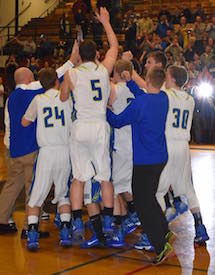
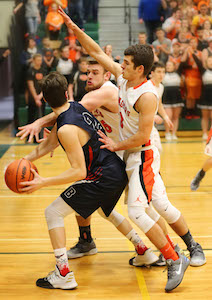
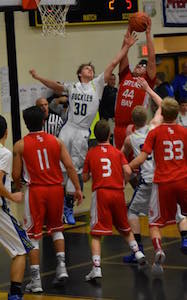
PHOTOS: (Top) Manton’s Trevor Salani works to get around a defender. (Middle top) Buckley celebrates Wednesday’s Regional Final win. (Middle below) Manton’s Wyatt Baker and Hunter Ruell lock down a Boyne City player working toward the basket. (Below) A Buckley player battles for a rebound against Suttons Bay. (Manton photos by Jeannie Christensen; Buckley photos courtesy of Buckley High School.)