


MHSA(Q&)A: Historian Ron Pesch
April 16, 2012
 When we receive a question on the history of MHSAA athletics that we can't answer on the spot, Muskegon's Ron Pesch is the first person we seek out for help.
Pesch took the reins as Michigan's chief high school sports historian during the mid 1990s after the retirement of legendary MHSAA record book originator Dick Kishpaugh and has contributed to various efforts and publications across the state.
One of his latest projects is the awarding of "retro" Mr. Basketball Awards. The first Hal Schram Mr. Basketball Award was given by the Basketball Coaches Association of Michigan in 1981 to Lansing Eastern's Sam Vincent. Three seasons ago, BCAM -- with research work by Pesch -- began awarding retro winners for the previous decades beginning with the 1920s. This winter, BCAM honored retro winners from 1922, 1932, 1942, 1952, 1962 and 1972.
Click to read more about those winners and the finalists recognized last month. Also, click for links to the previous retro winners. The retro Mr. Basketball project will last seven more seasons. Pesch explains more below.
How did you come up with rewarding a “Retro” Mr. Basketball?
The project came out of a conversation I had with (BCAM executive director) Tom Hursey at the basketball finals back in '99. Together, we hatched an approach honoring the state's past basketball greats. He let me run with it, while he worked on getting a subcommittee launched to make the selection.
How do you dig up all of this nomination info?
Between votes, I work on digging out the details. My initial target list always begins with all-state teams - if, of course they exist. All-tournament teams for the early years also serve as a starting point -- if they exist. Best I can tell, the Detroit Times, the Free Press and the News have all named all-state squads, at various points, back to about 1935. The Associated Press and UPI came to the game much later - somewhere around the early to mid 1960s. I then work on creating a crosstab on the players selected, noting the "teams" on which they were named (Class A 1st team, Dream Team, Class C 3rd team), and try to find quotes detailing their games. The result is really a reflection of the times and the history of newspaper reporting.
In early years, we can struggle to uncover a player’s first name, let alone his class in school. And statistical coverage of a player's abilities was very limited. It's simply the way things were back then. Everyone in town knew King Lewis, or Red Cherry, or Young Jacks. And the final box score only contained points, fouls, substitutions, as they were all you really needed to know about the game. But by visiting the state library in Lansing, and looking at a cross-section of newspapers, you can usually dig out what you need.
Do you collect from other sources as well?
Another source is high school yearbooks. Some resources have started to emerge online. I also tap into the MHSAA site and make contact with ADs around the state, asking for their assistance on digging out details - especially class in school. Like the current program, only "seniors" are considered for the award. Mid-year graduates can create a challenge, but the rule currently in place is a player is considered a nominee in the year in which he was last eligible for the state tournament. In other words, if you graduated in January or February of 1943, you would be considered for the 1942 ballot. It appears that a similar approach was used in selecting all-state teams.
|
Year |
Player |
High School |
Age |
Height |
Weight |
Year |
DFP |
DN |
DT |
AP |
UPI |
Tourney |
|
1971 A-1 G. |
Frank Tanana, Jr. (C) |
Detroit Catholic Central |
17 |
6-3 |
170 |
Sr. |
A1 |
A1 |
A1 |
A1 |
||
|
1971 A-1 C |
Tom McGill |
Flint Northern |
17 |
6-3 |
190 |
Sr. |
A1 |
DM |
A1 |
A1 |
||
|
1971 A-1 F. |
Lindsay Hairston |
Detroit Kettering |
17 |
6-9 |
203 |
Sr. |
A1 |
DM |
A1 |
A1 |
||
|
1971 A-1 F. |
Campy Russell |
Pontiac Central |
18 |
6-7 |
190 |
Sr. |
A1 |
DM |
A1 |
A1 |
That cross-tab table will help establish a list of nominees. A consensus first-team pick is an obvious candidate. When only a single all-state team is available, I'll do what I can to look up all-conference teams or all-area teams from around the state to see who else might be considered. While life after high school is not a considered when trying to pick a winner, a player who emerges as a star in college or in the pros may emerge as a candidate when you see his details in a local paper.
Bios are assembled from the newspaper reports, detailing as much as we can find on high school player's career. I'll tap into a variety of resources including old team histories when available. When needed, I'll toss out request to reporters, old and new, around the state. Local librarians and historians are another wonderful resource.
How does voting work?
Between sessions of the Boys Finals, the committee assembles to hash out a final ballot, and to make a selection. I don't vote, but I may guide the conversation and provide any additional details when needed, reminding members that we're focusing on their high school careers. The process is certainly imperfect. But the committee approach prevents the process from becoming a popularity contest. These guys have the benefit of watching many of the players play. And, like the current Mr. Basketball program, they sometimes surprise. But that's what makes it fun. And, of course, stirs the pot. It gets people talking about the history of basketball in this state.
Is there a theme to MHSAA basketball that has remained constant over the years?
For me the greatest thing about the basketball tournament is that it assembles a wide range of folks who want to see players they've heard about in action. And the process, for the most part, hasn't change since the 1920s. While the style of the game has changed, winning a title is much the same as it was back when our great-grandfathers played: You gotta get through the tournament. And only four trophies are awarded.
These guys were the "Magic" of their day. I'm hoping we never forget that.
A Year Older, Buckley Sets Aspirations High
December 15, 2016
By Dennis Chase
Special for Second Half
BUCKLEY – The Buckley Bears are hoping pizza parties become a regular occurrence this winter.
 As an incentive to improve defensively, Buckley basketball coach Blair Moss is rewarding his players with pizza parties if they can hold opponents under 40 points.
Through three games, all impressive wins, the Bears have earned one party, beating McBain Northern Michigan Christian 86-39 last Thursday.
“He (Moss) knows we can put up points in a hurry,” junior standout Denver Cade said, “but he wants to see us lock down the other team.”
So far, added emphasis on the team’s man-to-man defense seems to be working. The up-tempo Bears are averaging 92 points offensively, and surrendering 49.
“I know we can score,” Moss said. “That’s not the problem. The problem is locking it down on defense. On nights we’re not making our shots, we’re going to need to have stops (on defense). Since summer, that’s what I’ve been preaching. We’ve talked about it and worked hard on it.”
Focusing on that facet of the game is a priority because Buckley has high aspirations after making a run to the MHSAA Class D Regional Finals last March with a lineup comprised of four sophomores and a freshman. The Bears nearly won the Regional, taking Bellaire to the wire – the teams were tied at 55 with just over a minute to go – before losing 61-57.
“We were young and, as a coach, you wonder how your players are going to handle that kind of pressure,” Moss said. “We threw the ball away in the last couple minutes and that really hurt us. That’s being young. But I think we’ve learned from that.”
That loss became a motivator for the Bears.
“We used it as fuel,” junior Austin Harris said. “We started working even harder after that.”
In the months that followed, players hit the weight room and were in the gym as often as possible. Three starters were heavily involved with AAU. In addition, Moss set up a busy summer schedule that had the Bears traveling all over the state. They competed in scrimmages at Northwood University, Central Michigan University, Ferris State University, as well as local gyms, including Cadillac, where they saw two of the north’s best teams in McBain and Manton. All told, Buckley played nearly 40 games, almost all against larger schools.
“Playing that type of competition has helped prepare us for what’s ahead,” Cade said.
The 6-foot-3 Cade is listed as one of the top 100 players in the state by the Detroit Free Press. He’s off to a solid start, averaging 26 points and eight rebounds a game.
“He’s a winner,” Moss said. “He’s my general on the floor.”
The 6-foot-3 Harris is talented as well. He’s averaging 18 points, eight rebounds and eight assists. He registered a triple-double in Tuesday’s 100-59 win over Suttons Bay. Harris plays on the wing, but also moves to the point on occasion. Moss would like to play him strictly on the wing to increase his scoring opportunities and balance the floor with Cade on the opposite wing.
Cade and Harris are joined in the lineup by juniors Joey Weber and Brock Beeman and sophomore Ridge Beeman. Weber, who also plays the point, and Ridge Beeman average 11 points; Brock Beeman averages nine per game.
 All four juniors were on varsity as freshmen.
“You might get one of these groups every 10 years or so,” Moss said. “You’re just so thankful. They’re all so coachable – and they’re just as good in the classroom as they are on the court. They’ve been playing together since they could walk. They’re in the gym all the time. Their basketball IQ is very high.
“How many coaches start four freshmen at the high school level? I knew we were going to take our lumps that year. We were not very physical, but I knew we were talented enough that we could be in every game.”
The Bears finished 11-11 in 2014-15 and improved to 16-7 a year ago. They now have their sights set higher, starting with winning the Northwest Conference.
“It’s not going to be easy,” Cade warned.
Frankfort, heading into Thursday night’s game, has won 26 league games in a row and returns two top players in juniors Jaylon Rogers and Matt Loney. Glen Lake - bolstered by Lake City transfer Cade Peterson, the quarterback on the Lakers’ MHSAA Finals football team – is 2-0 and seems primed for a breakout campaign. And then there’s Benzie Central, which has given Buckley fits in recent seasons.
“This is the toughest I’ve seen this league,” Frankfort coach Reggie Manville said. “And what’s really scary is that all those teams at the top of the league have most of their starters coming back next season.”
Moss previously coached the Benzie Central varsity for seven seasons. After stepping down, he took two years off from coaching and then re-emerged at Buckley. He’s now in his fourth season.
“I still had that drive, that urge to coach,” he said. “I missed working with kids. I missed the camaraderie with the coaches.”
Todd Kulawiak, the elementary school principal at Buckley, reached out to Moss. The two have a connection – they were former standouts at Benzie under coach Will Lynch and are the two all-time leading scorers in school history. Kulawiak was also an all-state distance runner under Blair’s father, Pete.
Although the Bears struggled the first couple years under Moss, the coach could see what he had coming. Now he’s pushing that group, and himself, so they can reach their potential.
“We’re very capable if we keep focused, keep our heads on straight and keep working hard,” he said.
That drive to improve was a major reason he put together such an aggressive schedule in the summer. He wanted his team to face quality competition, and he was pleased with the results.
“It seemed like we were getting better all the time,” he said.
As an offshoot, Moss also wanted to get his players exposure, especially in camps at college venues.
“They deserve it,” he said. “I want (college coaches) to see our kids. It’s like I told Denver’s father, ‘You’re talking $100,000 for a college education. If he puts the time in now, bingo.’”
Buckley is not particularly big – “We’re mostly a five-guard lineup,” Cade said – so the Bears like to use their athleticism and push tempo.
“With Coach Moss, it’s go, go, go,” Cade said. “If the (MHSAA) had a shot clock, we would be one of the teams that would benefit from it the most because we find a way to get quick, quality shots.”
Opposing coaches have noticed.
“They’re extremely good shooters from the perimeter, and that sets up their offense,” Manville said. “You have to defend that shot. Now, they’re all starting to penetrate to the basket and dish, which makes them more difficult to guard. And if you want to help defend, you’ve got a problem.
“The other problem is they run. They want to score a lot of points. They scored 100 points Tuesday night. Scoring 100 is difficult nowadays. They must have been really efficient. And they’re getting better defensively. I know that’s something they’re working on.”
If Buckley needs size, the Bears can turn to 6-5 Nick Kuhn, who is still developing his game. He had eight points off the bench in a season-opening 91-50 win over Bear Lake.
Buckley’s ability to score, combined with its game experience and chemistry, gives the Bears a good base. But there’s another strength that’s just as important to the team’s success, Harris said.
“Our team has a lot of heart,” he said. “We play really, really hard.”
So now the goal is to play off those strengths while continuing to work on other aspects, like defense. It could make the difference in winning a league title and advancing along the March Madness tournament trail.
“Everybody at that next level can score,” Harris said. “It really comes down to who can play defense.”
 Dennis Chase worked 32 years as a sportswriter at the Traverse City Record-Eagle, including as sports editor from 2000-14. He can be reached at [email protected] with story ideas for Manistee, Wexford, Missaukee, Roscommon, Ogemaw, Iosco, Alcona, Oscoda, Crawford, Kalkaska, Grand Traverse, Benzie, Leelanau, Antrim, Otsego, Montmorency, Alpena, Presque Isle, Cheboygan, Charlevoix and Emmet counties.
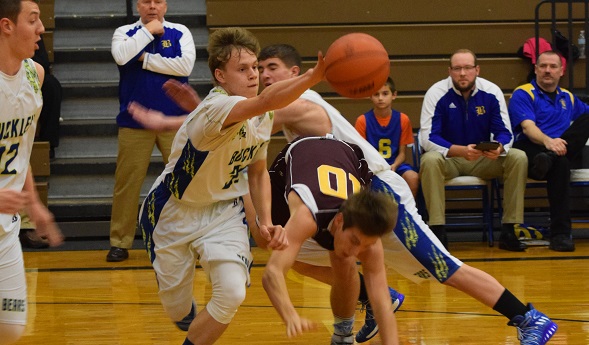
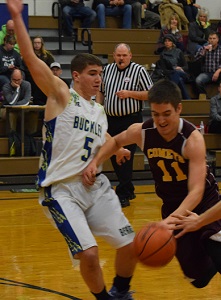
PHOTOS: (Top) Buckley’s Ridge Beeman (30) works to gather a loose ball against McBain Northern Michigan Christian on Dec. 8. (Middle) Joey Weber (5) blocks off a driving Bobcats player during the 86-39 win. (Photos courtesy of the Buckley athletic department.)