


MHSA(Q&)A: Historian Ron Pesch
April 16, 2012
 When we receive a question on the history of MHSAA athletics that we can't answer on the spot, Muskegon's Ron Pesch is the first person we seek out for help.
Pesch took the reins as Michigan's chief high school sports historian during the mid 1990s after the retirement of legendary MHSAA record book originator Dick Kishpaugh and has contributed to various efforts and publications across the state.
One of his latest projects is the awarding of "retro" Mr. Basketball Awards. The first Hal Schram Mr. Basketball Award was given by the Basketball Coaches Association of Michigan in 1981 to Lansing Eastern's Sam Vincent. Three seasons ago, BCAM -- with research work by Pesch -- began awarding retro winners for the previous decades beginning with the 1920s. This winter, BCAM honored retro winners from 1922, 1932, 1942, 1952, 1962 and 1972.
Click to read more about those winners and the finalists recognized last month. Also, click for links to the previous retro winners. The retro Mr. Basketball project will last seven more seasons. Pesch explains more below.
How did you come up with rewarding a “Retro” Mr. Basketball?
The project came out of a conversation I had with (BCAM executive director) Tom Hursey at the basketball finals back in '99. Together, we hatched an approach honoring the state's past basketball greats. He let me run with it, while he worked on getting a subcommittee launched to make the selection.
How do you dig up all of this nomination info?
Between votes, I work on digging out the details. My initial target list always begins with all-state teams - if, of course they exist. All-tournament teams for the early years also serve as a starting point -- if they exist. Best I can tell, the Detroit Times, the Free Press and the News have all named all-state squads, at various points, back to about 1935. The Associated Press and UPI came to the game much later - somewhere around the early to mid 1960s. I then work on creating a crosstab on the players selected, noting the "teams" on which they were named (Class A 1st team, Dream Team, Class C 3rd team), and try to find quotes detailing their games. The result is really a reflection of the times and the history of newspaper reporting.
In early years, we can struggle to uncover a player’s first name, let alone his class in school. And statistical coverage of a player's abilities was very limited. It's simply the way things were back then. Everyone in town knew King Lewis, or Red Cherry, or Young Jacks. And the final box score only contained points, fouls, substitutions, as they were all you really needed to know about the game. But by visiting the state library in Lansing, and looking at a cross-section of newspapers, you can usually dig out what you need.
Do you collect from other sources as well?
Another source is high school yearbooks. Some resources have started to emerge online. I also tap into the MHSAA site and make contact with ADs around the state, asking for their assistance on digging out details - especially class in school. Like the current program, only "seniors" are considered for the award. Mid-year graduates can create a challenge, but the rule currently in place is a player is considered a nominee in the year in which he was last eligible for the state tournament. In other words, if you graduated in January or February of 1943, you would be considered for the 1942 ballot. It appears that a similar approach was used in selecting all-state teams.
|
Year |
Player |
High School |
Age |
Height |
Weight |
Year |
DFP |
DN |
DT |
AP |
UPI |
Tourney |
|
1971 A-1 G. |
Frank Tanana, Jr. (C) |
Detroit Catholic Central |
17 |
6-3 |
170 |
Sr. |
A1 |
A1 |
A1 |
A1 |
||
|
1971 A-1 C |
Tom McGill |
Flint Northern |
17 |
6-3 |
190 |
Sr. |
A1 |
DM |
A1 |
A1 |
||
|
1971 A-1 F. |
Lindsay Hairston |
Detroit Kettering |
17 |
6-9 |
203 |
Sr. |
A1 |
DM |
A1 |
A1 |
||
|
1971 A-1 F. |
Campy Russell |
Pontiac Central |
18 |
6-7 |
190 |
Sr. |
A1 |
DM |
A1 |
A1 |
That cross-tab table will help establish a list of nominees. A consensus first-team pick is an obvious candidate. When only a single all-state team is available, I'll do what I can to look up all-conference teams or all-area teams from around the state to see who else might be considered. While life after high school is not a considered when trying to pick a winner, a player who emerges as a star in college or in the pros may emerge as a candidate when you see his details in a local paper.
Bios are assembled from the newspaper reports, detailing as much as we can find on high school player's career. I'll tap into a variety of resources including old team histories when available. When needed, I'll toss out request to reporters, old and new, around the state. Local librarians and historians are another wonderful resource.
How does voting work?
Between sessions of the Boys Finals, the committee assembles to hash out a final ballot, and to make a selection. I don't vote, but I may guide the conversation and provide any additional details when needed, reminding members that we're focusing on their high school careers. The process is certainly imperfect. But the committee approach prevents the process from becoming a popularity contest. These guys have the benefit of watching many of the players play. And, like the current Mr. Basketball program, they sometimes surprise. But that's what makes it fun. And, of course, stirs the pot. It gets people talking about the history of basketball in this state.
Is there a theme to MHSAA basketball that has remained constant over the years?
For me the greatest thing about the basketball tournament is that it assembles a wide range of folks who want to see players they've heard about in action. And the process, for the most part, hasn't change since the 1920s. While the style of the game has changed, winning a title is much the same as it was back when our great-grandfathers played: You gotta get through the tournament. And only four trophies are awarded.
These guys were the "Magic" of their day. I'm hoping we never forget that.
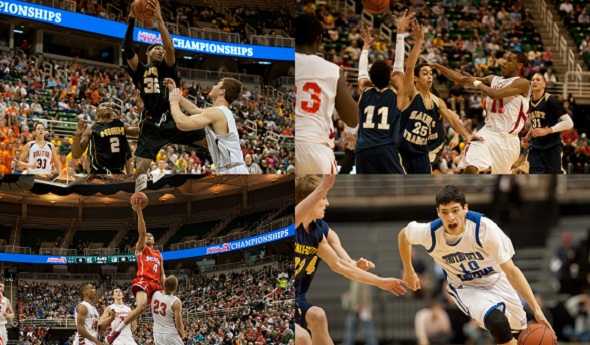
2012 Boys Basketball Finals in Review
April 5, 2012
Did we just watch one of the greatest MHSAA boys basketball champions of all-time?
That’s a question being asked around the state coming off this season’s Boys Basketball Finals at Michigan State’s Breslin Center.
The team that brought up in those comparisons is Lansing Sexton, which won its second-straight Class B championship in convincing fashion. But that run was only one stroke of historical significance to emerge from this season’s Finals.
Saginaw added to one of the state’s strongest traditions with another championship in Class A. Flint Beecher posted the best finish of its successful run by finishing undefeated and champion in Class C. And Southfield Christian set the bar high with its first title run, finishing with one of the sharpest shooting displays in MHSAA history.
We wrap up the winter with a look back at those four tournaments, and a look ahead at teams we could see back at Breslin in 2013.
Four quarters
Saginaw wins No. 6: Class A conveniently played out to end with No. 1 Saginaw vs. No. 2 Romulus – until unranked Rockford crashed with a 62-61 win over the Eagles in a Semifinal. But the Rams, making their second MHSAA Final appearance, nearly earned their second championship. Rockford made 10 3-pointers and was tied with the Trojans as late as 4:36 to play before Saginaw finished on a 14-2 run. (Read the full report.)
Seeing Red again: Lansing Sexton concluded one of the most impressive runs in MHSAA history with a 67-32 win over No. 7 Stevensville-Lakeshore in the Class B Final. The Big Reds finished 27-1, winning all of their games by at least eight points despite playing a schedule loaded with many of the best from Class A. It was Sexton’s third-straight appearance in the B championship game, and second-straight title; the Big Reds also won back-to-back titles, in Class A, in 1959-60. (Read the full report.)
Best of Buc-Town: That’s another argument being made after Beecher became the 12th team in MHSAA history to win 28 games – one more than the best of the school’s other three championship squads. Beecher claimed Class C this season by beating reigning champion Schoolcraft by 20 in the Semifinal and Traverse City St. Francis 74-60 in the championship game. (Read the full report.)
Can’t-miss champs: Southfield Christian tied an MHSAA record with 12 3-pointers in the Class D Final, on 46 percent accuracy, in downing Climax-Scotts 76-44 after escaping Muskegon Catholic Central 78-74 in the Semifinal. Senior Chris Dewberry made 10 of 13 shots from the floor in the championship game, including 6 of 8 from 3-point range. (Read the full report.)
Numbers game
54,823: Total attendance of the eight Semifinals and four championship games, combined, at the 2012 Boys Basketball Finals. The total was roughly 5,600 more than attended in 2011.
74: Wins over the last three seasons by Lansing Sexton, tied for sixth-most in MHSAA history for a boys basketball team over that span of time.
19: Number of games, to one win, that Southfield Christian lost two seasons ago. The Eagles improved to 11-10 last season before going 24-2 and winning the Class D championship last month.
3: Runner-up finishes by Flint Beecher before beating St. Francis to win its first MHSAA championship since 1987. Those just-misses came in 2008, 2003 and in Class B in 2000.
11: Points scored by Saginaw, in a row, to close out the Class A championship game. The Trojans rode that final 11-0 run to a 54-42 win over Rockford.
Quotable
“They have a big influence in my life. Coach Thomas with all the help he has done for me this season; I could call him any time and get advice. And the same thing with Coach Dawkins. We’re brothers. It’s all about love and having that relationship. He texts me at night and lets me know how things are going, and I text him and ask him for advice about things. I was really appreciative of their support.” – Saginaw first-year coach Julian Taylor, on former championship-winning Saginaw coaches Marshall Thomas and Lou Dawkins, who sat behind the Trojans’ bench at Breslin during the Final
“Denzel is every father’s dream. Both my sons, Drew and Denzel. I’ve been very lucky to be able to coach both my sons and for them to enjoy the thing that I love most, basketball. Denzel’s been incredible. He’s done everything we’ve asked of him. His freshman year he had two knee surgeries. The doctor had to put his knee back together. He didn’t know if he was even going to play again, and he fought through some difficult struggles with his knee. We talked about adversity and different things. When he was being recruited by Michigan State, coach (Tom) Izzo said, ‘I’m not going offer you, because you can’t shoot it. You can do everything else.’ So Denzel, when he got done, he went to the gym and shot 500 shots. … That’s the kind of guy Denzel is. He’s going to do extra. I’m really proud of him. I love him. He’s my son, and for the people who doubted him and watched him play, I feel bad for them, because they just missed a fine, fine high school basketball player.” – Sexton coach Carlton Valentine on his son, senior Denzel Valentine.
“It was worth it. We’ve been putting in work all year, the offseason, way before the season; we didn’t just wait for the season to prepare for it. So it was worth a lot. We put a lot into this. And we appreciate this, and not just us, the whole community, the whole coaching staff. We made a lot of sacrifices to get here and finish the job. It’s just a blessing.” – Beecher senior Cortez Robinson, on coming back to win a title after losing in the Semifinals the last two seasons.
“We don’t take anybody for granted. We learned earlier in the year looking at film and seeing guys and going, ‘Oh, this is going to be a cake walk,’ and we come out and guys get up 30 on us and we’re looking like, ‘All right, now we’ve got to find a way.’ We played our hardest, and we just felt like if we played our hardest, we know we put in more work than them. That’s the confidence we have in our work that we put in, so we came out and let that show.” – Southfield Christian senior guard Lindsey Hunter III
See you next year …
Rockford: The Rams certainly were a surprise of the tournament, but won’t be if they make it back in 2013. Seven juniors should return to lead the way, including top guard Chad Carlson and key contributors Chase Fairchild and Kyle Short. (Honorable mention to Macomb L’Anse Creuse North, which made its first Semifinal appearance ever and should return all but two players, including its top two scorers.)
Muskegon Heights: The Tigers look good to return – it’s just a matter of if it will be in Class C or if the school will opt up into Class B, the class it played in this season. Muskegon Heights’ top three players were a junior and two sophomores, and 6-foot-4 forward Mike Davis showed star potential in the Semifinal while carrying more of the load because of an injury to 6-5 leading scorer Juwon Martin.
Beecher: The Buccaneers will graduate seven players off this season’s team, but return two-time reigning Associated Press Class C Player of the Year Monte Morris. With some help, he could carry Beecher back to Breslin for a fourth-straight season.
Climax-Scotts: Three starters during this run were juniors, including 6-7 all-stater Malachi Satterlee. He and the other returnees gained valuable experience during this runner-up finish, as did coach Steve Critchlow, who went 25-1 in his first season running the program.
Link up
To watch all 12 games and press conferences after each, click on MHSAA.tv.
PHOTOS courtesy of Terry McNamara Photography.