

Michigan HS Hoops Celebrate a Century
By
Ron Pesch
MHSAA historian
February 27, 2016
Today we know the campus, and the buildings and playing fields it contains, as Eastern Michigan University. But 100 years ago, the grounds were known as Michigan State Normal College.
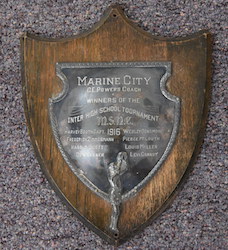
On an unusually warm 2016 February day, down on the court of Eastern’s Convocation Center, the Eagles of Eastern and the University of Toledo Rockets warmed up for tip-off. Standing near the doorway of a suite, above the action, Chris Ming, athletic director at Marine City High School, showed off an oak plaque, adorned with a beautiful silver shield featuring a basketball design in relief.
“I can tell you, they don’t make them like this anymore,” Ming said.
 At halftime, Ming and five other representatives from Michigan high schools met at center court to celebrate an event that had occurred a century ago on this campus. In March 1916, around 100 students total representing 12 high schools traveled to Ypsilanti to participate in what has been billed as the first organized high school basketball tournament in Michigan.
Historically speaking, the college was a perfect location for that tournament.
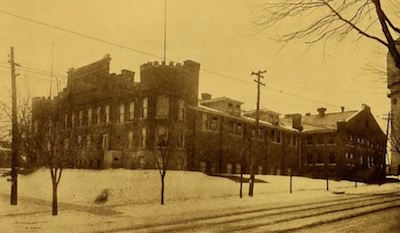
“In 1894 the Michigan State Normal College in Ypsilanti had started a new major in physical education. (Professor) Wilber Bowen was appointed chairman of that program,” wrote Dr. Erik (Rick) Pedersen, Professor Emeritus from EMU’s School of Health Promotion & Human Performance in a 2006 article for the Ypsilanti Historical Society. “Bowen had met James Naismith (who developed the game of basketball in 1891 at Springfield College in Massachusetts) through their involvement with the American Association for the Advancement of Physical Education in the late 1880's and early 1890's. To meet the needs of a new major program, the college had also completed construction of a new gymnasium in April of 1894. Bowen was looking for ideas to help with the dedication ceremony of the new gymnasium and recognition of the new major program. Consequently, arrangements were made to have the first basketball game played west of the Allegheny Mountains on May 18th, 1894, in Ypsilanti, Michigan.”
According to newspaper articles covering the 1916 high school tournament, the goal of the event was to arouse “greater interest in basketball in the smaller schools.” Around 300 invitations were sent out to high schools across the state having enrollments of “less than 200 students to take part in a basketball tournament.” It was through the efforts of the college’s Men’s Union, with cooperation from the Athletic Department, that the tournament was organized. According to the 1916 Michigan State Normal College yearbook, Aurora, the tournament also had a second goal. Acting in the best interests of the college, the Men’s Union wanted to showcase the “advantages offered at the Normal” in hopes of attracting future enrollment.
Enrollment at the time was fewer than 2,000 students. The college was the nation’s first teacher-training school to offer a four-year degree, and enrollment was dominated by females. The Men’s Union was formed in 1914 with the stated goal of bringing the male student body together socially, and to work toward recruiting more men to the college.
“Expenses related to transportation, room, and board (for the tournament) had to be provided by the participating schools,” noted Pedersen prior to the 2016 centennial gathering. “The Michigan State Normal College's Physical Education Department made it easier for schools to participate by making arrangements with local residents to provide food at 20 to 25 cents a meal and lodging at 25 cents a night for each player.”
 As things fell into place in Ypsilanti, awards were purchased, and prior to the contests, the trophies were placed on display at The Rowima Company, a general store near the school, to help build excitement for the games. It was also announced that players of the winning team would receive individual medals.
“The event is the first of its kind in the state and will be made an annual affair,” it was stated in the Daily Ypsilantian Press prior to the start of the tournament. “It is the aim to have larger high schools included in the contest if the affair is a success and as interest develops a more extensive list of prizes will be arranged. A small admission will be charged for each session which will include three or four games.”
Spread over three days, March 23 – March 25, sessions were scheduled for 7:30 on Thursday evening, 9:30 a.m., 1:30 p.m. and 7:30 p.m. on Friday, and Saturday at 9 in the morning and 1:30 in the afternoon at the Normal college gymnasium.
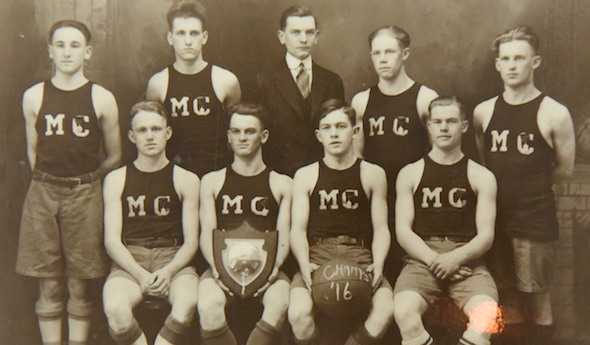
By Saturday afternoon, Dundee and Marine City had emerged as the tournament’s top teams, with 5-1 records, forcing a title game.
“Half the town turned out Saturday night to welcome the victorious basketball team home from Ypsilanti,” wrote a reporter for the Port Huron Times-Herald following Marine City’s thrilling 23-22 victory in the title game. “The silver shield, a trophy of the state championship, was proudly displayed by Coach Powers and every boy was glad to show his own individual (silver) medal.”
With a second-place finish, Dundee was awarded a handsome silver cup, while Milan, Mancelona and Farmington each received a banner in the Normal school colors of green and white, signifying a three-way tie in the tournament for third. Teams from East Lansing, Elkton, Middleville, Mount Clemens, Royal Oak, Saline, and Wayne also competed in the event. Teams were eliminated from play after two losses.
 “… It was a great day for Marine City when her team won,” continued the Times-Herald article. “Each member of the high school can take credit for the victory as the money to defray the expenses of the clash was earned in a series of inter-class games played during the last two weeks.”
Conversations about the use of tournaments to identify a state basketball champion in Michigan had been kicked around in years past.
“As long as teams journey about the state taking on different teams, making a fairly good showing and then trying to win titles by arguments based on comparative scores, all that will result in argument and three or four champions,” stated coach Edbert C. Buss of Detroit Central High School in a 1914 article in the Jackson Citizen Patriot. “The only way I can see to settle the title on the proper team and make it undisputed is by dividing the state into three sections, an eastern, western, and northern district.”
After determining district champions, Buss suggested then a state tournament at a central location to identify a true state champion.
Teams in the Upper Peninsula of Michigan staged basketball tournaments as early as 1913, with Ishpeming claiming the U.P. crown that winter.
“Calumet claims an Upper Peninsula title for 1914,” said Robert Erkkila, a U.P. historian from the city. “We’ve never claimed it to be a state championship.” Yearbooks attest to the fact, indicating they beat Ishpeming 24-21 in the U.P. tournament hosted at the Ishpeming YMCA. “While (Notre Dame legend) George Gipp didn’t spend a lot of time in high school, and never played on Calumet’s football team, he did play basketball, and was on that team,” stated Erkkila.
In January 1917, Northern Michigan Normal College (today, Northern Michigan University) announced plans for the very first U.P. tournament, scheduled for March 2 in Marquette. Michigan State Normal College hosted their second annual tournament, beginning on March 15th, while the University of Michigan and the Michigan College of the Mines in Houghton (known these days as Michigan Tech) scheduled tournaments for the following week.
Again, 12 teams entered the Michigan State Normal College tournament, which still targeted schools with high school enrollment of 200 of fewer.
“Four games of basketball will be played at one time in the state normal gymnasium,” wrote a Flint Journal correspondent, describing Mount Morris’ planned visit to the Normal tournament. “While on this trip the boys will visit the University of Michigan and will do some sight-seeing in Detroit on the trip home.”
“The visiting teams were so well-treated and the tournament was such a success that this year not enough rooms could be found to provide for the teams, and so the offices of the Gym were turned into a veritable dormitory,” recalled the 1917 Normal annual, Aurora.
“The games were all played in quarters with a minute rest between quarters and ten minutes rest between halves,” added the Journal correspondent following the tournament. “The (Mount Morris) boys were accorded a splendid time, given free use of the swimming pool, shower baths and were treated to a banquet in the gymnasium hall by members of the faculty of the State Normal College Friday evening.”
 Grayling emerged as the winner of the Normal tournament, winning four games over the two-day gathering. With a 49-9 win over Chelsea, the team earned a silver cup, while team members each earned medals. With confidence, the team stayed over, rested for a few days, then entered the U-M tournament, which was open to all schools of the state.
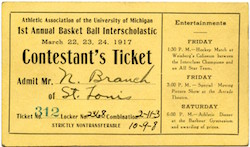
The interscholastic department of University of Michigan sent out around 250 printed circulars throughout the state, inviting teams to the “first annual inter-scholastic basketball tournament,” according to a January 5, 1917, article in the Flint Journal.
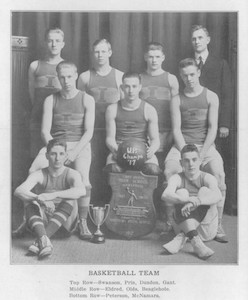
“Michigan’s first interscholastic basketball tournament is to be held in Waterman Gymnasium on March 22, 23 and 24, and replies from high schools of the State indicate that more than fifty quintets will battle through an elimination series for the State High school championship,” stated the February 1917 edition of The Michigan Alumnus. “This is the first time the University Athletic Association has attempted such a tournament and in view of the fact that Michigan is to have a Varsity basketball five next winter, the inauguration of the high school tourney this year becomes especially important.”
A recent enlargement of Waterman made the tournament possible. With four available courts, it was felt that the tournament could handle more than 60 teams and still be run in three days.
In total, the final field totaled 39 teams from 38 schools including squads from both peninsulas. Detroit Northwestern entered two teams, both coached by Bert Maris. The field was broken into four divisions.
“The meet is expected to result in a more satisfactory settlement of the scholastic championship than has been possible heretofore and to interest promising high school athletes in the University,” noted the March edition of the Alumnus.
The Michigan fraternities hosted the high school players during their stay with “a variety of entertainment … prepared to fill the odd hours,” including a hockey game at Weinberg Coliseum and a moving picture show at the Arcade Theater on Friday. A big dinner was planned for the final night of the tournament at the Barbour gymnasium, “at which the various cups and medals will be awarded,” according to the Alumnus. “The high school men were given the chance to get acquainted with University life and Michigan life in particular.”
“Three hundred high school players and coaches descended on the campus, and in a scene of mass confusion, 17 games were played on the first day alone,” wrote the late Dick Kishpaugh, historian for the MHSAA for 50 years. “Eventually, Detroit Northwestern, coached by Bert Maris, defeated Jackson, 24-21, to capture what virtually all observers at the time recognized as the first true state boys’ basketball champion.”
 In 1918, the Michigan State Normal tournament marched on for a third year, with 16 teams participating. The title was won by Milan, with Grayling finishing second. World War I halted the University of Michigan’s plan to repeat the format of 1917. However, the desire to find a champion among the state’s larger schools saw the state’s top teams, Kalamazoo Central and Detroit Central, travel to Ann Arbor for a special one-game championship contest. The teams had split two previous meetings that year. The rubber match, and hence the title, was won by Kalamazoo 26-18.
“Just who was in charge of the tournaments was the subject of heated debates in the early years,” Kishpaugh added. “High school administrators and the University of Michigan shared the responsibility in 1917 and 1918, but then (Michigan Agricultural College) wanted a piece of the action, and the finals were moved to East Lansing in 1919.”
That year, competition was divided into two, Class A for the larger schools and Class B for the smaller ones, setting a precedent for class competition which has been the hallmark of Michigan tournaments ever since.
In 1920, the predecessor to the MHSAA, a group called the Michigan Interscholastic Athletic Association, headed by high school administrators, took control of prep athletics and the tournament. Among their first actions was to split the finals between Ann Arbor and East Lansing each year. That year, Class A championship games were played at U-M in Ann Arbor, while Class B games were hosted at M.A.C. in East Lansing. Sites were reversed in 1921. The addition of Class C, segmenting the tournament further, came in 1922, and those games were played in the same city as Class B. The pattern was followed until 1926.
When the present Michigan High School Athletic Association was formed in the fall of 1924, Alden W. (Tommy) Thompson was hired on a full-time basis as State Director of the sport. Every tournament since 1925 has been under the direction of the MHSAA. In 1926, Class D was added, forming the approach taken to naming basketball champions in Michigan that we still use today.
 Ron Pesch has taken an active role in researching the history of MHSAA events since 1985 and began writing for MHSAA Finals programs in 1986, adding additional features and "flashbacks" in 1992. He inherited the title of MHSAA historian from the late Dick Kishpaugh following the 1993-94 school year, and resides in Muskegon. Contact him at [email protected] with ideas for historical articles.
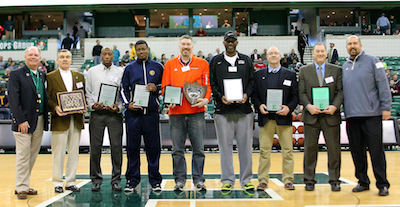
PHOTOS: (1) The Marine City boys basketball team won the inaugural high school basketball tournament at Michigan State Normal College. (2) A plaque commemorating the achievement hangs at the school. (3) The gymnasium at what is now Eastern Michigan University hosted the event. (4) Ishpeming won the first basketball tournament played in the Upper Peninsula. (5) University of Michigan hosted a tournament for schools of all enrollments in 1917. (6) Representatives of schools that played in the 1916 tournament at Michigan State Normal College receive plaques during a game this season at EMU. (Top five photos collected by Ron Pesch; bottom photo by Jonathan Knight.)
Stars-Now-Educators Relish Northport Run
March 3, 2017
By Dennis Chase
Special for Second Half
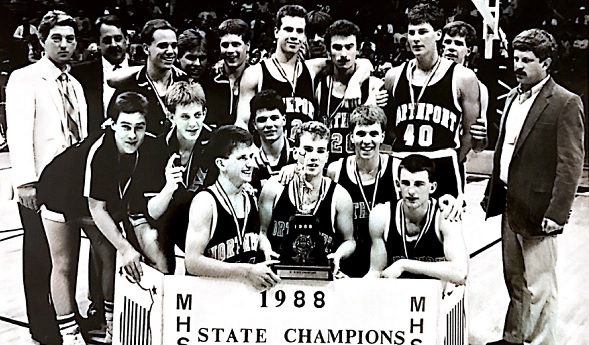
TRAVERSE CITY – Coach Gordie Wick was addressing the crowd that had gathered to celebrate Northport’s Class D boys basketball championship when he glanced at the trophy in front of him.
 “You look at this trophy, and it’s just a piece of wood with a little brass on it,” he said. “But when you put Class D state champions on it, that tells the whole story. We were not No. 2 or No. 3. We were No. 1.”
That will be the goal for hundreds of teams throughout the state when the MHSAA boys tournament tips off Monday.
And Northport’s magical seven-game postseason run in 1988 provides hope for the underdogs. The Wildcats, ranked 16th in the final Associated Press poll, beat four top-10 teams en route to their first and only MHSAA Finals title.
“I don’t think people gave us a shot,” said Jason Stowe, a senior guard on that team.
The players and coaching staff believed, though, and that March produced two of the most memorable shots in Northport history.
First, Jason Stowe hit an arching jumper from the top of the key in the waning seconds to lift Northport to the District title with a 67-65 win over Maple City Glen Lake, which had beaten the Wildcats twice during the regular season. Then, in the Class D championship game, Jason’s cousin, Dan Stowe, leaned in between two Beal City defenders and put up a shot that bounded around the rim and fell through with two seconds left to give Northport an 80-78 win – and the title.
“Every player has a dream to be in a situation like that,” said Dan Stowe, reflecting back. “I was lucky enough to have the ball in my hands, and I was lucky enough to have the shot go in.”
The championship trophy represented a collective effort. Among the starters, all-state guard Sander Scott, then a junior, averaged nearly 29 points a game in the tournament. He lit it up for 39, 40 and 46 in a span of 12 days. Senior guard Freddie Thomas, playing the best basketball of his career, averaged nearly 17 a game during the run. He was the star of the Semifinals with 27 points, seven steals and four assists in a win over Iron Mountain North Dickinson at Jenison Fieldhouse. Jason Korson and Dan Stowe, 6-foot-2 juniors, averaged double figures scoring, too, although it was their interior defense that proved critical. Jason Stowe’s tournament was interrupted by strep throat, but he had another moment to remember at the end – intercepting Beal City’s last gasp in-bounds pass and heaving the ball into the air to start the celebration.
For Jason Stowe, Scott and Dan Stowe, those days as students and players marked the start of their educational paths in Leelanau County. All three became teachers, coaches and school administrators. Jason Stowe is now in his seventh year as superintendent at Leland Public Schools. Scott, who previously served as associate superintendent at Traverse City Area Public Schools, was hired as superintendent at Glen Lake last year. Dan Stowe served as a principal at Northport before returning to the classroom two years ago.
Back to the classroom
It was a coincidence all three former Eagle Scouts went into education.
Jason Stowe made the switch to elementary education after his freshman year at Western Michigan University. He returned to Northport during his break and helped coach tennis, another sport he played in high school. He had experience teaching tennis, previously helping with youth lessons. It all made an impact.
“I realized I needed to teach,” Stowe recalled. “I was pretty good at it, and I loved being around a school environment. I thought it would be a great fit.”
Stowe’s sister, Tammy, was an elementary teacher and would become a big influence on his career choice.
Stowe landed his first job at Northport.
“I was a December graduate and there was an opening in mid-year,” he said. “I lucked out.”
He spent more than five years in Northport before taking a job at Leland. In addition to teaching, he coached varsity basketball for 12 years at the two schools. Two of his teams at Leland reached the Class D Quarterfinals.
Stowe, who has two children with his wife Cathy, said the most satisfying part of his job as an educator is helping students grow, and providing opportunities for them.
“I’ve been fortunate to work in Northport and Leland my entire (23-year) career with incredible people in incredible communities,” he said. “I go to work every day, and it’s a good day.”
Scott had visions of coaching college basketball when he was in high school. He went on to a stellar career at Central Michigan University – finishing 14th all-time in scoring (1,187 points), fourth in 3-pointers, third in 3-point accuracy (43 percent), and third in free throw accuracy (82.4 percent) – but his focus changed after his oldest son was born between his sophomore and juniors years. By then, he had also developed a keen interest in psychology.
“The life of a college basketball coach, especially when you’re starting off, is not very family oriented,” he said. “I didn’t want to spend that much time away from my family.
“After I began my course work at Central Michigan, I took some psychology classes from Gary Dunbar (whose brother Dirk was a basketball standout at Cadillac High School and later CMU). He was quite an inspiration to me. I fell in love with psychology. He was so engaging. His classes were so powerful that it drew me in.”
Scott, who has three children with his wife Shannon, majored in psychology, and then added English as a second major. Secondary teaching was in his plans.
“In order to get a good job, I knew I couldn’t just major in psychology,” he said. “I had to have something that would be more in demand.”
Hence, English, a subject his grandfather once taught.
Scott’s first teaching job was at Leland, where he also coached boys and girls basketball. He would later coach boys basketball for one year at Elk Rapids and Traverse City St. Francis. Scott then moved into administrative roles in Oscoda, Kingsley and Traverse City before taking over at Glen Lake.
Although he’s no longer in the classroom, Scott values the relationships he builds with students. Providing them with the best learning environment is his ultimate goal.
“I’m passionate about how human beings learn and what I can do in my current role to help develop systems that can (enhance) that,” he said.
Dan Stowe also completed his undergraduate studies at Central Michigan, where he majored in social studies. Returning to the classroom made sense.
“I enjoyed my time in school as a student,” he said. “In small northern Michigan communities, the school is the hub, the center of activity, whether it’s a homecoming celebration, a prom, a critical meeting regarding something in the community. I was always interested in that. I liked to be in places where people were talking about issues.”
 Like Jason, Dan Stowe was able to come back to Northport to start his teaching career. He’s now been there 21 years. Most of that time has been in the classroom, although he spent four years as an assistant principal and one year as a principal under superintendent Jeff Tropf (a former Holt High School and CMU basketball standout). He coached girls varsity basketball for several years and boys varsity basketball for one. He and his wife Beth also run a beef cattle farm.
Stowe said he’s enjoyed his return to the classroom.
“It was a good time to do it,” said Stowe, who has two children in school. “I would be interested in going back into administration at some point. But I missed the classroom and the life-long relationships you make there. I still have students that stop by unannounced to tell me what’s going on in their lives and sharing their experiences. I missed that.”
Stowe said the teachers he had at Northport were instrumental in his career decision.
“I had a good experience,” he said. “I’m forever grateful to the teachers I had. They were top notch.”
Coach and teacher
All three former players count Wick as one of their mentors. Wick coached all the players in seventh and eighth grade, and most of them at the junior varsity level. He was in his second year as varsity coach when the Wildcats won the Class D crown.
Wick inherited a driven, athletic team. All the players competed in soccer as well, and that’s where they got their first taste of success at the statewide level, reaching the Class D Finals three consecutive years. The Wildcats – with a student enrollment of 72 - won it all in 1987. In the fall of 1988, Northport lost in a Semifinal shootout to Detroit Country Day.
But the players made amends for that disappointment in basketball.
“Think about it, four state finals in four years, that’s incredible,” said Jason Stowe.
The players back then were almost inseparable.
“We were together a lot, I mean a lot,” said Jason Stowe. “That helped build that bond. We all came from hard-working families where the message was always to do your best and don’t get outworked. I think that’s why we were so successful. Now, some teams beat us, but they never outworked us.”
The players credit Wick’s leadership in harnessing the talent in basketball.
“He was a great coach,” said Jason Stowe. “He was really thoughtful. He put a lot of time into preparation – and he had a good temperament. He knew when to keep his calm and when to get after us, which wasn’t very often. He knew he had kids who were dedicated and put a ton of time into basketball. His job was to put the pieces together, and he did a great job doing that.”
Scott, who finished his career with 2,358 points, agreed.
“Gordie was always a very soothing person to me,” he said. “Basketball, I was obsessed with it and was very self-critical. Gordie knew he had a group of highly competitive individuals, and he was able to get us to come together and really develop a chemistry.”
For Scott, part of that development came in seventh grade, his first year playing for Wick.
“We had just started practice and I was trying to demonstrate how good I was to my coach,” he said. “We were doing a 3-on-2 drill and in my attempt to show I could play, I was taking it the basket myself and scoring. I did that once too many times and Gordie (cornered) me against the mat (under the basket) and said, ‘You need to learn how to pass the ball.’
“I had a temper as a kid and was mad so I stormed out and ran down the hill to my parents’ gas station. I proceeded to tell my dad what just happened. As I was telling the story my dad’s face was getting redder and redder and he was shaking his head up and down. I could tell I was digging my hole even deeper. Finally, he said to me, ‘Are you quite finished? You get your rear end back up there and apologize and get back into practice.’
“Gordie’s lesson that day was powerful to me. It was like ‘sure you can show me how good you are, but you’re not going to be able to do it alone. It’s a team sport, and to accomplish (success) it takes a team effort.’”
That was evident in 1988.
Ready to run
Northport, 15-4 in the regular season, opened the Districts with a 74-61 verdict over Leland. All five starters scored in double digits.
That set the stage for the District Final battle with No. 7 Glen Lake before a packed crowd at Traverse City Senior High.
It didn’t start well for the Wildcats as Glen Lake raced out to a 14-1 lead.
“Gordie told us to relax and chip away at it,” Jason Stowe recalled.
That’s what happened. The game was tied nine times in the fourth quarter – the last at 65 when the Lakers hit one of two free throws with 14 seconds left. As Northport looked to get off the final shot, Glen Lake pressured Scott, who spotted Stowe open at the top of the key. His shot was all net.
“He (Stowe) sure was cool, wasn’t he?” said a smiling Wick afterwards. “I’m about 10 feet off the ground right now. You always dream about those kind of things happening and tonight our dreams came true, but I’m still pinching myself to make sure this really happened.”
He wasn’t alone.
“Winning that district against Glen Lake was pretty special,” Stowe reminisced. “It wasn’t just that shot. I got the opportunity and took advantage of it. But playing in front of a packed crowd like that in Traverse City was special. Kids nowadays have a hard time imagining that 2,400 people would show up for a District Final to watch two Class D teams.”
And it was just the start.
In the two Regional games, Scott went off for a combined 86 points and 20 assists in wins over No. 8 Mio (87-72) and Bellaire (103-72). Thomas, a 5-8 senior guard, added 40 points and 13 steals over the two triumphs.
“Freddie is the heartbeat of this team,” declared Wick after the Mio win. “When he gets excited, we get excited. He represents the spirit on this team.”
It was Northport’s first Regional title in 43 years.
In the Regional Final with Bellaire, Jason Stowe started but could not continue.
“I was running a fever of 102, but I didn’t tell my parents or Gordie,” he said. “I didn’t want to miss that game.”
After the first quarter, he was taken to the locker room. Antibiotics helped restore his health in time for the Quarterfinals.
 The Quarterfinal showdown with reigning Class D champion McBain Northern Michigan Christian also was held at Traverse City Senior High, and once again it was filled to capacity. Some officials estimated the crowd close to 3,000.
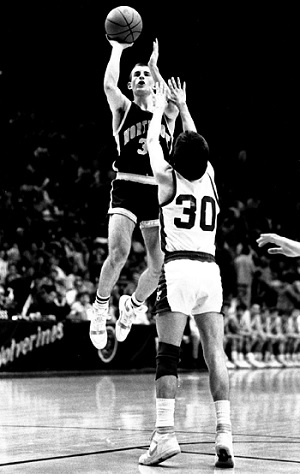
Northern Michigan Christian, ranked No. 10, had beaten Northport by about 10 in a summer tournament at Manton. But the results were different this night. The 6-foot Scott filled the stat sheet with 24 points, nine rebounds, seven assists, four steals and three blocks in a 71-55 win. Thomas contributed 18 points, five assists and four steals while Dan Stowe chipped in 15 points and 10 rebounds.
“I still think Beal City is the best team we’ve faced this season,” Northern Michigan Christian coach Scott Soodsma said afterwards, ‘but don’t sell Northport short. They’re right up there.”
The Wildcats turned it on again with Thomas leading the way in a 79-55 victory over North Dickinson in the Semifinals.
That put Northport into the Finals opposite No. 5 Beal City. Down 11 with just more than three minutes left in the third quarter, the Wildcats mounted a comeback and actually built a five-point lead with less than three minutes to play. But that’s when Scott fouled out.
Once again the players turned to Wick.
“He was that calm voice we needed,” Jason Stowe remembered. “We were strong-willed kids and he just said, ‘We’ve got good leadership on this team. We’re fine. We can finish this.’”
Beal City, though, tied the contest at 78 with 16 seconds remaining.
The Wildcats set up a play, but Dan Stowe said that option was taken away and he ended up with the ball.
“I’m sure if you were to ask Gordie he would tell you the plan wasn’t for Dan Stowe to take an off-balanced shot,” he said.
Stowe did, and it went in.
And after Jason Stowe intercepted the inbounds pass, the celebration was on.
As Scott was celebrating he saw McBain Northern Michigan Christian all-state center Mike Heuker watching from the sideline. Heuker, Scott recalled, had stayed on the court after their Quarterfinal game to congratulate the Wildcats. He told Scott then that “if you’re able to win this, it will be one of the best moments in your life.”
So at Crisler Arena that day, during the celebration, Scott went over to Heuker and the two shook hands. As they did, Heuker said, “It’s true, isn’t it?”
Scott could not argue.
Segments from that game can still be viewed on YouTube. Players have copies of it, but Dan Stowe has watched it only a couple times.
“I want to remember it for how it felt at that point in time,” he said.
When Scott looks at the team picture taken at mid-court that day, he realizes that, with the exception of one player, all had older brothers who had played before them.
“They toughened us up,” he said. “They had a lot to do with our competitiveness.”
Jason Stowe agreed.
“We grew up in a culture of working hard, playing hard,” he said. “There was no other option. When you’re growing up and watching your older brothers you’re so involved that you live and breathe it. They set the standard for us, and we carried the torch a little further.
“And it kind of helps to have Sander Scott on your team, by the way,” he added, laughing. “Those type of players come around once in a lifetime.”
The school held a celebration the day after winning the championship. Wick talked about how the team embraced the role of underdog.
JV coach Hugh Cook and his wife had planned a spring break trip long before the tournament run. He left the team after the Regional, but vowed to fly back if the Wildcats reached the Final Four. Sure enough, he was back on the bench that weekend. He had listened to the broadcast of the Quarterfinal game via a long distance call.
“I knew he’d be there. That’s just the way he is,” said Wick. “But I bet he’s not looking forward to his next phone bill.”
“That’s when you paid by the minute,” added Jason Stowe.
Wick closed out the ceremony by telling his players there would be no practice the next day.
“They won’t let us play anymore,” he said.
To which his brother, Jim, who helped as a scout, responded, “That’s because there’s no one left to beat.”
 Dennis Chase worked 32 years as a sportswriter at the Traverse City Record-Eagle, including as sports editor from 2000-14. He can be reached at [email protected] with story ideas for Manistee, Wexford, Missaukee, Roscommon, Ogemaw, Iosco, Alcona, Oscoda, Crawford, Kalkaska, Grand Traverse, Benzie, Leelanau, Antrim, Otsego, Montmorency, Alpena, Presque Isle, Cheboygan, Charlevoix and Emmet counties.
PHOTOS: (Top) The 1988 Class D title-winning Northport boys basketball team poses with its championship trophy. (Middle) From left: Sander Scott, Dan Stowe, Jason Stowe. (Below) Northport's Sander Scott launches a jumper against Beal City during the 1988 Final. (Top photo courtesy of Dan Stowe.)