

Midland Boys Hoops Earns 'Football' Buzz
March 21, 2016
By Bill Khan
Special for Second Half
MIDLAND — Payton DeWildt is accustomed to pep rallies at school.
 Just not during basketball season.
"It's just not something they do," the Midland High senior said. "Only when we play Dow, our crosstown rival."
And only in football.
"Midland High is known as a football school," said DeWildt, the quarterback on the Chemics' football team last fall. "When I was a freshman (on the varsity basketball team), the seniors were good. I said we've got to keep this winning tradition going and make Midland a basketball school, also."
In four seasons of basketball, DeWildt has known nothing but success, a concept that was foreign to a generation of hoopsters at Midland. The Chemics have won District championships in three of his four years after going 13 years without a title.
What sets this year's team apart is that it also added a Regional championship to the mix, the first for the Chemics since winning back-to-back titles in 1978 and 1979.
Suddenly, basketball is a big deal at Midland, worthy of the treatment usually reserved for the football team. A pep assembly will be part of the pregame hype at Midland before the Chemics face Macomb Dakota at 7 p.m. Tuesday at Grand Blanc in the MHSAA Class A Quarterfinals.
"There's quite a buzz," said 14-year coach Eric Krause. "It was really nice to see the people very excited. In the past football has been there, but it was really cool to see guys getting recognized. You like to see the efforts being rewarded, so it's really exciting. It's nice to see some of the older members of the community who will come to games, no matter what your record, and to see the excitement in their faces."
For the players, there is a sense that they are making history.
"Definitely," DeWildt said. "We just won the first Regional Final since 1979. We're trying to make it one more game. We just want to prove we're one of the best teams to come through Midland High, so we want to make it as far as we can."
If Midland can topple second-ranked Dakota (25-0), the Chemics (17-6) will reach the MHSAA Semifinals for only the second time in school history. The Chemics reached the semis in 1970, losing 82-71 to Detroit Pershing. Midland made the Quarterfinals two more times in the '70s, losing 72-53 to Flint Northern in 1978 and 66-58 to Saginaw in 1979.
A major reason why the Chemics haven't lasted to the final week of the postseason is geography. They not only play in one of the toughest leagues in the state, but they have had to go head-to-head with Saginaw Valley League rivals in the tournament. In the last three seasons, the Chemics lost in the 2013 Regional Semifinals to a Saginaw team that made the MHSAA Semifinals, in the 2014 District Semifinals to a Mount Pleasant team that made the MHSAA Semifinals, and in the 2015 Regional championship game to a Saginaw Arthur Hill team that was the MHSAA runner-up.
It's tough to go deep into the tournament when so many nearby schools are capable of going all the way to the Breslin Center. The Valley has had 12 schools combine to make the MHSAA Class A Quarterfinals 137 times. Five Valley schools — all from Flint or Saginaw — have combined for 22 MHSAA Class A championships.
"You had to play in a league that is arguably the best public school league, some years, in the nation in the 1990s before I got into it," Krause said. "I don't mean to take anything away from what we're doing, but Flint isn't Flint anymore — not the way it was. Dave MacDonald is a good friend of mine who coached Midland Dow for over 30 years. He'd be over .500 most years, some years with 12 or 13 wins. The amount of pros he coached against, people just don't understand.
"I believe the Valley is one of the best leagues in the state. The difference is it used to be one of the best leagues in the nation."
To reach the Quarterfinals, Midland had to take down one of the two elite Saginaw programs for the first time in the postseason since beating Arthur Hill in the 1971 District Final.
The Chemics split their regular-season series with Saginaw, each winning on its own home court, so what happened when the teams met for the Regional championship shouldn't come as a huge surprise. On a night in which the tension was felt on the court and in the stands, Midland knocked off Saginaw, 60-56.
Midland held a 10-point lead in the fourth quarter before Saginaw rallied to grab a four-point lead. Midland finished the game on a 12-4 run.
 "It was the best game I've ever played in my life, the most exciting game," said senior Matt Jarema, another four-year varsity player. "I can probably say that most of my teammates all said it was the most exciting game they ever played; it was something. We knew we were bigger and stronger than them. We knew we could beat them. That's what we came in and did."
The impetus for this year's Regional championship run was a tough loss to Arthur Hill in last year's Regional Final. Midland was within four points early in the fourth quarter before current University of Texas freshman Eric Davis scored 12 points in the final period to lead the Lumberjacks to a 66-52 victory. Arthur Hill went on to play for the Class A title.
"Ever since last year after that Regional Final loss against Arthur Hill, we knew this year we would win the Regionals and we'd be in the Quarterfinals," Jarema said. "Playing against Saginaw and Arthur Hill, they prepare us for pressure like no other. They get up on you. We believe their pressure is some of the best pressure we'll have to face each year to prepare us for this moment now."
Midland has won four postseason games but, much like its regular season, nothing has been easy. Three of the four games have been decided by four points or fewer.
The Chemics opened the postseason by beating Mount Pleasant, 49-48, taking the lead for good on Martin Money's layup with 34 seconds left. After a 58-37 rout of Saginaw Heritage in the District Final, the Chemics overcame adversity to edge Traverse City West, 61-59, in the Regional Semifinal at Gaylord. Center Kyle Johnson was nearly late for that game because of a flat tire, Krause was dealing with a flooded basement before leaving for the game, and West's cheering section dwarfed Midland's because of the travel. Then came the four-point victory over long-time nemesis Saginaw in the Regional Final.
And now a team that has lost six games is within one victory of playing in the Breslin Center.
"We're a very odd team," Krause said. "We know we can play with very elite teams, but we honestly can lose to a lot of teams that are levels below that elite level. We can lose to a lot of teams. Usually when you have teams go this far, that's not the case. We have a strange quality where if things aren't going well, we have to be ready for a close game. Sometimes that makes you not panic when the game is close, because you figure you're going to win the game. We're kind of an interesting team that way."
DeWildt returned from a shoulder injury for the postseason opener to lead Midland's tournament run. He is the only Chemics player averaging in double figures during the tournament, scoring 16.8 points per game.
The scoring is balanced after that, with Virgil Walker averaging 8.8 points, Garrett Willis and Johnson 7.3 apiece, and Jarema 7.0.
 Bill Khan served as a sportswriter at The Flint Journal from 1981-2011 and currently contributes to the State Champs! Sports Network. He can be reached at [email protected] with story ideas for Genesee, Lapeer, St. Clair, Sanilac, Huron, Tuscola, Saginaw, Bay, Arenac, Midland and Gladwin counties.
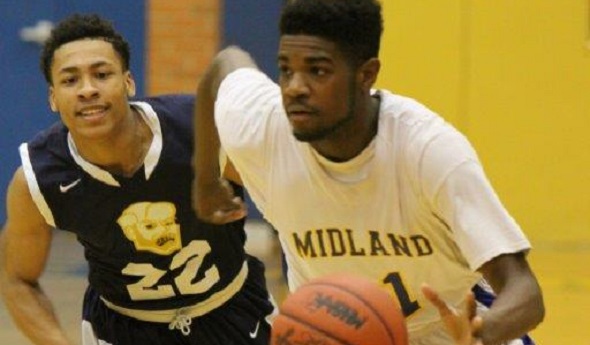
PHOTOS: Midland’s Virgil Walker drives past a Saginaw Arthur Hill player this season. (Middle) Payton DeWildt lines up for a free throw. (Photos courtesy of the Midland athletic department.)
Breslin Bound: Boys Report Week 1
December 16, 2019
By Geoff Kimmerly
Second Half editor
This boys basketball season needed just a few hours of opening night to satisfy the anticipation that’s been building since last season’s MHSAA Finals finished a little more than eight months ago.
 We’ll bank on that first week as an indication of what’s to come.
Below is our first “Breslin Bound” report of the boys season, powered by MI Student Aid and based on results and schedules posted for each school at MHSAA.com. Those results have become much more vital this winter – for the first time, there will be limited seeding of the top two teams at the District level based on their Michigan Power Rating (MPR). Check out how every team in the state ranks, and send corrections or missing scores to [email protected].
Week in Review
The countdown of last week’s five most intriguing results:
1. River Rouge 63, Ypsilanti Lincoln 53 – This high-profile matchup started the week and season, as reigning Division 2 runner-up Rouge handed reigning Division 1 champion Lincoln an opening defeat at Eastern Michigan University’s Convocation Center.
2. Grand Blanc 80, Detroit Douglass 77 – This Horatio Williams Showcase headliner featured one of the state’s best sophomores and juniors and two teams that should be making pushes in March in Divisions 1 and 2, respectively.
3. Saginaw 88, Saginaw Arthur Hill 76 – After scoring 101 points in its opener, Saginaw put up another big number in its first matchup of the season with the rival Lumberjacks.
4. Ferndale 66, Flint Beecher 55 – The Eagles also posted an impressive win at the Horatio Williams event, getting past a Beecher team looking toward contending in Division 3 again after making the Quarterfinals last season.
5. Ypsilanti Arbor Prep 48, Detroit U-D Jesuit 47 – Division 3 Arbor Prep started its season with a one-point win over the reigning Division 1 runner-up.
Watch List
With an eye toward March, here are two teams in each division making sparks:
DIVISION 1
Ann Arbor Huron (2-0) Last season’s 13-8 record was a bit deceptive; two losses were one-pointers and its District defeat came in overtime. The River Rats are starting out on the positive end of those close games this winter, with their first win 53-50 over returning Division 3 semifinalist Detroit Edison.
Marquette (2-0) For the second straight season, Marquette opened with wins over Brighton and Petoskey – this time by eight and three points, respectively. Last season, that start turned into a 19-4 finish with league and District championships.
DIVISION 2
Detroit Communication Media Arts (2-0) CMA improved five wins from 2017-18 last winter to get to 11-10, and may be on its way toward taking another step. The Pharaohs opened with a 74-48 win over Pershing to avenge last season’s one-point loss to the Doughboys, then got past Farmington in overtime 70-68 after Farmington had opened with an impressive win over Wayne Memorial.
Imlay City (3-0) The Spartans are coming off two straight sub-.500 seasons but did improve two wins last winter to 10-12. The Harry Moore Tournament at Capac gave them an opportunity for three wins during the first week, and Imlay City capitalized by defeating Deckerville in the championship game.
DIVISION 3
Burton Bendle (2-0) The Tigers are halfway to equaling last season’s 4-17 success thanks to double-digit wins over Flint Southwestern and Flint New Standard Academy. The 84-74 win over Southwestern avenged last season’s one and 11-point losses to the Jaguars.
Farwell (2-0) The Eagles haven’t won more than five games in a season since 2013-14, and tied that high of five last winter. But they are 2-0 for the first time in at least a decade, opening with a 65-64 win over Remus Chippewa Hills after losing to the Warriors by 17 a year ago.
DIVISION 4
Mayville (2-0) The Wildcats over the last six seasons have gradually climbed, progressing to an 8-14 finish a year ago. Last week gave them their best start in at least a decade, as Mayville stacked double-digit wins over Akron-Fairgrove and Caseville.
Three Oaks River Valley (3-0) The Mustangs doubled their success last season from 2017-18, going from 6-15 to 13-9 and despite a 1-3 start. River Valley opened last week with double-digit wins over Decatur and White Pigeon and then avenged a pair of losses from last season to Marcellus Howardsville Christian.
Can't-Miss Contests
Be on the lookout for results of these games coming up:
Tuesday – Sanford Meridian (1-1) at Beaverton (2-0) – Three wins over Beaverton last season played significant parts in Meridian winning the Jack Pine Conference title and reaching the Division 3 Quarterfinals.
Tuesday – Grand Rapids Catholic Central (1-0) at Grand Rapids Christian (2-0) – GRCC won the regular-season and District matchups between these two last season, the latter on the way to a Division 2 Regional Final.
Thursday – Pittsford (1-1) at Bellevue (1-0) – These two both won divisions of the Southern Central Athletic Association last season; Bellevue won their regular-season meeting and the rematch in the Division 4 Regional Final.
Friday – Kalamazoo Central (1-0) at Benton Harbor (2-0) – These annual southwestern powers are meeting for the first time since the 2014-15 season.
Saturday – Detroit U-D Jesuit (1-1) at Detroit Edison (1-1) – As noted above, both ended last season at Breslin Center, Jesuit in the Division 1 Final and Edison in the Division 3 Semifinals.
Second Half’s weekly “Breslin Bound” reports are powered by MI Student Aid, a part of the Office of Postsecondary Financial Planning located within the Michigan Department of Treasury. MI Student Aid encourages students to pursue postsecondary education by providing access to student financial resources and information. MI Student Aid administers the state’s 529 college savings programs (MET/MESP), as well as scholarship and grant programs that help make college Accessible, Affordable and Attainable for you. Connect with MI Student Aid at www.michigan.gov/mistudentaid and find more information on Facebook and Twitter @mistudentaid.
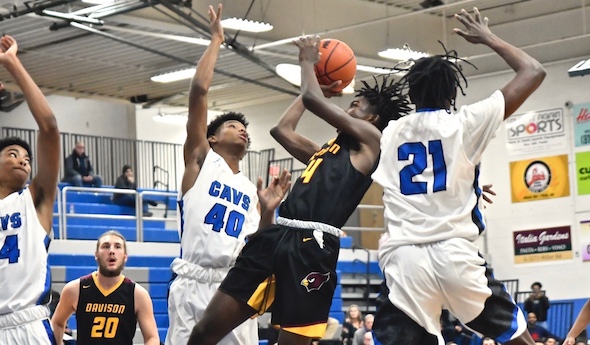
PHOTO: Flint Carman-Ainsworth opened the season last week with an 81-45 win over Davison. (Photo by Terry Lyons.)