

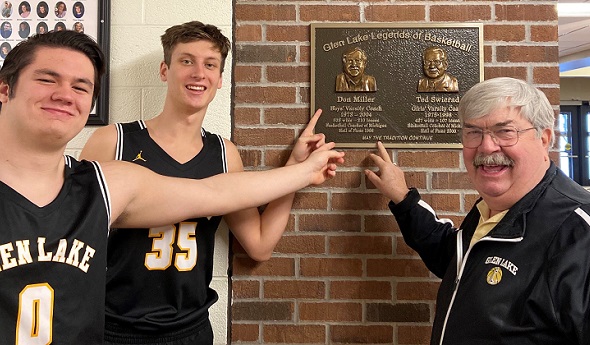
Miller's Mentoring Spans Into 7th Decade
January 29, 2020
By Mike Spencer
Special for Second Half
MAPLE CITY – With the dawn this winter of the 2020s, Don Miller is coaching high school basketball in a seventh decade.
 That’s rarefied air in Michigan High School Athletic Association circles, but it’s an atmosphere the 73-year-old longtime Maple City Glen Lake basketball coach has enjoyed and plans to continue as long as his health, family and Laker nation lets him.
“I have a passion for the bouncing of balls in a gym,” said Miller, who made his coaching debut at Howell in 1969 but then spent five decades guiding the Lakers’ ship. “The worst headache I may have disappears with that sound as I walk into a gym. The blood pressure goes down and the pleasure goes up – practices or games.”
Miller, admittedly the last man on his varsity basketball team at Southfield High during his playing days, coached a lot of good teams and players at Glen Lake during his varsity tenure (1973-2004) when he posted a 523-210 record.
“I didn’t have a lot of basketball skill, but I was a basketball junkie who got the bug to coach and I got better over the years,” Miller said. “I never scored a basket over the years, but I had a lot of players who made me look good. The kids loved the game and had the passion, and we had a spinning wheel of success breeding success.”
A Michigan State University grad, Miller enjoyed watching the Spartans practice after classes, although he never could have forecasted he’d become a Basketball Coaches Association of Michigan (BCAM) Hall of Famer in 1998 or enjoy decades of leading drills.
“Basketball is all about great chemistry, and being with young people sharing a game we love is just wonderful,” Miller said. “And to be able to do it this long is a gift, not a job. I am truly blessed to be in a gym for three hours a day.”
Today, there’s just a handful of active MHSAA coaches with Miller’s experience. Ironically, one of them is Beaverton’s Roy Johnston. Miller was an assistant of Johnston’s back in the early 1970s.
 “I’m shocked to see Don still coaching,” said Cody Inglis, a former Suttons Bay athletic director/coach who worked Miller’s camps for a decade and went on to serve as athletic director at Traverse City Central and currently as an MHSAA assistant director. “But it shows that if there’s something you are good at, and something that you are passionate about, that you are never too old to do it.
“Don’s been a wonderful role model for coaching, perseverance and doing it the right way.”
Former player Todd Ciolek, who also has had a child play for Miller, concurred.
“It’s pretty amazing,” Ciolek said of Miller’s tenure. “But when you have a love for something, it makes it easy to do. For him, he’s got a love for this and I think it comes naturally.”
Miller guided the Lakers boys team to the Class D title in 1977 and runner-up finish in 1996. His teams also reached the MHSAA Semifinals twice. His teams won six Regionals, 16 Districts and 14 conference titles.
He stepped down as Glen Lake’s main man after the 2004 season due to health issues, needing a pacemaker and a stent. He continued running his summer basketball camps and became a volunteer assistant coach for former all-state player Todd Hazelton in 2007.
When Rich Ruelas became head coach in 2015, he asked Miller to be his junior varsity coach. Miller did that for three seasons and is now an assistant varsity coach.
“I was reborn!” Miller said. “I don’t eat and sleep basketball like I used to, but I love my three hours each day with these young men who share this common passion. It’s been a lifesaver.
“My role is advisor and listener,” he added. “But watching Rich, he’s me 30 years ago. I love feeding off his intensity.”
“I truly enjoy having Coach Miller as part of the program that he helped build,” Ruelas said. “There is nothing he hasn't gone through as a coach, and I have relied on him for advice over the past five years.
“He just knows the game so well and has made such an impact on the lives of his former players and campers with his ability to teach life lessons through basketball. We are lucky to have a Hall of Fame coach as part of our program, and I don't take it for granted.”
Ruelas and Miller, a retired educator, not only get together three hours in a gym daily, they routinely have “Mornings with Miller,” on the phone as Ruelas makes his 30-minute commute to school.
Ruelas said Miller has already given him some memorable moments – the unbeaten junior varsity team in 2018 that Miller coached, assistance with the Lakers’ 2018 Finals run (Glen Lake finished Class C runner-up) and an opportunity to meet MSU coach Tom Izzo.
 “What sticks out to me most is that we cannot go anywhere in the state without Don running into a former camper or player,” Ruelas said. “He has made such a lasting impact on so many, and it is evident in his relationships with his former players over the past seven decades.
“I'm not sure how long he will continue to be on the bench with me, but I know he still has a lot of fire in his belly. As long as he has permission from his wife and is able, I expect him to be there.”
One of Miller’s trademarks is teaching life lessons first and basketball second.
“Don was a unique coach,” Ciolek said. “He wasn’t a coach of basketball first; he was a coach of ethics and morals and basketball came second.
“Most coaches start with some technique, but he started with the word respect and then engrained in us that there was more beyond basketball. He instilled a set of values in us that ultimately led to victories.”
While Miller has had decades of success, some of the losses were devastating.
“You remember the losses more than the wins, and three last-second losses are forever etched in my brain,” said Miller noting a 1978 loss to Mio and Jay Smith in the Regional Final at Gaylord, a buzzer-beating in 1988 by eventual Class D champ Northport and the 1996 Semifinal loss to Wyoming Tri-unity Christian. “The pain and tears and disappointment of these three were great memories. But losses are part of the game and the boys, now men on those teams, have made me very proud ever since.”
Miller said he’s seen a lot of things change for the better since he started coaching. Players are starting younger and getting better coaching earlier, and that has led to improved talent and team play. There are also nicer gyms and uniforms, and Miller loves the idea of boys sharing the spotlight with girls programs.
His disdains, however, are that larger schools today have kids who tend to specialize in one sport earlier, and the crowd of negative parents is growing.
“Our kids play several sports, and I feel it makes them better,” Miller said. “Playing for other coaches in other sports increases competitiveness and team play. You learn to be a different role player, and that carries over into life. “
Miller said credit for his decades of success goes to his supportive wife, Sandy, and the blind luck of having Paul Christiansen as his first junior varsity coach.
“Paul was my organizer, critic, conscience and cohort for three decades,” Miller said. “He is a Hall of Fame track coach but the real wind beneath my wings. None of this happens without Paul.”
 Both Miller and Christiansen were honored by BCAM in 1998, with Miller going into the HOF and Christiansen going into the Hall of Honor.
Miller also credits a number of coaching mentors including the late Larry Glass, a former Big Ten men’s coach and girls basketball coach at Leland, and great players and coaches he recruited to help at his summer camps in Wolverine and Glen Lake.
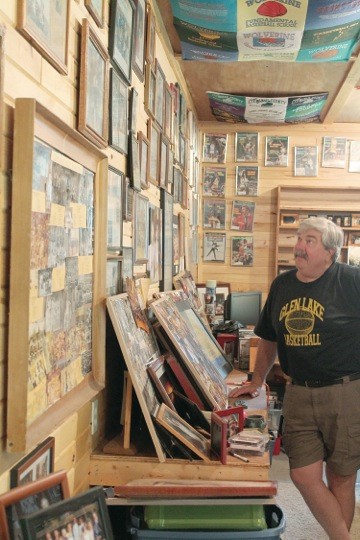
While Miller savors the friendships with other coaches, he’ll forever cherish his former players, who reciprocated their love by building him a man cave and basketball museum after he retired in 2004 and show up for weekly games of basketball at the Glen Arbor Town Hall – a 40-year-old tradition – with fellowship afterward.
“They call, email and treat me to meals out which really is too bad for my figure but great for my ego and friendships,” Miller admitted. “I love my boys (now men) and for that, I am truly the luckiest.”
“I was fortunate enough to be coached by Don when he was just starting out at Howell,” said Tom Murray, former Bay City John Glenn and Standish-Sterling Central coach. “He changed my life and many of my classmate’s lives.
“Don’s touched so many lives, it’s incredible. He instilled a lifelong love of basketball in me. He is a fantastic coach and man.”
Mike Spencer is a former MHSAA referee and sportswriter for the Bay City Times, Midland Daily News and Leelanau Enterprise and freelancer for both the Enterprise and the Traverse City Record Eagle.
Seven Decades of Miller Highlights
1960s – Last man on the Southfield High team. Watching MSU practice after class without a clue that he would coach someday. Getting hired in 1969 as the freshman coach at Howell because no else wanted the job and coaching Morey Ray, his first great player.
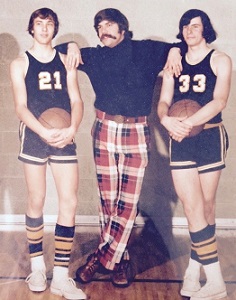
1970s – Coaching the 1977 Class D championship season and the slow evolution over the years of the front line of seniors Dave Prentice, Geof Kotila and Rick Baillergeon, who started for three years. Being down three points, without the ball and 30 seconds to go, and winning the Final by two on a shot with one second left against the No. 1-ranked team in the state, Detroit East Catholic, 70-68.
1980s – Keeping the ball rolling and seeing four of those starters – from the 1977 and 1978 teams – become captains of a college team. Reaching the quarters in 1980, the semis in 1981, 1984 and 1985. Standouts included Bob Sutherland (’80), Bill Zolman and Kevin Crinion (’81), Ron Winowiecki and Dan Witkowski (’84), and Mike Crinion and Ross Hazelton (’85). Beating No. 1 Bear Lake at Traverse City Central in front of 2,800 fans – “Loudest gym. Teamwork over talent and Mike Crinion was amazing.”
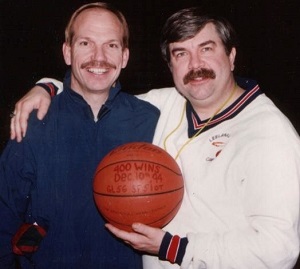 1990s – Keeping ball rolling as elementary kids became high school stars. Reaching the quarters in 1991 and 1995 and semis in 1996. Standouts included Micah Deegan and Bryan Fosmore (’91), Todd Ciolek and Max Miller (’95), and Jamie Mazurek and Greg Aylsworth (‘96). Semifinal upset of reigning Class D champ Detroit Holy Redeemer, 81-66.
2000s – Retired in 2004, but with recent adoring memories of 2002 league and District championship team led by Chris Milliron and Steve Walker. Team showed great improvement in ability and attitude, avenging losses to Suttons Bay and Traverse City St. Francis with 24-point victories.
2010s – Returned in 2015 as assistant coach to Rich Ruelas and coached the boys junior varsity to 55-5 record over his first two seasons with three sophomores and a freshman on the varsity. Posted two 20-0 seasons.
2020 – Still coaching as an assistant.
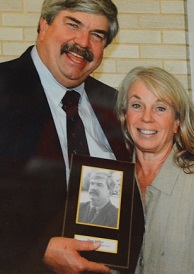
PHOTOS: (Top) Glen Lake assistant boys basketball coach Don Miller, with captains Ben Kroll (left) and Reece Hazelton, point to the plaque declaring his legendary status in the program. (2) Miller confers with a pair of players during the 1977 Class D championship season. (3) Miller and his wife Sandy. (4) Miller stands among the many mementos decorating his basketball museum built by former players. (5) Miller stands with longtime assistant Paul Christiansen, holding a ball commemorating Miller’s 400th coaching win in 1994. (Photos courtesy of Don Miller and the Leelanau Enterprise.)
Manton, Buckley Prepped for Final Week
March 17, 2017
By Dennis Chase
Special for Second Half
TRAVERSE CITY – History repeated itself Wednesday night.
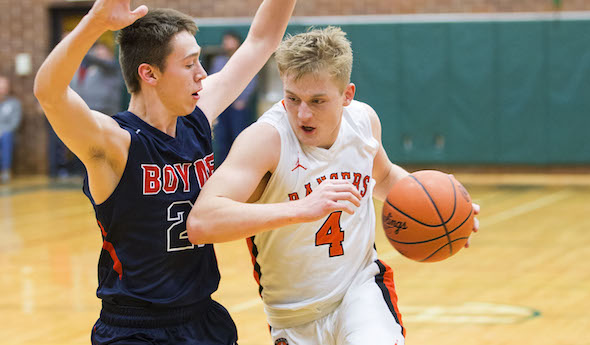
Down four midway through the fourth quarter, Manton rallied for an edge-of-your-seat 47-46 win over Boyne City in the MHSAA Class C Regional Final at Houghton Lake.
It was Manton’s first Regional title since 1998, when the Rangers topped Boyne City, also at Houghton Lake.
“It’s interesting how things work out,” said Manton coach Ryan Hiller, who was a star player on that 1998 squad.
The Rangers next will face Negaunee on Tuesday in Petoskey.
Manton is one of two Wexford County teams marching on to the Quarterfinals. Unbeaten Buckley upended Suttons Bay 56-37 for a Class D Regional crown at Traverse City Central.
It was Buckley’s first Regional championship since 2010. The Bears will meet Wyoming Tri-unity Christian on Tuesday in Cadillac.
“Let’s do it,” said Bears coach Blair Moss, who starts five underclassmen. “This is fun. I told the kids, ‘This is something you’ll remember the rest of your lives. Let’s not waste it.’ I’m not worried about next year because you never know what will happen next year. Let’s do it right now.”
While Manton players, coaches and fans were basking in the glow of victory in Houghton Lake, Hiller was relieved to be moving on. The Rangers won despite shooting 26 percent from the field – 23 percent from beyond the 3-point arc. In Monday’s Regional opening win over Maple City Glen Lake, the Rangers were 1-of-11 behind the arc in the first half.
“We just don’t shoot well in that gym,” said Hiller. “We’re a 42 percent 3-point shooting team. We had a stretch of five games this season where we hit over 10 3s (in each game).
“These were the two worst shooting nights we’ve had all year. That was my fear (coming into the Final). If we don’t hit our 3s, it’s a dogfight. And that’s exactly what happened.”
It forced Manton to rely on other parts of its game.
 “Free throws and defense won the game for us,” said junior guard Hunter Ruell after the title-clinching victory. “We got some big stops at the end – our coaches had a good gameplan for us – and we hit our free throws. That’s what got us the win.”
The Rangers were 14 of 18 from the charity stripe, 9 of 10 in the fourth quarter. On Monday night, they finished 17 of 19, 9 of 11 over the final eight minutes.
Ruell led the way Wednesday with 13 points, but Jayden Perry, Wyatt Baker and Trever Salani all made key shots down the stretch.
“It’s amazing,” said Ruell. “(A tournament run has) been our dream since day one. Our first goal was to get past McBain (in the District). Since then, we’ve been playing it game by game and it’s been working out.”
“For the players and coaches, who have all worked hard and put the time in, this is rewarding,” added Hiller. “And it’s great for our community. Our community needed something like this. I think our whole town was watching or listening to the game tonight.”
The tournament door swung open for the 20-4 Rangers when they beat unbeaten and top-ranked McBain in the District Final, 54-48. McBain had beaten Manton twice during the regular season, 57-55 and 61-45. The Ramblers also had sent the Rangers to the exits in the last two Districts with down-to-the-wire 46-43 and 49-48 triumphs.
“We’ve been so close,” said Hiller. “We’ve been in so many battles with them.”
This time the Rangers won that battle, and now their journey will take them to Petoskey, where they opened the season with wins over Class A Regional finalist Traverse City West 76-72 and the host Northmen 52-48 in the Petoskey Invitational.
Oh, by the way, the Rangers shot 48 percent beyond the arc in those games.
“Our kids should have confidence playing in that gym,” said Hiller.
There’s actually a Petoskey connection at work for the Rangers this season. Former Northmen standout Trevor Huffman, who led Kent State to the NCAA Elite Eight in 2002 and then played 12 years of professional basketball, is helping out, although now it’s “from afar” since he’s been in the Caribbean a good chunk of the season.
“We have good, hard-working, nice kids,” said Hiller. “He (Huffman) formed a bond with them. He said, ‘Hey, I’d love to help as much as I can.’ He’s been helping all season.”
Huffman started working with the team in practice, but left for the Caribbean around the first of the year, Hiller said. Still, he analyzes film for his friend after each Rangers game.
 Hiller loads the film on Hudl, allowing Huffman instant access to it.
“It’s awesome to see the game from his eyes,” said Hiller. “He sees things I don’t. He’s so competitive, and his reports are so detailed. He tells me, ‘You get that game on right after you win and I’ll watch it.’ He’s enjoying the coaching part of it.”
Huffman is also able to leave individual comments on the videos for players to review.
“He promised the kids if they made it to the Breslin he would fly back for the games,” said Hiller. “He’s sticking with it.”
On his Twitter account Wednesday, Huffman congratulated the Rangers on their Regional triumph.
“Proud of their team and what they have put into playing together, on and off the court,” he wrote. “There is nothing better than winning championships with your best friends. Congrats fellas! Enjoy the moment and back to work.”
It’s also back to work for Buckley.
The 24-0 Bears broke Wednesday’s Regional Final open in the third quarter, outscoring Suttons Bay 20-10 to stretch their lead to 15. It was still a 27-22 game when junior Austin Harris nailed a 3-pointer for Buckley. He was fouled after the shot, giving the Bears the ball back. Harris then hit another triple, and Buckley was on its way.
“This team is one of a kind,” said Harris. “We work really hard. We have depth and we have skill. But the biggest thing we have is heart.”
Buckley reached the Regional Finals a year ago, but turnovers in the final couple minutes proved costly in a loss to Bellaire.
“I thought we had them (Bellaire) on their heels,” said Moss, “and then we threw it away the last three or four possessions. We said then we wanted to get back here because we felt we left something on the court. We didn’t take care of the ball, and when you play like that against a good Bellaire team it comes back to haunt you and it haunted us all summer.”
The Bears vowed to improve in crunch time, but so far they rarely have been tested.
Of the 24 wins, 22 are by double digits. Only Glen Lake (63-60) and Manton (77-73) have put the heat on. Manton hit 13 3-pointers in their late February matchup.
 Moss’ message to his team after that game?
“Just a hand up is not good enough,” he said. “You have to get a hand in their face.”
Buckley put added emphasis on defense this season, and the results tell the story. The Bears have held the opposition to under 40 points in 13 games.
Perhaps the best individual defensive effort came Wednesday night when sophomore Ridge Beeman shadowed Suttons Bay’s leading scorer Thomas Hursey, limiting the junior to three points.
“Keep a hand in the chest, stay in front of him and don’t let him shoot,” said Beeman. “That’s what Coach told me to do.”
He then proceeded to carry out the orders.
“Unbelievable,” said Moss, who was still conducting interviews about 30 minutes after the game ended. “I’ve got to go in and shake that kid’s hand. To hold Hursey to three points – and that was on a long desperation shot before half – that was huge. Kudos to him. I told him I don’t care if you don’t score any points at all, you make sure you lock that kid (Hursey) down because he has range, he can score from anywhere.”
Denver Cade hit his average, scoring 21 points for the Bears. Harris added 15, Beeman eight and Joey Weber seven.
“It was a good team win,” said Beeman. “It was a low scoring game for us, but we grinded it out.”
And it kept Buckley’s ultimate goal – a trip to Michigan State’s Breslin Center – in play.
“Our first goal was to win the conference championship, and we accomplished that,” said Cade. “Then it was the District championship, and we accomplished that. The Regional? We just accomplished that. Now our goal is to get to the Breslin.”
The run has also helped Moss get through a difficult time. His mother passed away earlier this month.
“I was very close with my mother,” he said. “That’s been on my mind. I’ve got a heavy heart.”
March, in Michigan basketball circles, is known as a memory-maker month, and Moss is determined to get the best efforts out of his players.
His message?
“Play hard, give me everything,” he said. “Don’t leave anything on the floor because if you do you’ll regret it forever – forever.”
 Dennis Chase worked 32 years as a sportswriter at the Traverse City Record-Eagle, including as sports editor from 2000-14. He can be reached at [email protected] with story ideas for Manistee, Wexford, Missaukee, Roscommon, Ogemaw, Iosco, Alcona, Oscoda, Crawford, Kalkaska, Grand Traverse, Benzie, Leelanau, Antrim, Otsego, Montmorency, Alpena, Presque Isle, Cheboygan, Charlevoix and Emmet counties.
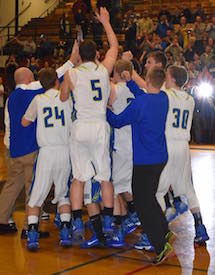
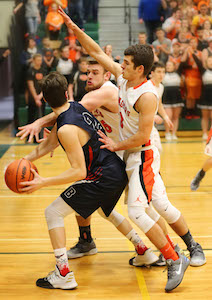
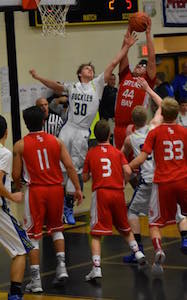
PHOTOS: (Top) Manton’s Trevor Salani works to get around a defender. (Middle top) Buckley celebrates Wednesday’s Regional Final win. (Middle below) Manton’s Wyatt Baker and Hunter Ruell lock down a Boyne City player working toward the basket. (Below) A Buckley player battles for a rebound against Suttons Bay. (Manton photos by Jeannie Christensen; Buckley photos courtesy of Buckley High School.)