

Mr. Basketball Drills Mr. Basketball-Level Shot To Keep East Lansing Repeat Drive Alive
By
Steve Vedder
Special for MHSAA.com
March 13, 2026
EAST LANSING – The only surprise would've been if it hadn't been East Lansing's KJ Torbert lining up the final shot.
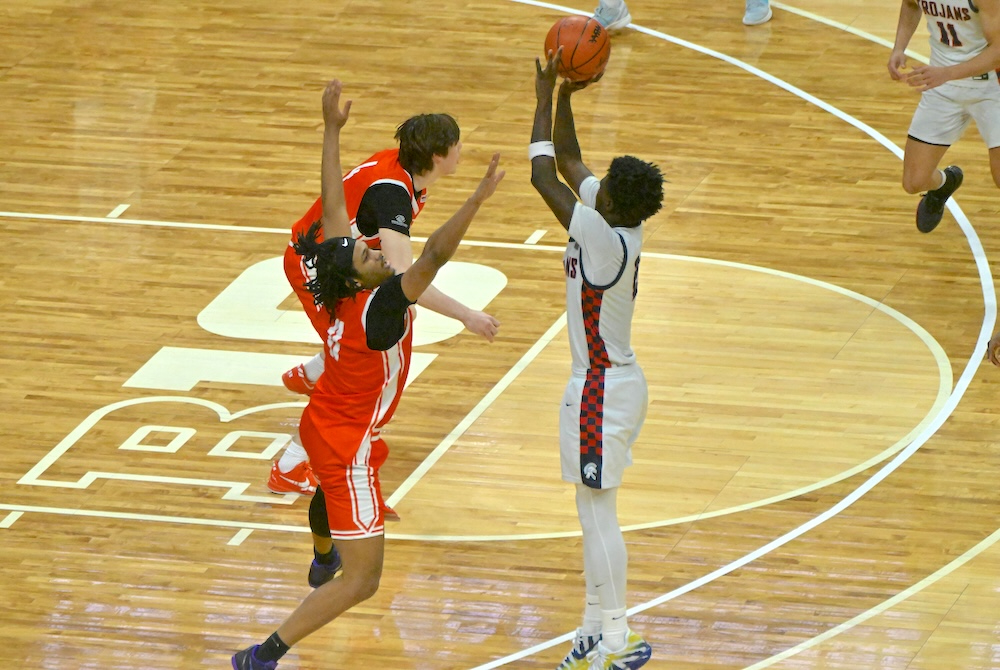
The Trojans' senior star added another thrilling chapter to a storybook season when he nailed a 3-pointer with 1.2 seconds left to give East Lansing a wild 55-52 win over Bloomfield Hills Brother Rice in Friday's packed Division 1 Semifinal at the Breslin Center.
After the Warriors' Jordan McDaniel converted a clutch three-point play with 15.8 seconds left to tie the game 52-52, the Trojans took a timeout to devise a strategy that certainly revolved around getting the ball into the hands of Torbert, named the state's Mr. Basketball Award winner earlier this week after averaging 25 points per game and accepting a scholarship from Bowling Green.
"What do you think?" East Lansing coach Ray Mitchell said when asked who would be tasked with attempting the last shot.
Torbert's game-winner kept East Lansing's hopes of successfully defending its state title alive. The Trojans (27-1), who won their 10th straight game, will play Rockford in Saturday's 12:15 p.m. Final.
Torbert, who finished with 23 points, three rebounds, two assists and two steals, said he saw an open spot on the floor about 25 feet from the basket and took advantage of getting off a quality shot.
 "It's the kinda stuff you dream about, hitting a 3-pointer to win a game," he said. "It's an exciting feeling; I can't stop smiling. It's exciting to hit a shot like that on the big stage."
Trojans teammate Kingston Thomas said it's no surprise to him who was pegged with taking the shot – or the final result.
"He's a great teammate who's been doing that all year," Thomas said. "I have 100-percent confidence in him in taking that shot. I knew he'd make it."
In the midst of a fourth-straight one-loss season, East Lansing led 23-19 at the half, but the Warriors, behind a sensational effort from McDaniel, rallied to lead 45-43 as late as 3:56 left in the game. Torbert's layup with three minutes left snapped a 45-45 tie, and the Trojans never trailed again.
McDaniel scored 12 of his 31 points during a torrid five-minute stretch late in the third quarter and the first three minutes of the fourth. His layup and free throw tied the game 52-52 with 15.8 seconds left.
Mitchell said there were actually any number of other players capable of attempting a last shot. And all were needed at some point in the game, he said.
"We've got capable shooters; we need everyone to step up, and all of them will step up," he said. "They've all had their moments. We've got guys who can knock down shots and make the right play. We're capable of that, and I hope we do it tomorrow. Passing and knocking down shots – that's how it's supposed to work."
East Lansing's Tyree Anthony said there's little doubt that the attempt at winning a repeat Division 1 title has been tougher than winning a year ago.
"We get everyone's best shot, everyone comes after us," he said. "We prepare for that."
Brother Rice coach Rick Palmer, whose team was playing in its first Semifinal in 14 years, said hats off to Torbert, who hit 8 of 18 shots, for coming up huge.
"We guarded the whole game," he said. "We just didn't make one more stop. He's a great player who made a great shot."
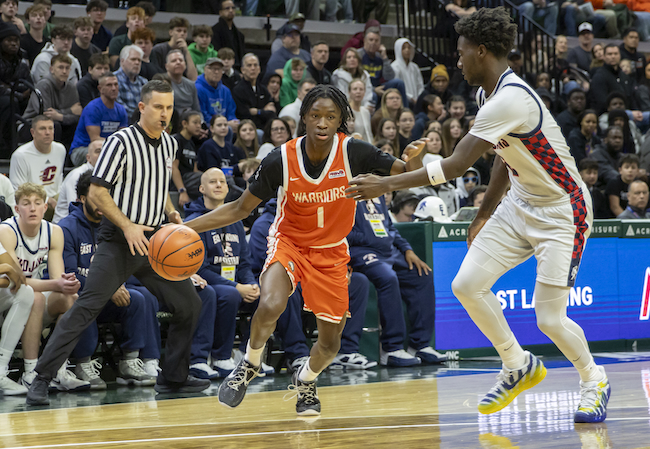
PHOTOS (Top) East Lansing’s KJ Torbert pulls up for the game-winning shot during the final seconds of his team’s Semifinal victory Friday. (Middle) Brother Rice’s Jordan McDaniel (1) makes his move to the basket. (Top photo by John Castine; middle photo by Adam Sheehan/Hockey Weekly Action Photos.)
Sweet-Shooting Briggs, Talented Teammates have Muskegon Dreaming Big Again
By
Tom Kendra
Special for MHSAA.com
January 10, 2023
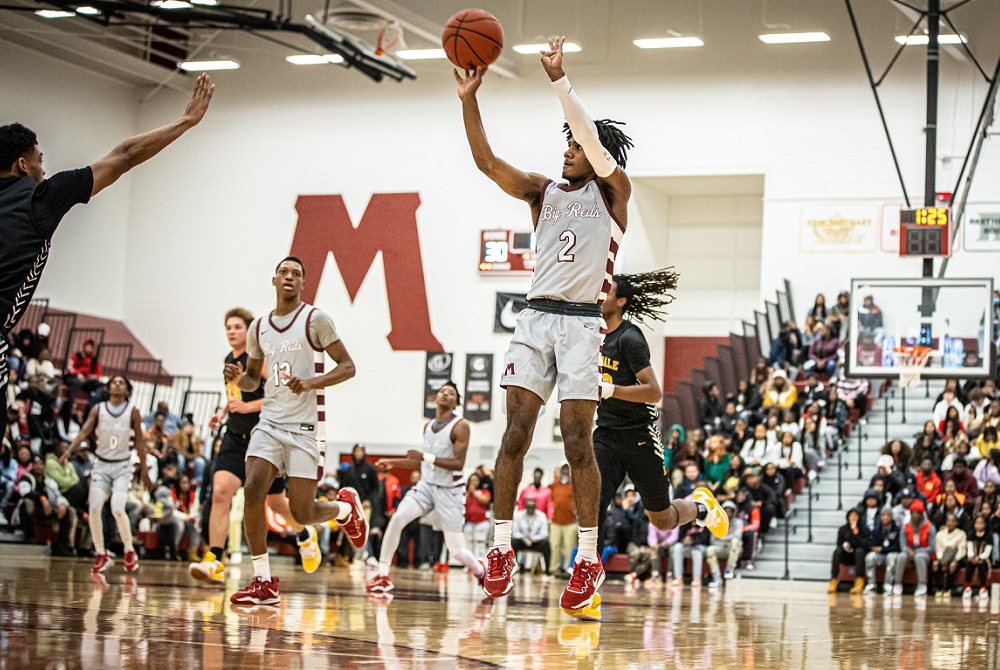
Jordan Briggs put on another shooting clinic Saturday night in front of a packed house at Muskegon’s historic Redmond-Potter Gymnasium, repeatedly elevating and hitting 3-pointers and mid-range jumpers, making it look effortless.
 While the Muskegon senior has certainly been blessed with plenty of God-given ability, there is so much more to his story.
To fully understand Briggs’ emergence as one of the state’s best pure shooters, you had to be in the gym this summer when there was no crowd, no opposing team, no coaches and no media – just Briggs and the school’s shooting machine.
The only sounds on those days were the squeaks of his shoes echoing off the walls, followed up repeatedly by the swish of a leather ball through nylon. Five-hundred made shots every day. No exceptions. No excuses.
“I love to shoot,” said Briggs, a 6-foot-1 senior who scored a team-high 24 points Saturday to keep Muskegon undefeated with a 62-51 victory over Ferndale in the finale of the three-game Muskegon Basketball Showcase.
“I never get bored, and I could do it all day. That work I’ve put in gives me and my coaches confidence to take those shots in games. I pretty much have the green light.”
He’s not kidding.
Late in the first half Saturday, Briggs had the ball on a 2-on-1 fastbreak when he suddenly pulled up and fired a 3-pointer, which just rimmed out. Muskegon coach Keith Guy, who loves his team to constantly attack the rim, clapped his approval.
“Jordan is a pure shooter,” explained Guy, whose team is 5-0 and 1-0 in the Ottawa-Kent Conference Green. “But he’s also crafty with the basketball. He can get other guys involved and he’s got it on a string, so that’s a nightmare for other teams.
“A lot of great shooters can’t hurt you off the dribble, but he can do both.”
 Muskegon’s win Saturday was the 400th career victory for Guy as a head coach – with 191 in nine years at Muskegon Heights and 209 wins in 11 years at Muskegon.
Guy, whose tenure at Muskegon is highlighted by a Class A title in 2014 and two Mr. Basketball winners in DeShaun Thrower (2014) and Deyonta Davis (2015), has another team with the makings of a championship run and another Mr. Basketball candidate in Briggs.
Muskegon features two floor general-type point guards in senior David Day III and junior M’Khi Guy, along with a loaded front court with seven players standing 6-4 or taller, led by starting juniors Terrance Davis (6-6) and Stanley Cunningham (6-5).
A pure shooter like Briggs – a three-year starter who has committed to Wayne State – is something that Guy hasn’t always had, and might be what makes the difference in March.
Briggs had his best game of the season back on Dec. 28 at the Muskegon Area Sports Hall of Fame Classic at Reeths-Puffer High School. Michigan State coach Tom Izzo was there to get a close look at recruiting target Durral Brooks of Grand Rapids Catholic Central, but it was Briggs who stole the show.
Briggs scored a game-high 35 points, including the winning bucket in overtime in an 81-79 victory.
“I just happened to catch fire that night,” said Briggs, who is a 4.0-GPA student and a National Honor Society member. “That was a great win for us and we’re rolling to start the season, which is great. But we want to keep it going and play our best basketball in March, when it really counts.”
In the Big Reds’ first league game Friday night at cross-town rival Muskegon Reeths-Puffer, Briggs got in foul trouble and didn’t score in the first half. He made amends by scoring his team’s first 12 points of the second half (on four 3-pointers), as Muskegon pulled away for a 51-26 victory.
He followed that up with his 24-point performance against Ferndale and is now averaging 24 points, six rebounds and five assists per game.
Guy hopes that, led by Briggs, this year’s team is ready for a long run – literally.
Guy made all of his varsity players that were not on the football team run cross country this fall, and not just for conditioning reasons.
“It put them out of their comfort zones, which is a good thing,” explained Guy, who is also Muskegon’s athletic director. “Take Jordan, for example. Basketball is comfortable for him. I wanted to put him in situations that weren’t as comfortable for him so that he would learn how to adapt and handle being uncomfortable a little better.”
 Tom Kendra worked 23 years at The Muskegon Chronicle, including five as assistant sports editor and the final six as sports editor through 2011. E-mail him at [email protected] with story ideas for Muskegon, Oceana, Mason, Lake, Oceola, Mecosta and Newaygo counties.
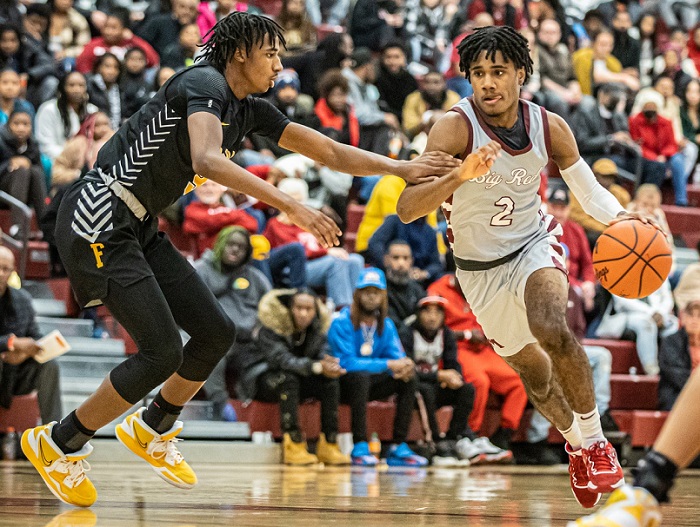
PHOTOS (Top) Muskegon’s Jordan Briggs (2) pulls up for a shot at the 3-point arc during his team’s win Saturday over Ferndale. (Middle) Briggs makes his move toward the basket. (Photos by Tim Reilly.)