

Muskegon, Mr. Basketball End Title Wait
March 22, 2014
By Bill Khan
Special for Second Half
EAST LANSING — Deshaun Thrower had this moment in mind back in November, even while the pain — literal and figurative — was still fresh from his final high school football game.
"I'll try to get healthy for basketball and try to win it in that," a banged-up Thrower said after he and his Muskegon teammates lost to Birmingham Brother Rice for the second straight year in the MHSAA Division 2 championship game at Ford Field.
Fast forward to March 22, and Thrower sat in another postgame press conference following an MHSAA championship game.
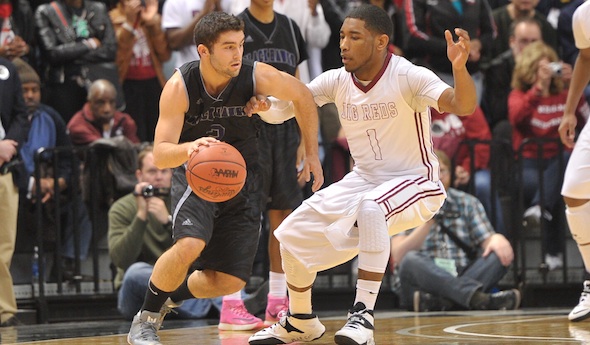
This time, he wasn't hanging his head and talking in hushed tones. Instead, he was smiling and clutching the Class A basketball championship trophy following Muskegon's 91-67 rout of Bloomfield Hills at the Breslin Center.
"It feels fake right now, because we're so used to being on the other end," said Thrower, a star quarterback in football and winner of Mr. Basketball this winter.
"This year, it's tears of joy instead of tears of sorrow. It feels good to get it for us, coach and the rest of the players who didn't get it.
"Just knowing I won my last high school game ever, won it with my teammates ... it feels good to leave on a good note."
Muskegon coach Keith Guy said Thrower's leadership was as big a key to the championship run as his numbers and physical tools.
"I don't think anybody's been in more big games than he has in football and basketball," Guy said. "He's a tough leader. He makes sure everyone is doing what they're supposed to do and holding themselves accountable. To have a leader on your team like that, everybody else follows."
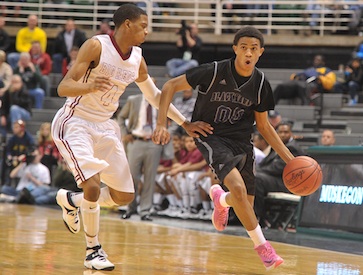 The Big Reds won their first MHSAA championship since 1937 and third overall. They also rode future University of Michigan two-sport All-American Bennie Oosterbaan to a title in the 1923 Michigan Interscholastic Athletic Association tournament; the MIAA was the predecessor to the MHSAA.
It's also the school's first MHSAA title in any sport other than football since the 1937 boys basketball team won the championship. The Big Reds have won five football championships, but took a big step toward removing the label of being just a football school. They reached the MHSAA Quarterfinals last season, losing 64-61 to Grand Rapids Christian.
The basketball team had six members of the football team.
"We want to build what they have here at Michigan State, a two-headed monster," Guy said. "(Football) coach Shane Fairfield does an excellent job. We share the kids and teach them the same message; it shows. The football team finished in the finals and the basketball team finished as champions, so I think that formula works."
Muskegon finished 28-0, joining the 2003 Rockford team (also 28-0) as one of only two unbeaten Class A champions in the last 24 years. Only two other Class A teams have had 28-0 seasons: Flint Central in 1981 and Flint Northwestern in 1985.
"They're good," Bloomfield Hills coach Duane Graves said. "We knew they were good. You can't go 28-0 and not be good. They have a good balanced attack. It had us on our heels all night."
Thrower affirmed why he was chosen Mr. Basketball as the state's top senior, scoring 21 points on 7 for 12 shooting.
Junior center Deyonta Davis may have established himself as the front-runner for next year's award, scoring 26 points on 12 for 14 shooting, grabbing 13 rebounds and blocking three shots.
"He's a different kid where he doesn't show a lot of emotion," Guy said. "There are no big moments for him. You won't see him cry. You probably won't see him smile. He's always even-keeled. Tonight he relaxed and played the way he's capable of playing. He came out with a lot of energy, and I thought he controlled the game."
The game was close for much of the first quarter, but Bloomfield Hills couldn't keep pace with Muskegon for long.
The Big Reds held an 18-15 lead when they scored nine straight points to ignite a 15-2 run that put them comfortably ahead for the rest of the game.
Muskegon built its lead to 43-22 with 24.2 seconds left in the first half and led 45-25 at halftime.
Senior guard Dylan Deitch gave Bloomfield Hills a glimmer of hope in the third quarter, hitting two 3-pointers and scoring eight points. His drive to the basket with 5:06 left in the third cut Muskegon's lead to 47-32, but the Big Reds responded with the next six points to put to rest any doubt about the outcome.
"Everything was geared toward the postseason," Guy said. "We've been trying to climb this mountain for years, and got here. These guys have the formula for success. We don't have any egos on our team. They're genuinely playing for one another. They're happy for one another. If one does better than the others tonight, they're happy as long as we get the win. It's truly a brotherhood and a family."
William Roberson Jr. had 17 points and five assists, while Joeviair Kennedy had 14 points for Muskegon, which scored a season-high 91 points.
Bloomfield Hills is a first-year school that formed when Andover and Lahser merged. Neither of the original schools ever won a regional championship, with Lahser reaching a Class A Regional Final last year under Graves' coaching before losing 65-41 to Rochester.
Xzavier Reynolds scored 21 points, going 4 for 4 from 3-point range, while Yante Maten had 13 points and three blocks for the Black Hawks (24-4).
Bloomfield Hills shot 9 for 31 (.290) in the first half before going 15 for 24 (.625) in the second.
"Shots just didn't fall," Graves said. "That happens. The ball didn't bounce our way. We couldn't make a layup in the first half — in and out, in and out. Someone forgot to take the Saran Wrap off the rim for us. Other than that, I thought the boys fought as hard as they could."
Click for the full box score and video from the press conference.
PHOTOS: (Top) Muskegon's Deshaun Thrower blocks off Bloomfield Hills' Todd Weiss during Saturday's Class A Final. (Middle) Bloomfield Hills' Cameron Dalton (00) works to get past Muskegon's Jordan Waire.
Cass Tech Continuing Rise to Hoops Elite
By
Tom Markowski
Special for Second Half
January 4, 2018
DETROIT – When you think of Detroit Cass Tech, one would probably think of its football program.
 Why not? The program coach Thomas Wilcher has built there has been arguably the best in the state the past dozen years.
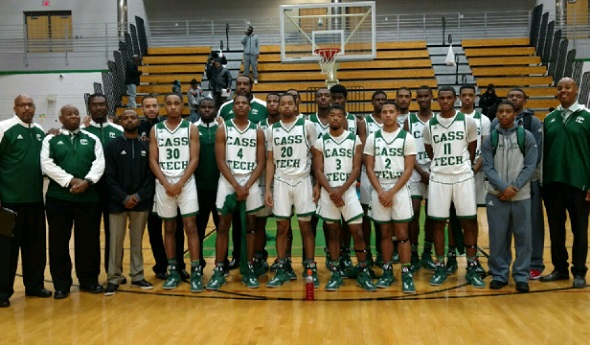
That fact doesn’t bother Steve Hall, the head coach of the Technicians’ boys basketball team. On the contrary, Hall, a 1988 Cass Tech graduate and co-athletic director (along with Wilcher), takes pride in it.
It also serves as motivation.
Hall is in his third season at Cass Tech, and when the next rankings are released his Technicians will be ranked No. 1 in Class A by at least one news service, State Champs Network, and likely others.
Cass Tech is 7-0 overall and 2-0 in the Detroit Public School League. The Technicians are currently on winter break and scheduled to play next against Detroit Henry Ford on Jan. 12.
That a PSL team is ranked No. 1 is common. Teams like Detroit Cooley, Detroit Pershing, Detroit Renaissance, Detroit Southwestern and, most recently, Detroit Western, all have been ranked No. 1 over the past many years.
But for Cass Tech, it is unusual. In fact, it is believed that a top ranking for a Cass Tech boys basketball team would be the program’s first.
Hall is careful not to boast or gloat. After all, it’s early in the season and nobody awards MHSAA championship trophies in January.
“It’s hard to feel great about being No. 1,” Hall said. “The last thing you want to do is exhale.”
The program has achieved success in the past but, truthfully, it’s been awhile. Before Hall took over, Cass Tech most recently had won two PSL titles under coach Robert Shannon, the last coming in 1998. During the late 1980s, when Hall was one of the state’s top players, Cass Tech reached the 1988 Class A Quarterfinals before losing to the eventual champion, Cooley. Cass Tech had defeated Cooley that season in the PSL quarterfinals. The 1993 team that won the PSL title made it all the way to a Class A Semifinals.
During the 1950s Cass Tech was a powerhouse in the city winning three PSL titles over the decade. As one might surmise, Cass Tech has never won a state title. And just once has it reached an MHSAA Final, as the Technicians lost to Birmingham Brother Rice, 60-56 in overtime, in the 1974 Class A championship game.
Since 1998, Cass Tech had reached a PSL final just once (2013). That is, before Hall came aboard.
Last season Cass Tech defeated Detroit Martin Luther King, 59-47, to capture the school’s eighth PSL title. The Technicians won a District title for the first time since 2014 and finished 20-5, a vast improvement from the 11-10 record they posted in Hall’s first season.
As good as last season was for the program, it was just one step forward. Hall has set loftier goals.
His three-year plan included becoming regarded at the state level and nationally. That plan is on schedule.
“There were some dynamics that first year,” Hall said. “I was hired late and I didn’t have the kids during the summer. We beat (Detroit) Western, Benton Harbor and Orchard Lake St. Mary’s that season. It’s a tough league. The stable programs had upperclassmen leading them. It was a year of growth. I wouldn’t have the same appreciation (for the success) if we had won that first year. ”
 Though Hall is in just his third season at Cass Tech, he’s built a strong resume as a coach, within the PSL and at the collegiate level. High school basketball fans will remember the great Detroit Rogers teams in the early 2000s that won three consecutive Class D titles (2003-05) with Hall as head coach. When that school closed in 2005, Hall went to Detroit Northwestern and guided the Colts to the PSL title in 2008, Northwestern’s first league championship in 30 years. That season Northwestern reached a Class A Regional Final before losing to Pershing.
Hall then left Michigan and became an assistant coach at Duquesne University in Pennsylvania. He stayed there four seasons before he was hired by Youngstown State in Ohio as an assistant. Hall remained there for four seasons before returning to Detroit.
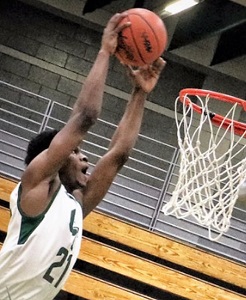
This team has talent, but is void of any one superstar. None of the four seniors are Division I recruits. Hall returned six players who started at least one game last season and the top senior is Randy Gilbert, a 6-foot-6 forward who signed with Ferris State.
There are Division I recruits coming up, however, including 6-3 sophomore Tyson Acuff and 6-5 juniors Kalil Whitehead and Tyland Tate.
Gilbert, who alternates between forward and center, is in his fourth season as a starter. He may not have made the varsity so early or with such an immediate impact playing at one of the city’s established basketball powers.
“Even going into my sophomore year people started to say things like I should transfer somewhere else,” Gilbert said. “I didn’t think about that at all. I thought we had potential.
“Coach Hall has been great to us players. He’s opened up a lot of doors. He takes us to a lot of team camps during the summer to different level of schools like Division I, Division II and NAIA so everybody gets a shot and to see where they can play (in college).
“I don’t look at Cass Tech being a football school now. We changed that.”
In the long run, that’s been one of Hall’s goals. Hall is a basketball coach, but he’s also a fan of all sports, in particular those at Cass Tech. He wants to see all of the athletic programs enjoy success, not just his team.
“When you’re a coach, it’s a way of life,” Hall said. “When I went to Cass our girls (basketball team) won the Class A title. I’ve been to Ford Field to watch the football team. I’ve been to their practices. I grew up around the school. My father (Ferd Hall) was an assistant principal here when I was growing up in the mid-70s. Cass Tech has always meant so much to me.”
 Tom Markowski is a columnist and directs website coverage for the State Champs! Sports Network. He previously covered primarily high school sports for the The Detroit News from 1984-2014, focusing on the Detroit area and contributing to statewide coverage of football and basketball. Contact him at [email protected] with story ideas for Oakland, Macomb and Wayne counties.
PHOTOS: (Top) The Cass Tech boys basketball team including head coach Steve Hall (far right) stands together at a game this season. (Middle) Randy Gilbert prepares to throw down a dunk. (Photos courtesy of the Cass Tech boys basketball program.