

Muskegon, Mr. Basketball End Title Wait
March 22, 2014
By Bill Khan
Special for Second Half
EAST LANSING — Deshaun Thrower had this moment in mind back in November, even while the pain — literal and figurative — was still fresh from his final high school football game.
"I'll try to get healthy for basketball and try to win it in that," a banged-up Thrower said after he and his Muskegon teammates lost to Birmingham Brother Rice for the second straight year in the MHSAA Division 2 championship game at Ford Field.
Fast forward to March 22, and Thrower sat in another postgame press conference following an MHSAA championship game.
This time, he wasn't hanging his head and talking in hushed tones. Instead, he was smiling and clutching the Class A basketball championship trophy following Muskegon's 91-67 rout of Bloomfield Hills at the Breslin Center.
"It feels fake right now, because we're so used to being on the other end," said Thrower, a star quarterback in football and winner of Mr. Basketball this winter.
"This year, it's tears of joy instead of tears of sorrow. It feels good to get it for us, coach and the rest of the players who didn't get it.
"Just knowing I won my last high school game ever, won it with my teammates ... it feels good to leave on a good note."
Muskegon coach Keith Guy said Thrower's leadership was as big a key to the championship run as his numbers and physical tools.
"I don't think anybody's been in more big games than he has in football and basketball," Guy said. "He's a tough leader. He makes sure everyone is doing what they're supposed to do and holding themselves accountable. To have a leader on your team like that, everybody else follows."
 The Big Reds won their first MHSAA championship since 1937 and third overall. They also rode future University of Michigan two-sport All-American Bennie Oosterbaan to a title in the 1923 Michigan Interscholastic Athletic Association tournament; the MIAA was the predecessor to the MHSAA.
It's also the school's first MHSAA title in any sport other than football since the 1937 boys basketball team won the championship. The Big Reds have won five football championships, but took a big step toward removing the label of being just a football school. They reached the MHSAA Quarterfinals last season, losing 64-61 to Grand Rapids Christian.
The basketball team had six members of the football team.
"We want to build what they have here at Michigan State, a two-headed monster," Guy said. "(Football) coach Shane Fairfield does an excellent job. We share the kids and teach them the same message; it shows. The football team finished in the finals and the basketball team finished as champions, so I think that formula works."
Muskegon finished 28-0, joining the 2003 Rockford team (also 28-0) as one of only two unbeaten Class A champions in the last 24 years. Only two other Class A teams have had 28-0 seasons: Flint Central in 1981 and Flint Northwestern in 1985.
"They're good," Bloomfield Hills coach Duane Graves said. "We knew they were good. You can't go 28-0 and not be good. They have a good balanced attack. It had us on our heels all night."
Thrower affirmed why he was chosen Mr. Basketball as the state's top senior, scoring 21 points on 7 for 12 shooting.
Junior center Deyonta Davis may have established himself as the front-runner for next year's award, scoring 26 points on 12 for 14 shooting, grabbing 13 rebounds and blocking three shots.
"He's a different kid where he doesn't show a lot of emotion," Guy said. "There are no big moments for him. You won't see him cry. You probably won't see him smile. He's always even-keeled. Tonight he relaxed and played the way he's capable of playing. He came out with a lot of energy, and I thought he controlled the game."
The game was close for much of the first quarter, but Bloomfield Hills couldn't keep pace with Muskegon for long.
The Big Reds held an 18-15 lead when they scored nine straight points to ignite a 15-2 run that put them comfortably ahead for the rest of the game.
Muskegon built its lead to 43-22 with 24.2 seconds left in the first half and led 45-25 at halftime.
Senior guard Dylan Deitch gave Bloomfield Hills a glimmer of hope in the third quarter, hitting two 3-pointers and scoring eight points. His drive to the basket with 5:06 left in the third cut Muskegon's lead to 47-32, but the Big Reds responded with the next six points to put to rest any doubt about the outcome.
"Everything was geared toward the postseason," Guy said. "We've been trying to climb this mountain for years, and got here. These guys have the formula for success. We don't have any egos on our team. They're genuinely playing for one another. They're happy for one another. If one does better than the others tonight, they're happy as long as we get the win. It's truly a brotherhood and a family."
William Roberson Jr. had 17 points and five assists, while Joeviair Kennedy had 14 points for Muskegon, which scored a season-high 91 points.
Bloomfield Hills is a first-year school that formed when Andover and Lahser merged. Neither of the original schools ever won a regional championship, with Lahser reaching a Class A Regional Final last year under Graves' coaching before losing 65-41 to Rochester.
Xzavier Reynolds scored 21 points, going 4 for 4 from 3-point range, while Yante Maten had 13 points and three blocks for the Black Hawks (24-4).
Bloomfield Hills shot 9 for 31 (.290) in the first half before going 15 for 24 (.625) in the second.
"Shots just didn't fall," Graves said. "That happens. The ball didn't bounce our way. We couldn't make a layup in the first half — in and out, in and out. Someone forgot to take the Saran Wrap off the rim for us. Other than that, I thought the boys fought as hard as they could."
Click for the full box score and video from the press conference.
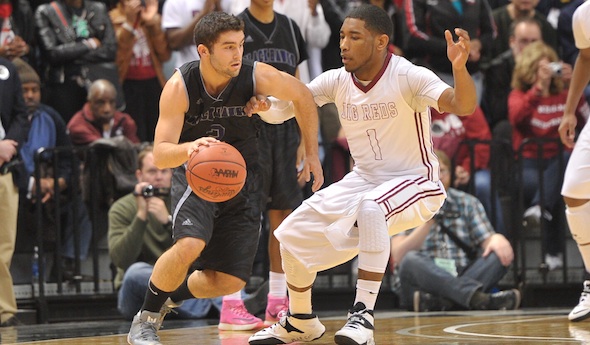
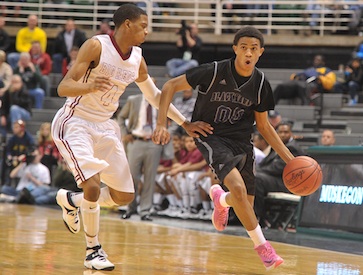
PHOTOS: (Top) Muskegon's Deshaun Thrower blocks off Bloomfield Hills' Todd Weiss during Saturday's Class A Final. (Middle) Bloomfield Hills' Cameron Dalton (00) works to get past Muskegon's Jordan Waire.

Hillman Becomes Basketball Town, Too
January 6, 2017
By Dennis Chase
Special for Second Half
HILLMAN – Eric Muszynski still remembers that day in 2005 when, as the newly appointed boys basketball coach at Hillman, he made a promise to the man who hired him, administrator Jack Richards.
 As they gazed at the banners in the school gymnasium – highlighted by the school’s three MHSAA Class D championships in baseball – Muszynski vowed to add some basketball banners to the collection.
“He (Richards) chuckled,” Muszynski recalled. “He said, ‘Try to get to .500 first.’”
Historically, Hillman’s been a baseball town. The Tigers played for MHSAA championships four times in six years during the 1990s.
“Basketball was something you did to stay in shape for baseball,” said Richards, who went on to serve as superintendent for five years. “Eric’s turned that around.”
Since 2009, Hillman has won four North Star Conference basketball championships, five Districts and one Regional. The Tigers stretched their regular-season win streak to 44 after Thursday night’s 68-38 victory over Mio. Their last regular-season loss was to Cedarville in the 2014-15 opener.
Quite a turnaround for a program that had won only one league title prior to Muszynski’s arrival.
“And that wasn’t an outright title,” senior guard Gunnar Libby said.
Libby, a first-team Associated Press all-state pick last season, is the catalyst for this 5-0 Tigers team. A four-year varsity veteran, Libby has played a vital role in the program’s growth. Hillman won its first outright league title when he was a freshman, captured its first Regional crown when he was a sophomore, and posted its first unbeaten regular season when he was a junior.
“I’ve been really lucky to play on some good teams,” he said.
The turnaround did not happen overnight. The Tigers were 10-32 in Muszynski’s first two years.
“I remember thinking to myself, ‘Will we ever get over that hump?’” Muszynski wondered.
His boss stood by him.
“I had some people come to my office, saying he wasn’t the guy for the job,” Richards said. “I told them, ‘Settle down. This guy will bring us championships.’ Eric heard me, and he took it to heart. He worked hard to prove me right.”
In his third season, Muszynski led Hillman to an 11-10 mark. From there, the program took off.
“It’s been truly amazing,” the former Alpena High School standout said. “As a coach, you envision and hope that your program can do big things. We’ve been in that conversation – of trying to get down to East Lansing (for the Final Four) – since 2013 when we almost upset Cedarville (a double overtime loss) in the Regional Final.”
Hillman, sparked by Mason VanPamel and Ty Jones, reached the Quarterfinals in 2015 before losing to eventual champion Powers North Central.
It looked like the Tigers might be in for a rebuild last season, losing eight seniors and four starters to graduation. Instead, Hillman won its first 22 games before losing to Onaway 58-57 in the District Final.
“We were counted out from the very beginning,” Libby said. “We proved everybody wrong.”
Still, the setback to Onaway – a team Hillman had knocked out of the Districts the previous three years – left a bitter taste. Onaway reached the Quarterfinals, but that loss motivates the Tigers.
When his team first gathered for practice this season, Muszynski stressed the importance of “protecting” its league title as well as recapturing the District championship. Hillman had won three Districts in a row before its sudden exit last March.
“That District (trophy) should be in Hillman,” Libby said.
That statement reflects how far this program has evolved. It’s a program that’s now won 46 consecutive league games and 36 consecutive home games.
Those streaks continue to grow, although Libby admitted he’s lost count.
“You just go out there and do what you’ve got to do,” he said.
The 5-foot-9 Libby is the floor general and lone senior in the starting lineup. He averages 25 points and six assists per game. He surpassed 1,000 career points in the season opener when he dropped 30 on Cedarville.
“He’s lightning quick,” Muszynski said. “He’s a tough kid; a hard-nosed, old school style point guard.”
Libby’s backcourt mate, 5-10 junior Brandon Banks, averages nearly 15 a game.
“That’s been our recipe for success since 2009,” Muszynski said. “We usually feature two dynamic scorers.”
Andrew Funk, a 6-foot junior, is also averaging in double figures. He scored 19 in Tuesday’s win, hitting five of Hillman’s 13 3-pointers.
The Tigers compensate for lack of size with speed, a trapping defense and a dangerous perimeter game. Kory Henigan, a 6-4 sophomore, and Billy Kolcan, a 6-1 junior, are the tallest starters. Henigan averages eight points and seven rebounds while the athletic Kolcan, an MHSAA Finals qualifier in track and an honorable mention all-state player in football, spearheads the press.
 “He (Kolcan) plays up front on our press,” Muszynski said. “He makes us go. He’s one of the best athletes to come through our school in a long time.”
Kolcan, Banks and Funk were on varsity as sophomores last season.
“On paper, it appears we’re young,” Muszynski said. “But we’re battle-tested.”
And, according to Libby, cohesive, too.
“We work well together,” Libby said. “We’re unselfish – and we scrap.”
Now, the Tigers would like to start playing more basketball. Hillman played just three games in December after two contests were postponed due to weather.
“It’s hard to get any kind of rhythm and consistency when you play two games, then you’re off two weeks, you play one game, then you’re off another two weeks,” Libby said.
As for Muszynski, this is his 12th season at Hillman. He was hired as a physical education/health/social studies teacher and girls basketball coach. When the boys job opened soon afterward, he added that to his responsibilities. He coached both teams for two years before the MHSAA switched girls basketball season to the winter. Even though the girls were 30-12 in those two seasons under his leadership, he felt coaching boys basketball was his calling.
“I liked the challenge,” he said. “With the girls, I walked into a good program. With the boys, I wanted to see if I could build a program.”
With a win over Rudyard just before the holiday break, the 37-year-old Muszynski notched his 200th career win at Hillman (30 with the girls, 170 with the boys).
“He’s been a real blessing for us,” Libby said. “He’s a great coach. He holds us all accountable. He’s thorough, and he can motivate. He knows his stuff.”
“I’m truly blessed,” Muszynski added. “That’s (200 wins) a credit to my players, past and present.”
Muszynski echoed those same sentiments after he won the Associated Press Class D Coach of the Year honor last season.
“One of the proudest moments in my coaching career,” he admitted. “Not only was it a great reward, but it was a reflection of our basketball program here.”
Richards, meanwhile, takes satisfaction in the basketball program’s accomplishments. Now retired, he still follows the Tigers – and Muszynski.
What did he see in Muszynski when he hired him in 2005?
“He has a drive,” Richards said. “He knows what it takes and the work that’s involved. A lot of people just want to work during the season, and when it’s over they’re done. That’s not Eric. He’s a worker, a planner. You could see his desire.”
Richards also feared, once the boys started winning, that Muszynski might leave for a bigger school. He even mentioned that to Muszynski.
“Eric said, ‘You gave me the opportunity to be a head coach and I want to do right by you,’” Richards recalled. “I said, ‘I understand that. But let me give you a piece of advice: it’s easier to build a dynasty in a small town than in a large town.’ I think he’s done a pretty good job with that.”
Muszynski looked north to Cedarville for inspiration. Coach Dave Duncan developed that program into a state contender. The Trojans won an MHSAA title in 2007 and nearly another two years later.
“I thought if a small Class D school in the Upper Peninsula can do that, why can’t we?” Muszynski reasoned.
One of Muszynski’s first priorities was to start applying his philosophies in the youth program so by the time those players reached the varsity they would know the defensive schemes and offensive sets.
“They’ve seen success so they know the formula works,” Muszynski said. “If you have some success, and start to win championships, everyone starts to buy in.”
As for baseball? Practice is still several weeks away.
“When I first got there,” Richards recalled, “the kids, after basketball practice, would put their gloves on and throw the baseball around. They even had a batting cage in the old gym. Now, you don’t see a baseball glove in the gym during the winter.”
Now you see basketball banners.
 Dennis Chase worked 32 years as a sportswriter at the Traverse City Record-Eagle, including as sports editor from 2000-14. He can be reached at [email protected] with story ideas for Manistee, Wexford, Missaukee, Roscommon, Ogemaw, Iosco, Alcona, Oscoda, Crawford, Kalkaska, Grand Traverse, Benzie, Leelanau, Antrim, Otsego, Montmorency, Alpena, Presque Isle, Cheboygan, Charlevoix and Emmet counties.
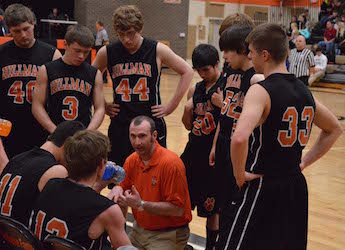
PHOTOS: (Top) Gunnar Libby, who has scored more than 1,000 points during his Hillman career, cuts through a group of defenders. (Middle) Hillman coach Eric Muszynski addresses his team. (Photos courtesy of The Alpena News.)