

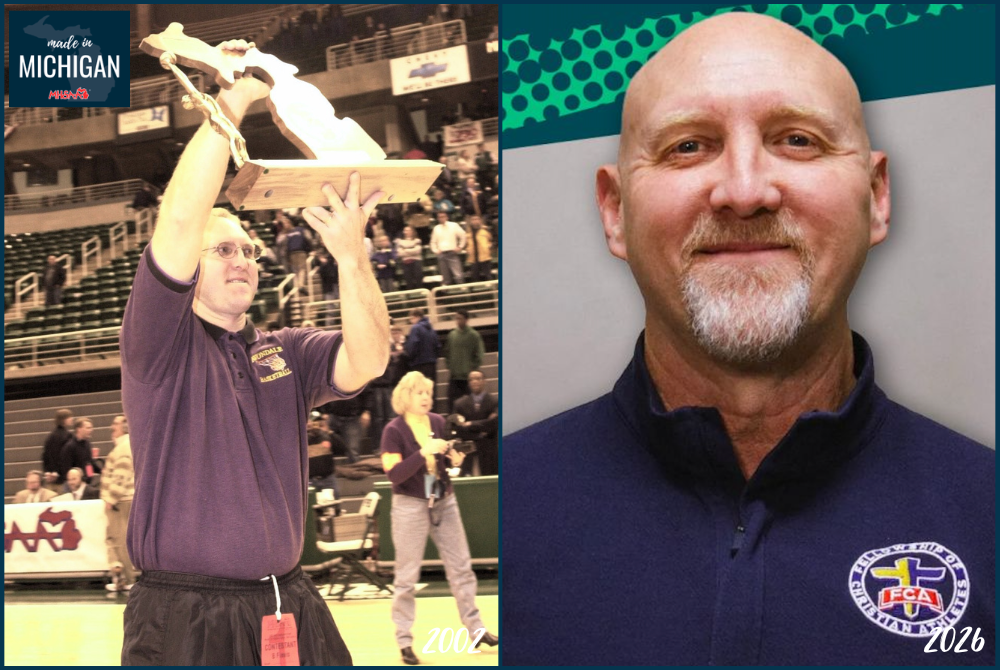
Nearly 25 Years After Leading Unexpected Run, Morton Directing Life-Changing Mission
By
Keith Dunlap
Special for MHSAA.com
August 11, 2026
Nearly a quarter century after presiding over arguably one of the most improbable boys basketball state championships in Michigan history, the same fight and underdog mentality still exists for Tim Morton.
 Back in 2002, Morton was the head boys basketball head coach at Auburn Hills Avondale, which produced a Hollywood-type run during that season’s Class B tournament.
Unranked and without a future Division I college player in the lineup, a Yellow Jackets team headlined by seven seniors went on a quest that stunned many statewide observers.
Avondale avenged the disappointment of not getting out of the District round the previous year and then recorded a stunning upset of a highly-ranked Flint Southwestern team in their Regional Final, winning in double overtime. But after squeaking out a six-point win over a solid Williamston team in a Quarterfinal and earning an 11-point win over Comstock Park in the Semifinals, surely midnight was going to strike for Cinderella in the championship game. After all, Avondale was up against a powerful Grand Rapids South Christian team which had multiple future Division I college players on its roster.
It didn’t matter as Avondale, led by tough-as-nails captains Mike Lewis and Wes Whiteside, senior Dionte Miller and sophomore Dave Holston, completed its stunning run with a 70-65 win to capture what still stands as the program’s only Finals basketball championship.
Morton said he thought his team the previous year that couldn’t make it out of Districts was more talented, but there were intangibles the 2001-02 team possessed that couldn’t be matched.
“I think that nobody really thought that they’d have a shot,” Morton said of his team. “I think that is why we were unranked, because of what had left. But you’ve got to have something to fight for, and I think the reason was the year before. We were motivated. I think playing that underdog role, we just loved it. We won games in so many different ways and got on that roll.”
This past March, Morton and other alumni of the Avondale team certainly were thrilled to see this year’s squad advance to the Semifinals for the first time since their 2001-02 team did so. This time, the Yellow Jackets suffered a three-point Semifinal loss to eventual Class A champion Rockford.
Today, Morton is also heading another team that has an underdog mentality but is motivated to fight for each other and surrounding communities.
Morton is the multi-area director for the Southeast Michigan chapter of the Fellowship of Christian Athletes, which aims to serve kids, coaches and communities by promoting through activities faith, self-esteem, serving others and being the best version of yourself.
The organization has roughly 50 student-led “huddles” that meet at high schools or middle schools, where students can have a safe haven to talk about problems, promote successes, go over scripture and bond during a challenging time of life.
Through volunteers and other staff members, the organization also conducts camps throughout the state for coaches, athletes and others to learn from each other and grow as leaders.
The chapter will have its annual golf outing Sept. 28 at Oakland University’s Sharf Golf Course.
“We just want to be really good at cultivating those relationships, making sure that we’re following up with people, and sharing what the Lord is doing so people feel like they can be connected to something bigger than themselves.”
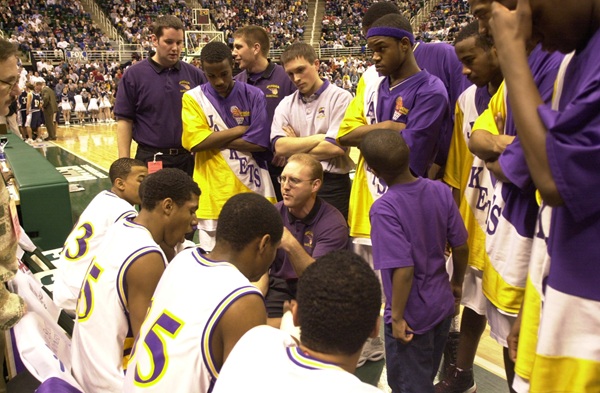 Playing for something bigger than themselves certainly worked for the 2002 team, and Morton said there is a 25th anniversary reunion in the works for next spring.
But while he nor anyone else in the Avondale community will forget that run in 2002, these days Morton is spearheading a team he said is playing for an even greater purpose, one he tried to describe to a group of youth football coaches in Flint during a recent gathering.
“I had only about 15 to 20 minutes to share with these guys,” Morton said. “I shared that we won a state title in 2002 and I was driven to be the best coach I could possibly be. A lot of great things happened, and the state championship happened. I’m on my way home from the state championship and we’re watching the video, and it’s crazy because this fear came over me. How are we going to do this again?
“Every coach that puts his or her full identity in the performance of the team, that’s scary and that’s not good. I got out six years later because of that fear. The most important relationships of my life were not good because I had to be validated by the performance of my team. That conversation kind of led into, “Why are you coaching? Why are you doing what you are doing? I wanted them to be motivated to be the best versions of themselves, for those kids, their wives and children. That’s why I’m in FCA. That’s my cause to fight for.”
2026 Made In Michigan
Aug. 7: Significance of Historic Run, Relationships Formed Live On for 1973 Unity Champs - Report
Aug. 4: Work Ethic Continues to Drive Van Dyk's Endeavors as Co-Owner of Family Farm - Report
July 24: Hackett Mentor's Care Sparked Lifetime in Hoops for BCAM President White - Report
July 24: Mackey Leaving Court with 500+ College Hoops Wins, Many More Lessons Shared - Report
July 16: Country Day Two-Time Champ Moore Building Perennial Winner at Harvard - Report
July 9: Multi-Sport Career at TC West Helps Gillis Thrive as Pro in Game She Once Left Behind - Report
July 2: Inspired by Home, Eager to Give Back, Spencer Hosts Hoop City Alumni Games - Report
PHOTOS At left, Tim Morton raises the Class B championship trophy in 2002. At right, Morton now a director for Fellowship of Christian Athletes. (Middle) Morton, kneeling, speaks to his team during the championship win at Breslin Center. (MHSAA archives)
Not Even Sky Seems Limit as Richards Keeps Calvary Sports Soaring
By
Tom Kendra
Special for MHSAA.com
January 4, 2024
Bradley Richards believes that life is all about trying new things, setting bigger goals and pushing yourself to new heights – in his case, literally.
 Richards, now a 6-foot-5, 190-pound junior basketball standout at tiny Fruitport Calvary Christian, played on the school’s fifth-grade team when he was in second grade.
He remembers staring longingly at the rim in those days and dreaming about dunking, before making that dream a reality by throwing one down in February of his seventh-grade year.
While his three older sisters - Taylor, Allyson and Kelsey - were leading the Calvary girls basketball program to new heights, he vowed he would do the same with the boys program someday.
Bradley and his teammates accomplished that goal last spring, winning the school’s first boys District basketball title despite a roster with no seniors.
This season, Calvary came flying out of the gate with a 5-0 start and is now 5-2 heading into Friday’s home game against Saugatuck.
“It’s been a lot of fun,” said Bradley, who averages 29 points and 14 rebounds per game. “Our school is so small that we’re more like a family. It’s not about me. I’m just so happy for our school and all of the guys on the team.”
The next goal is to repeat as District champions and try to win a Regional title, before setting his sights at clearing 7 feet in the high jump this spring.
“I’m going to try to get past that this year,” said Bradley in his typical humble, matter-of-fact fashion.
One thing his father and fourth-year Fruitport Calvary Christian boys basketball coach Brad Richards has learned is to not put anything past his only son, the youngest of his four children.
Bradley displayed an interest in music as a young boy and now sings in the school’s worship group and plays the saxophone, piano and guitar. Last fall, he played high school football for the first time as part of a cooperative agreement with Muskegon Catholic Central and wound up starting at wide receiver and defensive back for the state powerhouse program.
“He’s blessed and he’s gifted – yes,” said his father, who also coached all three of his girls during their Calvary Christian basketball careers. “But he works so hard.
“Bradley sets goals and works toward them. He’s always looking for the next thing to do.”
True to his school
One thing he doesn’t like to do is media interviews. Specifically, he doesn’t like calling attention to himself.
“He is pretty quiet and would rather have his teammates get the attention,” said his mother, Joy.
Fruitport Calvary Christian is one of the smallest schools on the entire Lakeshore with 51 students in grades 9-12, and just 17 boys in the high school.
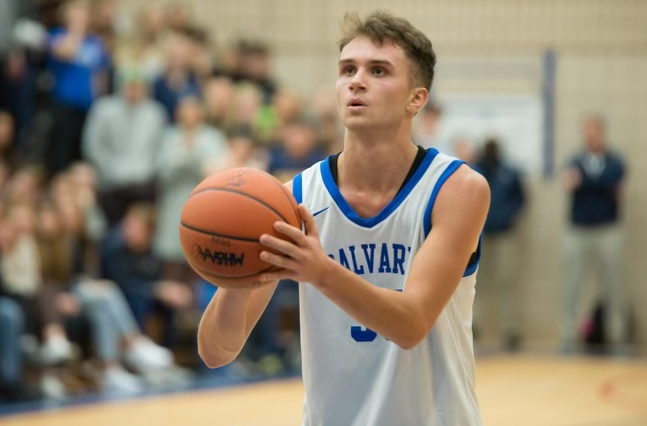 The Eagles take great pride in their ability to compete against much larger schools. They made a huge statement during the first full week of December with three convincing victories over bigger schools.
That week started on Tuesday, Dec. 5, with Calvary’s first-ever boys basketball win over neighbor Fruitport, a Division 2 school that competes in the Ottawa-Kent Conference Blue. Bradley scored 35 points with 14 rebounds in that game, with clutch free throws by role player Eric Dubois Quayle sealing the win.
Two days later, Richards scored 36 points with 17 rebounds in a win over Grand Rapids Sacred Heart.
Calvary then capped the 3-0 week Friday with a victory over Kent City, another Division 2 school, as Bradley scored 36 points with 18 rebounds.
Calvary is led by the “big three” of juniors Richards and Quinn Swanson and senior Sam Zelenka. Swanson, the team’s second-leading scorer with 17 points plus six rebounds and three assists per game, injured his knee last week against Schoolcraft and his health will have a huge bearing on the team’s success going forward. Zelenka is the top defender and averages 11 points, eight assists and seven rebounds.
The other starters are junior workhorse Zach McFarren, who owns the school’s shot put and discus records and has played all but six minutes over the team’s seven games, and senior Nolan Ghezzi.
Richards, already a two-time Associated Press all-state selection who even made the Basketball Coaches Association of Michigan all-state team as an eighth grader, has seen every gimmick defense to try and shut him down, including box-and-twos and triple teams. He credits his experience in football and track with helping him deal with it.
“There is usually a quick guy in front of me and a big guy behind me,” said Bradley, who scored a career-high 47 points in a game last season. “Football has really helped me, because I’m not as scared of the contact. The high jumping has helped me to elevate and get my shot off.”
Great heights
Jim McHugh is a high jump legend from Pentwater who went on to become a two-time national champion in the event at Hillsdale College, and he now coaches West Michigan athletes in the event.
The first time he worked with Bradley Richards, in April of last year, he knew he had something special on his hands.
“Bradley went up and literally hurdled the bar at 5-11,” said McHugh. “I was in shock. I said to myself: ‘This is gonna be a heck of a ride.’ The kid is a generational talent.”
The coaching of McHugh paid immediate dividends, as Bradley improved from a top jump of 6-1½ as a freshman to 6-6½ in last year’s Regional meet. Then came the Division 4 Finals at Hudsonville a few weeks later.
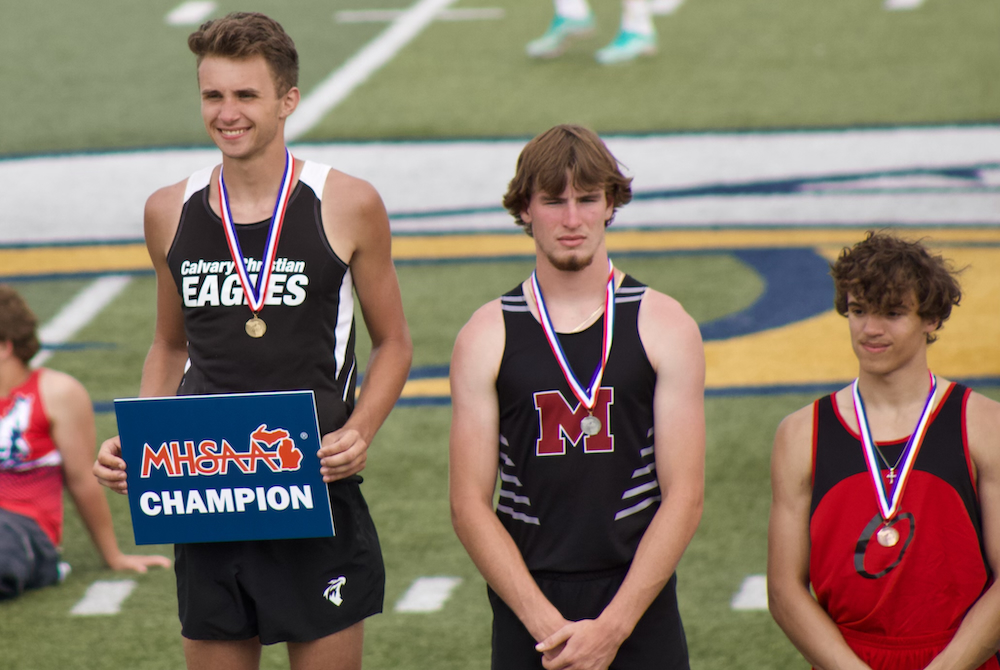
Bradley won the first track Finals championship for Fruitport Calvary with a leap of 6-10 – which was 3 inches higher than anyone else in any of the four Lower Peninsula divisions and entire Upper Peninsula that day – and caught the attention of college scouts from across the country.
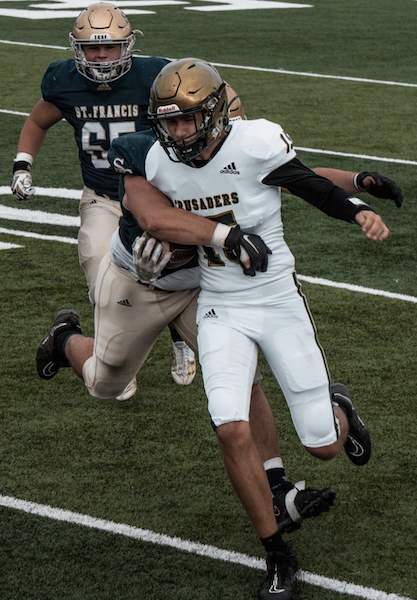 The following week, he competed at the New Balance Outdoor Nationals in Philadelphia and placed second with a jump of 6-8.24.
McHugh shudders to think of how high his prodigy can soar. He has his sights set on the Division 4 Finals record of 6-10½ (Kurt Schneider, Auburn Hills Oakland Christian, 2009), the Muskegon-area record of 7-0 (Steve Paulsen, Fremont, 1998) and the all-division/class Finals record of 7-1 (John Payment, Brimley, 1989).
“God has given him incredible talent, but he also has the desire it takes,” said McHugh, who is also working with another Division I college high jump prospect in Hart junior Addison Hovey. “I gave him a workout plan, and he has done every bit of it. He has cleaned up his diet, done the cold showers and the cold bathtubs, everything. I’m excited to see the results.”
Richards, whose first love was basketball, admits he is smitten with the high jump and seeing how high he can soar.
Now, when asked about his favorite athletes, he still mentions Michael Jordan and Kevin Durant, but he also includes Olympic gold medalist high jumper Mutaz Barshim of Qatar – who made news by not taking additional jumps at the 2020 Olympics in Japan, thereby sharing the gold medal with Gianmarco Tamberi of Italy.
“I just respect that so much, sharing the gold medal,” Bradley said.
Decision time
Now the Bradley Richards recruiting saga has begun and, for him, it’s not just about choosing what school – it’s also about choosing what sport.
“I would like to do both, play basketball and high jump in college, if possible,” Bradley said.
That would certainly be a possibility if Bradley follows in his family’s footsteps at Cornerstone University. His father was a basketball standout at Cornerstone, which is where he met Joy, and all three of his sisters played for the Golden Eagles. (Kelsey is currently a student assistant for this year’s team.)
Playing both may not be possible if he pursues high jump at the Division I level, where Michigan and Illinois are among schools actively recruiting him.
“I know at some point I’m going to have to make a decision, but I don’t have to right now,” said the 17-year-old Bradley. “So it doesn’t do me any good to sit and stress about it all the time.”
Instead, he is focused on more immediate goals.
The first is figuring out a way for his basketball team to snap a two-game losing skid and get positioned for another postseason run.
Then it will be trying to clear the magical high jump number of 7-0, and beyond. And don’t forget football, where he would love to start off his senior year by helping Muskegon Catholic improve on its 6-5 record from a year ago and make a run at the school’s 13th state football championship.
Only after all of that will it be college decision time.
“It’s not an easy choice, and it will take a lot of prayer and discernment,” admitted Richards, who will look for help from his immediate family and his school family in making his choice. “I’ll figure it out. I usually do.”
 Tom Kendra worked 23 years at The Muskegon Chronicle, including five as assistant sports editor and the final six as sports editor through 2011. E-mail him at [email protected] with story ideas for Muskegon, Oceana, Mason, Lake, Oceola, Mecosta and Newaygo counties.
PHOTOS (Top) Fruitport Calvary Christian’s Bradley Richards stands atop the podium after winning the high jump last spring at the Lower Peninsula Division 4 Finals. (Middle) Richards lines up to shoot a free throw. (Below) Playing as part of a cooperative with Muskegon Catholic Central, Richards works to get away from a Traverse City St. Francis tackler. (Track photo courtesy of Joy Richards; basketball and football photos courtesy of Local Sports Journal.)