

Nearly 25 Years After Leading Unexpected Run, Morton Directing Life-Changing Mission
By
Keith Dunlap
Special for MHSAA.com
August 11, 2026
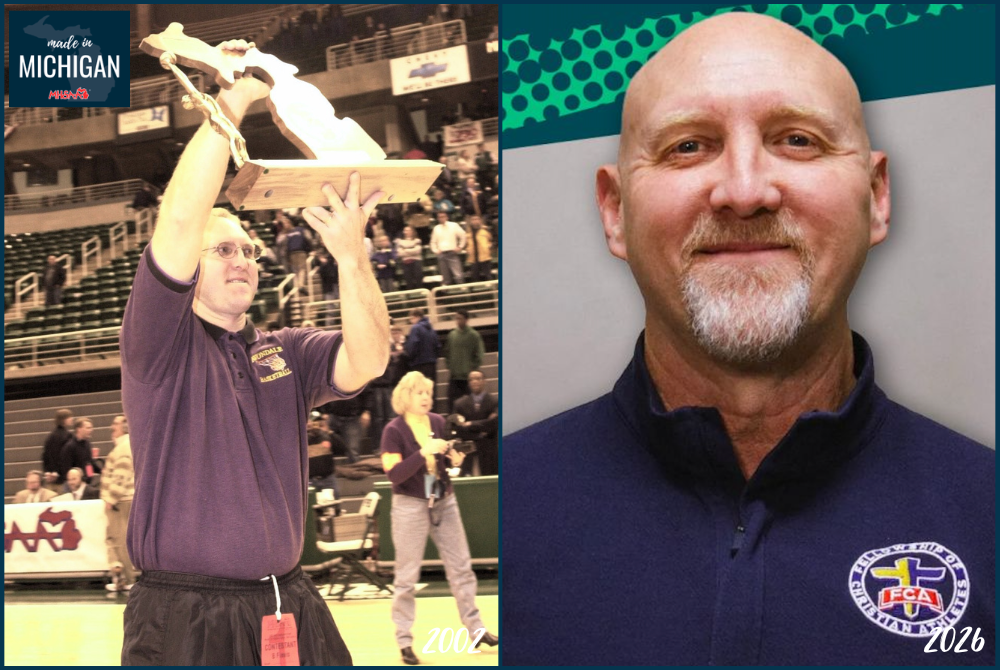
Nearly a quarter century after presiding over arguably one of the most improbable boys basketball state championships in Michigan history, the same fight and underdog mentality still exists for Tim Morton.
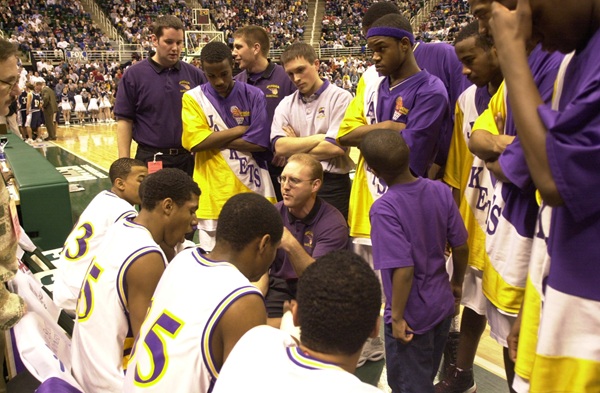
 Back in 2002, Morton was the head boys basketball head coach at Auburn Hills Avondale, which produced a Hollywood-type run during that season’s Class B tournament.
Unranked and without a future Division I college player in the lineup, a Yellow Jackets team headlined by seven seniors went on a quest that stunned many statewide observers.
Avondale avenged the disappointment of not getting out of the District round the previous year and then recorded a stunning upset of a highly-ranked Flint Southwestern team in their Regional Final, winning in double overtime. But after squeaking out a six-point win over a solid Williamston team in a Quarterfinal and earning an 11-point win over Comstock Park in the Semifinals, surely midnight was going to strike for Cinderella in the championship game. After all, Avondale was up against a powerful Grand Rapids South Christian team which had multiple future Division I college players on its roster.
It didn’t matter as Avondale, led by tough-as-nails captains Mike Lewis and Wes Whiteside, senior Dionte Miller and sophomore Dave Holston, completed its stunning run with a 70-65 win to capture what still stands as the program’s only Finals basketball championship.
Morton said he thought his team the previous year that couldn’t make it out of Districts was more talented, but there were intangibles the 2001-02 team possessed that couldn’t be matched.
“I think that nobody really thought that they’d have a shot,” Morton said of his team. “I think that is why we were unranked, because of what had left. But you’ve got to have something to fight for, and I think the reason was the year before. We were motivated. I think playing that underdog role, we just loved it. We won games in so many different ways and got on that roll.”
This past March, Morton and other alumni of the Avondale team certainly were thrilled to see this year’s squad advance to the Semifinals for the first time since their 2001-02 team did so. This time, the Yellow Jackets suffered a three-point Semifinal loss to eventual Class A champion Rockford.
Today, Morton is also heading another team that has an underdog mentality but is motivated to fight for each other and surrounding communities.
Morton is the multi-area director for the Southeast Michigan chapter of the Fellowship of Christian Athletes, which aims to serve kids, coaches and communities by promoting through activities faith, self-esteem, serving others and being the best version of yourself.
The organization has roughly 50 student-led “huddles” that meet at high schools or middle schools, where students can have a safe haven to talk about problems, promote successes, go over scripture and bond during a challenging time of life.
Through volunteers and other staff members, the organization also conducts camps throughout the state for coaches, athletes and others to learn from each other and grow as leaders.
The chapter will have its annual golf outing Sept. 28 at Oakland University’s Sharf Golf Course.
“We just want to be really good at cultivating those relationships, making sure that we’re following up with people, and sharing what the Lord is doing so people feel like they can be connected to something bigger than themselves.”
 Playing for something bigger than themselves certainly worked for the 2002 team, and Morton said there is a 25th anniversary reunion in the works for next spring.
But while he nor anyone else in the Avondale community will forget that run in 2002, these days Morton is spearheading a team he said is playing for an even greater purpose, one he tried to describe to a group of youth football coaches in Flint during a recent gathering.
“I had only about 15 to 20 minutes to share with these guys,” Morton said. “I shared that we won a state title in 2002 and I was driven to be the best coach I could possibly be. A lot of great things happened, and the state championship happened. I’m on my way home from the state championship and we’re watching the video, and it’s crazy because this fear came over me. How are we going to do this again?
“Every coach that puts his or her full identity in the performance of the team, that’s scary and that’s not good. I got out six years later because of that fear. The most important relationships of my life were not good because I had to be validated by the performance of my team. That conversation kind of led into, “Why are you coaching? Why are you doing what you are doing? I wanted them to be motivated to be the best versions of themselves, for those kids, their wives and children. That’s why I’m in FCA. That’s my cause to fight for.”
2026 Made In Michigan
Aug. 7: Significance of Historic Run, Relationships Formed Live On for 1973 Unity Champs - Report
Aug. 4: Work Ethic Continues to Drive Van Dyk's Endeavors as Co-Owner of Family Farm - Report
July 24: Hackett Mentor's Care Sparked Lifetime in Hoops for BCAM President White - Report
July 24: Mackey Leaving Court with 500+ College Hoops Wins, Many More Lessons Shared - Report
July 16: Country Day Two-Time Champ Moore Building Perennial Winner at Harvard - Report
July 9: Multi-Sport Career at TC West Helps Gillis Thrive as Pro in Game She Once Left Behind - Report
July 2: Inspired by Home, Eager to Give Back, Spencer Hosts Hoop City Alumni Games - Report
PHOTOS At left, Tim Morton raises the Class B championship trophy in 2002. At right, Morton now a director for Fellowship of Christian Athletes. (Middle) Morton, kneeling, speaks to his team during the championship win at Breslin Center. (MHSAA archives)
Gladstone Coach Smith Built Champions
October 24, 2016
By Dennis Grall
Special for Second Half
ESCANABA — Gerry Smith put his life into helping area youngsters get a foot into the athletic doorway, and in the process touched the lives of so many people.
 “Smitty” died Oct. 15 following a lengthy illness.
“God got a great softball coach,” said retired Gladstone athletic director Matt Houle. “He was unique and old school, but his love for kids and the game always showed clearly. He had such a passion for the game of softball and just loved working with kids.”
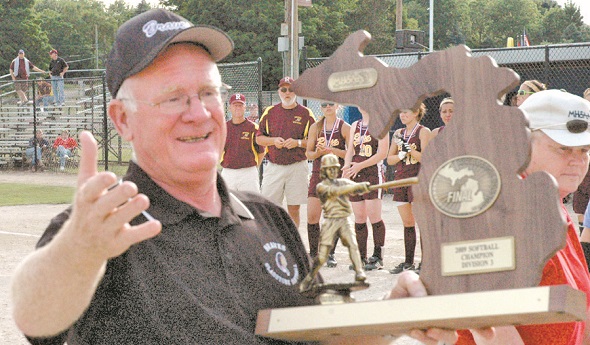
Smith, 70, worked at Mead Paper Co. for more than 30 years and was IBEW 979’s business agent for 21 years. But he will perhaps be most remembered for his 43 years on softball and baseball fields throughout the area. He spent 11 years as Gladstone High School’s head softball coach, directing the Braves to MHSAA titles in 2004 and 2009. He was 290-77-1, but missed much of the 2008 season because of shoulder surgery. The Braves were 31-10 under interim manager John Malloch, which would give Smith an overall 321-87-1 record.
 “He put a lot of trust into people he asked to help him out,” said Ashley Hughes, who succeeded Smith in 2014 and guided the Braves to the MHSAA Division 3 title that year.
Hughes, who joined Smith on the softball staff when she became a teacher at her alma mater in 2009, also pitched for Smith and the Braves before getting a softball scholarship to Lake Superior State University.
She recalled Smith sought her services when she returned to Gladstone. “Hey kiddo, how about helping us out this year,” is how Hughes remembers that conversation.
He then told her, “I’m going to teach you everything I know and in a few years this will all be yours,” Hughes related.
“For me to come as head coach after Smitty, there was so much pressure. I wanted to live up to everything he had provided for this program,” Hughes said. “I didn’t want to disappoint him. He put a lot of faith in me.”
She said Smith also had an impact when she was a player. “He was so in your face in such a positive light. He wanted you to be successful, whether you had never touched a ball or had the ability to go on to play college ball. He was a spit-fire. He was so intense.
“He just exuded passion, at practice, at games. He had so much love for the game. That is something I’ve held onto because I too loved that game. To have someone like Smitty be so passionate and intense helped me become passionate and gave me the drive to be like that.”
Bill Buchmiller and Smith were partners for 40 years and he became godfather to Buchmiller’s children. In addition to guiding the Braves’ high school varsity, they served as American Legion coaches in the early stages of Gladstone’s program, worked together as Little League coaches and were softball teammates.
“He took a program from nothing to two state championships,” said Buchmiller. “He always encouraged the group. He may have broke them down a little bit but he always built them back up. He was a hard guy to get to know, but once you got to know him, he was a great guy.”
Smith used the knowledge he had gleaned from many years as a player and infused that into his players. “He just dwelled on the basics of softball. If you had to play small ball to win, that is what he played,” said Buchmiller.
 “He covered all the different bases of softball. He stressed defense. He told (hitting coach) Al Verbrigghe, ‘You give me one run Al and we’ll win the ball game with my defense. Give me a run and we’ll manage somehow.’”
Theresa Shepeck, who joined Smith on the GHS staff in 2003, agreed with that assessment.
“Smitty always thought the short game was the way to go,” she said. “It was about bunting, not the long ball. You get a runner on one, you bunt her to two. You get somebody on three, then you suicide (bunt) her home.”
Shepeck said his players thrived on his various idiosyncrasies, such as finding tourney lodging in rather inexpensive motels and using a wad of cash to pay for the team’s rooms. “The kids just yukked it up,” she said with a laugh.
“He always put the kids first. If somebody made a mistake, it was never their fault; it is my (Smith’s) fault, the coaching staff’s fault. If one of us coaches made a mistake, he took that blame. It was always his fault, his responsibility,” said Shepeck.
The players appreciated how he used them in games and practices. “His philosophy was to put the best nine on the field, period,” she said. “He walked on a lot of toes, he had a lot of hurt feelings (of parents), but I think the kids respected that. Nobody ever doubted how they fit in. He was there to win.
“He was a little man (about 5-foot-6) but had a huge heart. He was all about the kids and the coaching staff. It was an honor to learn from him, to be in his presence, to be a mentor to the kids.”
Hughes agreed, noting “he had a way of figuring out what the team needs are and re-arranging the players (duties). He knew the players’ strengths and was always looking out for the entire team.”
Smith’s career record likely could have included more wins if he didn’t use the season’s first month to shuffle personnel while building for the postseason. It paid off when it counted the most as the Braves reached at least the Quarterfinal level each of his 11 seasons.
“He was definitely not afraid to experiment,” said Hughes. “He knew the rules of the game and he was always looking for more (from his players). He was an aggressive coach, and the girls who love the sport really grasped at that. He utilized every player on his roster.
“He didn’t have to say too much, but you always wanted to answer him and make him proud and prove to him that you can come through.”
Houle summed up Smith’s legacy when he said, “He was the person that put Gladstone High School on the map in high school activities. He will be dearly missed by so many. He touched so many lives.”
 Denny Grall retired in 2012 after 39 years at the Escanaba Daily Press and four at the Green Bay Press-Gazette, plus 15 months for WLST radio in Escanaba; he served as the Daily Press sports editor from 1970-80 and again from 1984-2012. Grall was inducted into the Upper Peninsula Sports Hall of Fame in 2002 and serves as its executive secretary. E-mail him at [email protected] with story ideas for the Upper Peninsula.
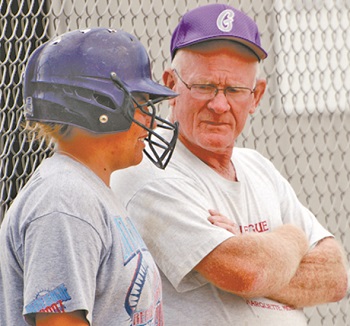
PHOTOS: (Top) Gladstone High School softball manager Gerry Smith holds the Division 3 championship trophy after the Braves won the 2009 title in Battle Creek. Smith, who also led the Braves to the 2004 crown, died Oct. 15. (Middle) Smith talks with catcher Jordan Kowalski at a practice prior to the 2011 Division 3 Semifinals. (Photos courtesy of Escanaba Daily Press.)