

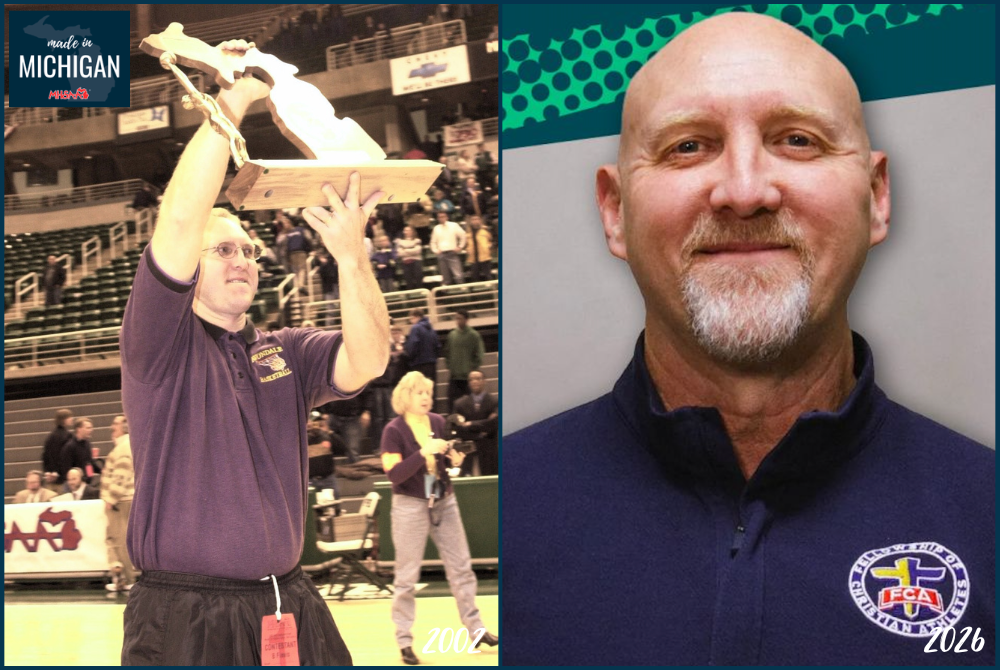
Nearly 25 Years After Leading Unexpected Run, Morton Directing Life-Changing Mission
By
Keith Dunlap
Special for MHSAA.com
August 11, 2026
Nearly a quarter century after presiding over arguably one of the most improbable boys basketball state championships in Michigan history, the same fight and underdog mentality still exists for Tim Morton.
 Back in 2002, Morton was the head boys basketball head coach at Auburn Hills Avondale, which produced a Hollywood-type run during that season’s Class B tournament.
Unranked and without a future Division I college player in the lineup, a Yellow Jackets team headlined by seven seniors went on a quest that stunned many statewide observers.
Avondale avenged the disappointment of not getting out of the District round the previous year and then recorded a stunning upset of a highly-ranked Flint Southwestern team in their Regional Final, winning in double overtime. But after squeaking out a six-point win over a solid Williamston team in a Quarterfinal and earning an 11-point win over Comstock Park in the Semifinals, surely midnight was going to strike for Cinderella in the championship game. After all, Avondale was up against a powerful Grand Rapids South Christian team which had multiple future Division I college players on its roster.
It didn’t matter as Avondale, led by tough-as-nails captains Mike Lewis and Wes Whiteside, senior Dionte Miller and sophomore Dave Holston, completed its stunning run with a 70-65 win to capture what still stands as the program’s only Finals basketball championship.
Morton said he thought his team the previous year that couldn’t make it out of Districts was more talented, but there were intangibles the 2001-02 team possessed that couldn’t be matched.
“I think that nobody really thought that they’d have a shot,” Morton said of his team. “I think that is why we were unranked, because of what had left. But you’ve got to have something to fight for, and I think the reason was the year before. We were motivated. I think playing that underdog role, we just loved it. We won games in so many different ways and got on that roll.”
This past March, Morton and other alumni of the Avondale team certainly were thrilled to see this year’s squad advance to the Semifinals for the first time since their 2001-02 team did so. This time, the Yellow Jackets suffered a three-point Semifinal loss to eventual Class A champion Rockford.
Today, Morton is also heading another team that has an underdog mentality but is motivated to fight for each other and surrounding communities.
Morton is the multi-area director for the Southeast Michigan chapter of the Fellowship of Christian Athletes, which aims to serve kids, coaches and communities by promoting through activities faith, self-esteem, serving others and being the best version of yourself.
The organization has roughly 50 student-led “huddles” that meet at high schools or middle schools, where students can have a safe haven to talk about problems, promote successes, go over scripture and bond during a challenging time of life.
Through volunteers and other staff members, the organization also conducts camps throughout the state for coaches, athletes and others to learn from each other and grow as leaders.
The chapter will have its annual golf outing Sept. 28 at Oakland University’s Sharf Golf Course.
“We just want to be really good at cultivating those relationships, making sure that we’re following up with people, and sharing what the Lord is doing so people feel like they can be connected to something bigger than themselves.”
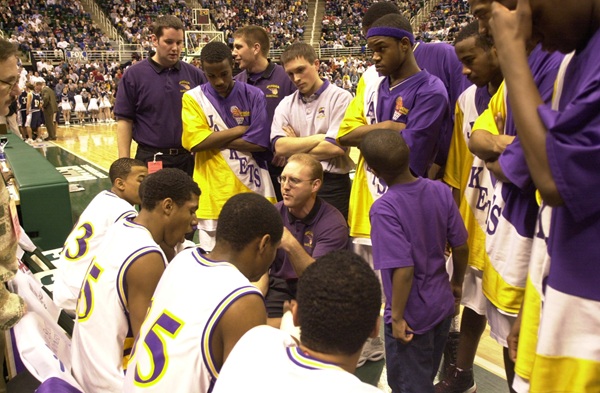 Playing for something bigger than themselves certainly worked for the 2002 team, and Morton said there is a 25th anniversary reunion in the works for next spring.
But while he nor anyone else in the Avondale community will forget that run in 2002, these days Morton is spearheading a team he said is playing for an even greater purpose, one he tried to describe to a group of youth football coaches in Flint during a recent gathering.
“I had only about 15 to 20 minutes to share with these guys,” Morton said. “I shared that we won a state title in 2002 and I was driven to be the best coach I could possibly be. A lot of great things happened, and the state championship happened. I’m on my way home from the state championship and we’re watching the video, and it’s crazy because this fear came over me. How are we going to do this again?
“Every coach that puts his or her full identity in the performance of the team, that’s scary and that’s not good. I got out six years later because of that fear. The most important relationships of my life were not good because I had to be validated by the performance of my team. That conversation kind of led into, “Why are you coaching? Why are you doing what you are doing? I wanted them to be motivated to be the best versions of themselves, for those kids, their wives and children. That’s why I’m in FCA. That’s my cause to fight for.”
2026 Made In Michigan
Aug. 7: Significance of Historic Run, Relationships Formed Live On for 1973 Unity Champs - Report
Aug. 4: Work Ethic Continues to Drive Van Dyk's Endeavors as Co-Owner of Family Farm - Report
July 24: Hackett Mentor's Care Sparked Lifetime in Hoops for BCAM President White - Report
July 24: Mackey Leaving Court with 500+ College Hoops Wins, Many More Lessons Shared - Report
July 16: Country Day Two-Time Champ Moore Building Perennial Winner at Harvard - Report
July 9: Multi-Sport Career at TC West Helps Gillis Thrive as Pro in Game She Once Left Behind - Report
July 2: Inspired by Home, Eager to Give Back, Spencer Hosts Hoop City Alumni Games - Report
PHOTOS At left, Tim Morton raises the Class B championship trophy in 2002. At right, Morton now a director for Fellowship of Christian Athletes. (Middle) Morton, kneeling, speaks to his team during the championship win at Breslin Center. (MHSAA archives)
CPR Training, CAP Add to Preparedness
By
Geoff Kimmerly
MHSAA.com senior editor
October 12, 2015
A recent graduate from Ovid-Elsie High School named Chris Fowler started classes this fall at Michigan State University, his days representing the Marauders on the basketball court, football field and golf course now memories as he starts the next chapter of his young adult life.
But his story also will remain a reminder as his high school’s athletic department prepares each year to keep its athletes as safe as possible.
Three years ago next month, Fowler collapsed on the football practice field in cardiac arrest. The then-sophomore was brought back to life by two of his coaches, who revived him with CPR and an AED machine.
There’s no need for athletic director Soni Latz to recount the events of that day when explaining the importance of being ready to respond to a medical crisis – her coaches are well aware of why Fowler survived and understand completely why they too must be prepared.
“Everyone is very aware of what happened and the importance of being trained and knowing what to do, and actually feeling comfortable to step in and administer CPR when needed,” Latz said. “You can feel it’s never going to happen to you, but once it has, it makes you more aware and conscientious to be prepared.”
But Fowler’s story is worth noting on a larger level as varsity coaches at all MHSAA member schools are required this year for the first time to become certified in CPR, and as the largest classes in Coaches Advancement Program history begin course work that includes up to four modules designed to make them aware of health and safety situations that may arise at their schools as well.
The CPR requirement is the most recent addition to an MHSAA thrust toward raising expectations for coaches’ preparedness. The first action of this effort required all assistant and subvarsity coaches at the high school level to complete the same rules and risk minimization meeting requirement as high school varsity head coaches beginning with the 2014-15 school year.
The next action, following the CPR mandate, will require all persons hired as a high school varsity head coach for the first time at an MHSAA member school after July 31, 2016, to have completed the MHSAA’s Coaches Advancement Program Level 1 or Level 2.
In addition, MHSAA member schools this summer received the “Anyone can Save a Life” program, an emergency action plan curriculum designed by the Minnesota State High School League to help teams – guided by their coaches – create procedures for working together during medical emergencies.
“Coaches get asked to do a lot, and even if a school has an athletic trainer or some other health care professional, that person can’t be everywhere all the time. Coaches often are called upon to be prepared for (medical) situations,” said Gayle Thompson, an adjunct assistant professor at Albion College who formerly directed the athletic training program at Western Michigan University and continues to teach CAP sports medicine modules.
“The more (coaches) can learn to handle the situations that can inevitably arise, the better off they’re going to feel in those situations and the better care they’ll be able to offer their athletes. It’s proven that the faster athletes are able to get care, the quicker they’re able to come back to play.”
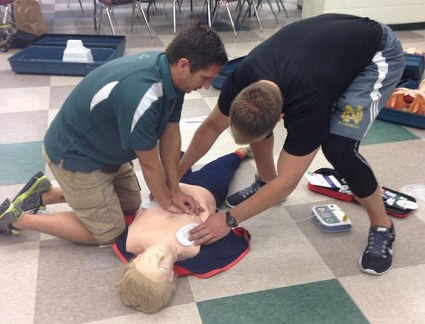 Pontiac Notre Dame Prep – which has sent a number of coaches through the CAP program – began a focus on heart safety about five years ago after a student-athlete was diagnosed with a heart issue that allowed her to continue to play volleyball and softball, but not basketball. Athletic director Betty Wroubel said that prior to the student’s diagnosis, the school did provide training in CPR, AED use and artificial respiration; however, that situation put coaches and administrators further on the alert.
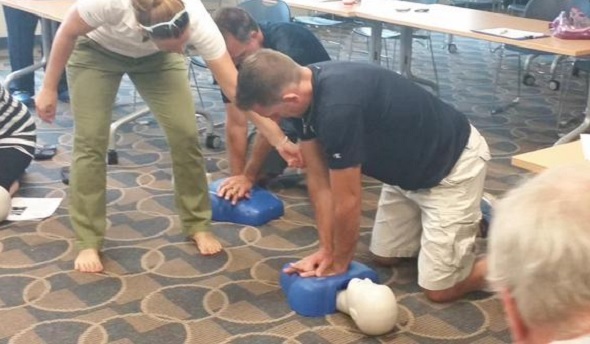
Her school offers CPR training also to subvarsity and middle school coaches, using a combination of video instruction from the American Red Cross and in-person guidance by members of the school community who are certified to teach those skills. Students at the school also have received training – and it paid off a few years ago when one of them gave CPR to a baby who had stopped breathing at a local shopping mall.
Portage Central scheduled two sessions this fall for its coaches to receive not only CPR certification, but AED training as well. Central was fortunate to have an American Red Cross first-aid trainer in house, teacher Rachel Flachs, who also is close to the athletic side as the girls swimming and diving coach at Mattawan High School.
Central athletic director Joe Wallace said the training was offered not just to varsity head coaches, but every head coach on every level of the program so that “at least we know that at every given practice, every game, we’d have someone recently trained,” he said.
And he was proud of how his coaches immersed themselves in the subject matter.
“They were putting themselves in scenarios to see how it related to their own sports and asking really great questions,” Wallace said. “It was thought provoking.”
The CAP sports medicine modules are designed to do the same as coaches consider the medical situations they could face. They aren’t designed as “medical training,” said Tony Moreno, a professor of kinesiology at Eastern Michigan University and teacher of all four CAP sports medicine modules. Rather, attendees receive an awareness and basic education on common injuries, injury mechanisms and prevention, and how to create an action plan in the event of an injury incident.
The CAP program touches on a variety of safety topics in several of the available seven levels of coach education.
CAP 1 – which is part of the mandate for new coaches beginning next school year – includes “Sports Medicine and First Aid.” Cap 4 has modules titled “Understanding Athlete Development” and “Strength and Conditioning: Designing Your Program.” CAP 5 includes the session, “Peak Health and Performance.” Attendees also have the option of receiving CPR and AED training as an addition to some courses.
With a quick Internet search, coaches have no trouble finding a variety of resources on sports medicine, performance enhancement, nutrition and healthy living regarding young athletes. “However, some of these sources are more credible and scientifically-based in comparison to others,” Moreno said. “CAP strives on an annual basis to continue to update and improve the quality and credibility of this information and in a face-to-face manner where coaches have the opportunity to ask questions about their experiences and specific programs.”
“Having the CAP requirement will only make them better informed. Many have had this kind of information before, but there’s always something new coming,” Thompson added. “I think we do a good job, not of trying to tell them they were wrong, but maybe taking what they’ve known a step further and making them better prepared – empowering them to do their best.”
Wroubel may understand more than most athletic directors the growing list of tasks coaches are asked to accomplish; she’s also one of the winningest volleyball and softball coaches in MHSAA history and continues to guide both Fighting Irish programs.
But she and Wallace both said the CPR mandate isn’t considered another box to check on a to-do list; there’s enthusiasm because of its importance and the opportunity to carry those skills into other areas of community life as well.
Wroubel has served as a coach since 1975 and said this renewed emphasis on coaches having knowledge of sports medicine actually is a return to how things were when she started. Back then, coaches were responsible for being that first line of medical know-how, from taping ankles to providing ice and evaluating when their athletes should make a trip to the doctor’s office.
“When I first started coaching, we didn’t have sports medicine people, trainers, or team doctors other than for football. You did everything yourself,” Wroubel said. “I think everybody got away from that, but I think it’s coming back because a trainer can’t be everywhere.
“It’s healthy and it’s good for kids. … The more of us with emergency skills, the better we’re able to serve our community.”
PHOTOS: (Top) Portage Central coaches receive CPR training earlier this fall. (Middle) Pontiac Notre Dame Prep coaches practice during AED training. (Photos courtesy of school athletic departments.)