

Nearly 25 Years After Leading Unexpected Run, Morton Directing Life-Changing Mission
By
Keith Dunlap
Special for MHSAA.com
August 11, 2026
Nearly a quarter century after presiding over arguably one of the most improbable boys basketball state championships in Michigan history, the same fight and underdog mentality still exists for Tim Morton.
 Back in 2002, Morton was the head boys basketball head coach at Auburn Hills Avondale, which produced a Hollywood-type run during that season’s Class B tournament.
Unranked and without a future Division I college player in the lineup, a Yellow Jackets team headlined by seven seniors went on a quest that stunned many statewide observers.
Avondale avenged the disappointment of not getting out of the District round the previous year and then recorded a stunning upset of a highly-ranked Flint Southwestern team in their Regional Final, winning in double overtime. But after squeaking out a six-point win over a solid Williamston team in a Quarterfinal and earning an 11-point win over Comstock Park in the Semifinals, surely midnight was going to strike for Cinderella in the championship game. After all, Avondale was up against a powerful Grand Rapids South Christian team which had multiple future Division I college players on its roster.
It didn’t matter as Avondale, led by tough-as-nails captains Mike Lewis and Wes Whiteside, senior Dionte Miller and sophomore Dave Holston, completed its stunning run with a 70-65 win to capture what still stands as the program’s only Finals basketball championship.
Morton said he thought his team the previous year that couldn’t make it out of Districts was more talented, but there were intangibles the 2001-02 team possessed that couldn’t be matched.
“I think that nobody really thought that they’d have a shot,” Morton said of his team. “I think that is why we were unranked, because of what had left. But you’ve got to have something to fight for, and I think the reason was the year before. We were motivated. I think playing that underdog role, we just loved it. We won games in so many different ways and got on that roll.”
This past March, Morton and other alumni of the Avondale team certainly were thrilled to see this year’s squad advance to the Semifinals for the first time since their 2001-02 team did so. This time, the Yellow Jackets suffered a three-point Semifinal loss to eventual Class A champion Rockford.
Today, Morton is also heading another team that has an underdog mentality but is motivated to fight for each other and surrounding communities.
Morton is the multi-area director for the Southeast Michigan chapter of the Fellowship of Christian Athletes, which aims to serve kids, coaches and communities by promoting through activities faith, self-esteem, serving others and being the best version of yourself.
The organization has roughly 50 student-led “huddles” that meet at high schools or middle schools, where students can have a safe haven to talk about problems, promote successes, go over scripture and bond during a challenging time of life.
Through volunteers and other staff members, the organization also conducts camps throughout the state for coaches, athletes and others to learn from each other and grow as leaders.
The chapter will have its annual golf outing Sept. 28 at Oakland University’s Sharf Golf Course.
“We just want to be really good at cultivating those relationships, making sure that we’re following up with people, and sharing what the Lord is doing so people feel like they can be connected to something bigger than themselves.”
 Playing for something bigger than themselves certainly worked for the 2002 team, and Morton said there is a 25th anniversary reunion in the works for next spring.
But while he nor anyone else in the Avondale community will forget that run in 2002, these days Morton is spearheading a team he said is playing for an even greater purpose, one he tried to describe to a group of youth football coaches in Flint during a recent gathering.
“I had only about 15 to 20 minutes to share with these guys,” Morton said. “I shared that we won a state title in 2002 and I was driven to be the best coach I could possibly be. A lot of great things happened, and the state championship happened. I’m on my way home from the state championship and we’re watching the video, and it’s crazy because this fear came over me. How are we going to do this again?
“Every coach that puts his or her full identity in the performance of the team, that’s scary and that’s not good. I got out six years later because of that fear. The most important relationships of my life were not good because I had to be validated by the performance of my team. That conversation kind of led into, “Why are you coaching? Why are you doing what you are doing? I wanted them to be motivated to be the best versions of themselves, for those kids, their wives and children. That’s why I’m in FCA. That’s my cause to fight for.”
2026 Made In Michigan
Aug. 7: Significance of Historic Run, Relationships Formed Live On for 1973 Unity Champs - Report
Aug. 4: Work Ethic Continues to Drive Van Dyk's Endeavors as Co-Owner of Family Farm - Report
July 24: Hackett Mentor's Care Sparked Lifetime in Hoops for BCAM President White - Report
July 24: Mackey Leaving Court with 500+ College Hoops Wins, Many More Lessons Shared - Report
July 16: Country Day Two-Time Champ Moore Building Perennial Winner at Harvard - Report
July 9: Multi-Sport Career at TC West Helps Gillis Thrive as Pro in Game She Once Left Behind - Report
July 2: Inspired by Home, Eager to Give Back, Spencer Hosts Hoop City Alumni Games - Report
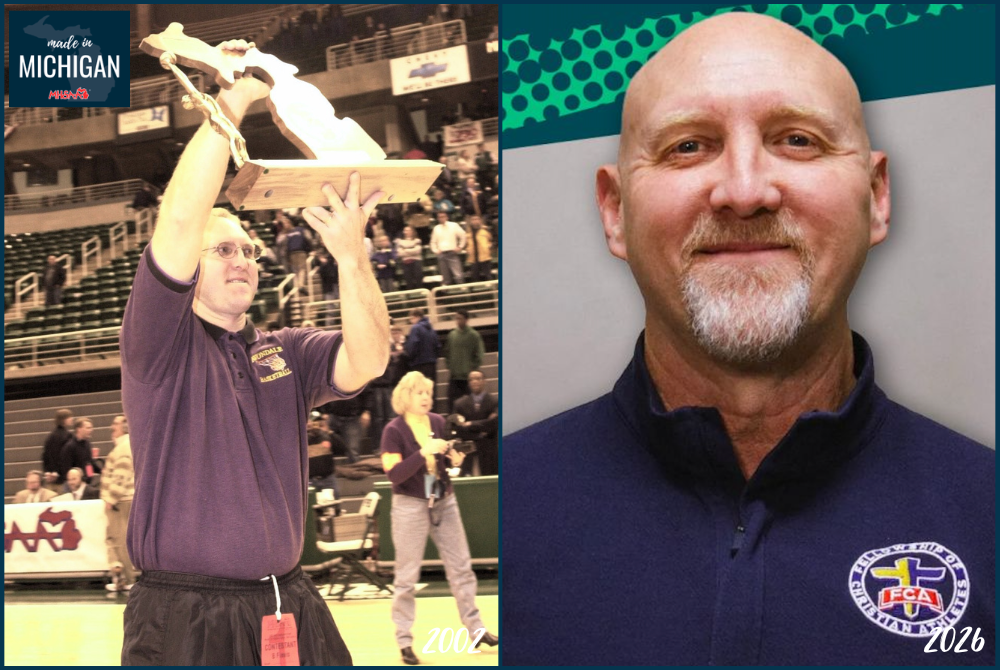
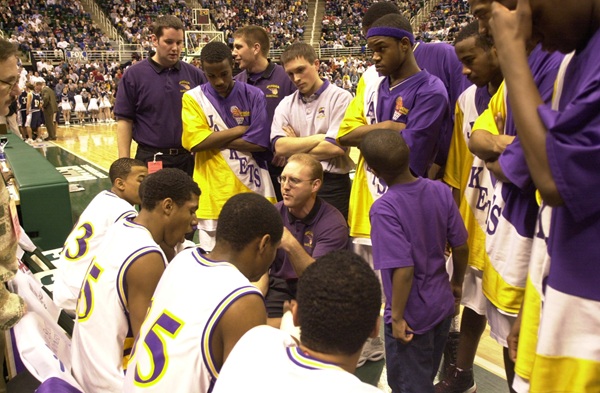
PHOTOS At left, Tim Morton raises the Class B championship trophy in 2002. At right, Morton now a director for Fellowship of Christian Athletes. (Middle) Morton, kneeling, speaks to his team during the championship win at Breslin Center. (MHSAA archives)
Making (Health) Histories Every Year
July 23, 2015
By Rob Kaminski
MHSAA benchmarks editor
Tom Minter, recently retired from the MHSAA as assistant director, wore many hats while serving the Association and donned official’s gear in numerous sports outside of business hours.
But one of his finest refereeing efforts might have come during the 2009-10 and 2010-11 school years when he guided approximately 60 individuals representing 25 medical and professional organizations through an arduous process to upgrade the antiquated Physical Form to what is the standard today: the Pre-participation Physical Examination/Health History Form.
The form highlighted Stage 1 of the MHSAA’s 4 Hs of Health and Safety – Health Histories – and the current form is much more comprehensive, answering questions previously not asked during the quicker, more brief, evaluations.
Sudden cardiac death claims the lives of more than 300 Michigan children and young adults between the ages of 1-39 years annually. Yet, many of these deaths could be prevented through screening, detection, and treatment. One such way to detect high risk conditions that predispose to SCDY is through pre-participation sports screening of student-athletes, and the current physical form provides a mechanism.
While much more detailed, schools report that parents are more than willing to take the extra time and effort to complete the lengthier version.
“When the expanded form came out, people kiddingly made comments about its length; yet in today's day and age everyone understands we need all the information we can cultivate regarding health histories of our student athletes,” said Mark Mattson, athletic director at Traverse City Central.
Down state, feelings have been similar. “We don’t have a problem at all here,” said Anna Devitt, athletic secretary at Hartland High School. “Our parents take care of it, and haven’t balked at the length at all.”
Both agree, and are joined by many others across the state, that the next logical step is for the form to be converted to a fillable, online document so that records can be accessed by those in need via mobile, laptop or desktop.
Thus, in the “No H left behind” mantra that the MHSAA has assumed, an electronic option of the Health History form is in the early planning stages.
“As an increasing number of our schools strive to be ‘paper-free,’ or at least as much so as possible, it is time to re-invent the delivery method for perhaps our most downloaded or distributed document,” MHSAA Executive Director Jack Roberts said. “Once again, as we move forward with our ‘Heart’ initiative for the coming school year, we are also intent on bringing other projects up to speed.”
The masses are certainly enthused.
“That would be heavenly. An online version that would prevent people from submitting the forms until all the required information was in place would be fantastic,” said Mattson, who has had to turn back, or hold out students while waiting for completed forms, whether at Marquette, Maple City Glen Lake, or his current post in Traverse City. “It’s always been the same; people move too quickly and overlook required fields. It would prevent two things: one, having to hold kids out while waiting for a signature, and two, prevent parents from having to drive in to the athletic office to sign or fill in that last field. We’d know we were getting a completed form.”
At Hartland, where athletic director Jason Reck created an online emergency contact form, a system is in place which allows coaches, administrators and trainers to share necessary data for all student-athletes in addition to the MHSAA forms.
“Our parents love the online emergency contact form, and we require them to fill it out every season, not just once a year,” Devitt said. “Sometimes an athlete gets injured during one season and the next season's coach wants to know about it.”
The information on the form is populated into an Excel spreadsheet which Reck, Devitt, the school trainer and all coaches can access. They can tailor the data by sport and pull it to their mobile devices.
“We’re trying to go completely paperless, and the MHSAA physical form would be another step,” Devitt said. “Our parents and doctor’s offices would love it.”