

New Haven Grows into Class B Contender
March 24, 2017
By Geoff Kimmerly
Second Half editor
EAST LANSING – Eric Williams, Jr., has learned a lot about becoming a champion these last few seasons.
And as Williams has grown, so too has New Haven’s success on the basketball court.
The Rockets will find themselves playing in their first MHSAA championship game Saturday night, thanks to a 78-49 win over Benton Harbor on Friday in what was the program’s first Semifinal as well.
Williams had 22 points, seven rebounds, four assists and three steals, continuing a closing run that could see him leave an unprecedented legacy at the school. He had 11 points, six rebounds and two steals in the first quarter Friday, setting the tone from the start.
“I just came out looking to be aggressive more, because last game I was just out there. I think I had to come in and prove something,” Williams said.
“I’ve learned I’ve just gotta stay calm and not get stage fright on the big stage. Learning to play defense and what team basketball really is, I think I’ve learned that over the (last) few years.”
New Haven (25-1) will face Ludington in the final game of this season, Saturday’s 6:30 p.m. Class B Final.
Williams, a 6-foot-5 guard, entered this week averaging 20.9 points, 6.5 rebounds, 4.1 assists and 3.8 steals per game. New Haven coach Tedaro France II said after Friday’s win that upping his defense has made Williams a complete player – and that newfound all-around game has made him “one of the hottest players in the state right now.”
The first Semifinal came three days after the Rockets' third straight Quarterfinal. They are now 72-5 during this three-season run, and Williams’ rise is just an example of how experience has benefitted the team as a whole.
“That’s something as a coach you can’t teach,” France said. “Kids have to play in big games, and sometimes like with these guys, we have to fail first before we have success. And we’ve failed a lot.
 “Me, I say to our kids, let’s win today. And in practice each day, we fail. I say, let’s learn from our mistakes. I don’t mind if they make 10 mistakes, but let’s not make the same ones. And I think our kids are learning to play through adversity. They know they can make mistakes, then just go back and get back on defense."
Following Williams’ hot start, New Haven took a 22-10 lead into the second quarter and a 43-19 advantage into halftime. The lead got up to 38 during the fourth quarter before Benton Harbor (22-4) finished on a 9-0 run.
The Tigers entered the postseason ranked No. 5 by The Associated Press – New Haven was No. 3 – and had plenty of success as well this season. But they struggled this time to get into a groove against an opponent that beat them at their own game.
New Haven excelled defensively, holding Benton Harbor to 33 percent shooting and taking advantage of 17 turnovers. The Rockets turned on the transition game, to the point Tigers freshman center Carlos Johnson said, “When we’re running up the floor … they were already up there.”
Benton Harbor also is used to outrebounding its opponents, and Johnson had 10. But as coach Corey Sterling said, it was like New Haven had “two or three Carloses” – the Rockets won the rebounding edge 44-31.
“Pretty much we do pressure defense and get out in transition, but they didn’t turn the ball over and they made shots, and that’s pretty much it,” Sterling said. “It seemed like they had an answer for everything we threw at them tonight.”
In addition to Johnson being one of the most highly-regarded freshmen in the state – and finishing with nine points and five blocks to go with those 10 boards – the game also featured one of the state's top sophomores in New Haven forward Romeo Weems, who tallied 14 points, 13 rebounds and five assists. Sophomore guard Roland Jeffery II added 10 points for the Rockets.
Junior guard Elijah Baxter scored 14 points to top Benton Harbor, which played in its second Semifinal in four seasons – and perhaps began a string of championship weekend trips to come.
“We’ve only got two seniors really in our rotation, and this is a good experience for guys like Elijah, Carson, Shawn (Hopkins) and Dennie (Brown),” Sterling said. “Now we know how to get here … now let’s work hard in the summer to take the necessary steps to try to win it all.”
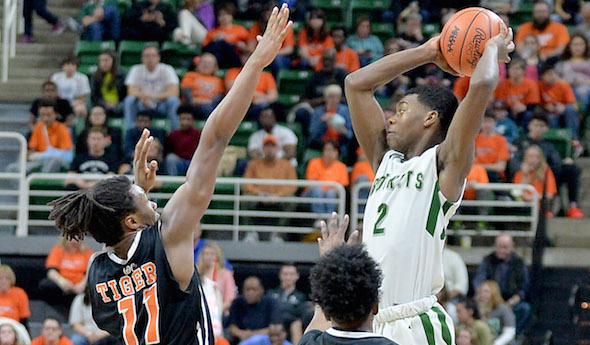
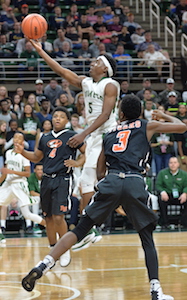
PHOTOS: (Top) New Haven’s Eric Williams, Jr., (2) looks to pass over Benton Harbor’s Carlos Johnson. (Middle) The Rockets’ A.J. Crawford III splits a pair of Tigers defenders during Friday’s Class B Semifinal.
Breslin Bound: Boys Report Week 2
December 20, 2012
By Geoff Kimmerly
Second Half editor
As with football during the fall, Second Half tries to hit all classes and all corners of the state for these weekly boys and girls basketball reports.
But sometimes, focusing on the powers in Class A and B is simply unavoidable.
Most of this week's 10 notable performances came from some of our biggest and best-known schools. (Results and records based on those reported to Score Center at MHSAA.com)
1. Warren DeLaSalle (3-0) – The Pilots have been the Detroit Catholic League team to beat for half a decade, and that could continue this winter. DeLaSalle beat Farmington Hills Harrison 64-50 before edging Class B power Grand Rapids Christian 77-76 in double overtime.
2. Gibraltar Carlson (2-0) – The Marauders’ 70-53 win over Saginaw Buena Vista might not have earned the biggest headline from Saturday’s Metro Detroit Saginaw Valley Challenge at West Bloomfield. But given Buena Vista’s rich tradition, it was still intriguing – although Carlson is coming off a run to its Regional Final too.
3. Romulus (2-1) – I hope to avoid repeating teams on this list from week to week. But Romulus beating reigning two-time Class B champion Lansing Sexton 67-52 makes the Eagles a must again.
4. Grand Rapids Christian (1-3) – It’s been a tough go for these Eagles, who are expected to contend in Class B. But despite finishing the week with that close loss to DeLaSalle, they did beat reigning Class A runner-up Rockford 48-39 earlier on.
5. Rockford (1-2) – The Rams also opened with a couple of losses, but finished the week with a 63-53 win over Muskegon – which made this list last week and is considered a possible contender this season.
6. Bessmer (5-0) – After going 10-11 in 2011-12, Bessemer is halfway to matching that win total. Last week’s were close ones – 50-48 over Hurley, Wis., and 55-51 over Ironwood.
7. Lansing Eastern (2-1) – The Quakers have had three Division I college prospects graduate or move to schools out of state over the last two years, but keep rolling. They picked up solid wins over Williamston (68-58) and East Lansing (55-50).
8. East Jackson (4-0) – The Trojans are off to another nice start coming off a 15-win season. They opened last week beating Brooklyn Columbia Central 51-45 before doubling up Manchester 102-61 – after another high-scoring 100-94 win over Manchester a year ago.
9. Saginaw (4-0) – The reigning Class A champion is on the move again. After beating Midland 86-77 and then Saginaw Heritage 81-34, the Trojans came back Saturday to beat a strong Detroit Southeastern team 57-56 in the MDSV Challenge.
10. Flint Southwestern (3-1) – The Knights are already halfway to last season’s win total, thanks in part to victories last week over Flint Northwestern (63-59) and Flint Powers Catholic (70-39).
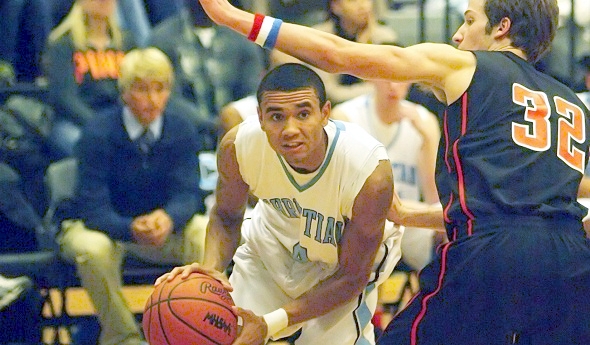
PHOTO: Grand Rapids Christian's Drake Harris attempts to drive around a Rockford defender during last week's win against the reigning Class A runner-up. (Click to see more at HighSchoolSportsScene.com.)