


New Haven Locks Down, Lifts Class B Trophy
By
Paul Costanzo
Special for MHSAA.com
March 25, 2017
EAST LANSING – The New Haven boys basketball team has made a habit of lighting up scoreboards with explosive offensive performances.
But in their biggest game of the season, when pulled into a slowed-down game by Ludington, the Rockets dug deep and won with defense.
They held Ludington scoreless for the first 6½ minutes of the fourth quarter Saturday on the way to a 45-36 win to claim the Class B title at the Breslin Center. It was the first MHSAA Finals title for the Rockets, who were also making their first appearance in a boys basketball championship game.
“It was a great game, they’re a great team – they took away things that we do and played a great zone,” New Haven coach Tedaro France II said. “We kept our composure. It wasn’t a game that if you told me, we would come here and win this way. We scored the lowest point total we scored the whole year, and we found a way to win.”
The Rockets held Ludington to 11 of 49 (22.4 percent) shooting from the field, and while they were credited with just four blocks – all by sophomore Romeo Weems – the presence of shot blockers clearly caused problems for the Orioles, especially in the fourth quarter, when they shot 2 of 15 (13.3 percent) from the floor.
“You have to give a lot of credit to New Haven for that,” Ludington coach Thad Shank said. “They’re long and athletic and make it hard to finish. I thought we got a lot of great looks tonight, but that’s the game of basketball; sometimes they don’t always go in.”
Weems, who is already fielding Division I college offers, led all scorers with 19 points. He added 10 rebounds and three steals as well. Senior Eric Williams, Jr., had 14 points and seven rebounds for the Rockets (27-1), and Ashton Sherrell grabbed 11 rebounds.
Ludington was led by Calvin Hackert, who had 16 points. Sam LaDuke scored 10, and Noah Laman pulled down 10 rebounds for the Orioles. Six of Hackert’s points came in the final 1:30 on a pair of 3-pointers. Those were the only points the Orioles scored in the final quarter.
“We went with our man-to-man press trapping (in the fourth quarter), and they called a timeout because I don’t think they knew what to do,” Weems said. “I started giving everything I had left, getting scrappy, started rebounding more and got more aggressive.”
The game was played at a pace Ludington dictated, as the Orioles killed clock with long possessions and limited second-chance opportunities for the Rockets despite a massive size disadvantage. Ludington actually grabbed more offensive rebounds than the Rockets (14-10), and matched the Rockets in second-chance points (11).
Thanks to that, New Haven’s lead was just one heading into the fourth quarter.
“It was absolutely the way we wanted it to be,” Shank said. “We were hoping we would have the ability to control this game with our offense a little bit coming in. Be aggressive but patient, and really force them to guard a lot of things, and keep them from getting out in transition, and we did a pretty good job of that.”
 Ludington (25-3) led by as many as eight, taking a 15-7 lead in the second quarter. But a Weems 3 sparked a 16-4 New Haven run to end the first half, giving the Rockets a 23-19 lead heading into the break. The game remained tight from there until the Rockets were able to break it open in the final four minutes of the fourth quarter.
“We started off and nobody was hitting shots,” Weems said. “I just looked at (Williams) and was like, ‘He’s not in it yet,’ so I hit the shot and was like, ‘I have to hit this and let him know I have his back.’
“We started hitting shots and started going on runs, then they started going on runs. In the second half, we just took off, started playing hard, started pressuring them and got them out of their comfort zone.”
For France, a New Haven graduate, bringing home a Class B title was extra special.
“It just means a lot – you could see all the fans here – it just means so much to our school, to our town, the Village of New Haven,” France said. “This sport here is what a lot of people live through. I had a family that’s been coming to the games the last two years – they were sick, the wife is dying. He said they come to watch these kids play, and when they come they don’t feel pain, they don’t feel stress. For that hour and a half, they’re just there to watch these kids play, and it brings so much pride to them.
“Like I tell (the players), you’re not just playing for yourselves, you’re playing for more than just you, and these kids get that.”
Ludington’s season ended with its first trip to an MHSAA championship game since 1953, and one night after a buzzer-beating overtime win against River Rouge.
“It’s pretty cool to know that we made history and this team will probably never be forgotten,” Hackert said. “It’s a huge accomplishment. It’s just awesome, and we’ll never forget it.”
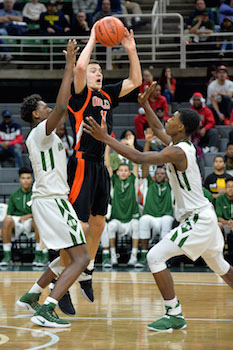
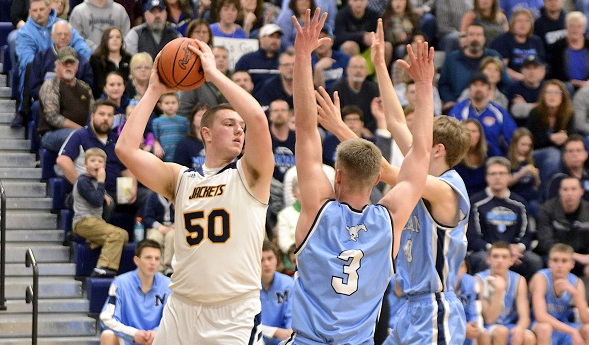
PHOTOS: (Top) New Haven’s Romeo Weems (23) and Ashton Sherrell (3) help surround a Ludington ballhandler during Saturday’s Class B Final. (Middle) Ludington’s Joshua Laman looks for an open teammate while being doubled by Rockets defenders.
Breslin Bound: Boys Regional Preview
March 14, 2016
By Geoff Kimmerly
Second Half editor
The MHSAA Boys Basketball Tournament finished up its first week Friday with many of the expected contenders moving on – but quite a few surprises as well.
See below for four teams from each class that jumped out from Districts, with Regionals tipping off tonight. Click for brackets for all 32 and stay with Score Center tonight for scores and updated matchups.
Class A
Belleville (19-4) – The Tigers have won eight games straight and improved seven wins from a year ago, and had an eventful District week. In the Semifinal, Belleville beat Romulus, the team with which it shared the Western Wayne Athletic Conference Blue title, and then downed Westland John Glenn in overtime in the Final.
Detroit Western International (17-3) – The reigning Class A champion has had a solid season, finishing second in the Detroit Public School League West Division 1. But the biggest highlights came last week with a 77-76 overtime win over PSL Tournament champion Detroit East English, followed by a 15-point District Final win over 14-win Martin Luther King.
Lowell (18-5) – Since winning three games in 2010-11, the Red Arrows have improved their win total every season of the last five and are four victories better than a season ago. Lowell added a couple top teams from the east side of the state to the schedule this winter and lost locally only to Grand Rapids Christian twice and Wyoming Godwin Heights.
Roseville (17-5) – The Panthers improved to five wins better than a season ago, adding a District title to a runner-up finish in the Macomb Area Conference White. They've won 10 of their last 12 games.
Class B
Ann Arbor Gabriel Richard (12-11) – The Fighting Irish entered the tournament two games below .500 but emerged on the plus side thanks in part to a 43-41 upset of Chelsea in the District Final. Chelsea finished 16-6.
Detroit Osborn (13-10) – The Knights again proved the tough competition in the Public School League is a good primer for the postseason, winning their second straight District title despite finishing fifth in the PSL East Division 1 standings and going 2-7 in January.
Flint Northwestern (12-11) – The Wildcats finished only fifth in the Saginaw Valley League South but have won five straight and avenged last season’s District loss, downing Frankenmuth 57-52 in this year’s Final. Frankenmuth finished 20-3.
Stockbridge (17-5) – The Panthers split with Leslie during the regular season but still finished a game behind the Blackhawks and second in the final Greater Lansing Activities Conference standings. But Stockbridge beat Leslie (20-3) in the District Final.
Class C
Beaverton (19-1) – Bad weather kept Beaverton from getting in its full 20 regular-season games, but the Beavers did manage to extend their Jack Pine Conference winning streak to 34 with a second straight league title. They beat two league foes to win the District as well.
Constantine (14-9) – The Falcons dropped their final two regular-season games and finished only fourth in the Southwestern Athletic Conference Valley. But they beat third-place Schoolcraft on the way to a second-straight District title and after losing to the Eagles only four days before.
Grandville Calvin Christian (17-4) – The Squires took a couple of late losses prepping for the postseason with a final run that included reigning Class C runner-up NorthPointe Christian, reigning Class B champion Godwin Heights, plus 17-win Allendale and 15-win Covenant Christian. But those challenges paid off as Calvin Christian downed Covenant Christian 64-50 to start last week and then NorthPointe 52-45 in the District Final.
Ishpeming Westwood (10-12) – The final two weeks of the regular season included four losses over its final five games, but Westwood was a different team once the District began. The Patriots started with a win over Manistique – which they had lost to Feb. 17 – and finished with a 51-47 win over rival Ishpeming after falling to the 16-win Hematites twice in league play.
Class D
AuGres-Sims (11-9) – The Wolverines were another team that entered the postseason on a bit of a stumble, having lost four of six after locking down second place in the North Star League Little Dipper division. But they beat champion Fairview by 12 to open last week and then Mio 62-59 in the Final.
Fulton (16-6) – A five-point loss to Class C Lakeview in the regular-season finale is the only blemish for the Pirates over their last eight games. They clinched the District title with a 55-42 win over league rival and 13-win Fowler.
Novi Franklin Road Christian (16-6) – Annual contender Southfield Christian is the team most pay attention to from the Michigan Independent Athletic Conference, either division. But Blue runner-up Franklin Road Christian has won eight of nine to continue a seven-win improvement from a season ago.
Rock Mid-Peninsula (13-9) – The Wolverines won only three games each of the last two seasons, but added a District title to this winter of improvement to go with the Skyline Central Conference East championship.
PHOTO: Ithaca repeated as a District champion last week, downing Sanford Meridian in a Class C Final. (Click to see more at HighSchoolSportsScene.com.)