

Newest Champs Earn Spot in Milan Lore
March 22, 2014
By Bill Khan
Special to Second Half
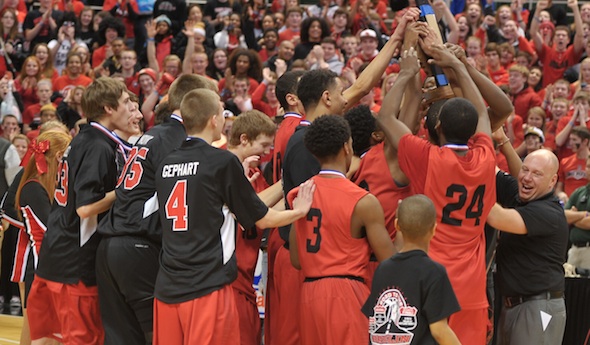
EAST LANSING — Milan's postgame celebration quickly went from the court to the stands.
Spectators who didn't understand what was taking place were befuddled when the Big Reds headed into the seats at the Breslin Center before receiving their championship trophy. One by one, they hugged an older gentleman many of them may not have heard of until a few days earlier.
The man was Harlan Benjamin, a member of Milan's 1948 MHSAA Class C championship basketball team. The Big Reds, playing beyond the Regionals for the first time since, found inspiration from this living, breathing embodiment of the school's athletic history.
"He inspired them before the game," Milan coach Josh Tropea said after the championship drought ended with a 78-59 victory over Benton Harbor in the Class B Final on Saturday. "They wanted to make sure they showed their appreciation."
Benjamin, 81, was a sophomore on the Milan team that beat Saginaw Ss. Peter & Paul, 45-42, for the Class C title. He went on to win the 120-yard and 180-yard hurdles at the 1950 Class C Track and Field Final, an accomplishment that led to his enshrinement in the Milan sports Hall of Fame.
He spoke with the Big Reds on Tuesday before their MHSAA Quarterfinal game against Wayland. He sought out Milan assistant coach Chris Pope before Saturday's title game and presented him with a memento.
"He gave us his state championship patch and he duct-taped over the '1948' and put '2014,' and said, 'Go win one for me,'" Tropea said. "To have him here and to have him on the floor with us after the game, like I told the kids on Thursday before we came here, whether you win this thing or not, someone's going to want you to speak in 40, 50, 60 years from now. After this weekend, they've solidified that. They're going to be remembered forever in Milan."
There's a good chance that it won't take 66 years for Milan to celebrate another MHSAA championship.
Four of the Big Reds' five starters are juniors, including the stars of Saturday's game.
 Junior guard Latin Davis was 7 for 7 from 3-point range, tying the Finals record for baskets beyond the arc, while scoring a career-high 34 points. Nick Perkins, a 6-foot-7 junior center, scored 24 points on 10 for 16 shooting and grabbed 10 rebounds.
"All year, we've been selling that players three through eight have to be the difference, because we know what Nick and Latin are going to do," Tropea said. "Before we went on the floor tonight, we said, 'Tonight, it's about the stars.' The best players showed up, and they won the game for us."
Davis' performance was particularly memorable.
He became the fifth player in Finals history to hit that 3-point mark. But only he and Berrien Springs' Shelby Wood (Class C, 2006) had a perfect shooting night from long range.
"I was coming off screens and was just feeling it, so I just shot it," said Davis, who averaged 1.3 3-pointers a game and never made more than five before Saturday. "My coach has been telling me to shoot off ball screens all year, so that's what I did tonight. I just kept shooting. I made one and kept hitting them and just kept shooting."
Toriano Smith of Saginaw Buena Vista (1990, Class B), Andrew Mitchell of Detroit East Catholic (1997, Class D) and Brian Watkins of Detroit Rogers (2005, Class D) also hit seven 3-pointers in a Final.
"Basically, we just tried to get out of the way," Perkins said. "After you set a screen once and he's shooting like that, he's basically going to make every one. After the fourth one, when we saw them start falling and he's draining it, you just keep letting him shoot."
Benton Harbor took its only lead when a 3-pointer by Jaton Gunn made it a 3-2 game with 6:07 left in the first quarter. Milan never trailed after scoring the next six points.
The Big Reds led 22-15 after one quarter, hitting seven consecutive field goal attempts during one stretch. They built their lead to 32-22 on a 3-pointer by Davis with 4:27 left in the second quarter, taking a 43-35 lead into halftime. Davis had 17 points in the first half on 7 for 17 shooting, dishing out three assists. Perkins had 14 points in the first half, shooting 7 for 11 and grabbing five rebounds.
Benton Harbor did not sub in the first half, while Milan got backups Thomas Lindeman (six minutes) and Garrett Gardette (four minutes) extensive playing time in the second quarter after going with its starters for the first. The Tigers' first substitution came with 6:06 left in the third quarter.
Davis opened the second half by hitting back-to-back 3-pointers, igniting an 8-0 run that extended Milan's lead to 51-35 with 5:25 left in the third quarter. The Tigers cut the lead to 56-46 with 2:25 left in the third, but the Big Reds scored the final nine points of the quarter to take a 65-46 lead into the fourth.
"The difference was in the third quarter we actually started playing some defense," Tropea said. "We hang our hat on our defense. It really wasn't there in the first half. That's all we talked about at halftime was we've got to do a better job rebounding the basketball, not giving up so many second-chance points and transition points. We really clamped down in the third quarter."
It didn't appear that this would be the season that Milan (25-3) ended that title drought when the Big Reds lost their first two games and started out 5-3. But they ended the season with a 20-game winning streak.
Benton Harbor (17-10), playing in its 10th MHSAA Final and first since 1993, was attempting to win its first crown since repeating as Class A champion in 1965. Overcoming Milan's 58.5-percent shooting from the floor proved to be too much for the Tigers.
"They were hot," Benton Harbor coach Corey Sterling said. "We had a game plan. We had hands up, but (Davis), I don't think he missed a three. Then the big (Perkins) was a force down low.
“We already knew, win or lose, we were proud of this bunch. We came in unranked. So, it might hurt right now, but like I told you (Friday), God is still good. He blessed the city. These two seniors (John Robinson Jr. and Cortez Moore) brought the city together. It's something to be proud of. There's been love all over. We just ran into a hot team tonight."
Robinson had 19 points, Jaton Gunn 16 and Moore 13 for Benton Harbor. Gunn had 11 points in the first quarter, hitting three 3-pointers.
Milan played without starting senior forward Jake Novak, who tore the anterior cruciate ligament and meniscus in his right knee during Tuesday's Quarterfinal victory. He walked onto the court on crutches during pregame introductions and greeted each of Milan's starters as they were called out.
"It felt really great to know that everybody cares about this team so much," Novak said. "It's really nice to see the whole community come out and support the team. It's nice to know everybody cares. Even though I can't play, I was doing everything I can to help the team."
Click for the full box score and video from the press conference.
PHOTOS: (Top) Milan celebrates its first MHSAA title since 1948 by hoisting the trophy at the Breslin Center. (Middle) Milan’s Latin Davis tries to get around Benton Harbor’s John Robinson, Jr.
HIGHLIGHTS: (1) Benton Harbor's John Robinson Jr. scored in transition in the second quarter of the Class B championship game against Milan. Robinson led the Tigers in scoring with 19. (2) Nick Perkins makes a Calvin Johnson-esque catch of a long pass by Lance Lewis for the dunk in the Class B title game. Perkins had 24 points and 10 rebounds for Milan, which defeated Benton Harbor, 78-59.
Breslin Bound: 2025-26 Boys Quarterfinal Preview
By
Geoff Kimmerly
MHSAA.com senior editor
March 10, 2026
One. More. Win.
That’s all that’s needed as 32 boys basketball teams take the floor tonight for Quarterfinals across the state and with a trip to East Lansing and Breslin Center on the line.

Below are quick glances at all 16 matchups. Games tip off at 7 p.m. unless noted. Details on tickets, brackets and more can be found on the Boys Basketball page. To watch all 16 games online, visit the NFHS Network.
“Breslin Bound” is powered by MI Student Aid and based on results and schedules posted for each school at MHSAA.com. (Abbreviations below denote ppg - points per game, rpg - rebounds per game and apg - assists per game.)
Week in Review
The countdown of last week’s five most intriguing results:
1. Grand Rapids Northview 52, East Kentwood 50 Cam Ryans drilled a buzzer-beating 3-pointer to send Grand Rapids Northview (22-4) past East Kentwood (22-3) in a Division 1 Regional Final.
2. Harbor Beach 64, International Academy of Flint 62 (2 OT) Harbor Beach (23-3) won its first Regional title, edging IAF (19-5) in Division 4.
3. Colon 49, Battle Creek St. Philip 40 The Magi (22-4) also clinched their first Regional title, in Division 4, by adding to two regular-season wins over St. Philip (16-9).
4. Onsted 42, Ecorse 40 Onsted (24-2) clinched its first Regional title since 1983, advancing in Division 3 with a close win over Ecorse (19-6).
5. Onekama 46, Traverse City Christian 40 Onekama (17-10) handed Traverse City Christian (25-1) its only loss in a Division 4 Regional Final.
Quarterfinals at a Glance
DIVISION 1
Rockford (22-3) vs. Grand Rapids Northview (22-4) at Hudsonville
These two met Jan. 31 at the 2K26 Showcase, with Rockford winning 48-45. Senior 6-foot-6 forward Jake Bascom is a tough matchup averaging 17.7 points and 7.1 rebounds per game. But so is Northview senior guard Cam Ryans, a Mr. Basketball Award finalist averaging 24.2 points, 7.6 rebounds and 3.3 assists per contest.
Auburn Hills Avondale (25-1) vs. Roseville (19-6) at Detroit Mercy
Avondale is coming off its first Regional title since 2002 with senior forward Jakobe Liford (15.2 ppg, 7.5 rpg) leading three players averaging double-digit scoring. Roseville last won a Regional in 2019 and returns to the season’s final week with junior guard Terrell Owens (17.3 ppg, 3.5 apg, 3.9 spg) setting the pace.
East Lansing (25-1) vs. Ann Arbor Pioneer (21-4) at Lansing Eastern’s Don Johnson Fieldhouse
Reigning Division 1 champion East Lansing celebrated senior guard KJ Torbert winning the Mr. Basketball Award on Monday, and he’s an especially impressive shooter making 52 percent of his shots from the floor – including 39 percent of his 3-point tries – on the way to averaging 25 points per game. Pioneer is back at the Quarterfinals for the first time since 2007, with senior guard Jordan Harrison a potent scorer (18.1 ppg) and distributor (3.9 apg).
Wayne Memorial (23-3) vs. Bloomfield Hills Brother Rice (21-5) at Detroit Mercy, 5:30 p.m.
The Zebras are also playing for a return trip to Breslin after finishing Division 1 runner-up a year ago, and they’re also led by a Mr. Basketball Award finalist in senior guard Jaylohn Allen (23.3 ppg, 6.0 apg). Brother Rice won its second Regional title over the last three seasons, keyed by a high-powered backcourt of senior Greg Grays (14.9 ppg) and freshman Jordan McDaniel (19.3 ppg).
DIVISION 2
Ludington (24-2) vs. Freeland (23-3) at Mount Pleasant
Junior guard Taj Williams (18.8 ppg) and senior forward Cameron Gunsell (18.2 ppg) have led Ludington to the Quarterfinals for the first time since 2017, as the Orioles advanced with a Regional Final win over 2025 semifinalist Kingsford. Freeland has won nine straight games to reach the Quarterfinals for the second consecutive year. Senior guard Wilson Huckeby is making almost 39 percent of his 3-pointers, drilling 81 this season while averaging 18.9 points per game.
Chelsea (20-5) vs. Romulus Summit Academy North (25-1) at Ypsilanti Lincoln, 5:30 p.m.
Summit is one win away from returning to Breslin after finishing Division 2 runner-up a year ago, its only loss to an Ohio opponent and with three players averaging double-digit points per game led by senior guard Jordan Fuller at 15.4. Chelsea has won nine of its last 10 games, with a big one over Lansing Sexton (23-3) in a Regional Final. Freshman Drew Cabana is averaging 21.8 points per game and senior Buck Allen adds 17.4 – and both have made at least 50 3-pointers.
Detroit University Prep (16-9) vs. Detroit Country Day (19-7) at Detroit Renaissance
University Prep has won nine of its last 10 games and edged reigning champion Warren Lincoln by two points in their Regional Final to reach this week. Senior guards Chris Byrd and Maurice Jackson are a 6-5 tandem averaging 19.6 and 14.6 ppg, respectively. Country Day has made a jump from 11-12 a year ago, winning nine of its last 10 games with junior guard Christian Cast (20.9 ppg) and 6-6 junior forward Isaiah Moreno (16.5) setting the pace.
Grand Rapids Catholic Central (20-6) vs. Hudsonville Unity Christian (23-3) at Hamilton
Grand Rapids Catholic Central is playing in its third-straight Quarterfinal and reached the Semifinals a year ago, and can turn to senior guards BB Watkins (14.4 ppg) and Jordan McCoy (15.5 ppg) for scoring punch. Unity Christian has won 19 of its last 20 games, its only defeat during that time against Freeland, and has five players averaging between 7-12 ppg topped by senior guard Brogan Sherd (12.2), who also has made 61 3-pointers.
DIVISION 3
Arts & Technology Academy of Pontiac (17-3) vs. Harbor Beach (23-3) at St. Clair County Community College
ATAP is a game away from a Breslin return as well after finishing Division 3 runner-up last season, and the Lions will take on a first-time Regional champ in Harbor Beach. Sophomore point guard Lewis Lovejoy paced last year’s ATAP run and leads again at 26.5 points and 7.6 assists per game. Senior guard Benson Harper leads three Harbor Beach players scoring in double digits at 17.3 ppg, and he and senior forward Skiler Krus (13.2 ppg) were also among stars on the Pirates’ Division 8 football championship team.
Menominee (22-4) vs. Beal City (24-2) at Boyne City
After a year away, Menominee is playing in its second Quarterfinal in three seasons and third over the last five – in part thanks to avenging a regular-season loss to 2025 semifinalist Ishpeming Westwood in their Regional Semifinal. Senior forward Tanner Theuerkauf quarterbacked the Division 7 football championship team and leads at 17.8 ppg, with senior guard Darren Butler at 15.2. Beal City is playing in its first Quarterfinal since 2013 and has reached 20 wins three straight seasons. Junior guard Cuyler Smith (15 ppg) leads three players averaging at least 11 points per game.
Flint New Standard Academy (20-4) vs. Onsted (24-2) at Ypsilanti Lincoln
New Standard is playing in its second-straight Quarterfinal and with its only losses this season to teams that all reached Regional Finals. Sophomore guard AJ Smith (12.4 ppg) and senior guard Jeffery Turner (12.0) lead four players averaging at least 10 ppg. As noted above, Onsted is back in the season’s final week for the first time in more than four decades, and after just missing with some very strong teams over the last 10 years. Mason Chesser (13.9 ppg) leads four averaging at least nine points per game who have helped the Wildcats push through.
Pewamo-Westphalia (24-2) vs. Schoolcraft (16-10) at Kalamazoo Loy Norrix
These two have met two other times in Quarterfinals this decade, with P-W advancing last season with a 50-45 victory. The Pirates have been regulars at this stage with this their fourth Quarterfinal over the last five seasons. Grady Eklund sets the pace for P-W at 20.7 points and 3.5 assists per game. Senior 6-10 forward Jimmy Miller leads three Schoolcraft players scoring at least 15 ppg with 19.3, plus nine rebounds per contest, and junior guard Kodee Bienz (15.1 ppg) has drilled 68 3-pointers.
DIVISION 4
Dollar Bay (23-2) vs. Pickford (25-0) at Gladstone
These two guarantee at least one Upper Peninsula team will be heading downstate, with Pickford making the attempt after losing a Quarterfinal last year by two points and Dollar Bay seeking its first Breslin trip since 2018. Gunner Bennin averages 19.1 points, 7.4 rebounds, 3.7 steals and 3.5 assists per game for the Panthers. Senior forward Liam Tourtillott (20.2 ppg, 73 3-pointers) and junior guard Baron Colbert (16.9 ppg) are strong perimeter options for Dollar Bay.
Detroit Douglass (19-7) vs. Waterford Our Lady of the Lakes (19-6) at West Bloomfield, 6 p.m.
Douglass has made its run after tying for second in a Detroit Public School League Blue filled at the top with Division 1 teams, and defeated 2025 semifinalist Allen Park Inter-City Baptist in a Regional Semifinal last week. Freshman guard Damani Oliver averages 22.5 ppg and senior guard Jeremiah Thurman adds 16.1. Our Lady started this season 2-4 but has surged since the start of January, with senior center Jack Miller (12.4 ppg, 7.2 rpg) and senior forward Latane Ware (11.3 ppg) pacing a balanced attack.
Colon (22-4) vs. Concord (22-4) at Portage Northern
As noted above, Colon is coming off its first Regional title, and the Magi also defeated league rival Mendon (22-2) in a District Final. Seniors forwards Dalton Williams (22.1 ppg) and Quincy Blair (17.7) lead four players averaging double-digit scoring. Concord is coming off its first Regional title since 1990 and has celebrated senior guard Jett Smith and senior forward Connor Stevens both reaching 1,000 career points this winter.
Onekama (17-10) vs. Wyoming Tri-unity Christian (24-1) at Big Rapids
Onekama stunned previously-undefeated Traverse City Christian with a 46-40 Regional Final win to advance to the season’s final week for the first time since 1997, and the Portagers now get to take on the reigning Division 4 champion Defenders. Center Luke Bradford sets the pace at 15 ppg and is one of three senior starters. Tri-unity has replaced four starters from last season’s title winner, with the lone returner junior center Cody Osbun leading at 12.4 points, 7.8 rebounds and 3.2 assists per game.
MHSAA.com's weekly “Breslin Bound” reports are powered by MI Student Aid, a division within the Department of Lifelong Education, Advancement, and Potential (MiLEAP). MI Student Aid encourages students to pursue postsecondary education by providing access to student financial resources and information. MI Student Aid administers the state’s scholarship and grant programs that help make college Accessible, Affordable and Attainable for you. Click to connect with MI Student Aid and find more information on Facebook and X @mistudentaid.
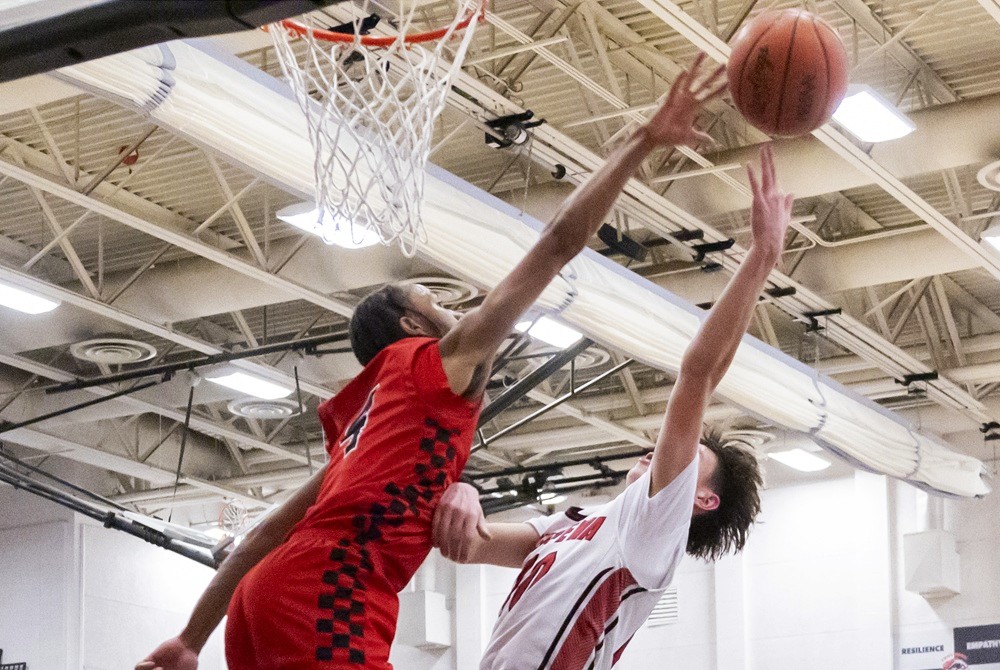
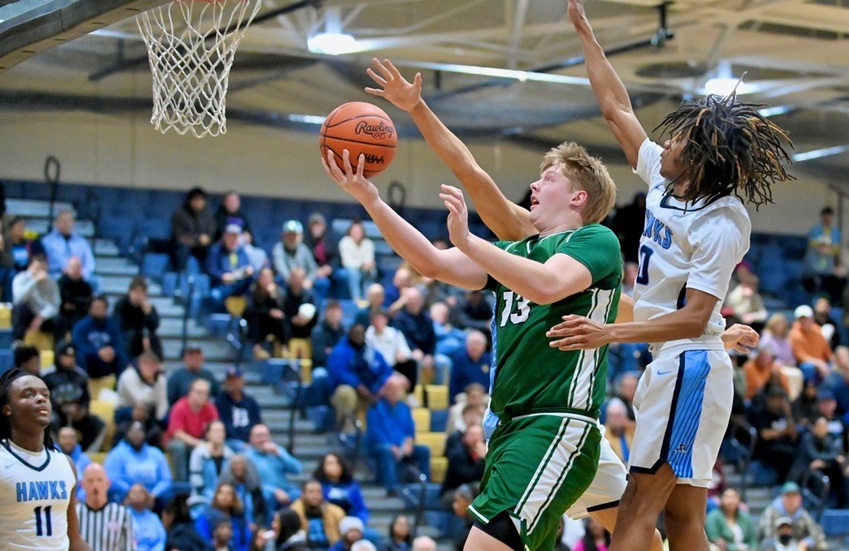
PHOTOS (Top) Roseville’s Terrell Owens (4) blocks a shot during his team’s 71-68 overtime win over Clinton Township Chippewa Valley in last week’s Regional Semifinal. (Middle) Freeland’s Tristan Comer (13) scoops a shot during the Falcons’ Regional Final win over Flint Hamady. (Roseville/Chippewa Valley photo by Adam Sheehan. Freeland/Hamady photo by Terry Lyons.)