

Next Generation Chargers Make C Final
March 23, 2017
By Geoff Kimmerly
Second Half editor
EAST LANSING – Carson Meulenberg and Trenton Koole had never played a game of this magnitude before taking the Breslin Center floor Thursday.
But their dads had, and perhaps indirectly that provided them a little experience. At least it seemed like it.
Covenant Christian didn’t seem bothered by any of the usual anxieties teams face when they play during the final weekend for the first time. The Chargers – in an MHSAA Semifinal for the first time since winning Class D in 1994 – got ahead early and never slowed in downing Manton 62-35 to earn a spot in Saturday’s Class C championship game.
Koole’s dad Scott played on that 1994 team that beat Eben Junction Superior Central 79-70 in the championship game. Scott Koole also played with Dave Meulenberg on the 1993 team that beat Muskegon Western Michigan Christian 53-42 to win the Class D title that season as well.
“To just stay calm, keep your composure, play your best,” Carson Meulenberg recalled of the advice his father gave him before Thursday. “Don’t worry about a lot of things. A lot of it is worrying about nothing, so just go play your game.”
And Covenant Christian’s game this season frequently has focused on defense, which was lockdown against the Rangers and will be especially key in Saturday's 4:30 p.m. Final against Flint Beecher.
Koole blocked Manton’s first shot of the game, and Covenant Christian had three blocks during the first five minutes. The Rangers still hung in to trail only 11-7 at the end of the first quarter, but the Chargers (21-5) scored the first 19 points of the second and never led again by fewer than 20.
They held usually sharp-shooting Manton (21-5) to 22 percent success from the floor, including 16 percent from 3-point range.
“Finally,” Calvin Christian coach Tyler Schimmel said. “To be honest, since the first District game, we haven’t played that well. I told the guys before (this) game, you’re due for one, especially defensively.
 “This year, we actually have (had games like this). That’s why I kept telling my guys they’re a good team. They’re capable of doing those types of things.”
Koole led Covenant Christian with a game-high 14 points and eight rebounds, and Meulenberg and junior forward Zach Kaptein both had 10 points. Senior guard Benji Kuiper had six points, seven rebounds, six assists and five steals, and junior Tyler Cammenga had nine points and seven rebounds.
Manton’s top three scorers this season were juniors and sophomores; junior Jayden Perry led again with 13 points, and junior Hunter Ruell had eight points.
“On film, we knew they were going to be athletic just by watching them,” Manton coach Ryan Hiller said. “Once they started getting offensive boards, and the transition game, and I don’t know how many shots they blocked that first half … through the first five minutes, we saw a trend there, and we had to adapt the things we normally do, and we struggled there.”
Manton was playing in its first Semifinal since 1996. The Rangers had been eliminated in the District Finals the last three seasons, losing those games by a combined seven points.
Covenant Christian is riding a streak of 14 wins in 15 games, and now has some bragging rights at home in addition to Saturday’s opportunity.
“He talks about it all the time to me, brags and says he made it this far,” Koole said of his dad's Finals memories. “Now I can go back to him and tell him I did the same thing.”
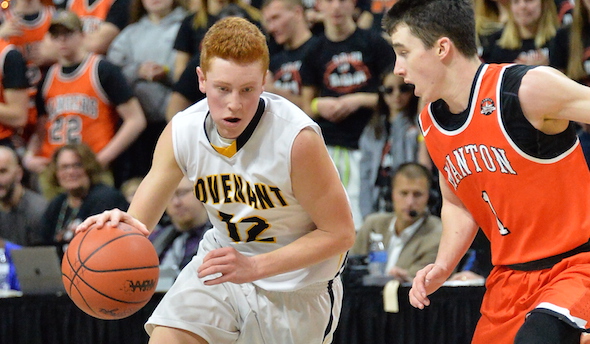
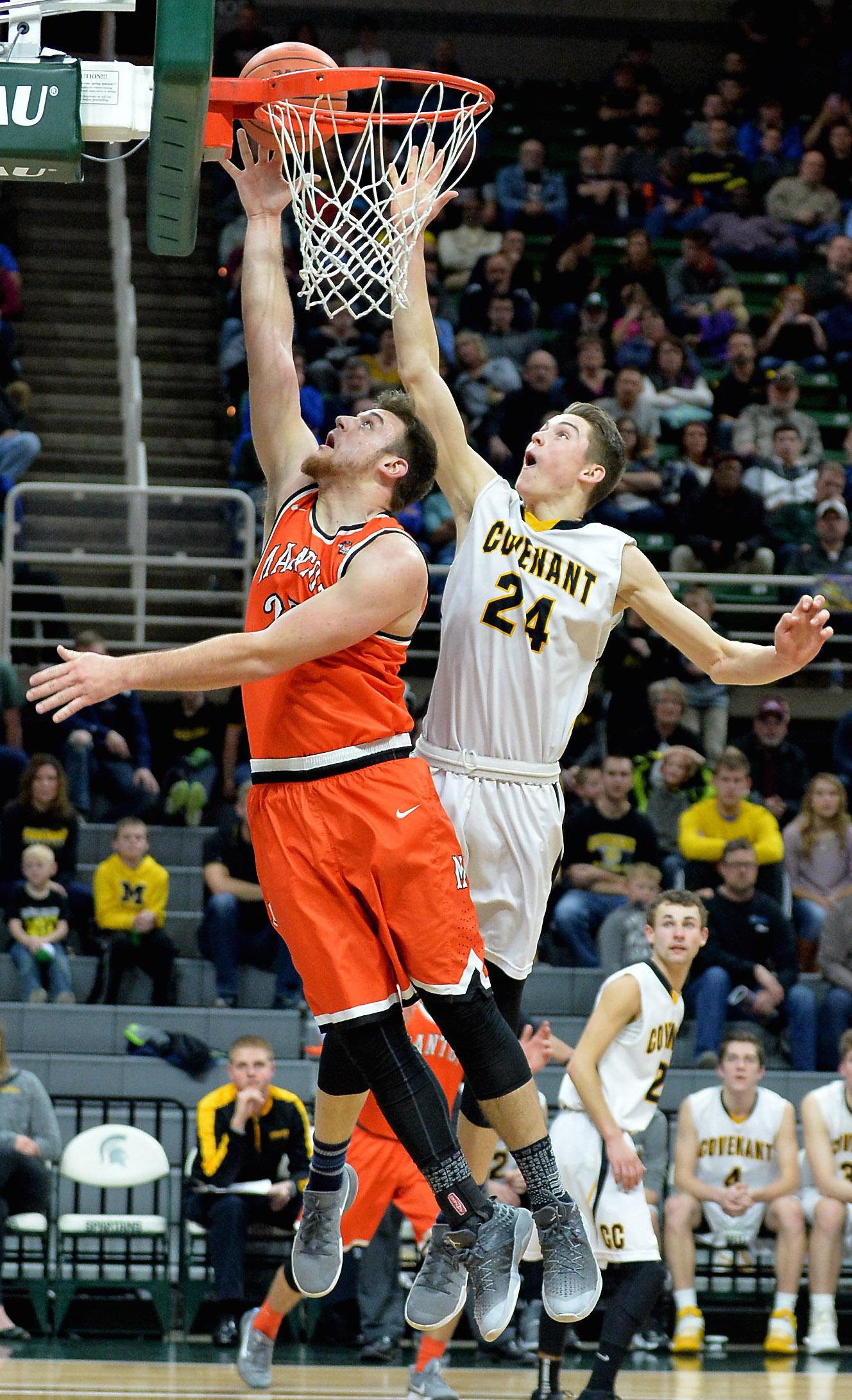
PHOTOS: (Top) Covenant Christian’s Benji Kuiper (12) works to get around Manton’s Jayden Perry during Thursday’s Semifinal. (Middle) The Rangers’ Wyatt Baker gets up a shot with the Chargers’ Carson Meulenberg (24) defending.
Breslin Bound: Boys Report Week 6
January 15, 2018
By Geoff Kimmerly
Second Half editor
We’re heading into the midpoint of this boys basketball season, and the surprises keep coming.
 Detroit Henry Ford and Grand Ledge were full of them last week, and Berkley has been one of the state’s most intriguing all season. We touch on those a little bit below, along with a number of others that most recently caught our attention.
Breslin Bound is powered by MI Student Aid and based on results and schedules posted for each school at MHSAA.com. To offer corrections or fill in scores we’re missing, email me at [email protected].
Week in Review
The countdown of last week’s five most intriguing results:
1. Detroit Henry Ford 63, Detroit Cass Tech 60 – The Trojans should be back in the Class B title talk after handing a first loss to one of the major favorites in Class A.
2. Grand Ledge 59, East Lansing 53 – The Comets are 6-1 but weren’t getting much attention until this upset broke East Lansing’s 45-game regular-season winning streak.
3. Frankfort 69, Buckley 53 – The Panthers handed the reigning Class D runner-up this defeat after falling to Buckley by 39 and then only three last season.
4. Detroit Cass Tech 85, Muskegon 78 (OT) – The Technicians did not waste time bouncing back from the Henry Ford loss, downing Muskegon in overtime the next day at Grand Rapids Ottawa Hills.
5. Macomb Dakota 64, Clinton Township Chippewa Valley 62 – The Cougars took big losses early to Detroit U-D Jesuit and New Haven, but are undefeated in the Macomb Area Conference Red after handing Chippewa Valley its first defeat in the league and overall this winter.
Watch List
With an eye toward March, here are two teams in each class making sparks:
CLASS A
Ann Arbor Skyline (7-0) – The Eagles have been building toward a start like this, even winning the Southeastern Conference Red title a year ago. They started the new year with a 20-point win over second-place Ann Arbor Pioneer on Saturday and have impressive wins by 14 over Belleville, one over Detroit Pershing and 20 over frequent nemesis Ann Arbor Huron.
Berkley (8-0) – The Bears have doubled their win total from last season after going 4-17, and they’re only a few more from guaranteeing a first winning season since 2010-11. They’ve pulled off a few close ones including a two-point victory over MAC Bronze leader Madison Heights Madison a month ago. Next up is Rochester with first place in the Oakland Activities Association Blue on the line.
CLASS B
Detroit Henry Ford (7-2) – The 2015-16 Class B champion still made the Regional last season despite finishing 13-11 overall, and another big run could be on the way. Ford opened this season with a two-point win over 2017 Class A semifinalist West Bloomfield, and has beaten a series of Class A teams including Cass Tech (see above). The losses came to Class A powers Grand Rapids Ottawa Hills and Hazel Park, the latter in overtime.
Ovid-Elsie (5-1) – The Marauders have hovered around .500 the last few seasons, but might have something more in store over the next two months after a fast start. Ovid-Elsie sits atop the Tri-Valley Conference West standings and hasn’t lost since its opener (to still-undefeated Fowler). Coming up Friday is a matchup with second-place Hemlock.
CLASS C
Norway (5-2) – The Knights moved over to the Skyline Central Conference after sharing the Mid-Peninsula Conference title last season and finishing 18-3 overall. They’ve won four straight and hold a half-game lead in the SCC’s Large School division. The two losses came in December in overtime to Powers North Central and by eight to nemesis Iron Mountain, which knocked Norway out of the tournament last season. Those two will face off again Feb. 9.
Sanford Meridian (7-1) – The Mustangs are playing for a second straight Jack Pine Conference championship and already have wins against usual annual contenders Beaverton and Clare. Meridian’s only loss was by 10 in early December to Class A Saginaw Heritage, and it’s got another similar test coming up against Midland Dow in two weeks.
CLASS D
Cedarville (7-2) – The Trojans are approaching the season’s midpoint in position to take back the Eastern Upper Peninsula Athletic Conference title after tying for second a year ago. Cedarville got past reigning champion Pickford 67-59 last week and has lost only to undefeated Hillman and Class B Boyne City.
Frankfort (6-0) – The Northwest Conference sent Buckley all the way to the Class D title game last year, and early this winter it’s Frankfort that could be setting up for a run. The Panthers held onto first place all alone in the league last week with a win over the Bears, and now face the other two teams with only one conference loss – Kingsley on Tuesday and Maple City Glen Lake on Thursday.
Can't-Miss Contests
Be on the lookout for results of these games coming up:
Tuesday – Rapid River (7-0) at Powers North Central (6-1) – The Rockets ended North Central’s record 84-game winning streak Dec. 7, but the Jets can make it six straight by taking the rematch.
Tuesday – Orchard Lake St. Mary’s (7-2) at Warren DeLaSalle (6-2) – In a strong Detroit Catholic League Central, these are two of the best; DeLaSalle leads and St. Mary’s is third after falling to second-place U-D Jesuit by a point last week.
Thursday – Bellevue (8-0) at Camden-Frontier (8-2) – Both are pushing for Southern Central Athletic Association titles; Bellevue is tied for first in the West and Camden-Frontier is second in the East, and this game counts in the standings for both.
Thursday – Maple City Glen Lake (5-1) at Frankfort (6-0) – The Panthers also must survive Kingsley on Tuesday to keep their perfect start going, and Glen Lake is aiming to gain a share of first place in the Northwest Conference too.
Friday – Hazel Park (8-0) at West Bloomfield (3-3) – Hazel Park and reigning Class A champion Clarkston have been the talk of a strong OAA Red, but West Bloomfield also is undefeated in league play after opening with three tough nonleague losses including two by only two points apiece.
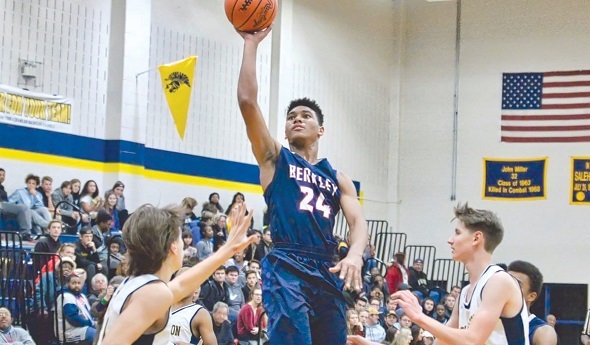
PHOTO: Berkley, here against Clawson in December, is one of this season’s biggest surprises. (Photo courtesy of C&G Newspapers.)