

Next Generation Chargers Make C Final
March 23, 2017
By Geoff Kimmerly
Second Half editor
EAST LANSING – Carson Meulenberg and Trenton Koole had never played a game of this magnitude before taking the Breslin Center floor Thursday.
But their dads had, and perhaps indirectly that provided them a little experience. At least it seemed like it.
Covenant Christian didn’t seem bothered by any of the usual anxieties teams face when they play during the final weekend for the first time. The Chargers – in an MHSAA Semifinal for the first time since winning Class D in 1994 – got ahead early and never slowed in downing Manton 62-35 to earn a spot in Saturday’s Class C championship game.
Koole’s dad Scott played on that 1994 team that beat Eben Junction Superior Central 79-70 in the championship game. Scott Koole also played with Dave Meulenberg on the 1993 team that beat Muskegon Western Michigan Christian 53-42 to win the Class D title that season as well.
“To just stay calm, keep your composure, play your best,” Carson Meulenberg recalled of the advice his father gave him before Thursday. “Don’t worry about a lot of things. A lot of it is worrying about nothing, so just go play your game.”
And Covenant Christian’s game this season frequently has focused on defense, which was lockdown against the Rangers and will be especially key in Saturday's 4:30 p.m. Final against Flint Beecher.
Koole blocked Manton’s first shot of the game, and Covenant Christian had three blocks during the first five minutes. The Rangers still hung in to trail only 11-7 at the end of the first quarter, but the Chargers (21-5) scored the first 19 points of the second and never led again by fewer than 20.
They held usually sharp-shooting Manton (21-5) to 22 percent success from the floor, including 16 percent from 3-point range.
“Finally,” Calvin Christian coach Tyler Schimmel said. “To be honest, since the first District game, we haven’t played that well. I told the guys before (this) game, you’re due for one, especially defensively.
 “This year, we actually have (had games like this). That’s why I kept telling my guys they’re a good team. They’re capable of doing those types of things.”
Koole led Covenant Christian with a game-high 14 points and eight rebounds, and Meulenberg and junior forward Zach Kaptein both had 10 points. Senior guard Benji Kuiper had six points, seven rebounds, six assists and five steals, and junior Tyler Cammenga had nine points and seven rebounds.
Manton’s top three scorers this season were juniors and sophomores; junior Jayden Perry led again with 13 points, and junior Hunter Ruell had eight points.
“On film, we knew they were going to be athletic just by watching them,” Manton coach Ryan Hiller said. “Once they started getting offensive boards, and the transition game, and I don’t know how many shots they blocked that first half … through the first five minutes, we saw a trend there, and we had to adapt the things we normally do, and we struggled there.”
Manton was playing in its first Semifinal since 1996. The Rangers had been eliminated in the District Finals the last three seasons, losing those games by a combined seven points.
Covenant Christian is riding a streak of 14 wins in 15 games, and now has some bragging rights at home in addition to Saturday’s opportunity.
“He talks about it all the time to me, brags and says he made it this far,” Koole said of his dad's Finals memories. “Now I can go back to him and tell him I did the same thing.”
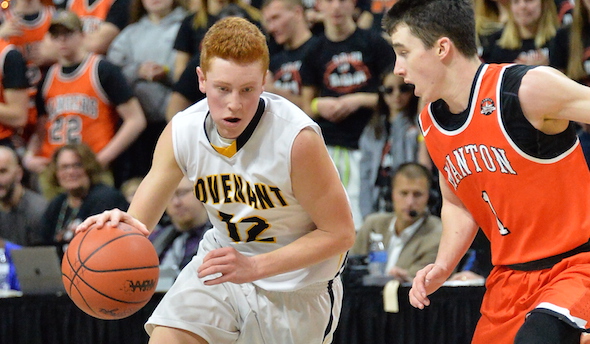
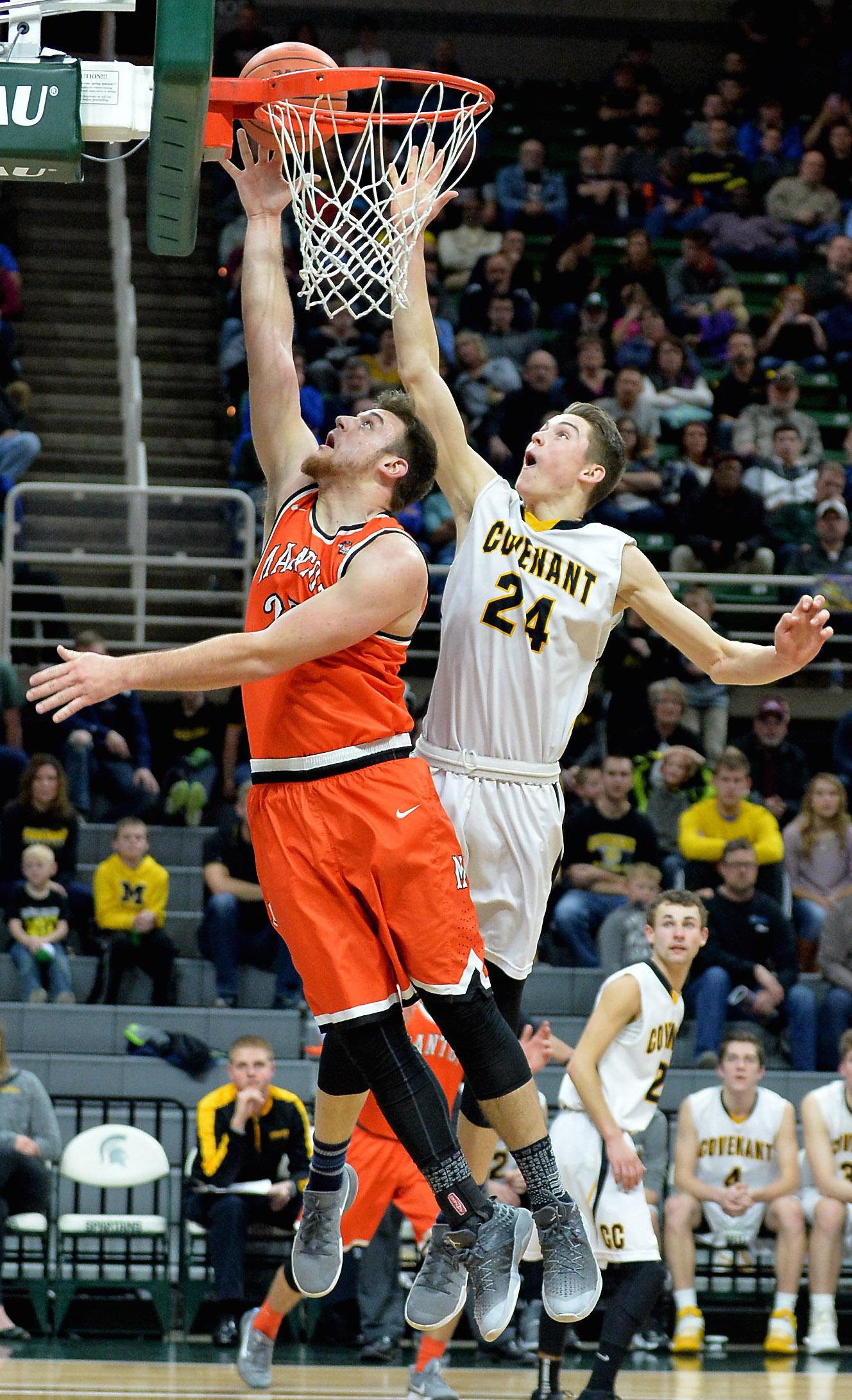
PHOTOS: (Top) Covenant Christian’s Benji Kuiper (12) works to get around Manton’s Jayden Perry during Thursday’s Semifinal. (Middle) The Rangers’ Wyatt Baker gets up a shot with the Chargers’ Carson Meulenberg (24) defending.
Buzzer Beater Sends Laingsburg to Final
March 21, 2013
By Geoff Kimmerly
Second Half editor
EAST LANSING – Had the final second of Thursday’s Class C Semifinal ended differently, Shaun McKinney surely would’ve felt worse about three lay-ins he missed during the game’s first 31 minutes.
Good thing he got one more chance to score the most meaningful points in Laingsburg basketball history.
With two tenths of a second remaining, the Wolfpack senior banked a layup from the left side of the glass to cement himself in Michigan hoops history – and send his team to its first MHSAA championship game.
McKinney’s make gave Laingsburg a 45-43 victory in front of what had to be most of the residents of his small town located just 15 miles northeast of the Breslin Center, and set his neighbors up for a return visit Saturday when the Wolfpack faces reigning champion Flint Beecher at 4:30 p.m..
“I was just saving them,” McKinney said of his early misses. “I knew it was going to come down to the last one. I had to make sure I saved one.”
The shot was described after as “legendary” and one “to remember” by those who played a part. And McKinney’s focus in that brief moment was laudable.
But he also was the end recipient of two more heads-up plays by senior teammates Jake Zielinski and Zach Walker.
With the score tied 50-50 and 52 seconds left, Zielinski made a bit of an overly-aggressive decision. He tried to take on three defenders in the Negaunee lane and had his shot blocked by Miners senior Andrew Katona.
But Zielinski would get another chance.
During a Negaunee timeout with 30 seconds left, Wolfpack coach Greg Mitchell reminded his players they had a foul to give and told them to keep the pressure high. And if one grabbed a rebound or made a steal, the rest should “just go” to the basket, he said. “I would’ve sent seven guys if I could have.”
Negaunee did get off a final shot with nine seconds to play. But the rebound fell right to Zielinski below the basket, and after a few dribbles he fired a near-fullcourt football pass down the right side of the floor to a streaking Walker.
“Just don’t overthrow it. Just give them a chance to make a play,” Zielinski recalled of his thought as he threw.
 Walker couldn’t corral the pass in the air – but did grab it off the first bounce. As he began sailing out of bounds, Walker fired the ball back to McKinney, who scored the last and most important of his 16 points. (Click to watch the game's final minute.)
“Obviously, you think as a coach that you’re in a position that you want to be in, 39 seconds and you have the ball in a tie game. But it just didn’t work out for us,” Negaunee coach Michael O’Donnell said. “As a coach, it’s tough. There’s not much you can say in the locker room. After a fun, exciting, successful season, there’s not a whole lot you can say.”
Aside from the final second, the teams battled to nearly a statistical draw.
Both shot between 35-37 percent from the floor and finished with one rebound and one turnover of each other's totals.
Laingsburg (24-2) led most of the game, but didn’t open up its largest advantage of six until sophomore Ryan Wade hit a 3-pointer with 2:32 remaining. Negaunee senior Tanner Uren scored five points and junior guard Tyler Jandron also drained a 3-pointer to pull the score back even heading into the final minute.
“Coming out, it definitely was a bigger stage than we thought it was going to be,” Uren said. “But by halftime, all of those jitters were gone, and after we came out (for the third quarter), we finally played our game. We said, we’re going to get back in it.”
Zielinski led the Wolfpack with 18 points and eight rebounds, and McKinney had four steals. Uren had 16 points and nine rebounds to lead Negaunee, and Jandron added 12 points and four assists.
The Miners, ranked No. 3 entering the tournament, finished 24-2.
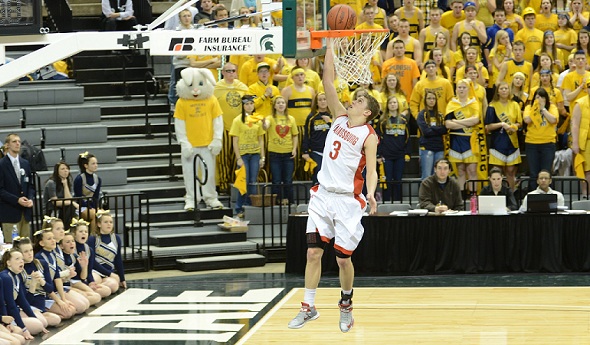
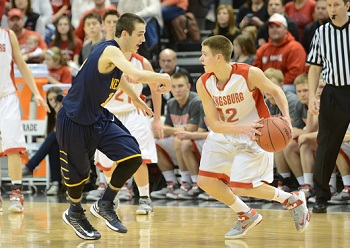
PHOTOS: (Top) Laingsburg's Shaun McKinney scores two of his 16 points in Thursday's Semifinal. (Middle) Laingsburg's Zach Walker (12) looks for a teammate as Negaunee's Tyler Jandron defends. (Photos by Hockey Weekly Action Photos.)