

NorthPointe Comes Back to Land 1st Final
March 26, 2015
By Geoff Kimmerly
Second Half editor
EAST LANSING – Preston Huckaby is a four-year varsity starter for Grand Rapids NorthPointe Christian’s basketball team.
So he had a decent idea what was necessary to earn one more chance to suit up for the Mustangs, and with history on the line.
NorthPointe trailed Boyne City by 12 points less than a minute into the second quarter of their Class C Semifinal at Michigan State University’s Breslin Center.
Huckaby sank his first shot seconds later – and went on to score a game-high 26 points to lead the Mustangs back and into their first MHSAA Final with a 48-45 edging of the Ramblers.
“I think going into the game, we were a little nervous, this being our first time in this type of environment. We said if we want to play another game, we have to do what we need to do to win this game,” Huckaby said. “I think I needed to be more aggressive. That’s what I needed to do to get our team where we needed to be.”
And that’s in Saturday’s 4 p.m. Class C Final, where NorthPointe (21-5) will seek its first MHSAA title, taking on Flint Beecher.
Huckaby was a solid 9 of 20 from the floor and also grabbed nine rebounds. And falling in line with that "aggressive" approach, he made a final deciding play at the other end of the court.
Boyne City (21-6) came back from a 23-point swing to pull within 46-45 with 31 seconds to play. The Ramblers took two strong drives to the basket – the first ended with miss but an offensive rebound; Huckaby stepped in front of the second and took a charge that all but sealed the win. He made two free throws to extend NorthPointe's lead to three, and Boyne City’s final shot to tie hit off the front of the rim.
“He might be the all-time leading scorer in our school’s history, but in my three years at NorthPointe he’s probably taken 75 charges,” NorthPointe coach Jared Redell said of his senior guard. “If there was a stat on all-time charge takers, I imagine not only at our school, but he’d be close to a state record.”
Boyne City senior guard Cole Butler scored 11 of his team’s first 15 points as the Ramblers quickly built their early double-digit advantage. Huckaby scored 11 points during the second quarter, his last-second shot tying the score at 26-26 heading into halftime.
 Senior Andrew Holesinger opened the second half with a 3-pointer to give NorthPointe its first lead in more than 13 minutes. But Butler got hot again in the fourth quarter, scoring five more points to put Boyne City in position to take back the lead.
“We talked about coming in today, playing loose, playing confident and playing to win. And I felt we did that tonight,” Boyne City coach Nick Redman said. “We got off to a great start, and I’m super proud of that. They gave themselves an opportunity to win, and that’s all you can ask for.”
Butler had 16 points and 10 rebounds taking on the lead role from senior teammate Corey Redman, who will play at Central Michigan University next season. Redman ended with only six points and five rebounds playing 30 minutes despite a foot sprain he suffered during the District that required he wear a walking boot.
Senior guard Zach Napont added five points, five rebounds, seven assists and four steals for the Ramblers, who started four seniors total. Holesinger added nine points for NorthPointe and a key blocked shot on Boyne City’s first attempt to re-take the lead with 1:25 to play.
Leaders from both teams brought experience at this level into Thursday – both schools’ football teams advanced to the Division 6 Semifinals this fall.
But NorthPointe coach Jared Redell saw his team’s nerves early in the shots it was allowing and the way the Mustangs seemed out of sync.
“The third quarter always has been great for us, all tournament long,” Redell said. “We barely hung on, and you don’t want to hang on; we want to make sure we finish and we put them away. There’s a lot of things to learn from the game, and the good thing is we get to learn from them and play another game.”
Click for the full box score and video from the postgame press conference.
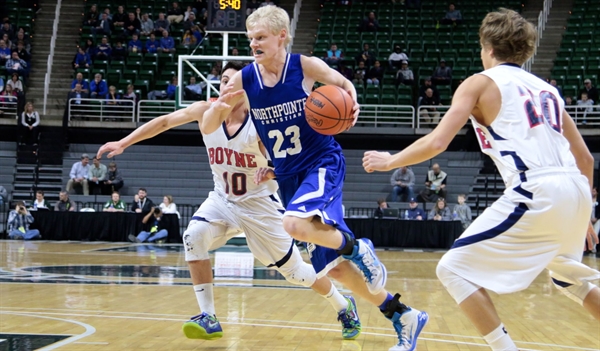
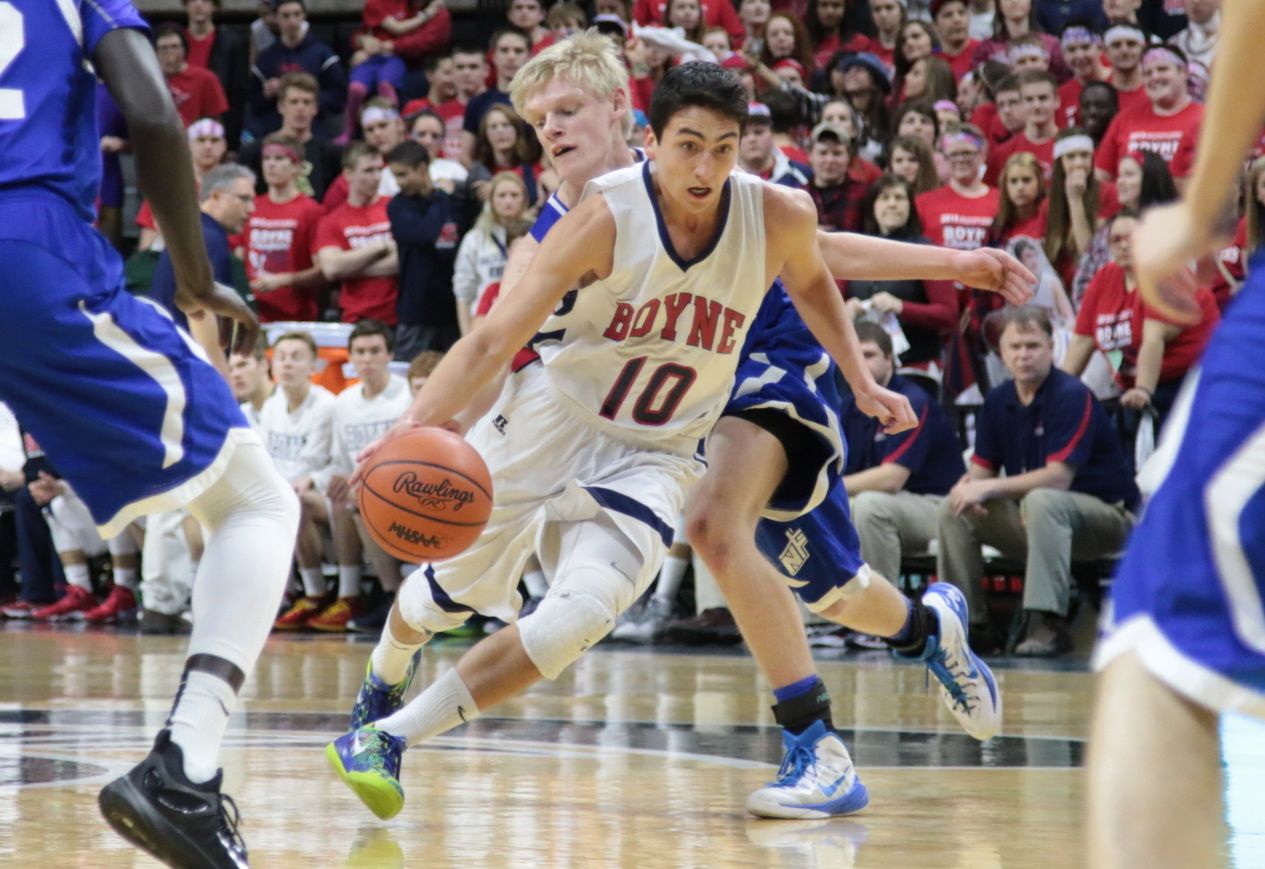
PHOTOS: (Top) NorthPointe Christian’s Andrew Holesinger (23) drives during Thursday’s Class C Semifinal. (Middle) Boyne City’s Zach Napont pushes the ball upcourt against a number of defenders.

Beecher Seniors Lead 3-Peat Attempt
March 23, 2017
By Geoff Kimmerly
Second Half editor
EAST LANSING – The day after Flint Beecher won the Class C boys basketball championship in 2013, coach Mike Williams went to watch an eighth-grade game.
He saw Levane Blake get a steal and a dunk, Malik Ellison pull up for a 3-pointer. “I just remember seeing the chemistry between them,” Williams said. “And I thought to myself, I think we’ll be going back down to Lansing a few more times.”
Now seniors, Blake, Ellison and Jordan Roland have a chance to finish their Beecher careers among the most successful players in the program’s storied history.
The Bucs have won seven MHSAA titles, and those three captains have been part of two straight – and earned an opportunity to three-peat with a 76-68 victory over Detroit Edison Public School Academy in Thursday’s first Semifinal at the Breslin Center.
“We feel more poised this year. It’s our senior year, and we want to go out with a bang,” Roland said.
“It’s our senior year, and I won’t be able to wear this jersey anymore,” Blake added, “or play on the court with my team, or lead the young guys. So we work every day in practice, go hard, hard, hard, and Coach Mike pushes us.”
Beecher (22-5) will play Grand Rapids Covenant Christian in Saturday’s 4:30 p.m. Final. The Bucs not only have won the last two Class C titles, but four of the last five.
After watching these seniors star as eighth graders that day in 2013, Williams knew they’d be on varsity as freshmen. Ellison, Roland and Blake all joined the varsity that next winter; Ellison and Blake started as sophomores in the 2015 championship win, and all three started in last year’s title game.
 Ellison scored a game-high 28 points and added seven rebounds and seven assists Thursday, while Roland and Blake both scored 10 points, Roland also grabbing seven rebounds and the 6-foot-7 Blake blocking six shots.
Edison (14-12), in its first Semifinal after winning its first Regional title last week, fought back-and-forth for the lead through the first five minutes of the second quarter until Beecher took a one-point lead on a Roland bucket with 3:17 to go in the first half, and never gave up the advantage again.
“We know Malik is a tough little guard, and I think the thing you never can put a hand on is a guy coming up here playing in three state championships games,” DEPSA coach Brandon Neely said. “I think the advantage he had is he just understood how the game would go. … You know that those guys are never going to get rattled. They’ve been in so many wars that when they come to battle, they’re just loose; it’s just another game for them."
Senior guard Jamal Keesee led the Pioneers with 21 points and 12 rebounds, while junior center Deante Johnson had 17 points and nine rebounds. Junior guard Gary Solomon added 15 points, six rebounds and four assists, and junior guard Pierre Mitchell, Jr., had 10 points and also six rebounds and four assists.
Beecher freshman guard Jalen Terry had 15 points as his team’s second-leading scorer, something that spoke to what Williams has emphasized to his successful seniors this winter. He put it on them to play major roles in bringing along the next generation, to work at both continuing the Bucs’ legacy and setting it up for the future as well, just as others did to assist them at the start of their careers.
“I’m just going to go out there and play hard for them,” Terry said. “They gave me everything they’ve got. I’m going to give them everything I’ve got.”
PHOTOS: (Top) Flint Beecher’s Malik Ellison drives hard to the basket during Thursday’s first Class C Semifinal. (Middle) The Bucs score two more on the way to earning their third straight championship game berth.