

Onsted: Scholars, Athletes, Contenders
By
Chip Mundy
Special for Second Half
February 19, 2016
By Chip Mundy
Special for Second Half
ONSTED – The Onsted boys basketball team, undefeated at 16-0 and ranked No. 2 in the latest Associated Press Class B poll, can beat an opponent in a number of ways.
 Want to run with the Wildcats in a high-scoring game? Coach Brad Maska welcomes it.
“The first time we play teams, we get up and down the floor, and they don’t expect us to do that,” he said.
Want to slow it down, and turn it into a half-court game? Maska welcomes that, too.
“The second time we play, they are trying to slow the game down, and it makes it more like a half-court possession game. That’s fine, too. We can play it both ways.”
However, the most inadvisable way to challenge the Wildcats might not even be on the basketball court. It’s in the classroom, where the basketball team has three of the top 10 students in the school and one of eight student-athletes to win the MHSAA-Farm Bureau Insurance Class B Scholar-Athlete Award, plus a second who was one of 32 finalists.
“Top to bottom, last year we were top 10 in GPA I believe, and we have to be on an average of 3.6 of 3.7 this year,” Maska said.
Top scholars
Senior point guard Dallas Heidbreder carries a near-perfect 3.95 GPA, and somehow he is third on the team in that category. Senior forward Austin Thompson is off the charts with a 4.29 GPA, while senior center Austin Davis checks in at an incredible 4.15.
Thompson was one of the Class B Scholar-Athlete Award winners, and although he is not a starter on the team, he has a huge influence and is quite aware of the basketball history at Onsted. No team had won a District championship since 1983 – a team that compiled a perfect regular season, something Onsted is shooting to duplicate this year.
“It’s an excellent feeling to make a mark for Onsted,” Thompson said. “We’ve talked about 1983, and we’re aware of it. They made it to the Quarterfinals, and that team had guys like the Hubbards and Greg Worker.”
 Thompson plans to attend the University of Michigan, where he will major in actuarial mathematics, which he explained is, “using probability and statistics and risk factor. Most likely I will work for an insurance agency calculating insurance rates based on all the risks.”
Davis also is headed to Michigan, and while his intelligence is impressive too, he will as concerned with putting up numbers as charting them. He was the first signee of Michigan’s basketball recruiting class of 2016.
He refuses to take much credit for his academic success, though.
“My parents put a huge emphasis on academics, and they never accepted anything less than my best,” he said. “I’ve been around a great group of people. Our teachers are great here at Onsted, and the community has raised us right.”
Davis said he plans to go into the math or science field after college, unless, of course, playing basketball professionally is an option.
Heidbreder plans to pursue a career in real estate, but unlike Thomson and Davis, he expects to do it at Michigan State University. He’ll likely be wearing green and white in the Izzone at Breslin Center when Davis and the Wolverines visit next year.
“I’ll probably cheer for him a little bit,” Heidbreder said.
Heidbreder’s intelligence and maturity is showing up on the court, too.
“I’ve learned to keep my composure during the game,” he said. “It’s a lot with the refs, too, not to talk or even show any emotion if they make a bad call or anything. You just have to put that aside and keep playing the game.
“Last year I would lose my temper and maybe argue about some calls, and I think I’ve gotten a lot better this year, and it really helps the relationship between the refs and you.”
Really, though, the Wildcats haven’t needed much help from the refs this season.
Special group
Maska is an elementary physical education teacher in Onsted, and he saw this group from the start. An immediate impression was made.
“I had these guys all the way up,” he said. “I do recall going over to the RAC (Rando Activity Center) in Jackson and watching this group play. They probably were sixth or seventh grade, and they were doing really well. They are a group that has always fit well together. They all respect each other and work hard together. It’s a really neat group.
“The thing about this group is they were always good in middle school football, they were good in baseball, they were good in all these sports. Winning was already in the environment with these guys all the way up, so they knew nothing else but winning.”
Winning in basketball had not been a habit at Onsted. After claiming a Class C Regional title in 1983, Onsted did not win another District championship until last year – a span of 31 seasons.
That’s hard to fathom, considering this season’s success so far.
The signature wins this season came against Hillsdale, a team that has been dominant and a nemesis for Onsted. On Jan. 8, Onsted won an up-tempo game 66-62 at Hillsdale. Four weeks later, Onsted survived a different type of game, claiming a 45-34 victory and displaying its ability to win against different styles of play.
Sweeping Hillsdale was huge for the Wildcats.
“For me, I had never beaten Hillsdale ever before, so those two wins – especially the first one – that really boosted our confidence,” Heidbreder said. “It was an amazing feeling playing in front of so many people in the big games like Hillsdale. The stands are packed, and it’s just an awesome feeling.”
Heidbreder has his coach’s trust on the court, too.
 “Dallas is a great kid, very cerebral,” Maska said. “He is like having myself on the court. I say something to him, and he knows exactly what I am talking about, and he gets us in the right sets when he needs to. He is playing like a senior point guard should.”
The team is packed with players who do things right, as Maska notes.
“Skyler Lipinski is a 6-6 floor man with unique skills stepping out and hitting shots, so he makes it difficult for teams to double-team Austin (Davis) because he can finish at the rim and do some nice things for us,” Maska said.
“James Deitrich is a sophomore guard who is out with an ankle (injury). We’ve been without him the last three games, so we’re finding ways to win without him. He’s a kid who can slash and get to the rim, and he is a phenomenal defender.
“One of our other guards is Gabe Richardson. He’s a junior who has been up since his freshman year, so he’s had a lot of experience as well. He does a good job defensively, and he’s able to knock down the 3-point shot when called upon, and he does a really nice job for us.
“Patrick Iott has been inserted in the starting lineup as of late. He’s a 3-point shooter, and he’s able to knock down shots when they sag and help, and he’s been able to pick up his defensive effort.
“Isaac Henry is another post player we bring off the bench for us. He’s about 6-3, 6-4, a really athletic kid. Austin Thompson, Josh Jeffords, Kyle Smiths, Brendan Black, we have lots of other guys who we might need for three or four minutes, and they do a tremendous job, and that’s what has been really neat about this group. They’re not worried about points or minutes, they are worried about us winning.”
And the biggest key to Onsted winning? Of course, it’s Davis, the 6-10, 230-pound senior center.
Road to Michigan
Rural schools like Onsted are not breeding grounds for Division I college basketball players, especially for Big Ten Conference schools. But Michigan could not pass on Davis, who began to blossom after playing on a senior-laden summer team after his freshman year in high school. Although he did not get a lot of playing time, it was a beneficial experience.
“That’s when it started to turn for him,” Maska said “He realized he could be pretty special, and he dedicated himself that summer. He had a great year his sophomore year.”
As word spread, Michigan assistant coach LaVall Jordan made the trip to Onsted to see Davis for himself. But Maska was a little concerned about the timing as Onsted was due to play two games in two nights, and Jordan was going to be on hand for the second game.
“I said, ‘I don’t know, it’s going to be a tougher game, but you are more than welcome to come,’” Maska remembers telling Jordan.
Maska won’t forget what Jordan told him after the game.
“It was really funny at the end of the game – it was a close, back-and-forth game – and LaVall just said, ‘51,’ and I said, ‘Yea, No. 51, that’s who you came to look at.’ And he’s like, ‘No, he had 51 points.’ I didn’t even realize that at the time. They were very impressed with his skill level.”
Davis, who wears uniform No. 51, had scored a career-high 51 points in front of a Michigan assistant coach.
Word was out on Davis, and while it was an exciting time at Onsted, it also was a stressful time for Maska.
“It was hard; I’m not going to say it wasn’t,” he said. “Last year we’re in the locker room after a big game, and I get a phone call from Coach (Fran) McCaffery from Iowa, and he wants us to have a practice on Sunday.
“You look at the team – we don’t normally practice on Sundays – and say, ‘Guys, this guy wants to come look at Austin, and he wants us to go full-court five-on-five,’ and without even questioning it, they were like, ‘Let’s do it, coach.’ They jumped right in.”
Eventually, Michigan coach John Beilein made his way to see Davis play in person, and Maska, a big Michigan fan, felt somewhat overwhelmed.
“It was kind of surreal for me when Coach Beilein came to a practice,” Maska said. “I had my practice plan, and I made a copy and said, ‘Here Coach, here’s my practice plan.’ For me, giving Coach my practice plan and having him look it over and say, ‘You have some good stuff here,’ it was pretty neat for me.
“It’s Austin’s process, but I’ve had a blast through it and met some really good coaches. It’s been just an awesome ride.”
 As Davis and the Wildcats have plowed through the schedule, he has been treated somewhat as a friend and a foe at the same time. When asked what he hears more on the court from opposing players, ‘Go Blue’ or ‘Sparty On,’ he smiled and said, ‘The second one.’ ”
Yet, after the game, the opponents seek him out. The cheerleaders from Erie-Mason asked to have their photo taken with him, and a player from Blissfield went over to shake his hand and said, “I can’t wait to watch you on TV. Go Blue.”
Davis takes it all in stride, focusing on the task at hand.
“I’ve had a little bit of fun with it,” he said. “It’s definitely a great opportunity, but I’m going to enjoy this year while I can. I’ve grown up with everybody on the team for the most part. I got to play three, four years of basketball with them in high school and many more in our younger years.
“I’m just enjoying it right now. We’re having a great year and want to keep it going and prepare for what’s ahead and not overlook what’s happening now.”
Davis said one of his biggest challenges playing for Michigan will be adapting to the style of play. The Wolverines love to put up the 3-pointer, something that was not his strength a few years ago.
“It’s something that I have incorporated into my game the last few years,” he said. “My freshmen and sophomore year, I was a plodder, that’s what they called me, and I’ve had to expand it to play out on the perimeter. It’s definitely something I need to work on and acclimate a little more to it, but I’m very excited to learn every aspect of the game.”
Taska said that has made Davis a much better high school player as well.
“He can shoot it, and with his workouts and such, that was what was so impressive to those guys is he could go out and make seven out of 10 3-pointers,” Maska said. “Do I ask him to do that? I’d be called crazy if I asked Austin to shoot 3s when there is a 5-8 post player out there.
“He’s very skilled, and the one thing Coach Beilein really liked about him was his skill level, being able to pass, catch and shoot it, because in that system you have to be able to do everything. You have to be able to make great passes, you have to be able to catch the ball, and you have to knock down open shots when you get the opportunity.
“Many thought he was just a big kid, but we knew the skill level – we knew it was a tremendous fit for him at Michigan.”
End game
A team can’t be 16-0 and ranked No. 2 in the state and not be thinking about winning an MHSAA championship. But Maska stopped short of saying this was a “state championship or bust” situation.
“There is a lot of pressure, and we talk about that as a team,” he said. “There is pressure, and there is stress. Stress you want to get rid of as much as possible. Pressure is good, and if you are prepared, we love that kind of pressure and opportunity.
“As a coach, you want it to be one of the most enjoyable seasons, but there is a lot of pressure every game.”
Maska, in his ninth season as basketball coach at Onsted, is a tireless worker, a devoted teacher in practice and a respected leader.
“He cares about this team a lot,” Heidbreder said. “He spends countless hours breaking down film to try to make our team better. He focuses on what aspects in each game we need to work on. If we give up some offensive rebounds, we’ll spend the whole next day boxing out. If we look tired, we’ll start running, and if we’re not shooting well, we’ll start shooting.
“He knows what to do for us. He’s the best coach I’ve ever had in building a relationship with the players.”
Davis, about to step onto a much larger stage, will leave Onsted with a lot of respect for Maska and the coaching staff.
“He puts in so much time outside of practice breaking down film, scouting other teams and looking at what we need to do to get better,” Davis said. “He’s amazing in that aspect. We also have amazing assistant coaches, and our whole staff varsity through freshmen is amazing. They’ve pushed us through our entire careers here, and I’m very honored to have played for them.”
Brains and brawn have mixed well for the Onsted basketball team.
“It comes from home,” Maska said. “These kids are tremendous kids who have great parents at home. They have goals – they’re very goal-orientated – and it allows me not to worry about other things. I don’t have to look at that eligibility sheet to see who is ineligible or who is struggling in class.
“It does make us more cerebral, although basketball knowledge and academic knowledge don’t always mix well, but with this group it does. They are very smart in the classroom, and they know basketball. They know the game, and it allows me to maybe add three or four more plays that we wouldn’t normally do with other groups.
“They just click in that sense as they are very intelligent.”
Intelligent … and undefeated.
 Chip Mundy served as sports editor at the Brooklyn Exponent and Albion Recorder from 1980-86, and then as a reporter and later copy editor at the Jackson Citizen-Patriot from 1986-2011. He also co-authored Michigan Sports Trivia. E-mail him at [email protected] with story ideas for Jackson, Washtenaw, Hillsdale, Lenawee and Monroe counties.
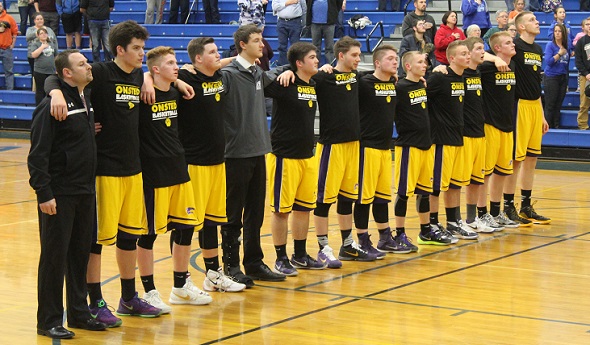
PHOTOS: (Top) Onsted's boys basketball team lines up for the national anthem before their game against Dundee on Feb. 2. (Middle) Guard Austin Thompson drives for a layup against Hudson on Jan. 12. (Middle below) Point guard Dallas Heidbreder sets the offense against Hillsdale on Feb. 5. (Below) Center Austin Davis dunks home two points against Blissfield on Feb. 11. (Photos courtesy of the Onsted boys basketball program.)
Johnston Finds Home with Onsted Hoops
March 13, 2020
By Doug Donnelly
Special for Second Half
ONSTED – When Mary Kay LaFerney moved from California to Michigan, she had no idea the impact a group of freshmen and sophomore boys were going to have on her son.
And she certainly didn’t know it would be because of basketball.
But that’s what happened this past season for LaFerney and her son, Zachary Johnston, at Onsted High School in Lenawee County. Johnston, 15, who has Down syndrome, wanted to be part of the junior varsity basketball team. The JV head coach Travis Wobrock was on board with the idea.
“He came to every practice and every game,” Wobrock said.
Johnston didn’t mind filling water bottles, grabbing towels or throwing out basketballs. He would also often take part in layup lines at the start of practice and shoot baskets when he could. It didn’t take long before Johnston made a request.
“He said he wanted a jersey,” Wobrock said.
The Onsted junior varsity team members had bigger ideas for Johnston. They wanted him to play in a game.
“Every week, one of the kids on the team would come to me and ask when Zach was going to get his chance,” Wobrock said. “They wanted this to happen so bad.”
As the season drew closer to the finish, Wobrock put the plan in motion. He contacted Clinton junior varsity basketball coach Greg Dutton and told him about Zachary. Dutton was instantly in favor of helping Johnston get into the action.
“When I played at Napoleon, we had a team manager, Alex DeNato, who had Down syndrome,” Dutton said. “He never had the opportunity to get a basket in one of our games, but he would lead us in pre-game speeches and occasionally led us out of the locker room for pre-game warmups.”
The Onsted players decided to wrap Zachary’s jersey up and present it to him a couple of days before the game vs. Clinton.
 “He got into the car, and he was smiling,” LaFerney said. “He was carrying a bag. I asked him what was in the bag. He said, ‘Take a peek.’ He was so excited to have a jersey.”
Wobrock videotaped the moment Johnston opened his jersey and posted it on social media. Thousands of people viewed it and read about plans for Johnston to play in the game. As the JV game went on, the stands began to fill up. Some held signs for Zachary. Fans were chanting his name.
“It was the biggest crowd we’ve ever had for a JV game,” said Wobrock.
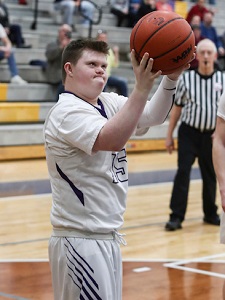
The players on the floor kept looking over at the bench to see if Johnston was ready. Finally, late in the game, Wobrock walked with Johnston to the scorer’s table. Johnston showed the scorekeeper his jersey – number 15 – checked into the game, and ran onto the court.
“When the crowd erupted, it gave me chills,” Wobrock said. “I’ve never seen anything like that. All the kids stood up. Everyone stood up. We weren’t even focused on basketball that night. We were focused on Zach.”
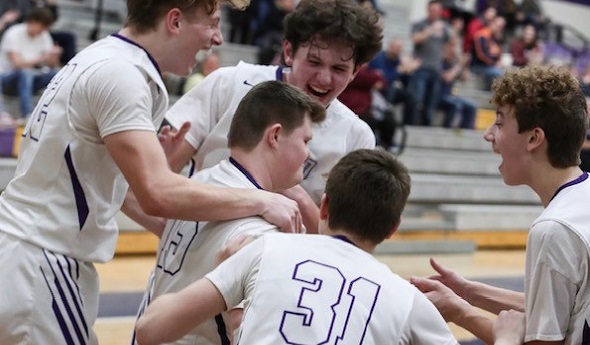
As players from both teams circled around Johnston, he got his chance. Finally, on a pass from Clinton’s Derek Tomalak, Johnston took aim at the basket and sank the jump shot.
The crowd erupted. Several people were in tears.
“I can’t remember being that emotional before the varsity game even started,” Onsted varsity basketball coach Brad Maska said. “I’m proud of my JV coaches for how they handled that night.”
Dutton said he was more than happy to help the Onsted basketball team make the moment happen. He was also glad his children got to watch from the stands.
“It was a special thing to be a part of and witness,” he said. “I am happy Travis asked our team to be involved. It helps bring into the limelight that basketball is just a game and that there are greater things in life than wins and losses. It's about building young men to be caring, thoughtful individuals when they are done playing.”
Wobrock, who is the graduation coach at Onsted High School, said his eight-player squad learned a lot of valuable lessons this season with Johnston as their manager. The players - Daniel Harrah, Jordan Santimore, Brody Giroux, Zack Gillean, Bradlee Vanbrunt, Harrison Moore, Matt Marsh and Brandon Corder – were just as emotional as everyone else in the Onsted gym.
“They’ve been amazing through this whole thing,” Wobrock said. “I’m very proud of them.
 “It’s amazing how they have taken him under their wing. They give him fist-bumps in the hall and hugs. They eat lunch with him. I think that’s kind of how it started. They saw him eating alone at lunch and the whole table invited him to their table. The relationship has just taken off. He’s one of the guys.”
LaFerney is a California native and lived in the San Diego area until two years ago when her family moved to Michigan, where her husband was originally from and has family. They bought a home in the Onsted Community Schools district. It’s been a perfect fit for her son, who is a freshman at the school.
Being part of the school, part of the team, has been extremely important to Zachary, she said. “He’s a smart kid. He’s very aware of his situation and surroundings. He knows how people are treating him.
“This is about way more than just basketball,” she added. “It’s about inclusion. Coach Wobrock was amazing about making sure Zachary was included in every way possible. The players on that team really care for Zachary.”
Wobrock recognized the impact basketball has had on Johnston – and the other players on the Wildcats team.
“Just because someone is different,” Wobrock said, “it doesn’t mean they don’t have the same goals, the same dreams, as everyone else.”
 Doug Donnelly has served as a sports and news reporter and city editor over 25 years, writing for the Daily Chief-Union in Upper Sandusky, Ohio from 1992-1995, the Monroe Evening News from 1995-2012 and the Adrian Daily Telegram since 2013. He's also written a book on high school basketball in Monroe County and compiles record books for various schools in southeast Michigan. E-mail him at [email protected] with story ideas for Jackson, Washtenaw, Hillsdale, Lenawee and Monroe counties.
PHOTOS: (Top) Onsted junior varsity teammates celebrate with Zachary Johnston after his basket against Clinton. (Middle) Johnston squares up and takes aim. (Below) Johnston shares a celebratory moment with coach Travis Wobrock. (Photos courtesy of Eric Tjolsen.)