

Onsted: Scholars, Athletes, Contenders
By
Chip Mundy
Special for Second Half
February 19, 2016
By Chip Mundy
Special for Second Half
ONSTED – The Onsted boys basketball team, undefeated at 16-0 and ranked No. 2 in the latest Associated Press Class B poll, can beat an opponent in a number of ways.
 Want to run with the Wildcats in a high-scoring game? Coach Brad Maska welcomes it.
“The first time we play teams, we get up and down the floor, and they don’t expect us to do that,” he said.
Want to slow it down, and turn it into a half-court game? Maska welcomes that, too.
“The second time we play, they are trying to slow the game down, and it makes it more like a half-court possession game. That’s fine, too. We can play it both ways.”
However, the most inadvisable way to challenge the Wildcats might not even be on the basketball court. It’s in the classroom, where the basketball team has three of the top 10 students in the school and one of eight student-athletes to win the MHSAA-Farm Bureau Insurance Class B Scholar-Athlete Award, plus a second who was one of 32 finalists.
“Top to bottom, last year we were top 10 in GPA I believe, and we have to be on an average of 3.6 of 3.7 this year,” Maska said.
Top scholars
Senior point guard Dallas Heidbreder carries a near-perfect 3.95 GPA, and somehow he is third on the team in that category. Senior forward Austin Thompson is off the charts with a 4.29 GPA, while senior center Austin Davis checks in at an incredible 4.15.
Thompson was one of the Class B Scholar-Athlete Award winners, and although he is not a starter on the team, he has a huge influence and is quite aware of the basketball history at Onsted. No team had won a District championship since 1983 – a team that compiled a perfect regular season, something Onsted is shooting to duplicate this year.
“It’s an excellent feeling to make a mark for Onsted,” Thompson said. “We’ve talked about 1983, and we’re aware of it. They made it to the Quarterfinals, and that team had guys like the Hubbards and Greg Worker.”
 Thompson plans to attend the University of Michigan, where he will major in actuarial mathematics, which he explained is, “using probability and statistics and risk factor. Most likely I will work for an insurance agency calculating insurance rates based on all the risks.”
Davis also is headed to Michigan, and while his intelligence is impressive too, he will as concerned with putting up numbers as charting them. He was the first signee of Michigan’s basketball recruiting class of 2016.
He refuses to take much credit for his academic success, though.
“My parents put a huge emphasis on academics, and they never accepted anything less than my best,” he said. “I’ve been around a great group of people. Our teachers are great here at Onsted, and the community has raised us right.”
Davis said he plans to go into the math or science field after college, unless, of course, playing basketball professionally is an option.
Heidbreder plans to pursue a career in real estate, but unlike Thomson and Davis, he expects to do it at Michigan State University. He’ll likely be wearing green and white in the Izzone at Breslin Center when Davis and the Wolverines visit next year.
“I’ll probably cheer for him a little bit,” Heidbreder said.
Heidbreder’s intelligence and maturity is showing up on the court, too.
“I’ve learned to keep my composure during the game,” he said. “It’s a lot with the refs, too, not to talk or even show any emotion if they make a bad call or anything. You just have to put that aside and keep playing the game.
“Last year I would lose my temper and maybe argue about some calls, and I think I’ve gotten a lot better this year, and it really helps the relationship between the refs and you.”
Really, though, the Wildcats haven’t needed much help from the refs this season.
Special group
Maska is an elementary physical education teacher in Onsted, and he saw this group from the start. An immediate impression was made.
“I had these guys all the way up,” he said. “I do recall going over to the RAC (Rando Activity Center) in Jackson and watching this group play. They probably were sixth or seventh grade, and they were doing really well. They are a group that has always fit well together. They all respect each other and work hard together. It’s a really neat group.
“The thing about this group is they were always good in middle school football, they were good in baseball, they were good in all these sports. Winning was already in the environment with these guys all the way up, so they knew nothing else but winning.”
Winning in basketball had not been a habit at Onsted. After claiming a Class C Regional title in 1983, Onsted did not win another District championship until last year – a span of 31 seasons.
That’s hard to fathom, considering this season’s success so far.
The signature wins this season came against Hillsdale, a team that has been dominant and a nemesis for Onsted. On Jan. 8, Onsted won an up-tempo game 66-62 at Hillsdale. Four weeks later, Onsted survived a different type of game, claiming a 45-34 victory and displaying its ability to win against different styles of play.
Sweeping Hillsdale was huge for the Wildcats.
“For me, I had never beaten Hillsdale ever before, so those two wins – especially the first one – that really boosted our confidence,” Heidbreder said. “It was an amazing feeling playing in front of so many people in the big games like Hillsdale. The stands are packed, and it’s just an awesome feeling.”
Heidbreder has his coach’s trust on the court, too.
 “Dallas is a great kid, very cerebral,” Maska said. “He is like having myself on the court. I say something to him, and he knows exactly what I am talking about, and he gets us in the right sets when he needs to. He is playing like a senior point guard should.”
The team is packed with players who do things right, as Maska notes.
“Skyler Lipinski is a 6-6 floor man with unique skills stepping out and hitting shots, so he makes it difficult for teams to double-team Austin (Davis) because he can finish at the rim and do some nice things for us,” Maska said.
“James Deitrich is a sophomore guard who is out with an ankle (injury). We’ve been without him the last three games, so we’re finding ways to win without him. He’s a kid who can slash and get to the rim, and he is a phenomenal defender.
“One of our other guards is Gabe Richardson. He’s a junior who has been up since his freshman year, so he’s had a lot of experience as well. He does a good job defensively, and he’s able to knock down the 3-point shot when called upon, and he does a really nice job for us.
“Patrick Iott has been inserted in the starting lineup as of late. He’s a 3-point shooter, and he’s able to knock down shots when they sag and help, and he’s been able to pick up his defensive effort.
“Isaac Henry is another post player we bring off the bench for us. He’s about 6-3, 6-4, a really athletic kid. Austin Thompson, Josh Jeffords, Kyle Smiths, Brendan Black, we have lots of other guys who we might need for three or four minutes, and they do a tremendous job, and that’s what has been really neat about this group. They’re not worried about points or minutes, they are worried about us winning.”
And the biggest key to Onsted winning? Of course, it’s Davis, the 6-10, 230-pound senior center.
Road to Michigan
Rural schools like Onsted are not breeding grounds for Division I college basketball players, especially for Big Ten Conference schools. But Michigan could not pass on Davis, who began to blossom after playing on a senior-laden summer team after his freshman year in high school. Although he did not get a lot of playing time, it was a beneficial experience.
“That’s when it started to turn for him,” Maska said “He realized he could be pretty special, and he dedicated himself that summer. He had a great year his sophomore year.”
As word spread, Michigan assistant coach LaVall Jordan made the trip to Onsted to see Davis for himself. But Maska was a little concerned about the timing as Onsted was due to play two games in two nights, and Jordan was going to be on hand for the second game.
“I said, ‘I don’t know, it’s going to be a tougher game, but you are more than welcome to come,’” Maska remembers telling Jordan.
Maska won’t forget what Jordan told him after the game.
“It was really funny at the end of the game – it was a close, back-and-forth game – and LaVall just said, ‘51,’ and I said, ‘Yea, No. 51, that’s who you came to look at.’ And he’s like, ‘No, he had 51 points.’ I didn’t even realize that at the time. They were very impressed with his skill level.”
Davis, who wears uniform No. 51, had scored a career-high 51 points in front of a Michigan assistant coach.
Word was out on Davis, and while it was an exciting time at Onsted, it also was a stressful time for Maska.
“It was hard; I’m not going to say it wasn’t,” he said. “Last year we’re in the locker room after a big game, and I get a phone call from Coach (Fran) McCaffery from Iowa, and he wants us to have a practice on Sunday.
“You look at the team – we don’t normally practice on Sundays – and say, ‘Guys, this guy wants to come look at Austin, and he wants us to go full-court five-on-five,’ and without even questioning it, they were like, ‘Let’s do it, coach.’ They jumped right in.”
Eventually, Michigan coach John Beilein made his way to see Davis play in person, and Maska, a big Michigan fan, felt somewhat overwhelmed.
“It was kind of surreal for me when Coach Beilein came to a practice,” Maska said. “I had my practice plan, and I made a copy and said, ‘Here Coach, here’s my practice plan.’ For me, giving Coach my practice plan and having him look it over and say, ‘You have some good stuff here,’ it was pretty neat for me.
“It’s Austin’s process, but I’ve had a blast through it and met some really good coaches. It’s been just an awesome ride.”
 As Davis and the Wildcats have plowed through the schedule, he has been treated somewhat as a friend and a foe at the same time. When asked what he hears more on the court from opposing players, ‘Go Blue’ or ‘Sparty On,’ he smiled and said, ‘The second one.’ ”
Yet, after the game, the opponents seek him out. The cheerleaders from Erie-Mason asked to have their photo taken with him, and a player from Blissfield went over to shake his hand and said, “I can’t wait to watch you on TV. Go Blue.”
Davis takes it all in stride, focusing on the task at hand.
“I’ve had a little bit of fun with it,” he said. “It’s definitely a great opportunity, but I’m going to enjoy this year while I can. I’ve grown up with everybody on the team for the most part. I got to play three, four years of basketball with them in high school and many more in our younger years.
“I’m just enjoying it right now. We’re having a great year and want to keep it going and prepare for what’s ahead and not overlook what’s happening now.”
Davis said one of his biggest challenges playing for Michigan will be adapting to the style of play. The Wolverines love to put up the 3-pointer, something that was not his strength a few years ago.
“It’s something that I have incorporated into my game the last few years,” he said. “My freshmen and sophomore year, I was a plodder, that’s what they called me, and I’ve had to expand it to play out on the perimeter. It’s definitely something I need to work on and acclimate a little more to it, but I’m very excited to learn every aspect of the game.”
Taska said that has made Davis a much better high school player as well.
“He can shoot it, and with his workouts and such, that was what was so impressive to those guys is he could go out and make seven out of 10 3-pointers,” Maska said. “Do I ask him to do that? I’d be called crazy if I asked Austin to shoot 3s when there is a 5-8 post player out there.
“He’s very skilled, and the one thing Coach Beilein really liked about him was his skill level, being able to pass, catch and shoot it, because in that system you have to be able to do everything. You have to be able to make great passes, you have to be able to catch the ball, and you have to knock down open shots when you get the opportunity.
“Many thought he was just a big kid, but we knew the skill level – we knew it was a tremendous fit for him at Michigan.”
End game
A team can’t be 16-0 and ranked No. 2 in the state and not be thinking about winning an MHSAA championship. But Maska stopped short of saying this was a “state championship or bust” situation.
“There is a lot of pressure, and we talk about that as a team,” he said. “There is pressure, and there is stress. Stress you want to get rid of as much as possible. Pressure is good, and if you are prepared, we love that kind of pressure and opportunity.
“As a coach, you want it to be one of the most enjoyable seasons, but there is a lot of pressure every game.”
Maska, in his ninth season as basketball coach at Onsted, is a tireless worker, a devoted teacher in practice and a respected leader.
“He cares about this team a lot,” Heidbreder said. “He spends countless hours breaking down film to try to make our team better. He focuses on what aspects in each game we need to work on. If we give up some offensive rebounds, we’ll spend the whole next day boxing out. If we look tired, we’ll start running, and if we’re not shooting well, we’ll start shooting.
“He knows what to do for us. He’s the best coach I’ve ever had in building a relationship with the players.”
Davis, about to step onto a much larger stage, will leave Onsted with a lot of respect for Maska and the coaching staff.
“He puts in so much time outside of practice breaking down film, scouting other teams and looking at what we need to do to get better,” Davis said. “He’s amazing in that aspect. We also have amazing assistant coaches, and our whole staff varsity through freshmen is amazing. They’ve pushed us through our entire careers here, and I’m very honored to have played for them.”
Brains and brawn have mixed well for the Onsted basketball team.
“It comes from home,” Maska said. “These kids are tremendous kids who have great parents at home. They have goals – they’re very goal-orientated – and it allows me not to worry about other things. I don’t have to look at that eligibility sheet to see who is ineligible or who is struggling in class.
“It does make us more cerebral, although basketball knowledge and academic knowledge don’t always mix well, but with this group it does. They are very smart in the classroom, and they know basketball. They know the game, and it allows me to maybe add three or four more plays that we wouldn’t normally do with other groups.
“They just click in that sense as they are very intelligent.”
Intelligent … and undefeated.
 Chip Mundy served as sports editor at the Brooklyn Exponent and Albion Recorder from 1980-86, and then as a reporter and later copy editor at the Jackson Citizen-Patriot from 1986-2011. He also co-authored Michigan Sports Trivia. E-mail him at [email protected] with story ideas for Jackson, Washtenaw, Hillsdale, Lenawee and Monroe counties.
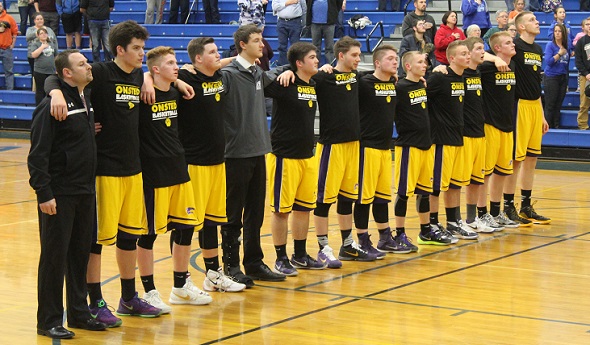
PHOTOS: (Top) Onsted's boys basketball team lines up for the national anthem before their game against Dundee on Feb. 2. (Middle) Guard Austin Thompson drives for a layup against Hudson on Jan. 12. (Middle below) Point guard Dallas Heidbreder sets the offense against Hillsdale on Feb. 5. (Below) Center Austin Davis dunks home two points against Blissfield on Feb. 11. (Photos courtesy of the Onsted boys basketball program.)
Detroit 'Longtime' Boys Coaches Down to Few
By
Tom Markowski
Special for Second Half
December 14, 2016
Gary Fralick considers himself one of the fortunate ones.
 Fralick, 66, is in his 32nd season as a head boys basketball coach. He retired from his teaching position in 2013. He started coaching at Redford Thurston in 1979, went to Royal Oak Kimball in 1984 and is in 23rd season as the head coach at Troy.
Fralick might be lucky, but he is unquestionably rare. Fralick is believed to be one of three coaches in the Macomb/Oakland/Wayne area who has coached for more than 30 seasons.
There’s Dan Fife at Clarkston and Kevin Voss of Clinton Township Chippewa Valley, both of whom in their 35th seasons, all at the same school.
Another, Greg Esler at Warren DeLaSalle, is in his 30th season. He was the head coach at St. Clair Shores Lake Shore for seven seasons before going to DeLaSalle in 1994.
“We’re part of a dying breed,” Voss said.
It certainly appears so. Coaching longevity has taken on a different meaning recently. Twenty seems like a lot in these times, and in reality it is a long time. Twenty years or so ago, 20 years was normal. There’s a new normal, and 20 or 25 years isn’t it.
Many factors have contributed to this change. A person’s personal and family life often don’t coincide with the demands of coaching basketball. The responsibilities that come with coaching have increased. Some coaches say that to be an effective coach, it can be a 10- or 11-month job.
Two factors are at the forefront, and they are both financial. Coaches used to be educators as well as coaches. Yes, coaching can be viewed as teaching on the court, but at one time teaching in a classroom and coaching used to go hand in hand.
 Then there’s the subsidy coaches receive. It varies from school district to school district. Some make $4,000 a season, others can make $7,000. And it also costs money to run a program; unless the coach receives financial help from a booster club or parents, the money he or she receives begins to dwindle.
But the most important factor is time.
“A tremendous amount of time is devoted to watching DVD or tapes,” Fralick said. “I know I’m dating myself with saying that. The point is, you’re watching a lot. There’s more scouting. And you don’t get paid much. Why don’t they stay as long as they used to? They get burned out. They want to spend more time with their families.
“You don’t see as many of the young coaches stay. Coaches don’t have the ambition to coach a long time. It’s not a profitable job. I don’t know what other coaches make. We used to compare what we made. Not anymore.
“Thirty years or more? I don’t see it happening. There’s the dual job thing. Things have changed. To me, it’s been a great job.”
To compensate for being away from home, Fralick brought his family with him. Sort of. He coached his son Gary, Jr., and Tim. Gary, a 1996 Troy graduate, played for his father his junior and senior seasons and Tim, a 1999 graduate, played four seasons on varsity. Fralick said he was even more fortunate to coach both on the same team (during the 1995-96 season).
Then there’s his wife, Sharon, who remains the scorekeeper.
“I’ve always had a passion for coaching and teaching,” Fralick said. “I love the game of basketball. I love the kids. There’s never a dull moment. It’s been a great ride.”
Vito Jordan has been around basketball all of his life. His father, Venias Jordan, was the boys head varsity coach at Detroit Mackenzie and Detroit Mumford before stepping down as a head coach only to return to the bench assisting his son the last six seasons.
Vito Jordan, 31, became a head coach at Detroit Osborn when he was 24. He started his coaching career the year before as an assistant to Henry Washington at Macomb College. Jordan went to Detroit Community after one season at Osborn and guided Community to its only MHSAA Finals appearance (Class B, 2013). He’s now in his fourth season as the head coach at Detroit Renaissance.
“I followed my father all of my life,” Jordan said. “I knew what I wanted to do when I was in college (Alma College). This is what I want to do the rest of my life.”
It’s different in Detroit. Schools close. Job titles change. Jordan, for instance, teaches at the Academy of Warren, a middle school in Detroit. It’s a charter school, not within the Detroit Public School system, therefore he receives his pay from two separate school systems (Renaissance is in the DPS).
There is a distinction. In some school systems coaches will receive a percentage – let’s say for argument sake, 10 percent – of their teaching salary to coach. Let’s say a person makes $60,000 a year to teach. He or she would then receive $6,000 to coach. If you coach two sports, that’s $12,000.
 Jordan is not privy to such a contract. Each job is separate. Jordan loves to coach, and he understands he must be a teacher to earn a decent living, and he’s content to continue on the path he is following. But he also knows that to make a good salary just coaching one must move on to the collegiate level like others have done.
“When there were coaches like my dad, Perry Watson (Detroit Southwestern), Johnny Goston (Detroit Pershing) and others, they all worked in the (Detroit Public) school system. Everyone was teaching. That was your career. None of them had aspirations of being a college coach. Not even Watson. Now everyone isn’t in the teaching profession. Maybe they do have a degree and maybe they don’t. The point is, most aren’t teachers. I can count on one hand those (in Detroit) who have their teaching certificate and coach.”
Jordan noted such successful PSL coaches like Derrick McDowell, Steve Hall and Robert Murphy who left high school to pursue a coaching career in college. Murphy guided Detroit Crockett to the Class B title in 2001 and is now the head coach at Eastern Michigan. McDowell has had two stints as a collegiate assistant coach, most recently at EMU. He’s since returned to coach at Detroit Western. Hall coached Detroit Rogers to three consecutive Class D titles (2003-05) before going to Duquesne University and Youngstown State as an assistant coach. Hall returned to Detroit last season and is in his second season as head coach at Detroit Cass Tech.
Jordan said they left high school to challenge themselves professionally, among other considerations. Voss said there are variables that influence how long a person lasts, in one school district or in coaching in general, that didn’t exist 20 years ago.
“Athletics have become pervasive in high school,” he said. “The whole booster situation you find in college is here. You can be winning but not winning enough. It’s a trickle down affect.
“Coaches complain about parents. Parents complain about playing time. High school sports is not as pure as it once was. Winning is way more important now. Now a coach comes in with a three-year window. You can have one or two down years, and the third you’d better win.
“Then there’s the pressure on your family. I’ve been lucky. My wife and I have had the players over for team dinners. We create a family atmosphere. It’s a change of society. I don’t envy the young coaches coming in.”
Community involvement has always been a priority for Voss. To keep a hand on the pulse, Voss heads the elementary basketball program within the Chippewa Valley school district. Games are held on Saturdays, and approximately 750 students take part.
“You have to have the right fit,” he said. “I’m in the right spot. You coach for different reasons when you get older. I’m enjoying the game. There’s a different level of satisfaction.”
 Tom Markowski is a columnist and directs website coverage for the State Champs! Sports Network. He previously covered primarily high school sports for the The Detroit News from 1984-2014, focusing on the Detroit area and contributing to statewide coverage of football and basketball. Contact him at [email protected] with story ideas for Oakland, Macomb and Wayne counties.
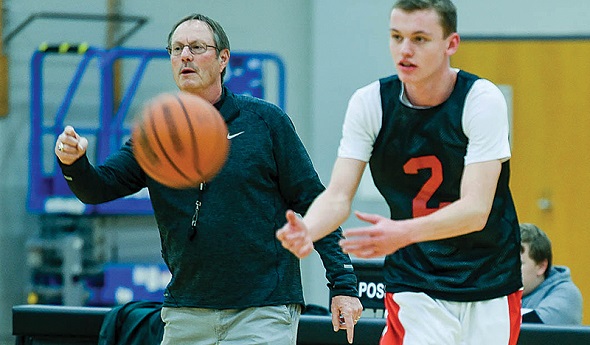
PHOTOS: (Top) Troy boys basketball coach Gary Fralick, left, is in his 32nd season coaching. (Middle) Detroit Renaissance boys coach Vito Jordan is following in the coaching footsteps of his father, Venias. (Below) Chippewa Valley boys coach Kevin Voss, left, is in his 35th season at his school. (Top and below photos courtesy of C&G Newspapers; middle photo courtesy of Detroit Public School League.)