

Performance: Benton Harbor's Carlos Johnson
March 28, 2018
 Carlos Johnson
Benton Harbor sophomore – Basketball
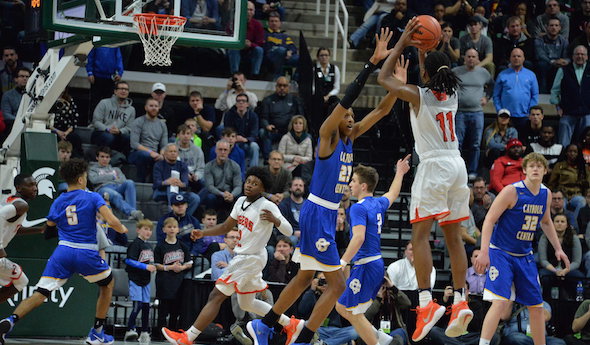
Johnson, a 6-foot-6 wing and power forward, finished an all-state season with what he called the biggest shot of his life, drilling the game winner as Benton Harbor claimed its first MHSAA boys basketball championship since 1965 with a 65-64 overtime victory over Grand Rapids Catholic Central in Saturday’s Class B Final. His 3-pointer with 10 seconds to play gave him 24 points total in earning the Michigan Army National Guard “Performance of the Week.”
Johnson showed a statewide audience why he’s considered arguably the top sophomore in Michigan, making 10 of 20 shots in the championship game, including three 30-pointers, and grabbing 11 rebounds. He had nine points, nine rebounds and six blocked shots in Friday’s 60-49 Semifinal win over River Rouge, and finished this season averaging 17.9 points, 12.9 rebounds, 4.9 assists and 3.2 blocks per game. Johnson also started as a freshman, averaging just over 14 points, 14 rebounds and three blocks per game in also leading the Tigers to the 2017 Class B Semifinals, where they lost to eventual champion New Haven.
 Benton Harbor has one of the richest basketball traditions in the state – this championship was its fourth, coming in its 11th appearance in a title game. The Tigers finished 27-1 overall and are a combined 49-5 over Johnson’s first two seasons. The expectations surely will grow over his next two – he’ll eventually choose from a number of opportunities to play college basketball at the Division I level and also is a tremendous student, posting a 4.0 grade-point average last semester and carrying a 3.8 currently this spring.
Coach Corey Sterling said: “Carlos worked on his game. As a freshman at the Breslin last year, a 14-year-old, skinny kid, to now – he dedicated his offseason to work. He’s jumping better, he’s shooting well, he’s dribbling better, he’s getting tons of Division I offers and interest. He’s playing with a great AAU team. Carlos will be a pro. He’s our star. He’s our Division I player. And he’ll be better next year too. After this, we’re going to give it a week, and he’ll be right back in the gym.”
Performance Point: “Since (Friday) night I’ve been thinking about it,” Johnson said Saturday evening. “I came into the hotel room, took a shower and went to sleep. I woke up this morning around 7 o’clock. I was talking to one of my teammates, just talking about it all morning. It was a dream come true. It got my heart beating all day. Oh my gosh, we won. It just came true. … To bring one back to Benton Harbor, it’s been like 50-some years. When I was in sixth grade, all the way through eighth grade and as a freshman … we’ve had this goal since fourth grade. It’s a dream come true. It’s reality.”
 If this was a year ago: “I probably wouldn’t have made (the winning shot). I worked on my jumpshot this summer. My IQ and my dribble moves (have improved), and more of my footwork came through in this game. Two years to go, (I’ll) just keep working hard and get college material and try to bring another one back.”
Win for all: “As we all know, Benton Harbor’s been going through deep depression-like, so for us to bring one back, it just brings light and enjoyment all the way back to the house.”
Ready for more: “Next year I’ll have to take a guard role. We have a lot of bigs coming in, but I’m going to get comfortable with that. I think I’m going to play a big role (in leading) the next season that’s coming up. The challenge is getting everybody on one page and everybody to work hard and stay focused the whole time.”
Everybody’s watching: “I’ve been handling it since last year. It’s been a lot of pressure. A lot of people are reaching out to me. But I’ve got good coaches and good family member and friends, and they just help me to stay calm.”
- Geoff Kimmerly, Second Half editor
Every week during the 2017-18 school year, Second Half and the Michigan Army National Guard will recognize a “Performance of the Week" from among the MHSAA's 750 member high schools.
The Michigan Army National Guard provides trained and ready forces in support of the National Military Strategy, and responds as needed to state, local, and regional emergencies to ensure peace, order, and public safety. The Guard adds value to our communities through continuous interaction. National Guard soldiers are part of the local community. Guardsmen typically train one weekend per month and two weeks in the summer. This training maintains readiness when needed, be it either to defend our nation's freedom or protect lives and property of Michigan citizens during a local natural disaster.
Previous 2017-18 honorees:
March 22: Shine Strickland-Gills, Saginaw Heritage basketball - Read
March 15: Skyler Cook-Weeks, Holland Christian swimming - Read
March 8: Dakota Greer, Howard City Tri-County wrestling - Read
March 1: Camree' Clegg, Wayne Memorial basketball - Read
February 23: Aliah Robertson, Sault Ste. Marie swimming - Read
February 16: Austin O'Hearon, Eaton Rapids wrestling - Read
February 9: Sophia Wiard, Muskegon Oakridge basketball - Read
February 2: Brenden Tulpa, Hartland hockey - Read
January 25: Brandon Whitman, Dundee wrestling - Read
January 18: Derek Maas, Holland West Ottawa swimming - Read
January 11: Lexi Niepoth, Bellaire basketball - Read
November 30: La'Darius Jefferson, Muskegon football - Read
November 23: Ashley Turak, Farmington Hills Harrison swimming - Read
November 16: Bryce Veasley, West Bloomfield football - Read
November 9: Jose Penaloza, Holland soccer - Read
November 2: Karenna Duffey, Macomb L'Anse Creuse North cross country - Read
October 26: Anika Dy, Traverse City Central golf - Read
October 19: Andrew Zhang, Bloomfield Hills tennis - Read
October 12: Nolan Fugate, Grand Rapids Catholic Central football - Read
October 5: Marissa Ackerman, Munising tennis - Read
September 28: Minh Le, Portage Central soccer - Read
September 21: Olivia Theis, Lansing Catholic cross country - Read
September 14: Maddy Chinn, Pontiac Notre Dame Prep volleyball - Read
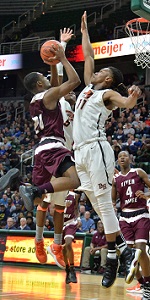
PHOTOS: (Top) Benton Harbor's Carlos Johnson launches the game-winning 3-pointer during overtime of Saturday's Class B Final. (Middle) Johnson (11) gets a hand up as a River Rouge player drives to the basket during Friday's Semifinal.

Beecher Seniors Lead 3-Peat Attempt
March 23, 2017
By Geoff Kimmerly
Second Half editor
EAST LANSING – The day after Flint Beecher won the Class C boys basketball championship in 2013, coach Mike Williams went to watch an eighth-grade game.
He saw Levane Blake get a steal and a dunk, Malik Ellison pull up for a 3-pointer. “I just remember seeing the chemistry between them,” Williams said. “And I thought to myself, I think we’ll be going back down to Lansing a few more times.”
Now seniors, Blake, Ellison and Jordan Roland have a chance to finish their Beecher careers among the most successful players in the program’s storied history.
The Bucs have won seven MHSAA titles, and those three captains have been part of two straight – and earned an opportunity to three-peat with a 76-68 victory over Detroit Edison Public School Academy in Thursday’s first Semifinal at the Breslin Center.
“We feel more poised this year. It’s our senior year, and we want to go out with a bang,” Roland said.
“It’s our senior year, and I won’t be able to wear this jersey anymore,” Blake added, “or play on the court with my team, or lead the young guys. So we work every day in practice, go hard, hard, hard, and Coach Mike pushes us.”
Beecher (22-5) will play Grand Rapids Covenant Christian in Saturday’s 4:30 p.m. Final. The Bucs not only have won the last two Class C titles, but four of the last five.
After watching these seniors star as eighth graders that day in 2013, Williams knew they’d be on varsity as freshmen. Ellison, Roland and Blake all joined the varsity that next winter; Ellison and Blake started as sophomores in the 2015 championship win, and all three started in last year’s title game.
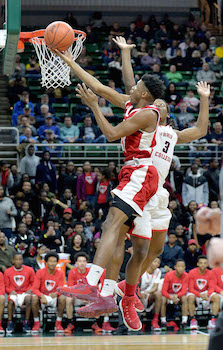 Ellison scored a game-high 28 points and added seven rebounds and seven assists Thursday, while Roland and Blake both scored 10 points, Roland also grabbing seven rebounds and the 6-foot-7 Blake blocking six shots.
Edison (14-12), in its first Semifinal after winning its first Regional title last week, fought back-and-forth for the lead through the first five minutes of the second quarter until Beecher took a one-point lead on a Roland bucket with 3:17 to go in the first half, and never gave up the advantage again.
“We know Malik is a tough little guard, and I think the thing you never can put a hand on is a guy coming up here playing in three state championships games,” DEPSA coach Brandon Neely said. “I think the advantage he had is he just understood how the game would go. … You know that those guys are never going to get rattled. They’ve been in so many wars that when they come to battle, they’re just loose; it’s just another game for them."
Senior guard Jamal Keesee led the Pioneers with 21 points and 12 rebounds, while junior center Deante Johnson had 17 points and nine rebounds. Junior guard Gary Solomon added 15 points, six rebounds and four assists, and junior guard Pierre Mitchell, Jr., had 10 points and also six rebounds and four assists.
Beecher freshman guard Jalen Terry had 15 points as his team’s second-leading scorer, something that spoke to what Williams has emphasized to his successful seniors this winter. He put it on them to play major roles in bringing along the next generation, to work at both continuing the Bucs’ legacy and setting it up for the future as well, just as others did to assist them at the start of their careers.
“I’m just going to go out there and play hard for them,” Terry said. “They gave me everything they’ve got. I’m going to give them everything I’ve got.”
PHOTOS: (Top) Flint Beecher’s Malik Ellison drives hard to the basket during Thursday’s first Class C Semifinal. (Middle) The Bucs score two more on the way to earning their third straight championship game berth.