

Performance: East English's Kamari Newman
February 25, 2016
 Kamari Newman
Detroit East English senior – Boys Basketball
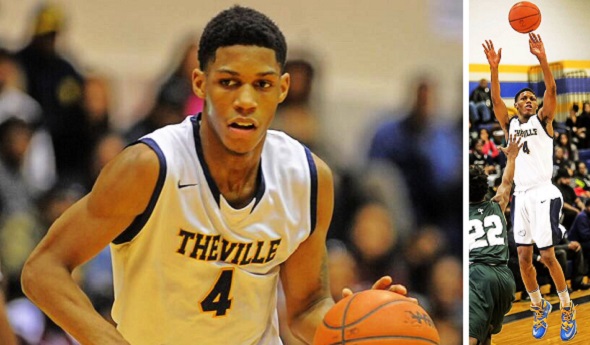
Newman joined Detroit East English’s first boys varsity basketball team as a freshmen for the 2012-13 season and will graduate as the first all-time great in the young program’s history (the school opened in 2012 after the closures of Detroit Crockett and Finney). In his fourth and final opportunity, the 6-foot-4 guard led the Bulldogs to their first Detroit Public School League Tournament title to earn the Michigan National Guard’s “Performance of the Week.”
Newman scored 17 of his game-high 28 points during the first half of a 71-70 semifinal win over Detroit Collegiate Prep on Feb. 12, then scored a game-high 24 points in the 86-62 championship game win over Detroit Renaissance on Feb. 19 (East English had lost to Renaissance by four in a 2015 PSL semifinal). For the season, Newman is averaging 22 points, six rebounds, four assists and 1.5 steals per game for East English, which is 16-3. Not surprisingly, Newman has the school record for 1,591 career points and also with 193 3-pointers – which are enough to make the MHSAA’s career list in that category, and while he has at least two more games to play. Newman has been a strong shooter throughout his career, but said he's improved his rebounding and leadership most as a senior.
 He also earned all-city honors in cross country in the fall and ran on that team all four years of high school along with a number of his teammates – he credits cross country with helping the basketball team train to play its uptempo style during the winter. Newman has signed to continue his basketball career at George Mason University in Virginia. He is unsure what we will study, but said the sciences are among his favorite and best subjects.
Coach Juan Rickman said: “He’s always worked hard. He likes to stay in the gym. That’s one of the biggest impacts he’s had with our program. He’s been the catalyst. When we started the (PSL) run, he made the conscious decision in his mind that he was done losing, coming up short. When the opportunity presented itself, he became more of a leader. He just didn’t want to lose.”
Performance Point: “It was a tough road. I just wanted to lead us there. We came up short (in the past), so many people were counting us out. I definitely didn’t want to come up short this time.
 Best in Bulldogs history: “It means a lot, but I know I’ve got a whole lot of work to do. It’s going to be great honor (though), but we’re not done yet. The group of guys, we go so deep. That’s been my favorite part, just being around those guys. (My role) is just to push everybody, to lead, to their limit. I try to get the best out of all my teammates; they respect me.”
Had to be a Patriot: “Just the coaching staff (at George Mason), they were telling me basically what Coach Rickman tells me. They work extremely hard, and really they don’t have anybody to score the ball like that, so I want to go in there and help them where they’re struggling.”
Create like Curry: “Steph Curry; I don’t really watch him too much, because I’m not him. But sometimes I try to be like him. How quickly he gets it off, creates his own shot, that what I like about him. ... I want to get better at becoming the combo (guard), getting the ball when I need it, distributing it, seeing the floor on the defensive end and being more aware.”
– Geoff Kimmerly, Second Half editor
Every week during the 2015-16 school year, Second Half and the Michigan National Guard will recognize a “Performance of the Week" from among the MHSAA's 750 member high schools.
The Michigan Army National Guard provides trained and ready forces in support of the National Military Strategy, and responds as needed to state, local, and regional emergencies to ensure peace, order, and public safety. The Guard adds value to our communities through continuous interaction. National Guard soldiers are part of the local community. Guardsmen typically train one weekend per month and two weeks in the summer. This training maintains readiness when needed, be it either to defend our Nation's freedom, or protecting lives and property of Michigan citizens during a local natural disaster.
Previous 2015-16 honorees
Feb. 17: Jason Whitens, Powers North Central boys basketball - Read
Feb. 10: Rachel Hogan, Grand Ledge gymnastics - Read
Feb. 3: Nehemiah Mork, Midland Dow swimming & diving - Read
Jan. 27: Mardrekia Cook, Muskegon girls basketball - Read
Jan. 20: Sage Castillo, Hartland wrestling - Read
Jan. 13: Rob Zofchak, Dexter swimming & diving - Read
Jan. 6: Tyler Deming, Caro wrestling – Read
Dec. 15: Jordan Weber, East Jordan boys basketball – Read
Dec. 8: Kaitlyn Geers, Kent City girls basketball – Read
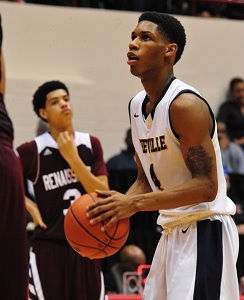
PHOTOS: (Top) Detroit East English’s Kamari Newman brings the ball upcourt during the Detroit Public School League Tournament. (Middle) Newman was the team’s leading scorer in both the semifinal and championship game. (Top photos courtesy of the Detroit East English basketball program, middle photo courtesy of the Detroit Public School League/Bonnie Warmack.)

Beecher Seniors Lead 3-Peat Attempt
March 23, 2017
By Geoff Kimmerly
Second Half editor
EAST LANSING – The day after Flint Beecher won the Class C boys basketball championship in 2013, coach Mike Williams went to watch an eighth-grade game.
He saw Levane Blake get a steal and a dunk, Malik Ellison pull up for a 3-pointer. “I just remember seeing the chemistry between them,” Williams said. “And I thought to myself, I think we’ll be going back down to Lansing a few more times.”
Now seniors, Blake, Ellison and Jordan Roland have a chance to finish their Beecher careers among the most successful players in the program’s storied history.
The Bucs have won seven MHSAA titles, and those three captains have been part of two straight – and earned an opportunity to three-peat with a 76-68 victory over Detroit Edison Public School Academy in Thursday’s first Semifinal at the Breslin Center.
“We feel more poised this year. It’s our senior year, and we want to go out with a bang,” Roland said.
“It’s our senior year, and I won’t be able to wear this jersey anymore,” Blake added, “or play on the court with my team, or lead the young guys. So we work every day in practice, go hard, hard, hard, and Coach Mike pushes us.”
Beecher (22-5) will play Grand Rapids Covenant Christian in Saturday’s 4:30 p.m. Final. The Bucs not only have won the last two Class C titles, but four of the last five.
After watching these seniors star as eighth graders that day in 2013, Williams knew they’d be on varsity as freshmen. Ellison, Roland and Blake all joined the varsity that next winter; Ellison and Blake started as sophomores in the 2015 championship win, and all three started in last year’s title game.
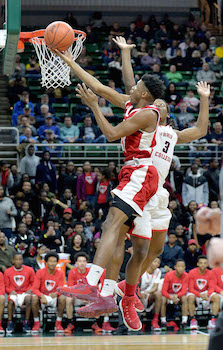 Ellison scored a game-high 28 points and added seven rebounds and seven assists Thursday, while Roland and Blake both scored 10 points, Roland also grabbing seven rebounds and the 6-foot-7 Blake blocking six shots.
Edison (14-12), in its first Semifinal after winning its first Regional title last week, fought back-and-forth for the lead through the first five minutes of the second quarter until Beecher took a one-point lead on a Roland bucket with 3:17 to go in the first half, and never gave up the advantage again.
“We know Malik is a tough little guard, and I think the thing you never can put a hand on is a guy coming up here playing in three state championships games,” DEPSA coach Brandon Neely said. “I think the advantage he had is he just understood how the game would go. … You know that those guys are never going to get rattled. They’ve been in so many wars that when they come to battle, they’re just loose; it’s just another game for them."
Senior guard Jamal Keesee led the Pioneers with 21 points and 12 rebounds, while junior center Deante Johnson had 17 points and nine rebounds. Junior guard Gary Solomon added 15 points, six rebounds and four assists, and junior guard Pierre Mitchell, Jr., had 10 points and also six rebounds and four assists.
Beecher freshman guard Jalen Terry had 15 points as his team’s second-leading scorer, something that spoke to what Williams has emphasized to his successful seniors this winter. He put it on them to play major roles in bringing along the next generation, to work at both continuing the Bucs’ legacy and setting it up for the future as well, just as others did to assist them at the start of their careers.
“I’m just going to go out there and play hard for them,” Terry said. “They gave me everything they’ve got. I’m going to give them everything I’ve got.”
PHOTOS: (Top) Flint Beecher’s Malik Ellison drives hard to the basket during Thursday’s first Class C Semifinal. (Middle) The Bucs score two more on the way to earning their third straight championship game berth.