

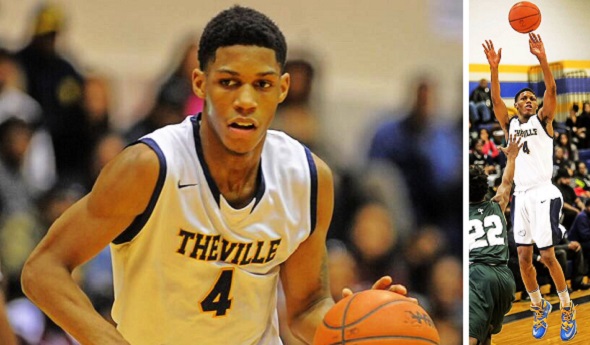
Performance: East English's Kamari Newman
February 25, 2016
 Kamari Newman
Detroit East English senior – Boys Basketball
Newman joined Detroit East English’s first boys varsity basketball team as a freshmen for the 2012-13 season and will graduate as the first all-time great in the young program’s history (the school opened in 2012 after the closures of Detroit Crockett and Finney). In his fourth and final opportunity, the 6-foot-4 guard led the Bulldogs to their first Detroit Public School League Tournament title to earn the Michigan National Guard’s “Performance of the Week.”
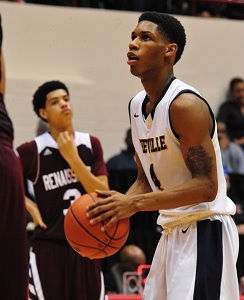
Newman scored 17 of his game-high 28 points during the first half of a 71-70 semifinal win over Detroit Collegiate Prep on Feb. 12, then scored a game-high 24 points in the 86-62 championship game win over Detroit Renaissance on Feb. 19 (East English had lost to Renaissance by four in a 2015 PSL semifinal). For the season, Newman is averaging 22 points, six rebounds, four assists and 1.5 steals per game for East English, which is 16-3. Not surprisingly, Newman has the school record for 1,591 career points and also with 193 3-pointers – which are enough to make the MHSAA’s career list in that category, and while he has at least two more games to play. Newman has been a strong shooter throughout his career, but said he's improved his rebounding and leadership most as a senior.
 He also earned all-city honors in cross country in the fall and ran on that team all four years of high school along with a number of his teammates – he credits cross country with helping the basketball team train to play its uptempo style during the winter. Newman has signed to continue his basketball career at George Mason University in Virginia. He is unsure what we will study, but said the sciences are among his favorite and best subjects.
Coach Juan Rickman said: “He’s always worked hard. He likes to stay in the gym. That’s one of the biggest impacts he’s had with our program. He’s been the catalyst. When we started the (PSL) run, he made the conscious decision in his mind that he was done losing, coming up short. When the opportunity presented itself, he became more of a leader. He just didn’t want to lose.”
Performance Point: “It was a tough road. I just wanted to lead us there. We came up short (in the past), so many people were counting us out. I definitely didn’t want to come up short this time.
 Best in Bulldogs history: “It means a lot, but I know I’ve got a whole lot of work to do. It’s going to be great honor (though), but we’re not done yet. The group of guys, we go so deep. That’s been my favorite part, just being around those guys. (My role) is just to push everybody, to lead, to their limit. I try to get the best out of all my teammates; they respect me.”
Had to be a Patriot: “Just the coaching staff (at George Mason), they were telling me basically what Coach Rickman tells me. They work extremely hard, and really they don’t have anybody to score the ball like that, so I want to go in there and help them where they’re struggling.”
Create like Curry: “Steph Curry; I don’t really watch him too much, because I’m not him. But sometimes I try to be like him. How quickly he gets it off, creates his own shot, that what I like about him. ... I want to get better at becoming the combo (guard), getting the ball when I need it, distributing it, seeing the floor on the defensive end and being more aware.”
– Geoff Kimmerly, Second Half editor
Every week during the 2015-16 school year, Second Half and the Michigan National Guard will recognize a “Performance of the Week" from among the MHSAA's 750 member high schools.
The Michigan Army National Guard provides trained and ready forces in support of the National Military Strategy, and responds as needed to state, local, and regional emergencies to ensure peace, order, and public safety. The Guard adds value to our communities through continuous interaction. National Guard soldiers are part of the local community. Guardsmen typically train one weekend per month and two weeks in the summer. This training maintains readiness when needed, be it either to defend our Nation's freedom, or protecting lives and property of Michigan citizens during a local natural disaster.
Previous 2015-16 honorees
Feb. 17: Jason Whitens, Powers North Central boys basketball - Read
Feb. 10: Rachel Hogan, Grand Ledge gymnastics - Read
Feb. 3: Nehemiah Mork, Midland Dow swimming & diving - Read
Jan. 27: Mardrekia Cook, Muskegon girls basketball - Read
Jan. 20: Sage Castillo, Hartland wrestling - Read
Jan. 13: Rob Zofchak, Dexter swimming & diving - Read
Jan. 6: Tyler Deming, Caro wrestling – Read
Dec. 15: Jordan Weber, East Jordan boys basketball – Read
Dec. 8: Kaitlyn Geers, Kent City girls basketball – Read
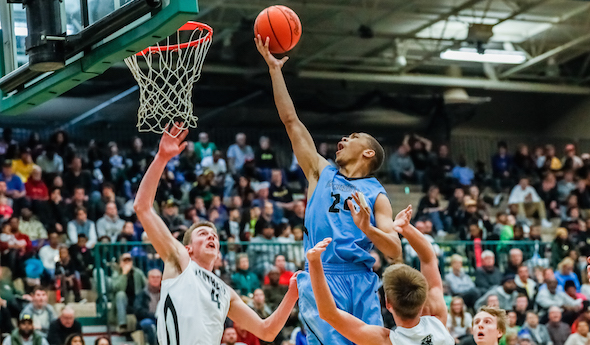
PHOTOS: (Top) Detroit East English’s Kamari Newman brings the ball upcourt during the Detroit Public School League Tournament. (Middle) Newman was the team’s leading scorer in both the semifinal and championship game. (Top photos courtesy of the Detroit East English basketball program, middle photo courtesy of the Detroit Public School League/Bonnie Warmack.)
Breslin Bound: Boys Report Week 5
January 9, 2017
By Geoff Kimmerly
Second Half editor
How quickly can a lackluster season become a distant memory?
 Ask a few of the teams we’ve highlighted in this week’s Breslin Bound Boys Report, powered by MI Student Aid.
Two of the eight on our “Watch List” this week have already won more games this winter than in all of 2015-16, and a third team could equal last season’s total by the end of this week.
Week in Review
The countdown of last week’s five most intriguing results:
1. Clarkston 60, Flint Carman-Ainsworth 47 – The Wolves remain undefeated at 8-0 after handing Carman-Ainsworth its first loss (and later in the week doing the same to Walled Lake Western).
2. Detroit U-D Jesuit 71, Romulus 58 – The Cubs finished nonleague play at 5-2 and with one more solid win over a Class A power heading into the Detroit Catholic League schedule.
3. Ann Arbor Skyline 74, Belleville 71 – Skyline is tied for the lead in the Southeastern Conference Red, but handing Belleville its first loss may have surprised a few even though Skyline has broken 70 points five of the last six games.
4. Grand Rapids Forest Hills Central 55, Grand Rapids Forest Hills Northern 51 – This neighborly rivalry game hadn’t meant this much in a while, with both now in the Ottawa-Kent Conference White and Central handing Northern its first loss of the season.
5. Holt 59, Okemos 49 – This gave the Rams an early co-lead with East Lansing in the Capital Area Activities Conference Blue and added to a 4-2 start with those losses by a combined seven points.
Watch List
With an eye toward March, here are two teams in each class making sparks:
CLASS A
Davison (6-1) – After watching the football team make a nice jump in the fall, the basketball team is doing the same coming off a 5-16 finish. The only defeat was to one-loss Carman-Ainsworth.
Bloomfield Hills (6-1) – The Black Hawks are two wins better than at this point a year ago, with their only loss to Orchard Lake St. Mary’s. They should provide a nice challenge to Clarkston in the Oakland Activities Association Red.
CLASS B
Hillsdale (6-0) – The Hornets are always in the mix, and got off to another fast start this winter after ending last year’s 18-win campaign with a three-point loss in their first District game. Last week’s double-overtime win over Onsted might be the best so far.
Wyoming Kelloggsville (5-0) – The Rockets could be in the midst of another of the most significant turnarounds in the state this winter, going 7-15 a year ago but most recently handing a one-point loss to reigning Class C runner-up Grandville Calvin Christian.
CLASS C
Maple City Glen Lake (5-0) – The Lakers opened this season by avenging last year’s season-ending loss to Traverse City St. Francis, and since they’ve played to a first-place tie in the Northwest Conference with rival Frankfort. Thursday opponent Buckley will provide another major test.
Munising (6-0) – After finishing 11-10 and falling in its first postseason game last winter, Munising is more than halfway to a better finish. This start included an avenging of that season-ending loss to Rock Mid-Peninsula and three victories total by five or fewer points.
CLASS D
Bellevue (4-0) – The Broncos have been riding a nice run the last few seasons, winning 18 games a year ago. They already own a win over Climax-Scotts, the team with which they shared the Southern Central Athletic Association West title last winter.
Marcellus (4-1) – The Wildcats also are on the rebound, having already surpassed last season’s three wins. The lone loss was a three-pointer to Constantine during the season’s first week.
Can't-Miss Contests
Be on the lookout for results of these games coming up:
Tuesday – Grand Rapids Christian (4-0) at Wayland (4-1) – These two and Wyoming look like the contenders in the O-K Gold, with Christian one to chase both in the league and Class A statewide.
Tuesday – Bellaire (5-1) at Gaylord St. Mary (5-1) – These two are contenders in the Ski Valley Conference, but also stand to be among Class D’s best from just below the bridge.
Friday – Saginaw (6-1) at Saginaw Arthur Hill (4-2) – One of the oldest rivalries in state history remains one of the best, with this and the Feb. 3 matchup likely to decide the Saginaw Valley League North title winner.
Friday – Holt (4-2) at East Lansing (6-0) – The Trojans have high hopes in Class A this season, but first comes taking care of the CAAC Blue and a strong field including the Rams (also mentioned above).
Saturday – Detroit East English (5-0) vs. Kalamazoo Central (5-0) at Grand Rapids Ottawa Hills – Arguably the top matchup of the Floyd Mayweather Classic, this one pits two of the best in Class A.
PHOTO: Grand Rapids Christian, driving to the basket, downed Holland West Ottawa on Dec. 28 as part of its 4-0 start. (Photo by Tim Reilly.)