

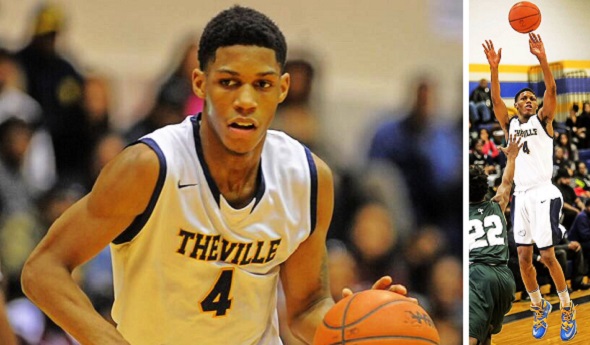
Performance: East English's Kamari Newman
February 25, 2016
 Kamari Newman
Detroit East English senior – Boys Basketball
Newman joined Detroit East English’s first boys varsity basketball team as a freshmen for the 2012-13 season and will graduate as the first all-time great in the young program’s history (the school opened in 2012 after the closures of Detroit Crockett and Finney). In his fourth and final opportunity, the 6-foot-4 guard led the Bulldogs to their first Detroit Public School League Tournament title to earn the Michigan National Guard’s “Performance of the Week.”
Newman scored 17 of his game-high 28 points during the first half of a 71-70 semifinal win over Detroit Collegiate Prep on Feb. 12, then scored a game-high 24 points in the 86-62 championship game win over Detroit Renaissance on Feb. 19 (East English had lost to Renaissance by four in a 2015 PSL semifinal). For the season, Newman is averaging 22 points, six rebounds, four assists and 1.5 steals per game for East English, which is 16-3. Not surprisingly, Newman has the school record for 1,591 career points and also with 193 3-pointers – which are enough to make the MHSAA’s career list in that category, and while he has at least two more games to play. Newman has been a strong shooter throughout his career, but said he's improved his rebounding and leadership most as a senior.
 He also earned all-city honors in cross country in the fall and ran on that team all four years of high school along with a number of his teammates – he credits cross country with helping the basketball team train to play its uptempo style during the winter. Newman has signed to continue his basketball career at George Mason University in Virginia. He is unsure what we will study, but said the sciences are among his favorite and best subjects.
Coach Juan Rickman said: “He’s always worked hard. He likes to stay in the gym. That’s one of the biggest impacts he’s had with our program. He’s been the catalyst. When we started the (PSL) run, he made the conscious decision in his mind that he was done losing, coming up short. When the opportunity presented itself, he became more of a leader. He just didn’t want to lose.”
Performance Point: “It was a tough road. I just wanted to lead us there. We came up short (in the past), so many people were counting us out. I definitely didn’t want to come up short this time.
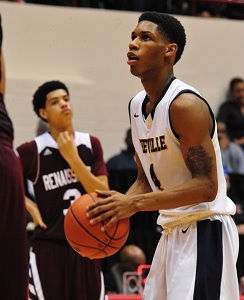 Best in Bulldogs history: “It means a lot, but I know I’ve got a whole lot of work to do. It’s going to be great honor (though), but we’re not done yet. The group of guys, we go so deep. That’s been my favorite part, just being around those guys. (My role) is just to push everybody, to lead, to their limit. I try to get the best out of all my teammates; they respect me.”
Had to be a Patriot: “Just the coaching staff (at George Mason), they were telling me basically what Coach Rickman tells me. They work extremely hard, and really they don’t have anybody to score the ball like that, so I want to go in there and help them where they’re struggling.”
Create like Curry: “Steph Curry; I don’t really watch him too much, because I’m not him. But sometimes I try to be like him. How quickly he gets it off, creates his own shot, that what I like about him. ... I want to get better at becoming the combo (guard), getting the ball when I need it, distributing it, seeing the floor on the defensive end and being more aware.”
– Geoff Kimmerly, Second Half editor
Every week during the 2015-16 school year, Second Half and the Michigan National Guard will recognize a “Performance of the Week" from among the MHSAA's 750 member high schools.
The Michigan Army National Guard provides trained and ready forces in support of the National Military Strategy, and responds as needed to state, local, and regional emergencies to ensure peace, order, and public safety. The Guard adds value to our communities through continuous interaction. National Guard soldiers are part of the local community. Guardsmen typically train one weekend per month and two weeks in the summer. This training maintains readiness when needed, be it either to defend our Nation's freedom, or protecting lives and property of Michigan citizens during a local natural disaster.
Previous 2015-16 honorees
Feb. 17: Jason Whitens, Powers North Central boys basketball - Read
Feb. 10: Rachel Hogan, Grand Ledge gymnastics - Read
Feb. 3: Nehemiah Mork, Midland Dow swimming & diving - Read
Jan. 27: Mardrekia Cook, Muskegon girls basketball - Read
Jan. 20: Sage Castillo, Hartland wrestling - Read
Jan. 13: Rob Zofchak, Dexter swimming & diving - Read
Jan. 6: Tyler Deming, Caro wrestling – Read
Dec. 15: Jordan Weber, East Jordan boys basketball – Read
Dec. 8: Kaitlyn Geers, Kent City girls basketball – Read
PHOTOS: (Top) Detroit East English’s Kamari Newman brings the ball upcourt during the Detroit Public School League Tournament. (Middle) Newman was the team’s leading scorer in both the semifinal and championship game. (Top photos courtesy of the Detroit East English basketball program, middle photo courtesy of the Detroit Public School League/Bonnie Warmack.)
Breslin Bound: Boys A-B Semis Preview
March 19, 2014
By Geoff Kimmerly
Second Half editor
Winning an MHSAA championship Saturday will be thrilling enough for whichever teams emerge from eight Class A and B semifinalists heading to the Breslin Center on Friday.
But the two that finish this weekend as champions will be able to celebrate some additional historical significance.
Four of those eight teams are seeking their first MHSAA title. The most recent championship among the four that have won before came way back in 1965.
Below is the schedule for all four Friday Semifinals and Saturday Finals, plus broadcast information and a look at all eight A and B semifinalists. (See Class C and D previews and schedule in a separate post.)
Semifinals - Friday
Class A
Mount Pleasant (22-4) vs. Muskegon (26-0), 1 p.m.
Detroit U-D Jesuit (22-2) vs. Bloomfield Hills (23-3), 2:50 p.m.
Class B
Benton Harbor (16-9) vs. Cadillac (19-6), 6 p.m.
Detroit Douglass (17-9) vs. Milan (23-3), 7:50 p.m.
Finals - Saturday
Class A - Noon
Class B - 6:30 pm
Class C - 4:30 pm
Class D - 10 am
Tickets cost $8 per pair of Semifinals and $10 per two-game Finals session. All Semifinals will be streamed live on MHSAA.TV on a pay-per-view basis. All four Finals will be broadcast live on Fox Sports Detroit-PLUS. Free radio broadcasts of all weekend games will be available on MHSAANetwork.com.
And now, a look at the Semifinalists in Class A and B.
Class A
BLOOMFIELD HILLS
Record/rank: 23-3, No. 8
League finish: Second in Oakland Activities Association Red
Coach: Duane Graves, first season (23-3)
Championship history: Has not played in an MHSAA Final (first season as a school).
Best wins: 74-62, 73-57 and 53-52 (Regional Final) over honorable mention Clarkston, 67-60 over Class B No. 7 Milan.
Players to watch: Armand Cartwright, 6-2 sr. G; Yante Maten, 6-8 sr. C. (Statistics not submitted.)
Outlook: Neither Bloomfield Hills Lahser nor Andover ever made it to a Quarterfinal, much less the final weekend of the season. But the school created when those two joined last summer has done so immediately under Graves, who coached Lahser before the merger. Cartwright scored his 1,000th career point this season. Maten is an absolute force in the post, and those two led Lahser to a District title last season as well.
DETROIT U-D JESUIT
Record/rank: 22-2, No. 3
League finish: Tied for first in Detroit Catholic League Central
Coach: Pat Donnelly, sixth season (90-43)
Championship history: Has not played in an MHSAA Final.
Best wins: 54-53 (Quarterfinal) and 67-57 over No. 6 Romulus,52-51 over No. 10 Detroit Cass Tech in Regional Final, 47-45 over No. 7 Detroit Southeastern in Regional Semifinal, 59-32 over honorable mention Detroit Renaissance in District opener.
Players to watch: Cassius Winston, 6-1 soph. G (18.4 ppg, 7.2 rpg, 8.7 apg, 4.3 spg); Noah King, 6-4 sr. F (12.5 ppg, 5.8 rpg).
Outlook: Jesuit won its first Regional championship last week after losing during the regular season only to Catholic League rival Warren DeLaSalle and in overtime to Ohio’s Toledo St. John. The starting lineup includes four seniors along with leading scorer Winston, and sophomore guard Billy Thomas is the team’s second-leading scorer with 13.7 points per game off the bench.
MOUNT PLEASANT
Record/rank: 22-4, honorable mention
League finish: Tied for second in Saginaw Valley Association North
Coach: Dan Schell, second season (33-14)
Championship history: Class B Lower Peninsula champion 1932, three runner-up finishes.
Best wins: 69-60 over No. 5 Saginaw Arthur Hill, 64-61 over honorable mention Flint Carman-Ainsworth in Regional Final, 64-54 over Cadillac.
Players to watch: Jaleel Hogan, 6-6 sr. F (16.5 ppg, 11.4 rpg); Aaron Leasher, 6-3 sr. G (11.2 ppg, 3.8 apg. 2.9 spg).
Outlook: The Oilers fell just one win shy of tying for the SVA North championship, but did return to the Quarterfinals for the first time since 1982 – and are seeking their first championship game berth since finishing runner-up in 1981. Hogan, who will play next season at the University of Detroit Mercy, is one of eight seniors who have helped the team improve 11 wins from last season.
MUSKEGON
Record/rank: 26-0, No. 1
League finish: First in Ottawa-Kent Black
Coach: Keith Guy, second season (45-7)
Championship history: Two MHSAA titles (most recent 1937), two runner-up finishes.
Best wins: 88-78 over No. 5 Saginaw Arthur Hill, 65-50 over honorable mention Westland John Glenn, 68-59 over Class C No. 1 Mount Clemens, 73-55 over Benton Harbor.
Players to watch: Deshaun Thrower, 6-0 sr. G (18.6 ppg, 5.6 rpg, 7.0 apg, 3.0 spg); Deyonta Davis, 6-9 jr. F/C (14.2 ppg, 13.6 rpg, 7.0 bpg); Joeviair Kennedy, 6-3 jr. F (12.3 ppg, 6.3 rpg).
Outlook: Muskegon is back in the Semifinals for the first time since 1947 and has made this undefeated run with only four seniors. But one is Mr. Basketball and standout football quarterback Thrower, and Davis is likely the Mr. Basketball favorite for 2014-15. Guy formerly led Muskegon Heights to a number of successful seasons during the 2000s.
Class B
BENTON HARBOR
Record/rank: 16-9, unranked
League finish: Tied for third in Southwestern Michigan Athletic Conference West
Coach: Corey Sterling, second season (34-16)
Championship history: Three MHSAA titles (most recent 1965), six runner-up finishes.
Best wins: 68-61 over No. 1 Wyoming Godwin Heights in Semifinal, 78-73 over T-No. 5 Otsego in Regional Final, 72-63 over Class A No. 9 Battle Creek Central.
Players to watch: Cortez Moore, 6-6 sr. F (21 ppg, 12 rpg, 4.0 apg, 4.0 spg, 3.0 bpg); Jaton Gunn, 6-2 soph. F/G (18 ppg, 3.0 apg, 3.0 spg).
Outlook: Given Benton Harbor’s strong hoops reputation, it’s hard to believe this is the team’s first Semifinal run since 1993. And it came with consecutive upsets of top-five teams, including handing Godwin Heights its only loss this winter. Sterling was a member of that 1993 Class A runner-up team playing for longtime coach Paul Wilhite. Sophomore point guard Curtis Dawson runs the show adding 11 points, seven assists and six steals per game.
CADILLAC
Record/rank: 19-6, unranked
League finish: Tied for second in Big North Conference
Coach: Jeff McDonald, 20th season (322-131)
Championship history: Has not played in an MHSAA Final.
Best wins: 55-49 OT over Big Rapids in Quarterfinal, 46-42 over Mason County Central in Regional Final, 55-52 over Escanaba in Regional Semifinal, 50-42 over Petoskey.
Players to watch: Jalen Brooks, 6-4 sr. F (17.6 ppg, 7.8 rpg); Justin Liptak, 6-5 sr. C (9.0 ppg, 5.3 rpg).
Outlook: Cadillac has won its last four games by six or fewer points to return to the Semifinals for the second straight season. A win Friday would give the Vikings at least 20 in four straight seasons, along with four straight District and Regionals titles. Junior guard Andrew Emington adds another 9.2 points per game from the backcourt.
DETROIT DOUGLASS
Record/rank: 17-9, honorable mention
League finish: Third in Detroit Public School League East Division 1
Coach: Nkwane Young, 10th season (154-72)
Championship history: Has not played in an MHSAA Final.
Best wins: 41-39 over No. 10 Ferndale University in District Final, 69-56 over No. 9 Detroit Country Day in Regional Final, 48-45 over Class A No. 7 Detroit Southeastern, 49-46 and 62-26 over Class A honorable mention Detroit Renaissance.
Player to watch: Darrell Davis, 6-5 sr. G (24.6 ppg, 6.7 rpg, 4.2 apg, 2.0 spg).
Outlook: Douglass has taken the next step after winning its fifth straight District title and second Regional championship during that string. Davis, who will play at University of Dayton next season, was a Mr. Basketball finalist and plays both guard spots. He’s also one of seven seniors, with forward DeShawn Sanders and point guard Terrell Hales also starters.
MILAN
Record/rank: 23-3, No. 7
League finish: First in Huron League
Coach: Josh Tropea, fifth season (90-27)
Championship history: Class C champion 1948.
Best wins: 62-53 over honorable mention Wayland in Quarterfinal, 55-40 over honorable mention Detroit Community in Regional Final, 42-40 (District Semifinal), 57-37 and 59-50 over honorable mention Monroe St. Mary Catholic Central, 57-54 over Class A No. 9 Battle Creek Central.
Players to watch: Latin Davis, 5-9 jr. G (15.9 ppg, 3.8 apg); Nick Perkins, 6-7 jr. F (15 ppg, 9.1 rpg).
Outlook: Milan upped its winning streak to 18 by winning its first Quarterfinal appearance since 1948. The Big Reds lost to a couple of strong Class A schools in Saginaw and Bloomfield Hills during the regular season, which no doubt helped prepare for a competitive string of Class B opponents the last three weeks. The team has only three seniors, with 6-3 guard Donovan Verges adding 9.4 ppg.
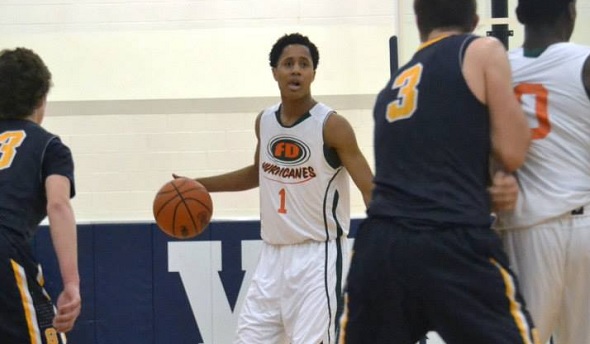
PHOTO: Detroit Douglass' Darrell Davis looks for an open teammate during Tuesday's Quarterfinal win over Goodrich. (Photo courtesy of Detroit Public School League.)