

Performance: Quincy's William Dunn
January 18, 2019
 William Dunn
Quincy junior – Basketball
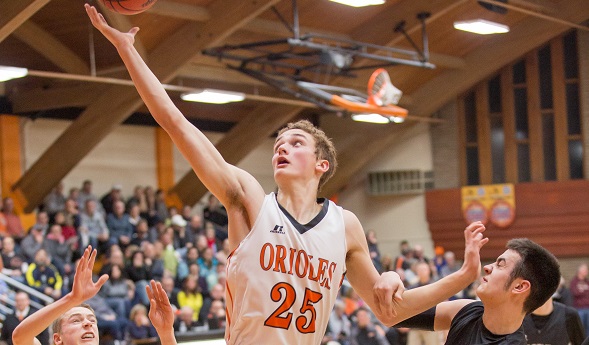
The 6-foot-8 forward had 30 points to lead Quincy past Reading 55-46 on Jan. 8, pushing the Orioles to 9-0 this season while becoming just the third player in program history to go over 1,000 career points. He entered the game needing four to reach the milestone, and he also grabbed 12 rebounds on the way to earning the Michigan Army National Guard “Performance of the Week.”
Over 2½ varsity seasons, Dunn has lead Quincy to a combined 47-10 record, two league titles and a District championship, earning all-state honorable mention from The Associated Press after both of his first two seasons. This winter he’s averaging 25.2 points, 12.1 rebounds, 2.3 assists, 3.4 blocks and 1.2 steals per game, making 55 percent of his shots from the floor and 42 percent of his 3-point tries. Heading into tonight’s game against Concord, Dunn has 1,026 career points, trailing only 1995 graduate Jeff Bell (1,071 points) and 2003 grad Dominic Lopez (1,707) on the school’s all-time scoring list. Both of those players went on to compete at the college level – Bell at Olivet and Lopez at Navy – and Dunn already has scholarship offers from three Division I or II programs, including Division I American University in Washington, D.C.
 Dunn has worked over the last year to get stronger and has upped his endurance as well, necessities especially as he deals with two and three defenders at a time aimed at stopping him. He also played football as a freshman and sophomore, making the varsity as a receiver his second season, and carries a 3.2 GPA with history his favorite academic interest. He could help his 380-student high school make some before his career is done; the Orioles are seeking their first Regional title in boys basketball and made the Regional Final his freshman season.
Coach Scott Rodesiler said: “William Dunn is a unique talent who has been on the varsity team since his freshman season. During his first season, you could see that there was something special about him as a player. … (He) brings a unique blend of size, skill, athleticism, work ethic, competitiveness, and unselfishness to our team. Dunn's game is extremely versatile because his skill set allows him to score in so many different ways: fastbreaks, posting up, shooting a 3-pointer, driving to the hoop, shooting a mid-range jumper, (putting back) an offensive rebound, or hitting free throws. You may see him filling a lane on the fastbreak or getting the rebound and leading the fastbreak himself. William is basically a guard in a big man's body. I would not hesitate to play him at point guard if I needed him to do so. His ball handling and vision of the court are outstanding. The great thing about having William on the team is that you always know going into a game that you have a great chance of winning because he is capable of scoring 30+ points, pulling down 15+ rebounds and forcing other teams to change their defensive game plans. ... William's biggest improvement since last season has been his outside shot, in my opinion. Dunn made thousands of shots in the past year to take his game to a new level. He always had a nice shooting stroke, but the work he put in has allowed him to shoot with greater consistency. William has achieved at a high level all while facing double and triple teams, as well as numerous 'junk' defenses. One of his greatest abilities is making the right decisions with the basketball when faced with these types of defenses.”
Performance Point: “I just thought it was pretty cool that I was the third player to get (1,000), and so that means that not many people get that opportunity,” Dunn said. “(Reaching it as a junior) just shows all of the work that I've put in. It's just reflecting that. It's another step to everything that's been going on.”
On the radar, and the map: “It's nice for people to start recognizing some of the stuff that I've been able to do, or some of the stuff that I've accomplished. After my freshman year I had gone to some camps, and some people asked who I was and said they had heard of me. It's funny, because a lot of times they'll ask me where I'm from, and I tell them and they have no clue. They don't know where (Quincy) is. I ask them (if they know) where Coldwater is, because we're right next to that and it's a little bigger town, and if they don't know where that is, I just say it's right next to the Indiana border. ... Sometimes I hold up my hand like the mitten and point to it.”
 Small town, big support: “It's kinda unique. … It feels like when we do something special, it's means more because it doesn't happen as often. I like the community aspect (of being small-town). Everybody knows you, everywhere you go. You go in town, go out to eat, there's people that you have no clue who they are but they've heard about you, seen you in the newspaper. It's real cool.”
Hard work pays: “It's really exciting to do this for the school and for the town. We work hard. We come into practice every day, practice extremely hard. We bond really well. There's nobody butting heads or anything; we mesh really well.”
School in session: “I’m been thinking about going into education and trying to be a teacher. Both of my parents are teachers; my dad is a weight training teacher and (teaches) health class and personal finance, and my mom is a fifth-grade science teacher. … They’ve always stressed (education), that school always comes first. Sometimes it gets a little hectic, but I've always adjusted to it. I always have known I have to get my work done.”
- Geoff Kimmerly, Second Half editor
Every week during the 2018-19 school year, Second Half and the Michigan Army National Guard recognizes a “Performance of the Week" from among the MHSAA's 750 member high schools.
The Michigan Army National Guard provides trained and ready forces in support of the National Military Strategy, and responds as needed to state, local, and regional emergencies to ensure peace, order, and public safety. The Guard adds value to our communities through continuous interaction. National Guard soldiers are part of the local community. Guardsmen typically train one weekend per month and two weeks in the summer. This training maintains readiness when needed, be it either to defend our nation's freedom or protect lives and property of Michigan citizens during a local natural disaster.
Past 2018-19 honorees
November 29: Dequan Finn, Detroit Martin Luther King football - Read
November 22: Paige Briggs, Lake Orion volleyball - Read
November 15: Hunter Nowak, Morrice football - Read
November 8: Jon Dougherty, Detroit Country Day soccer - Read
November 1: Jordan Stump, Camden-Frontier volleyball - Read
October 25: Danielle Staskowski, Pontiac Notre Dame Prep golf - Read
October 18: Adam Bruce, Gladstone cross country - Read
October 11: Ericka VanderLende, Rockford cross country - Read
October 4: Kobe Clark, Schoolcraft football - Read
September 27: Jonathan Kliewer, Grand Rapids Forest Hills Northern soccer - Read
September 20: Kiera Lasky, Bronson volleyball - Read
September 13: Judy Rector, Hanover-Horton cross country - Read
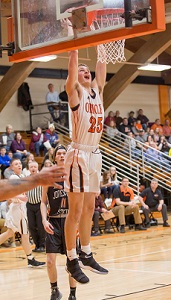
PHOTOS: (Top) Quincy's William Dunn goes to the basket against Jonesville on Dec. 9. (Middle) Dunn rises to the rim during the 35-29 win. (Photos by Expressions Photography Design.)
Starkey's Petoskey Ready to Shine Again
December 15, 2017
By Dennis Chase
Special for Second Half
PETOSKEY – Dennis Starkey remembers it like it happened yesterday.
Thirty-five years ago, at the age of 23, Starkey made his varsity head coaching debut with the Boyne City Ramblers.
 “The first game I coached was against the legendary Charlie Paige (Harbor Springs),” Starkey recalled. “I got it handed to me pretty good. I knew I had a long way to go after that ballgame.”
Starkey learned quickly. Now, starting his 31st season as coach of the Petoskey Northmen, the 58-year-old is among the winningest coaches in MHSAA history. His 536 career wins rank 18th all-time among boys coaches – with an average of nearly 16 wins a season.
Starkey should move up that list in the coming weeks as the Northmen appear poised for a promising winter.
Petoskey opened the campaign by capturing its Tip-Off Classic last weekend, beating Marquette 55-38 and Manton 66-57. Marquette won 20 games a year ago, while Manton was a Class C semifinalist.
“It’s a great start,” Starkey said. “We played two good teams. We have a lot of work to do, but we’re excited. This is a good group. These guys were really committed during the offseason. Hopefully, that will pay dividends.”
Petoskey was an uncharacteristic 12-8 a year ago. That squad was comprised of three seniors and nine juniors – and one of the key juniors, 6-foot-9 center Danny Kolp, was recovering from knee surgery.
“I’ve always said you win and lose with seniors,” Starkey said. “Our inexperience really showed last year. Luckily, we’re loaded with seniors this year. We’re hoping to get back to where we were before.”
The Northmen were 20-2 two years ago.
Motivation should not be a problem.
“We were pretty unhappy with how we did last year,” senior Joel Wilson, a two-year starter, said. “I expect a lot from this team.”
So does Kolp.
“(High school) memories last forever, and we want to make this a memorable senior season,” he said. “We want to reach our full potential. We have a high ceiling.
“We have the athleticism and skills to make a run in the tournament,” he added. “That’s our goal. Petoskey hasn’t been to a Regional (since 2012). We have a good chance to do it this year if we keep playing as a team.”
Petoskey, which returns four starters, put its size and balance on display last weekend. Seth Mann, a 6-5 guard, averaged 17 points in the two wins. Kolp, who has signed with Northwood University, came up big in the paint, averaging 16 points, six rebounds and two blocks. The athletic 6-4 Wilson contributed 13 points a game, and 6-5 Jake Lee 9.5 points. All are seniors, as is starting point guard Collin Kingma.
Petoskey not only used its length to its advantage – especially defensively and on the boards – but played with a focus.
“I think the biggest improvement thus far is mental,” assistant coach Kevin Starkey, Dennis’s son, said. “Even coach Hiller (Ryan Hiller at Manton) told me after watching the Marquette game that the guys looked locked in, ready to go. It’s visibly noticeable.”
Dennis Starkey started this season much like he has the previous 34, preaching a “team first” approach. From there, he addressed the standards his program is built on.
“It starts with being good students, good citizens,” he said. “If you have to fight issues that do not involve basketball, then you’re never going to be successful (on the court). Our guys have bought into a system that starts with everyone playing together, playing the way we expect and acting the way we expect.”
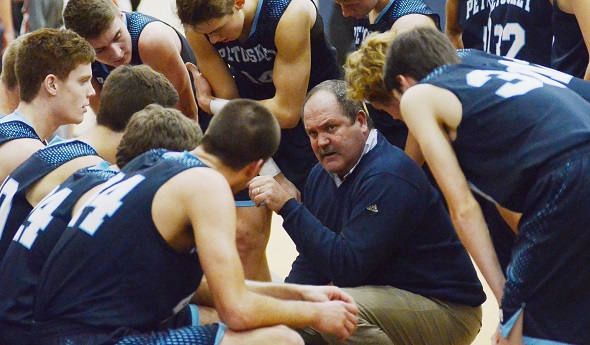
Starkey asks that his players, especially his seniors, take ownership of the team. As a reminder, after each practice, the coaches step away as the players huddle on the court to dissect that day’s effort.
“The one thing I’ve always enjoyed about coach Starkey is that he emphasizes it’s our team and we can make it how we want to make it,” Kolp, a three-year varsity veteran, said. “We’re not going to be as good if he’s the only one barking at us. He holds us accountable, and we enjoy that challenge.”
“He likes to say we’re all coaches on the court, that we should be coaching and learning from each other,” Wilson added. “He stresses that every day.”
It helps, of course, to have a team that’s already tightly woven. The seniors on this team have been playing basketball together since fifth grade and are “buddies” off the court.
 On the court, Starkey clearly sets the tone, though.
“He’s not afraid to get in your face,” Wilson said. “He pushes you hard. But it’s all for the better.”
Petoskey has long been noted for producing disciplined, fundamentally-sound teams. That’s Starkey’s style.
“We try to play up-tempo as much as we can,” he said. “But we really rely on executing offensively and defensively in the half court.”
It’s an approach that runs deep in the system. Sean Pollion, Matt Tamm and Jason Miller all have 20-plus years coaching high school basketball at the school. Pollion is an assistant to Starkey, Tamm is now the JV coach while Miller just moved over to the girls program. In addition, Kevin Starkey and Jon Flynn, a star on the school’s two Class B Semifinal teams in the late 1990s, are assisting.
“That continuity means so much in high school basketball,” Dennis Starkey said. “Some programs have a hard time keeping coaches for extended periods. It’s been an advantage for us. It’s paid dividends.”
Starkey started honing his skills at Boyne City, serving a one-year apprenticeship under Bob Taylor, who went on to coach in the Great Lakes Intercollegiate Athletic Conference. He replaced Taylor, who took the Lake Superior State women’s job, and then left Boyne City after a season to accept a head coach/athletic director position at Vanderbilt. It was there he met his wife, Karen. After three years, Starkey moved on to Petoskey. To this day, former longtime Petoskey athletic director Gary Hice calls it one of the best decisions he ever made.
Inducted into the Basketball Coaches Association of Michigan Hall of Fame in 2014, Starkey has coached teams that have won 17 Districts and four Regionals.
His 1996-98 squads featured guards Trevor Huffman, who later led Kent State to an Elite 8 NCAA Tournament appearance in 2002, and Flynn, Grand Valley State’s all-time leading scorer (2,220 points).
Starkey would later coach his sons, Kevin and Cory. Cory, who went on to earn all-state honors, played at Bucknell and then a year professionally in Ireland. After earning his master’s degree in international finance, Cory accepted a job with an investment company in Chicago. His boss? Former Charlevoix basketball standout Scott Friske, now a senior vice president at First Trust. Friske and Petoskey’s Damon Huffman, Trevor’s younger brother, were teammates at Brown. Another former Charlevoix Rayder, Jared Hunt, also works at First Trust.
“Basketball opened a door for (Cory) in the business world,” Dennis Starkey said. “He’s been blessed. When you’re involved in this sport, you have so many contacts. And a lot of the northern Michigan guys look after each other. It’s a real special bond they create, all because of high school basketball.”
But the story is not over. Trevor Huffman is also in Chicago and lives with Cory. Huffman is still involved in basketball.
“He’s using basketball as an adult workout platform,” Starkey said. “He has guys come in and they do drills, much like we do in practice. So instead of going to the gym and lifting weights and doing cross-training, his clients, most of them former players, use basketball as a form of exercise to become more fit.”
After graduating from University of Michigan, Kevin Starkey headed back north and took a teaching/coaching job at Manton, serving as an assistant to Hiller. The Rangers first game that season? Petoskey.
“That was bizarre, coaching against my dad,” Kevin admitted.
When Dennis Starkey retired as a physical education teacher, Kevin Starkey was hired to replace him. He’s now in his third year at the school.
It’s given Kevin a unique perspective on his dad. He played two years for him on varsity (2007-08 and 2008-09) and has now coached with him three years. When asked if he has a favorite story that encapsulates the type of person his father is, Kevin doesn’t have to think long.
“My senior year we were playing Charlevoix and I had just recently broken my hand,” he said. “It was my first game back. We didn’t know what to expect. When the game started, they were sagging off me because (the injury) was to my shooting hand. When I put up that first shot, I hit it. Then, all of a sudden, I hit five 3s in the first half. He never lets it go. It’s something I remember because he was so proud of me. It was my last (home) game and I was just trying not to air-ball it. Somehow, a few of them went in.
“Well, the next year when I came home from college – we sometimes watched old game films, or films of us growing up – he puts that game in first. He was like, ‘Man, that was so cool.’ I say that not because I need credit, but it was one of those things where he was more excited than I was for myself.”
 That, Kevin added, is how Dennis is with his players. He wants the best for them.
This team is no exception.
Kolp, who has had two knee operations, is finally healthy. His last surgery was in June of 2016, and he missed the first six games a year ago.
“He really wasn’t himself - until now, to be honest,” Starkey said.
In eighth grade, Kolp landed awkwardly on his right leg, tore a ligament and dislocated his kneecap.
“They couldn’t do the full operation because I was still growing,” he explained. “Two years later I blew it out again.”
Kolp, who plans to go into an entrepreneurial program at Northwood, spent this past offseason working hard in the weight room.
“I was in there five days a week, lifting to improve my upper and lower body,” he said. “Now, during the season, I’m in there two to three times a week to maintain my strength. I feel good. Everything is coming together.”
Wilson, all agree, is the most athletic player on the squad. He was a first-team all-Big North Conference pick as a quarterback and outside linebacker in football. Several colleges have expressed interest, and he is visiting Central Michigan this weekend and will miss Saturday’s game with Zeeland East. Central Michigan is recruiting him as a preferred walk-on with plans to use him at tight end.
“It’s (disappointing) to miss the game, but I have a decision to make that will (affect) the next four years of my life,” he said.
Mann is the team’s top perimeter shooter.
“Seth is a skilled shooter,” Starkey said. “He has good size and length. I think he’s going to have a great year.”
Kolp agrees.
“With our size, if we get it into the post, and (opponents are) starting to play help defense from the backside, and Seth is in the corner, he’ll punish them for it,” he said.
It could be a special season.
Starkey, though, is not one to think too far ahead. He said the best advice he ever received was to “live in the moment, coach in the moment.”
And he knows there will be challenges ahead. There are no guarantees.
“As excited as I am with all the guys we have back, every coach in the league feels the same way,” he said. “Last year there was only one senior on the first and second all-conference team. It’s going to be a very good race.”
As for the future, Starkey, who credits a strong support system at home for his success, is not saying how much longer he’ll coach.
Kevin has an opinion, however.
“It’s something he’s really good at,” Kevin said. “I look at it like this: Don’t throw it away if you’ve still got it.”
 Dennis Chase worked 32 years as a sportswriter at the Traverse City Record-Eagle, including as sports editor from 2000-14. He can be reached at [email protected] with story ideas for Manistee, Wexford, Missaukee, Roscommon, Ogemaw, Iosco, Alcona, Oscoda, Crawford, Kalkaska, Grand Traverse, Benzie, Leelanau, Antrim, Otsego, Montmorency, Alpena, Presque Isle, Cheboygan, Charlevoix and Emmet counties.
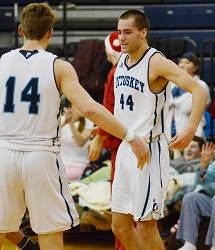
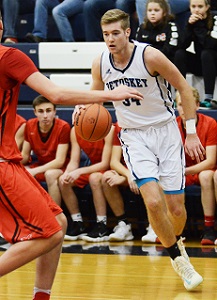
PHOTOS: (Top) Petoskey coach Dennis Starkey huddles with his team during the season-opening Tip-Off Classic. (Middle) Joel Wilson (14) and Jake Lee share a celebratory moment. (Below) Senior Danny Kolp pushes the ball upcourt during the event. (Photos courtesy of the Petoskey News-Review.)