

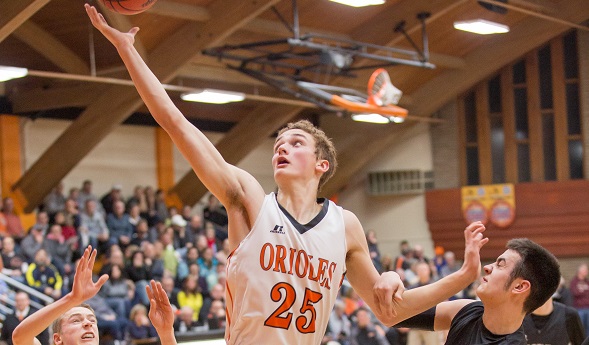
Performance: Quincy's William Dunn
January 18, 2019
 William Dunn
Quincy junior – Basketball
The 6-foot-8 forward had 30 points to lead Quincy past Reading 55-46 on Jan. 8, pushing the Orioles to 9-0 this season while becoming just the third player in program history to go over 1,000 career points. He entered the game needing four to reach the milestone, and he also grabbed 12 rebounds on the way to earning the Michigan Army National Guard “Performance of the Week.”
Over 2½ varsity seasons, Dunn has lead Quincy to a combined 47-10 record, two league titles and a District championship, earning all-state honorable mention from The Associated Press after both of his first two seasons. This winter he’s averaging 25.2 points, 12.1 rebounds, 2.3 assists, 3.4 blocks and 1.2 steals per game, making 55 percent of his shots from the floor and 42 percent of his 3-point tries. Heading into tonight’s game against Concord, Dunn has 1,026 career points, trailing only 1995 graduate Jeff Bell (1,071 points) and 2003 grad Dominic Lopez (1,707) on the school’s all-time scoring list. Both of those players went on to compete at the college level – Bell at Olivet and Lopez at Navy – and Dunn already has scholarship offers from three Division I or II programs, including Division I American University in Washington, D.C.
 Dunn has worked over the last year to get stronger and has upped his endurance as well, necessities especially as he deals with two and three defenders at a time aimed at stopping him. He also played football as a freshman and sophomore, making the varsity as a receiver his second season, and carries a 3.2 GPA with history his favorite academic interest. He could help his 380-student high school make some before his career is done; the Orioles are seeking their first Regional title in boys basketball and made the Regional Final his freshman season.
Coach Scott Rodesiler said: “William Dunn is a unique talent who has been on the varsity team since his freshman season. During his first season, you could see that there was something special about him as a player. … (He) brings a unique blend of size, skill, athleticism, work ethic, competitiveness, and unselfishness to our team. Dunn's game is extremely versatile because his skill set allows him to score in so many different ways: fastbreaks, posting up, shooting a 3-pointer, driving to the hoop, shooting a mid-range jumper, (putting back) an offensive rebound, or hitting free throws. You may see him filling a lane on the fastbreak or getting the rebound and leading the fastbreak himself. William is basically a guard in a big man's body. I would not hesitate to play him at point guard if I needed him to do so. His ball handling and vision of the court are outstanding. The great thing about having William on the team is that you always know going into a game that you have a great chance of winning because he is capable of scoring 30+ points, pulling down 15+ rebounds and forcing other teams to change their defensive game plans. ... William's biggest improvement since last season has been his outside shot, in my opinion. Dunn made thousands of shots in the past year to take his game to a new level. He always had a nice shooting stroke, but the work he put in has allowed him to shoot with greater consistency. William has achieved at a high level all while facing double and triple teams, as well as numerous 'junk' defenses. One of his greatest abilities is making the right decisions with the basketball when faced with these types of defenses.”
Performance Point: “I just thought it was pretty cool that I was the third player to get (1,000), and so that means that not many people get that opportunity,” Dunn said. “(Reaching it as a junior) just shows all of the work that I've put in. It's just reflecting that. It's another step to everything that's been going on.”
On the radar, and the map: “It's nice for people to start recognizing some of the stuff that I've been able to do, or some of the stuff that I've accomplished. After my freshman year I had gone to some camps, and some people asked who I was and said they had heard of me. It's funny, because a lot of times they'll ask me where I'm from, and I tell them and they have no clue. They don't know where (Quincy) is. I ask them (if they know) where Coldwater is, because we're right next to that and it's a little bigger town, and if they don't know where that is, I just say it's right next to the Indiana border. ... Sometimes I hold up my hand like the mitten and point to it.”
 Small town, big support: “It's kinda unique. … It feels like when we do something special, it's means more because it doesn't happen as often. I like the community aspect (of being small-town). Everybody knows you, everywhere you go. You go in town, go out to eat, there's people that you have no clue who they are but they've heard about you, seen you in the newspaper. It's real cool.”
Hard work pays: “It's really exciting to do this for the school and for the town. We work hard. We come into practice every day, practice extremely hard. We bond really well. There's nobody butting heads or anything; we mesh really well.”
School in session: “I’m been thinking about going into education and trying to be a teacher. Both of my parents are teachers; my dad is a weight training teacher and (teaches) health class and personal finance, and my mom is a fifth-grade science teacher. … They’ve always stressed (education), that school always comes first. Sometimes it gets a little hectic, but I've always adjusted to it. I always have known I have to get my work done.”
- Geoff Kimmerly, Second Half editor
Every week during the 2018-19 school year, Second Half and the Michigan Army National Guard recognizes a “Performance of the Week" from among the MHSAA's 750 member high schools.
The Michigan Army National Guard provides trained and ready forces in support of the National Military Strategy, and responds as needed to state, local, and regional emergencies to ensure peace, order, and public safety. The Guard adds value to our communities through continuous interaction. National Guard soldiers are part of the local community. Guardsmen typically train one weekend per month and two weeks in the summer. This training maintains readiness when needed, be it either to defend our nation's freedom or protect lives and property of Michigan citizens during a local natural disaster.
Past 2018-19 honorees
November 29: Dequan Finn, Detroit Martin Luther King football - Read
November 22: Paige Briggs, Lake Orion volleyball - Read
November 15: Hunter Nowak, Morrice football - Read
November 8: Jon Dougherty, Detroit Country Day soccer - Read
November 1: Jordan Stump, Camden-Frontier volleyball - Read
October 25: Danielle Staskowski, Pontiac Notre Dame Prep golf - Read
October 18: Adam Bruce, Gladstone cross country - Read
October 11: Ericka VanderLende, Rockford cross country - Read
October 4: Kobe Clark, Schoolcraft football - Read
September 27: Jonathan Kliewer, Grand Rapids Forest Hills Northern soccer - Read
September 20: Kiera Lasky, Bronson volleyball - Read
September 13: Judy Rector, Hanover-Horton cross country - Read
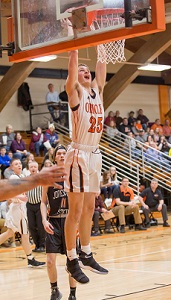
PHOTOS: (Top) Quincy's William Dunn goes to the basket against Jonesville on Dec. 9. (Middle) Dunn rises to the rim during the 35-29 win. (Photos by Expressions Photography Design.)
C-D Preview: All Eyes on Thursday
March 22, 2017
By Geoff Kimmerly
Second Half editor
It's rare that Michigan's smallest schools are the headliners of the MHSAA's Boys Basketball Finals.
But as the final weekend of the tournament gets underway Thursday, the evening session's first game arguably is the most intriguing matchup of the entire event.
Two-time reigning Class D champion Powers North Central will try to extend the longest active winning streak in the country against a recent three-time champion in Southfield Christian that played in Class C the last two seasons. The Jets have won 81 straight games, breaking the MHSAA record with their 66th straight victory earlier this winter.
That's just one of what should be an entertaining collection of games in Class C and D this weekend. All four Class C and D Semifinals will be played Thursday, with all four championship games Saturday.
Semifinals - Thursday
Class C
Detroit Edison PSA (14-11) vs. Flint Beecher (21-5), 1 p.m.
Grand Rapids Covenant Christian (20-5) vs. Manton (21-4), 2:50 p.m.
Class D
Powers North Central (26-0) vs. Southfield Christian (21-5), 6 p.m.
Lansing Christian (19-6) vs. Buckley (25-0), 7:50 p.m.
Finals - Saturday
Class A - Noon
Class B - 6:30 p.m.
Class C - 4:30 p.m.
Class D - 10 a.m.
Tickets cost $8 per pair of Semifinals and $10 per two-game Finals session. All Semifinals will be streamed live on MHSAA.tv on a pay-per-view basis. All four Finals will be broadcast live on Fox Sports Detroit. Free radio broadcasts of all weekend games will be available on MHSAANetwork.com.
And now, a look at the semifinalists in Class C and D. Click on the name of the school to see that team’s full schedule and results from this season. (Statistics are through teams' Regional Finals.) The Boys Basketball Finals are presented by Sparrow Health System.
Class C
DETROIT EDISON PUBLIC SCHOOL ACADEMY
Record/rank: 14-11, unranked
League finish: Third in Detroit Public School League East Division 1
Coach: Brandon Neely, fourth season (56-33)
Championship history: Has never appeared in an MHSAA Final.
Best wins: 61-48 over No. 2 Monroe St. Mary Catholic Central in the Quarterfinal, 66-60 over Detroit Cornerstone Health & Technology in the Regional Final, 57-51 over Detroit Martin Luther King, 99-81 over Class A honorable mention Detroit East English, 68-67 over Detroit Osborn.
Players to watch: Pierre Mitchell, Jr., 6-0 jr G; Gary Solomon, 6-5 jr. G (Statistics not submitted).
Outlook: Edison won its first Regional title to advance to this week and will now try to follow the example of its girls team, which won the Class C championship last weekend. The Pioneers joined the PSL this season and split with Class A King and East English and Class B quarterfinalist Osborn – and also avenged an earlier 26-point loss to Cornerstone by winning the Regional Final. Solomon made the all-state first team, and Mitchell earned an honorable mention.
FLINT BEECHER
Record/rank: 21-5, Tied for No. 4
League finish: First in Genesee Area Conference Red
Coach: Mike Williams, 13th season (250-76)
Championship history: Seven MHSAA titles (most recent 2016), four runner-up finishes.
Best wins: 59-57 over Class A No. 6 Detroit U-D Jesuit, 72-57 and 88-63 over Lake Fenton, 63-54, 77-73 and 80-64 (District Quarterfinal) over Flint Hamady.
Players to watch: Malik Ellison, 5-7 sr. G (23.8 ppg, 64 3-pointers); Jordan Roland, 5-11 sr. G (12.6 ppg); Levane Blake, 6-7 sr. C (7.7 ppg, 8.8 rpg, 3.7 bpg).
Outlook: Beecher has won the last two Class C championships and four of the last five, and enters with the Class C Player of the Year from The Associated Press in Ellison – who with Blake and Roland started in last season’s championship game (Ellison and Blake also started in the 2015 Final). Blake and Roland both earned all-state honorable mentions this season to go with Ellison’s top honor. The losses were all to Class A and B teams, including B semifinalist New Haven (in triple overtime) and reigning champion Detroit Henry Ford
GRAND RAPIDS COVENANT CHRISTIAN
Record/rank: 20-5, unranked
League finish: Does not play in a league.
Coach: Tyler Schimmel, third season (48-20)
Championship history: Class D champion in 1994, 1993 and 1973.
Best wins: 51-50 over Muskegon Heights Academy in the Regional Final, 56-52 (2OT) over No. 7 Pewamo-Westphalia in the Regional Semifinal, 80-67 over Class D No. 8 Lansing Christian, 61-47 over Spring Lake.
Players to watch: Carson Meulenberg, 6-6 jr. F (13.4 ppg, 6.5 rpg); Benji Kuiper, 6-0 sr. G (10.6 ppg, 49 3-pointers, 5.1 apg).
Outlook: Covenant Christian is back at the Semifinals for the first time since 1994 and for the first time ever as a Class C school. The Chargers played a regular-season schedule filled with larger schools, making their streak of 13 wins over their last 14 games especially impressive. Kuiper earned an all-state honorable mention and distributes to a starting lineup with four juniors. In addition to Kuiper’s sharp-shooting, teammate Tyler Cammenga had 64 3-pointers entering the week; he and forward Trenton Koole both add 9.1 ppg.
MANTON
Record/rank: 21-4, unranked
League finish: Second in Highland Conference
Coach: Ryan Hiller, 11th season (123-119)
Championship history: Class C (Lower Peninsula) champion 1946, Class C runner-up 1996.
Best wins: 51-49 (OT) over Negaunee in the Quarterfinal, 54-48 over No. 1 McBain in the Regional Final, 58-32 over Beaverton, 52-48 over Petoskey, 76-72 over Traverse City West.
Players to watch: Jayden Perry, 5-7 jr. G (16 ppg, 53 3-pointers); Hunter Ruell, 5-8 jr. G (12.7 ppg, 3.6 apg, 50 3-pointers).
Outlook: Manton’s only two losses over its last 17 games were to undefeated Buckley and McBain, which Manton then upset during the tournament. The Rangers have increased their win total for four straight seasons. Perry earned an all-state honorable mention and has the most attempts among a trip of sharp shooters – in addition to Perry and Ruell, sophomore guard Trevor Salani also had 48-pointers entering the week and averages 11 points per game.
Class D
BUCKLEY
Record/rank: 25-0, No. 4
League finish: First in Northwest Conference
Coach: Blair Moss, fourth season (53-36)
Championship history: Has never appeared in an MHSAA Final.
Best wins: 48-37 over Wyoming Tri-unity Christian in the Quarterfinal, 50-38 and 56-41 over No. 8 Frankfort, 77-73 over Manton, 78-39 and 63-60 over Maple City Glen Lake.
Players to watch: Denver Cade, 6-2 jr. G (21 ppg, 6.9 rpg, 3.6 apg); Austin Harris, 6-3 jr. C (18.5 ppg, 6.9 rpg, 5.5 apg, 2.4 bpg).
Outlook: Buckley has advanced to its first Semifinals with only two wins by fewer than 10 points this season and without a senior in the starting lineup. The Bears set the tone with a District title in 2016, and have simply dominated led by Cade, an all-state first-team selection, and honorable mention pick Harris. Those two also had combined for 103 3-pointers heading into this week, both making more than half their attempts from behind the arc. Junior guard Joe Weber adds another 10.9 points and 3.5 assists per game.
LANSING CHRISTIAN
Record/rank: 19-6, Tied for No. 8
League finish: Tied for first in Greater Lansing Activities Conference
Coach: Chris Mustaine, first season (19-6)
Championship history: Has never appeared in an MHSAA Final.
Best wins: 63-36 over Webberville in the District Semifinal, 74-63 over Olivet, 54-39 over Wyoming Tri-unity Christian, 56-42 over Leslie.
Players to watch: Matt Havey, 6-1 sr. G (17.9 ppg, 58 3-pointers); Preston Granger, 6-4 sr. C (15.4 ppg, 7.2 rpg).
Outlook: Lansing Christian is back at the Breslin Center for the first time since 2013 and after bouncing back from a brief lull at the end of the regular season. The Pilgrims dropped three of their final four games before the playoffs, but stormed back to win all of their tournament games by at least 10 points. Havey is an impressive shooter; the all-state first-teamer was hitting 42 percent of his 3-point tries entering the week. Granger also earned an all-state honorable mention, and senior guard Forrest Bouyer adds 10 points, 6.2 assists and 3.9 steals per game.
POWERS NORTH CENTRAL
Record/rank: 26-0, No. 1
League finish: First in Skyline Central Conference West
Coach: Adam Mercier, 11th season (186-78)
Championship history: Class D champions 2016, 2015 and 1984.
Best wins: 74-61 over No. 3 Hillman in the Quarterfinal, 75-73 over Dollar Bay in the Regional Semifinal, 76-29, 84-52 and 79-60 (District Final) over No. 7 Bark River-Harris.
Players to watch: Jason Whitens, 6-5 sr. G (22.6 ppg, 11.1 rpg, 6.1 apg, 3.1 spg); Dawson Bilski, 6-3 sr. G (19.7 ppg, 8.0 rpg, 4.0 apg).
Outlook: North Central has now won 81 straight games, including through two straight Class D title runs. Whitens was named Class D co-Player of the Year by The Associated Press and was a Mr. Basketball Award finalist, and Bilski also made the all-state first team. They’ve both started on all three Breslin teams, while senior guard Bobby Kleiman (10.6 ppg) was a main sub the last two seasons and senior guard Marcus Krachinski (10.6 ppg) played a big role off the bench during last season’s run. A number of players also were part of the last two 8-player football MHSAA champions. Bilski will continue next season at Michigan Tech, and Whitens is choosing from a number of college options.
SOUTHFIELD CHRISTIAN
Record/rank: 21-5, No. 2
League finish: First in Michigan Independent Athletic Conference Blue
Coach: Josh Baker, sixth season (110-18)
Championship history: Class D champions 2014, 2013 and 2012.
Best wins: 64-42 over No. 10 Fowler in the Quarterfinal, 72-65 over North Farmington, 87-77 over West Bloomfield, 73-55 over Detroit Cornerstone Health & Technology.
Players to watch: Bryce Washington, 6-3 jr. G (18.5 ppg, 7.0 rpg); Brock Washington, 6-4 sr. G (13.1 ppg, 6.6 rpg).
Outlook: Southfield Christian played in Class C the last two seasons and won two District titles, and returns to Class D with plenty of star power again. Washington was named co-Player of the Year with Whitens, and Brock Washington also made the all-state first team. Sophomore guards Harlond Beverly (12.4 ppg) and Caleb Hunter (11.6) also offer scoring punch, and all four had at least 22 3-pointers this season entering this week. Three losses came to Class A teams, and the other two came to teams in Class B including one to semifinalist River Rouge.
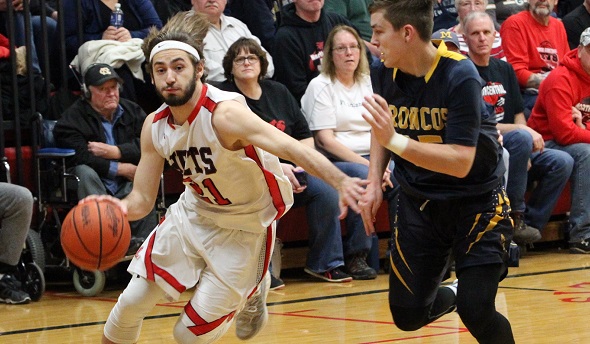
PHOTO: Powers North Central's Bobby Kleiman (21) drives around a Bark River-Harris defender during their first matchup this season. (Photo by Paul Gerard)