

Performance: Unity's Noah Wiswary
March 22, 2019
 Noah Wiswary
Hudsonville Unity Christian senior – Basketball
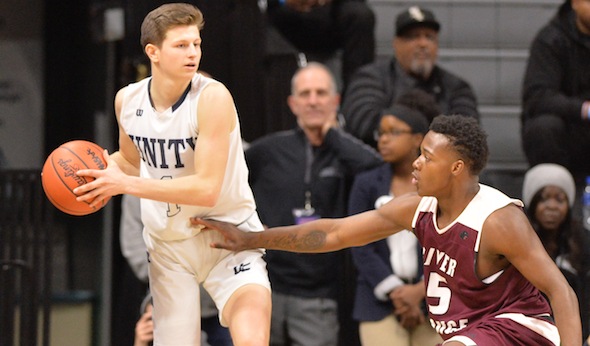
The 6-foot-1 senior point guard entered the final week of the season as Unity Christian’s fourth-leading scorer at 7.8 points per game. But Wiswary led the Crusaders in scoring in their Quarterfinal, Semifinal and championship game wins as the program won its first MHSAA Finals championship, earning Wiswary the Michigan Army National Guard “Performance of the Week.”
Wiswary had 15 points and eight assists in the Quarterfinal as Unity avenged an earlier two-point loss with a 71-45 win over Grand Rapids South Christian. He added 17 points on 6-of-8 shooting against Ludington in a 69-30 Semifinal win, and then 17 points again on 6-of-9 shooting as the Crusaders edged River Rouge 58-55 on Saturday. Wiswary also scored 11 points in Unity’s Regional Final win the week before over Benton Harbor, last season’s Class B champion. His final week of work raised Wiswary’s scoring average to 8.7 ppg for the season, to go with 4.5 assists per game. The varsity’s ball boy before high school, Wiswary finished his career either first or second all-time on Unity’s career assists list – the numbers are being tabulated – and the team was a combined 63-12 during his three seasons on varsity, including 26-2 this winter.
 This was the second championship of this school year for Wiswary, a starting defensive back on the football team that won the Division 5 title in the fall. He also plays center field and pitches for the baseball team, and is hoping he’ll continue his basketball career at the college level. Wiswary is undecided where, but plans to study criminal justice in pursuit of a career in law enforcement.
Coach Scott Soodsma said: “If you wanted to look at one key individual who stepped up his game during the tournament run, there is one unanimous choice and it’s him. It’s not that he was always the best player, but where he came from to where he ended was sensational. The kid obviously led us through the tournament. I really was impressed with his hustle at both ends of the floor. He’s always been a pretty good offensive player, and he really turned it up defensively a lot. He’s capable of guarding almost everything, and his leadership, his will to win – he was willing to do whatever it took, and the urgency set in being a senior. … Just the expectation was there. Without an expectation, it’s a lot more difficult to win. When you expect to win rather than hope to win, you think you’ll win. The expectation we are going to win is a huge asset, and I think that’s exactly where he was at – he really believed we were going to win, and he played like that.”
Performance Point: “I just think we took the role as underdog. Last year we lost to Benton Harbor, so we were like, ‘This is our year.’ Nobody really looked at us because obviously there’s Benton Harbor, River Rouge, South Christian, and we were going to just shock the world – and that’s what we did. … I knew we had to turn it up a notch because (there were) only three games left in our season, and my teammates, they got me the ball in the right spots. When I have shooters that other people are worried about, it just got me open way more. I’ve got four shooters on the floor. I’m going to get them the ball. But the opportunity was there. I was open – I was going to shoot it.”
Winner’s mentality: “We’ve been here (to Finals in other sports) before, and nobody really cares – I play good, T.J. (VanKoevering) plays good, nobody really cares as long as we win. If I scored 40 points and we lost, we’d all still be really mad and I’d be mad, but all we wanted to do was win. We had that winning mentality of we just wanted to win. … I thought we could beat Benton Harbor, but I didn’t actually think it was going to happen. Once we beat Benton Harbor I was like, ‘All right, we can beat anyone now.’ We did not have an easy path. In our District we had to beat a good Holland Christian team, and we had to beat them three times in a year which is not easy to do. In the Regional we’ve got play Benton Harbor, which beat us last year by 15, and in the Finals we gotta play River Rouge, which is a historic program. Beating those three teams in a playoff run, and South Christian – who was on a 19-game winning streak – beating those teams on a playoff run, that’s unheard of.”
 Multi-sport crossover: “That River Rouge game was physical; it was practically a football game out there half the time. Football prepares you for physicality and footwork and quick spurts on the floor. All three sports – the more experience you have in sports, the more experience you have being on a team and being able to be a leader. And (with) communication – communication is a big part of our team this year.”
Know your role: “Everybody just did their roles and nobody tried to do more than that. We had shooters, and if they were shooters they would shoot. Rebounders, they would rebound. Passers, they would pass. We just all did our roles, and it meshed really good. My role was to lead everyone. Get the ball to the shooters, if I had to score I’ll score, and push the ball in transition."
Take the lead: “If my guys are hot and doing their thing, I’m just going to let them be. But if they’re struggling, I’m going to be like, ‘You’re still in it. You’re still good.’ I’m going to try to get them an open look as a point guard, get them an easy look under the basket, get their confidence going. Give them a little bump on the back, just try to pick them up. … My coach ever since sophomore year, when I came in (to varsity) he told me I would be a leader. I wasn’t really a leader sophomore or junior year, but he kept pushing on me that I’ve gotta step up, I’ve gotta be more confident in my guys. Senior year I just said hey, I’ve gotta do it now.”
- Geoff Kimmerly, Second Half editor
Every week during the 2018-19 school year, Second Half and the Michigan Army National Guard recognizes a “Performance of the Week" from among the MHSAA's 750 member high schools.
The Michigan Army National Guard provides trained and ready forces in support of the National Military Strategy, and responds as needed to state, local, and regional emergencies to ensure peace, order, and public safety. The Guard adds value to our communities through continuous interaction. National Guard soldiers are part of the local community. Guardsmen typically train one weekend per month and two weeks in the summer. This training maintains readiness when needed, be it either to defend our nation's freedom or protect lives and property of Michigan citizens during a local natural disaster.
Past 2018-19 honorees
March 14: Cam Peel, Spring Lake swimming - Read
March 7: Jordan Hamdan, Hudson wrestling - Read
February 28: Kevon Davenport, Detroit Catholic Central wrestling - Read
February 21: Reagan Olli, Gaylord skiing - Read
February 14: Jake Stevenson, Traverse City Bay Reps hockey - Read
February 7: Molly Davis, Midland Dow basketball - Read
January 31: Chris DeRocher, Alpena basketball - Read
January 24: Imari Blond, Flint Kearsley bowling - Read
January 17: William Dunn, Quincy basketball - Read
November 29: Dequan Finn, Detroit Martin Luther King football - Read
November 22: Paige Briggs, Lake Orion volleyball - Read
November 15: Hunter Nowak, Morrice football - Read
November 8: Jon Dougherty, Detroit Country Day soccer - Read
November 1: Jordan Stump, Camden-Frontier volleyball - Read
October 25: Danielle Staskowski, Pontiac Notre Dame Prep golf - Read
October 18: Adam Bruce, Gladstone cross country - Read
October 11: Ericka VanderLende, Rockford cross country - Read
October 4: Kobe Clark, Schoolcraft football - Read
September 27: Jonathan Kliewer, Grand Rapids Forest Hills Northern soccer - Read
September 20: Kiera Lasky, Bronson volleyball - Read
September 13: Judy Rector, Hanover-Horton cross country - Read
PHOTOS: (Top) Unity Christian's Noah Wiswary (1) looks for an open teammate during Saturday's Division 2 championship game against River Rouge. (Middle) Wiswary brings the ball upcourt during the Semifinal win over Ludington.
Jake Witt: the UP's Best-Kept Secret
December 22, 2017
By Dennis Grall
Special for Second Half
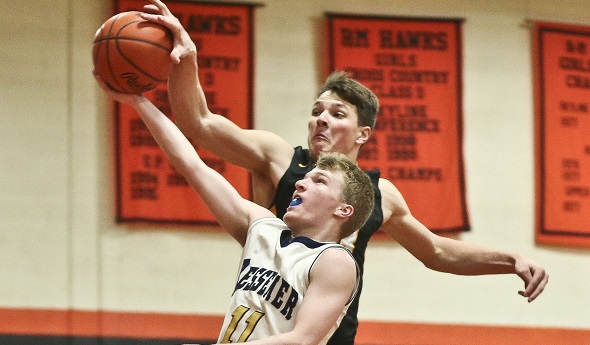
ESCANABA – You would think it difficult to be a 6-foot-7 athlete and weigh 235 pounds and not be known outside your home area.
 It can happen. And it did happen.
Jake Witt has basically flown beneath the radar of high school sports aficionados heading into the final months of his high school career. That despite the fact he is perhaps the premier senior athlete in Michigan's Upper Peninsula and among the best in the state.
The Ewen-Trout Creek senior has scored more than 1,000 points and is close to 1,000 rebounds in basketball. He is a two-time 8-player all-state football selection, earning those honors after the only two seasons he played football.
He lives about 10 miles from tiny Ewen, where E-TC is located on M-28 about 55 miles from the peninsula's western border with Wisconsin. His school has fewer than 100 students and plays basketball against mostly similar-sized schools from its side of the U.P.
Only a handful of colleges even knew about him, in either sport, primarily because of location and the fact he did not participate in the travel ball circuit. Michigan Tech University, about 70 miles north of his home, knew all about him and offered him a basketball scholarship. Witt signed his letter of intent this fall.
Northern Michigan University, about 110 miles east in Marquette, was in football contact with him before basketball got on board. NMU's basketball team was Witt's second choice behind Tech, where he had participated in some team camps.
Wisconsin-Green Bay was the lone Division I school on his trail, although Northwestern University showed some initial interest. Ferris State and Grand Valley State – which play in the Great Lakes Intercollegiate Athletic Conference with Tech and NMU – also were interested.
"It was nice not having as much attention and having a low profile," Witt said a day after the Panthers beat Bessemer 63-59 last week to raise their record to 4-0 this season. "It was nice playing on a team that does not have much hype. I can just go out and play."
Despite the low profile, it is surprising he escaped notice on the recruiting trail. After all, how many players his size run the 40-yard dash in 4.8 seconds, are used as the primary ball handler on the press break, shoot 3-point field goals with 50 percent accuracy and dominate inside despite constant double- and triple-team defenses?
"He is a big-time athlete, a big-time performer in the U.P.," said veteran Tech coach Kevin Luke. "He is bigger, faster and stronger than anybody up here."
With that pedigree, it is surprising Witt escaped attention of the major schools, although the U.P. is far from even the outlying recruiting paths and not known as a breeding ground for high-caliber cagers – and Witt has not played in Lower Michigan or Wisconsin.
"If he played just one summer of AAU ball (or played downstate) he would have had a ton of Division I schools after him," said E-TC coach Brad Besonen, adding "his location and not advertising himself" were factors in his lack of attention.
Witt had an opportunity to join a travel team in Escanaba, but declined because of six-hour round-trip drives for practice on Wednesday and Sunday nights in addition to lengthy travel for games. "It was mainly my location," he said of avoiding travel teams.
The colleges that did not chase Witt may have missed someone who could be a big contributor.
 "We rely on him for everything," said Besonen, citing his protection of the basket that includes blocking shots and/or forcing shot adjustments, ball-handling and floor-wide scoring skill. "He is very agile, has great feet and excellent body control."
Besonen said Witt's lack of "advertising himself" is because of strong family ties, which also were a factor in his decision to stay within about five hours of home. "He likes to hang out with his family (and friends), bass fish and weight lift.
"He is a total throw-back kid from 30-40 years ago," said Besonen. "He is definitely not a look-at-me-guy."
As a powerful presence, Witt draws major defensive attention – and through his unselfishness, he has developed into an excellent passer. "Our biggest problem is not being able to take him out for a lot of rest. He has a big frame, and he gets gassed. We don't play slow," said Besonen.
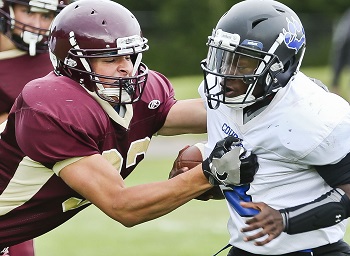
This season Witt is averaging 33 points and 14 rebounds a game. In football, where E-TC students played for Ontonagon in a co-op arrangement, 13 of his 28 pass receptions in a run-oriented offense were touchdowns, and he covered about 600 yards. Last year at E-TC, he set an MHSAA 8-player record with 25 TD catches while nabbing 71 passes for 1,698 yards.
Playing college football was considered, but he had 12 years of basketball experience. With only two years of gridiron experience and at the 8-player level, he probably would have been a football red-shirt and may have bulked up to play tackle, although his desire was to be a tight end and catch passes.
Tech gained his scholarship signature because of its splendid academic reputation.
"After college and entering the work force, the degree you get up there (in Houghton) is worth so much," said Witt, who is still pondering his academic direction.
"I am definitely excited to finish my senior year with my college decision already made," he added, noting that he is looking forward to working with Tech assistant coach Josh Buettner, a former GLIAC all-star for the Huskies. "Josh is one of the best big-men coaches in the GLIAC, and Coach Luke is also a very good coach."
Witt, who is a good fit for the blue-collar Tech brand of basketball, will likely play a 3-4 spot with the ability to venture outside to force mismatch situations. "We feel like we are getting a good ball player, a great blue-chipper," said Luke.
After towering over his prep opponents, Witt knows it will be an adjustment to battle players of equal size or bigger when he gets to Tech. "It will take a lot of getting used to playing bigger guys," he said, expecting to get more one-on-one opportunities than in high school.
Besonen firmly believes Witt will adjust the college level. "They could benefit from him being there right now. Add another year and offseason conditioning, and he could be helpful next year," said Besonen.
"He is still building (his game). The adjustment level will be huge for him, especially at his position," Besonen added, noting Witt must improve his footwork. "His feet are coordinated and quick."
Witt may be virtually unknown now. But clearly, he has the potential to become well known.
 Denny Grall retired in 2012 after 39 years at the Escanaba Daily Press and four at the Green Bay Press-Gazette, plus 15 months for WLST radio in Escanaba; he served as the Daily Press sports editor from 1970-80 and again from 1984-2012. Grall was inducted into the Upper Peninsula Sports Hall of Fame in 2002 and serves as its executive secretary. E-mail him at [email protected] with story ideas for the Upper Peninsula.
PHOTOS: (Top) Jake Witt blocks a shot during his team's win earlier this month against Bessemer. (Middle) Witt, left, playing for the Ontonagon/Ewen-Trout Creek football co-op team, wraps up an Eben Junction Superior Central ball carrier this fall. (Photos courtesy of the Ironwood Daily Globe.)