

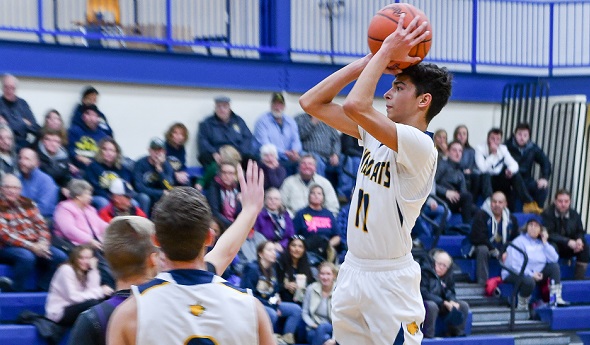
Pino's Project to Teach Lessons of 'TEAM'
February 16, 2018
By Dennis Chase
Special for Second Half
NORTHPORT – Dan Stowe wondered how Northport might celebrate the 30th anniversary of its MHSAA Class D boys basketball championship.
 Enter Ethan Pino.
The 17-year-old, a forward on the current Wildcats team coached by Stowe, has organized an event for Saturday night that will bring players and coaches off that 1988 squad together for a panel discussion on various topics, including the benefits of playing team sports.
It’s all part of Pino’s senior project.
“People still talk about (the state title) a lot,” said Pino. “It’s one of the great things that’s happened in Northport. It’s such a small town.”
Pino, who will be an interviewer, said he’s eager to hear team members talk about life lessons learned that season and what it took to win an MHSAA Finals crown.
“This was a great experience for them, a once-in-a-lifetime opportunity,” he said. “I want (to hear) about the dedication they put into it and the legacy they left behind.”
Audience members will be able to ask questions, too.
The team has had two reunions since claiming the title, but the last was 20 years ago, said Gordie Wick, the coach of the 1988 squad.
“I was wondering who was going to (organize) a reunion or celebration,” said Stowe, who hit the game-winning shot to beat Beal City 80-78 in the Final. “I wasn’t sure how it was going to happen.
“When Ethan suggested he wanted a role as part of his Northport senior project it made a lot of sense. Josh (athletic director Josh Vander Meulen) is his mentor (on the project). I think this is a good opportunity to have those people that were involved in that experience congregate (at the school) for some pointed, and some fun, questions. It will give us a chance to reminisce. Everybody wins.”
Northport seniors are required to complete a project to graduate. There are 17 seniors in this year’s class. Their project topics range from females in the military to drug awareness to the farm-to-table food movement. Pino, who has played five years of varsity soccer and four of varsity basketball, went the sports route. He said playing sports has taught him valuable lessons about teamwork and commitment. Plus, he added, it’s improved his communication, leadership and social skills. And it’s opened the door to lasting friendships, too.
Pino, who hopes to attend Oakland University, was selected as the school’s student athlete of the fall.
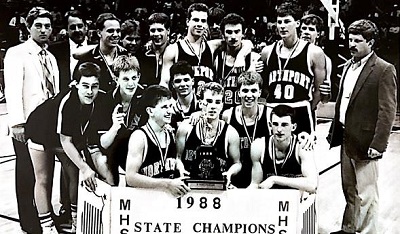 “He wanted to focus on team sports because it’s through his experiences with his teammates that he’s been able to grow,” said Vander Meulen. “Sports are a big part of his life. Ethan’s not a boisterous student. He’s celebrated because he’s a quiet competitor who is dependable and trustworthy. He’s not looking to stand out. He’s not looking for a gold star. When you work with him, you know he’s going to do a good job and you’re going to have fun. You know he won’t let you down.”
The 30-year reunion comes at a rather poignant time. Tonight’s game with Burt Lake Northern Michigan Christian Academy could be the last home game for players wearing Northport uniforms. Because of declining numbers – the high school enrollment is in the 40s - Northport may have to go to a co-op, like it does with neighboring Suttons Bay in soccer and girls basketball. There are currently nine players on varsity, but only three return next season. There is no JV team.
The Wildcats, 10-4, recently clinched the Cherryland Conference title. The team had won eight games in a row before a loss to Traverse City Christian on Wednesday. That was Northport’s first league loss in two years.
“It’s been rewarding to see how far we’ve come since the beginning of the season,” said Pino.
It’s been a hectic winter for Pino – and Vander Meulen, who has helped him pull his senior project together. There are three components to all projects – a research paper, a formal product and a presentation.
“This (projects) gives all of our seniors a chance to dive into something deeper than maybe they’re allowed to in the classroom,” said Vander Meulen.
Saturday’s event will be Pino’s product, although Vander Meulen said he believes “the planning is the product and the event is the cherry.”
“Certainly we want to pull it off and have it be a great night for everyone involved,” he said. “Planning is so important, and hopefully that’s what Ethan takes away from this. It’s the planning that makes it happen – and good planning takes work.”
Pino and Vander Meulen decided in October that the 30th anniversary of Northport’s title would be a perfect tie-in to the project.
“The 1988 team is the vehicle to drive the message of the benefits (of playing team sports) forward,” said Vander Meulen.
 “In our community, they are the team, and that’s capital TEAM. And that’s what this narrative is about. If you ask anybody in our community, who lived here (at that time), they all have a story. To the modern athletes, though, they are mostly unknown so this will be a cool opportunity for our student athletes to see those former players and hear their stories from 30 years ago.”
Several of those players were also part of the school’s Class D championship soccer team in 1986. But it’s that magical March basketball run in 1988 that captured the attention of northern Michigan.
“Football and boys basketball, at least in northern Michigan, drive the dialogue,” said Vander Meulen. “All sports are important and valuable, but public interest in those two can capture a community, ignite not only a town but a region. When I watch highlights of the Buckley boys on the news you can’t see a place to sit. That’s the same energy that was once there with the Northport boys.”
After completing his research paper in late November, Pino reached out to former players and coaches about the idea and to see if they would be able to make it. Seven players and two coaches are planning to attend.
“Some are living out of town and are busy and cannot come,” said Pino. “Some we could not get ahold of. Overall, though, they were pretty excited to hear about it.”
Two dates were considered before Saturday was agreed upon.
When asked how much time he’s put in on the project, Pino paused.
“Mmm …, hours wise, I’m not exactly sure,” he said. “But it’s all good.”
Stowe appreciates the fact Pino and Vander Meulen went the extra mile.
“I think they’ve gone way over the top on this one,” he said.
And they’re still making sure everything is set for Saturday.
“Since we got back from (Christmas) break it’s been logistics, logistics, logistics,” said Vander Meulen. “We don’t want to invite people to Northport and have it be a sloppy presentation. We meet every day. In fact, I don’t know how he feels when he sees me in the hallway now because I always have a new idea. It’s ‘Ethan, we should be tackling this’ or ‘Ethan, did you take care of that?’ We hope we’re not leaving any stone unturned. We feel pretty good, but we’re still turning stones to see if there’s not more we can do.”
 Dennis Chase worked 32 years as a sportswriter at the Traverse City Record-Eagle, including as sports editor from 2000-14. He can be reached at [email protected] with story ideas for Manistee, Wexford, Missaukee, Roscommon, Ogemaw, Iosco, Alcona, Oscoda, Crawford, Kalkaska, Grand Traverse, Benzie, Leelanau, Antrim, Otsego, Montmorency, Alpena, Presque Isle, Cheboygan, Charlevoix and Emmet counties.
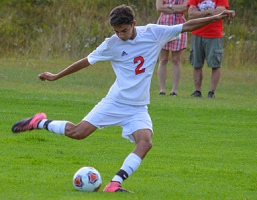
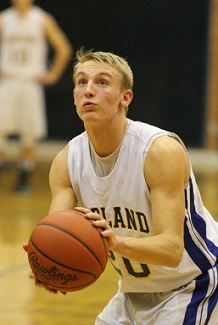
PHOTOS: (Top) Northport’s Ethan Pino squares up for a shot during a game this season. (Middle) The 1988 Northport boys basketball team remains legendary in its community. (Below) Pino winds up during this past soccer season. (Top and below photos by Dan Duffiney.)
Midland Boys Hoops Earns 'Football' Buzz
March 21, 2016
By Bill Khan
Special for Second Half
MIDLAND — Payton DeWildt is accustomed to pep rallies at school.
 Just not during basketball season.
"It's just not something they do," the Midland High senior said. "Only when we play Dow, our crosstown rival."
And only in football.
"Midland High is known as a football school," said DeWildt, the quarterback on the Chemics' football team last fall. "When I was a freshman (on the varsity basketball team), the seniors were good. I said we've got to keep this winning tradition going and make Midland a basketball school, also."
In four seasons of basketball, DeWildt has known nothing but success, a concept that was foreign to a generation of hoopsters at Midland. The Chemics have won District championships in three of his four years after going 13 years without a title.
What sets this year's team apart is that it also added a Regional championship to the mix, the first for the Chemics since winning back-to-back titles in 1978 and 1979.
Suddenly, basketball is a big deal at Midland, worthy of the treatment usually reserved for the football team. A pep assembly will be part of the pregame hype at Midland before the Chemics face Macomb Dakota at 7 p.m. Tuesday at Grand Blanc in the MHSAA Class A Quarterfinals.
"There's quite a buzz," said 14-year coach Eric Krause. "It was really nice to see the people very excited. In the past football has been there, but it was really cool to see guys getting recognized. You like to see the efforts being rewarded, so it's really exciting. It's nice to see some of the older members of the community who will come to games, no matter what your record, and to see the excitement in their faces."
For the players, there is a sense that they are making history.
"Definitely," DeWildt said. "We just won the first Regional Final since 1979. We're trying to make it one more game. We just want to prove we're one of the best teams to come through Midland High, so we want to make it as far as we can."
If Midland can topple second-ranked Dakota (25-0), the Chemics (17-6) will reach the MHSAA Semifinals for only the second time in school history. The Chemics reached the semis in 1970, losing 82-71 to Detroit Pershing. Midland made the Quarterfinals two more times in the '70s, losing 72-53 to Flint Northern in 1978 and 66-58 to Saginaw in 1979.
A major reason why the Chemics haven't lasted to the final week of the postseason is geography. They not only play in one of the toughest leagues in the state, but they have had to go head-to-head with Saginaw Valley League rivals in the tournament. In the last three seasons, the Chemics lost in the 2013 Regional Semifinals to a Saginaw team that made the MHSAA Semifinals, in the 2014 District Semifinals to a Mount Pleasant team that made the MHSAA Semifinals, and in the 2015 Regional championship game to a Saginaw Arthur Hill team that was the MHSAA runner-up.
It's tough to go deep into the tournament when so many nearby schools are capable of going all the way to the Breslin Center. The Valley has had 12 schools combine to make the MHSAA Class A Quarterfinals 137 times. Five Valley schools — all from Flint or Saginaw — have combined for 22 MHSAA Class A championships.
"You had to play in a league that is arguably the best public school league, some years, in the nation in the 1990s before I got into it," Krause said. "I don't mean to take anything away from what we're doing, but Flint isn't Flint anymore — not the way it was. Dave MacDonald is a good friend of mine who coached Midland Dow for over 30 years. He'd be over .500 most years, some years with 12 or 13 wins. The amount of pros he coached against, people just don't understand.
"I believe the Valley is one of the best leagues in the state. The difference is it used to be one of the best leagues in the nation."
To reach the Quarterfinals, Midland had to take down one of the two elite Saginaw programs for the first time in the postseason since beating Arthur Hill in the 1971 District Final.
The Chemics split their regular-season series with Saginaw, each winning on its own home court, so what happened when the teams met for the Regional championship shouldn't come as a huge surprise. On a night in which the tension was felt on the court and in the stands, Midland knocked off Saginaw, 60-56.
Midland held a 10-point lead in the fourth quarter before Saginaw rallied to grab a four-point lead. Midland finished the game on a 12-4 run.
 "It was the best game I've ever played in my life, the most exciting game," said senior Matt Jarema, another four-year varsity player. "I can probably say that most of my teammates all said it was the most exciting game they ever played; it was something. We knew we were bigger and stronger than them. We knew we could beat them. That's what we came in and did."
The impetus for this year's Regional championship run was a tough loss to Arthur Hill in last year's Regional Final. Midland was within four points early in the fourth quarter before current University of Texas freshman Eric Davis scored 12 points in the final period to lead the Lumberjacks to a 66-52 victory. Arthur Hill went on to play for the Class A title.
"Ever since last year after that Regional Final loss against Arthur Hill, we knew this year we would win the Regionals and we'd be in the Quarterfinals," Jarema said. "Playing against Saginaw and Arthur Hill, they prepare us for pressure like no other. They get up on you. We believe their pressure is some of the best pressure we'll have to face each year to prepare us for this moment now."
Midland has won four postseason games but, much like its regular season, nothing has been easy. Three of the four games have been decided by four points or fewer.
The Chemics opened the postseason by beating Mount Pleasant, 49-48, taking the lead for good on Martin Money's layup with 34 seconds left. After a 58-37 rout of Saginaw Heritage in the District Final, the Chemics overcame adversity to edge Traverse City West, 61-59, in the Regional Semifinal at Gaylord. Center Kyle Johnson was nearly late for that game because of a flat tire, Krause was dealing with a flooded basement before leaving for the game, and West's cheering section dwarfed Midland's because of the travel. Then came the four-point victory over long-time nemesis Saginaw in the Regional Final.
And now a team that has lost six games is within one victory of playing in the Breslin Center.
"We're a very odd team," Krause said. "We know we can play with very elite teams, but we honestly can lose to a lot of teams that are levels below that elite level. We can lose to a lot of teams. Usually when you have teams go this far, that's not the case. We have a strange quality where if things aren't going well, we have to be ready for a close game. Sometimes that makes you not panic when the game is close, because you figure you're going to win the game. We're kind of an interesting team that way."
DeWildt returned from a shoulder injury for the postseason opener to lead Midland's tournament run. He is the only Chemics player averaging in double figures during the tournament, scoring 16.8 points per game.
The scoring is balanced after that, with Virgil Walker averaging 8.8 points, Garrett Willis and Johnson 7.3 apiece, and Jarema 7.0.
 Bill Khan served as a sportswriter at The Flint Journal from 1981-2011 and currently contributes to the State Champs! Sports Network. He can be reached at [email protected] with story ideas for Genesee, Lapeer, St. Clair, Sanilac, Huron, Tuscola, Saginaw, Bay, Arenac, Midland and Gladwin counties.
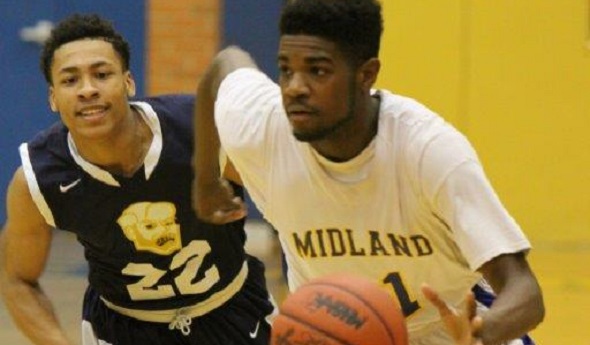
PHOTOS: Midland’s Virgil Walker drives past a Saginaw Arthur Hill player this season. (Middle) Payton DeWildt lines up for a free throw. (Photos courtesy of the Midland athletic department.)