


Pressure? No problem as Our Lady Advances
March 24, 2016
By Geoff Kimmerly
Second Half editor
EAST LANSING – The bright lights have worn off for Waterford Our Lady’s seniors.
 And that might have made all the difference over the final minutes of what could’ve been their final high school basketball game.
Andrew Kline and brothers Clay and Devin Senerius brought the Lakers to the Class D Semifinals a year ago for the first time since 1993, and they just missed a football championship losing by seven points in the Division 8 Final this fall.
So when the score of Thursday’s first Class D Semifinal sat tied for the seventh time with 5:49 to play, the Our Lady seniors weren’t phased by the building Breslin Center pressure.
The Lakers closed on a 15-3 run to finally break away from Wyoming Tri-unity Christian and earn their first MHSAA championship game appearance with a 64-53 victory.
“Playing on the big stage, it’s not as hard as it used to be,” said Devin Senerius, who led four Our Lady players with 17 points. “At the beginning of last year, at the Semifinals we were all nervous. And then at the state finals (for football), we were a little nervous. Now we all just wanted to win instead of lose.”
They’ve got a chance to win one more time, and for the first time in program history on the final day of the season, when they face Powers North Central at 10 a.m. in Saturday’s Class D Final.
The Lakers (22-4) were ranked No. 3 at the end of the regular season, so this run was hardly a surprise. But they also lost the final two games before the District began, putting the senior leaders in a position to pull their team back on track.
Our Lady responded by winning four of seven tournament games by at least 10 points.
“First off, it’s their personality. They want to win, and that’s vital,” Our Lady coach Paul Robak said. “It doesn’t matter if it is basketball, football, whatever; they want to win. That’s the most important part of the culture, teaching that not only to others in their class but the younger classes.
 “We took a step backward toward the end of the year, and we got a little sloppy. But to their credit, we went back to being more competitive on the practice floor. And it starts with these three guys.”
Still, the final score Thursday was not indicative of how close the game stayed until the final six minutes.
To that point, neither team built a lead of more than six points. From 2:25 to play in the second quarter until 1:17 remained, neither team got ahead by more than four. There were 14 lead changes, seven in the third quarter and five during the fourth.
There would be only one run – and it would belong to Our Lady.
Kline scored nine of his 15 points during the final go-ahead drive, while Tri-unity Christian made only 1 of 9 shots from the floor during the final six minutes.
“Coach told us it’s crunch time,” Kline said. “We’ve got to buckle down. We knew we were the better team.”
Freshman Noah Robak added 12 points and Clay Senerius had 11 for Our Lady. Devin had 12 rebounds and Clay added 10 and six assists as the Lakers outrebounded the Defenders 37-15.
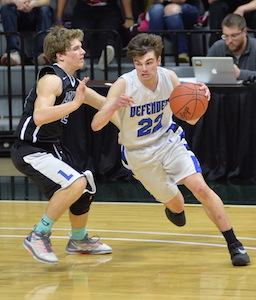
Senior guard Collin Rosendall led Tri-unity (20-6) with 17 points and four steals, and senior forward Javi Cuevas had 12 points and four assists.
Although the Defenders made a decent 44 percent of its shots from the floor, they connected on only 7 of 27 tries from 3-point range – struggling at what’s usually a strength.
“All year long we’ve done a good job of maintaining the bleeding on the boards,” Tri-unity coach Mark Keeler said. “Tonight we didn’t do a good job of that. They have good shooters and I think they knocked down key shots at the right time.
"They stayed in their zone, and I was happy they stayed in their zone because our 3-point shooting is normally good. But it failed us at the end.”
The Boys Basketball Finals are presented by Sparrow Health System.
PHOTOS: (Top) Our Lady’s Clay Senerius looks for an opening while Tri-unity’s Javi Cuevas defends. (Middle) The Defenders’ Collin Rosendall works to get past a Lakers player during the Class D Semifinal.
Like Parents, Ayrault Twins 'Born to Play'
By
Tom Markowski
Special for Second Half
November 30, 2017
GROSSE POINTE WOODS – Kim Ayrault and her husband Andy were careful not to overly encourage their children to play sports, specifically basketball, the sport they played so well for so long.
 But if their children did decide to play, they would teach them to play the right way and be there every step of the way.
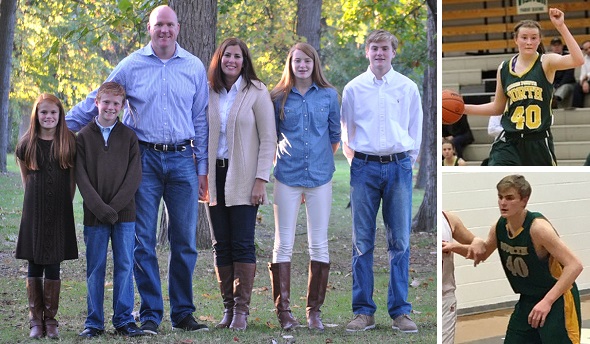
Julia and Joe Ayrault, juniors at Grosse Pointe North, are the first set of twins born to Kim and Andy. Annabel and Adam are the second. Born nearly four years apart, all four play basketball and the younger pair play multiple sports.
The Ayraults are a family whose lives often revolve around practices and games, and driving to and from said events. It can be simultaneously rewarding and tiresome, and they wouldn’t have it any other way.
Kim recalls one of her first memories of Julia, a 4-year-old bouncing up and down the court.
“She went to the basket and scored,” Kim said. “Then she came back down with her ponytails flying and waving her hands up in the air, and I said to myself, no, no, no. I went up to her and said, you can’t do that. You can’t celebrate like that. She learned. She never did that again.
“She was competitive at that age. She was born ready to play.”
Julia Ayrault started bouncing a basketball just about the time she learned to walk. When her parents introduced her to the sport, she dove in head first and hasn’t looked back.
She tried soccer. That didn’t last. As a second sport she preferred baseball, but basketball was always first.
Julia and Joe, 16, both play varsity basketball and anticipate having more than just a good season. Their parents were also fine basketball players in the Pointes, Kim at North, Andy at Grosse Pointe South. The Ayraults’ other set of twins also play basketball, at Grosse Pointe Shores Our Lady Star of the Sea. Annabel and Adam are in the seventh grade and, yes, they’re good players, too. Annabel plays volleyball as well and Adam plays baseball. He was a member of the Grosse Pointe Shores/Woods Little League team that reach the World Series in Williamsport, Pa., this past summer.
After graduating from high school, the Ayraults began dating while playing basketball at Wayne State University. Andy was a junior, Kim (Reiter) a sophomore. Both had fine careers, both played four years and Andy went on to have a brief career professionally in Europe. The two are tall: Andy is 6-foot-7 and Kim is 6-foot, and, not surprisingly, their children are tall. Julia is 6-2, Joe 6-5.
 It’s too early to tell, but Julia just might be the best. A three-year starter for longtime coach Gary Bennett, she has committed to Michigan State and is one of the state’s top players in the class of 2019. Bennett coached Kim in high school, and he first saw Julia play when she was in elementary school.
Andy has coached Julia, on and off but mostly on, since she started playing. Currently Andy is Bennett’s assistant coach. Andy also coached Julia at Star of the Sea and began coaching his two eldest children when they were in elementary school.
“From third to sixth grades I had her playing on the boys AAU team,” Andy said. “I used to put them on the same team because she was so good. In the seventh grade we switched out of AAU to the CYO (Catholic Youth Organization). Going on a weekend and playing four AAU games in one day wasn’t doing her any good. Playing two CYO games and practicing three days a week was better.
“Joe should have a breakout season. Julia had a breakout summer. She played more on the perimeter. She’s athletic enough to cover the post and take the ball to the rim.”
Andy has never stopped working with Julia, even if he wasn’t officially her coach. She developed a love for the game at an early age and Andy continued to teach, lending support as Julia’s game continued to improve.
“She blows our mind all the time,” Kim said. “We’ll say to each other later, did she really do that? When I watch, I see it from the stands and it’s a different look than what Andy sees. I’ll yell something at her during the game. Andy doesn’t like me doing that. I still do it.”
In addition to her playing basketball with the boys for three years, the athletically gifted Julia also played outfield and was a pitcher on a little league baseball team with her brother for two years. Also teaming up with Julia on that little league team was Evelyn Zacharias, one of Julia’s best friends and now a member of the North varsity basketball team as well.
One of Julia’s first memories of playing sports is a positive one.
“I remember when I was at Star of the Sea, we went a long way (in the playoffs),” she said. “It started to be a lot of fun. A lot of those girls who were on that team are at North with me. Evelyn and others. We have the memories.”
Kim and Andy have memories, too, and there are many more to come.
Right now, their lives are often discombobulated trying to give the four equal time. It’s a great goal in theory, but much more difficult to accomplish in reality.
 A typical day will find Kim driving home after work as an elementary school teacher to pick up Julia from practice and get Adam to his game at Star of the Sea on time. One particular evening the MSU women’s team is playing the University of Detroit at Calihan Hall and Kim and Julia are going. Home by 10 p.m., there’s time for a snack before the good nights are said.
“People, many of our friends, tease us that we make them do this,” Kim said. “We’ve never done that.”
Kim keeps a schedule of all the comings and goings on a board hanging in the back of the house. She does it alone. She doesn’t trust anyone else to keep track.
Andy is in between jobs so his free time, if you can call it that, consists of completing Kim’s honey-do list.
“We were laughing the other day,” Kim said. “How did we do this before when (Andy) was working? I’m just trying to be patient.”
At the very least, 20 years of marriage will teach you that.
In addition to his work with Julia, Andy coaches Adam’s team at Star of the Sea, and he’s usually the one taking Julia and Joe on trips, whether it be sports-related or the occasional trip to check out a college campus.
Julia said with every member of the family involved in sports in one capacity or another, it helps keep them all together, at the dinner table, riding in a car or wherever.
“(Sports) is a big topic all of the time,” she said. “We have fun with it. We mess with each other.
“My dad has taught me a lot about the game. The biggest thing is to put others before yourself. My biggest thing is to get my teammates involved. Even if they’re not going to play in college, it should be a good experience for them. I try to make sure everyone has their role. I don’t want it to be about me.”
 Tom Markowski is a columnist and directs website coverage for the State Champs! Sports Network. He previously covered primarily high school sports for the The Detroit News from 1984-2014, focusing on the Detroit area and contributing to statewide coverage of football and basketball. Contact him at [email protected] with story ideas for Oakland, Macomb and Wayne counties.
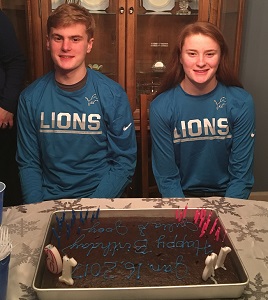
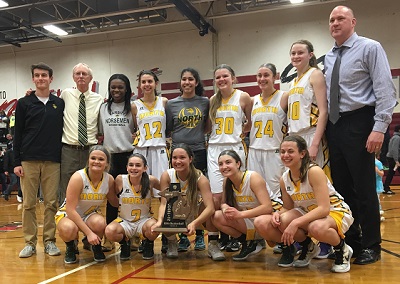
PHOTOS: (Top) The Ayrault family, from left: Annabel, Adam, Andy, Kim, Julia and Joe; inset: Julia and Joe suiting up for Grosse Pointe North. (Middle) Julia and Joe celebrate a birthday together in 2012. (Below) Julia and her dad/assistant coach Andy anchor the right side of the team photo after last season’s District title win. (Photos courtesy of the Ayrault family.)