


Pressure? No problem as Our Lady Advances
March 24, 2016
By Geoff Kimmerly
Second Half editor
EAST LANSING – The bright lights have worn off for Waterford Our Lady’s seniors.
 And that might have made all the difference over the final minutes of what could’ve been their final high school basketball game.
Andrew Kline and brothers Clay and Devin Senerius brought the Lakers to the Class D Semifinals a year ago for the first time since 1993, and they just missed a football championship losing by seven points in the Division 8 Final this fall.
So when the score of Thursday’s first Class D Semifinal sat tied for the seventh time with 5:49 to play, the Our Lady seniors weren’t phased by the building Breslin Center pressure.
The Lakers closed on a 15-3 run to finally break away from Wyoming Tri-unity Christian and earn their first MHSAA championship game appearance with a 64-53 victory.
“Playing on the big stage, it’s not as hard as it used to be,” said Devin Senerius, who led four Our Lady players with 17 points. “At the beginning of last year, at the Semifinals we were all nervous. And then at the state finals (for football), we were a little nervous. Now we all just wanted to win instead of lose.”
They’ve got a chance to win one more time, and for the first time in program history on the final day of the season, when they face Powers North Central at 10 a.m. in Saturday’s Class D Final.
The Lakers (22-4) were ranked No. 3 at the end of the regular season, so this run was hardly a surprise. But they also lost the final two games before the District began, putting the senior leaders in a position to pull their team back on track.
Our Lady responded by winning four of seven tournament games by at least 10 points.
“First off, it’s their personality. They want to win, and that’s vital,” Our Lady coach Paul Robak said. “It doesn’t matter if it is basketball, football, whatever; they want to win. That’s the most important part of the culture, teaching that not only to others in their class but the younger classes.
 “We took a step backward toward the end of the year, and we got a little sloppy. But to their credit, we went back to being more competitive on the practice floor. And it starts with these three guys.”
Still, the final score Thursday was not indicative of how close the game stayed until the final six minutes.
To that point, neither team built a lead of more than six points. From 2:25 to play in the second quarter until 1:17 remained, neither team got ahead by more than four. There were 14 lead changes, seven in the third quarter and five during the fourth.
There would be only one run – and it would belong to Our Lady.
Kline scored nine of his 15 points during the final go-ahead drive, while Tri-unity Christian made only 1 of 9 shots from the floor during the final six minutes.
“Coach told us it’s crunch time,” Kline said. “We’ve got to buckle down. We knew we were the better team.”
Freshman Noah Robak added 12 points and Clay Senerius had 11 for Our Lady. Devin had 12 rebounds and Clay added 10 and six assists as the Lakers outrebounded the Defenders 37-15.
Senior guard Collin Rosendall led Tri-unity (20-6) with 17 points and four steals, and senior forward Javi Cuevas had 12 points and four assists.
Although the Defenders made a decent 44 percent of its shots from the floor, they connected on only 7 of 27 tries from 3-point range – struggling at what’s usually a strength.
“All year long we’ve done a good job of maintaining the bleeding on the boards,” Tri-unity coach Mark Keeler said. “Tonight we didn’t do a good job of that. They have good shooters and I think they knocked down key shots at the right time.
"They stayed in their zone, and I was happy they stayed in their zone because our 3-point shooting is normally good. But it failed us at the end.”
The Boys Basketball Finals are presented by Sparrow Health System.
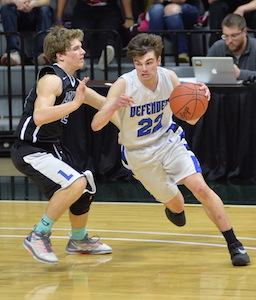
PHOTOS: (Top) Our Lady’s Clay Senerius looks for an opening while Tri-unity’s Javi Cuevas defends. (Middle) The Defenders’ Collin Rosendall works to get past a Lakers player during the Class D Semifinal.
Performance: Big Rapids' Demetri Martin
December 15, 2016
 Demetri Martin
Big Rapids senior – Basketball
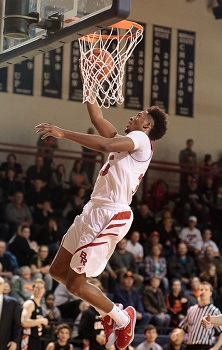
To finish last season, Martin led unranked Big Rapids to its first MHSAA Semifinals and within a basket of playing for the Class B championship. He began his senior campaign with another, more individual highlight; the 6-foot-4 guard scored his 1,000th point in a 65-50 win over Grant on Friday to earn the Michigan National Guard “Performance of the Week.” Martin, a four-year starter, finished with 31 points and 12 rebounds against Grant and added 24 points and 10 rebounds in Tuesday’s 63-43 win over Lakeview.
Martin also was the team’s leading scorer last season, averaging 19.5 points per game along with 8.8 rebounds before scoring a team-high 22 in a 61-60 Class B Semifinal loss to Stevensville Lakeshore. After, he was named Central State Activities Association Gold Player of the Year for the second time and made the Basketball Coaches Association of Michigan all-state team. This winter, Martin is teaming with senior Christian Hector, junior Braeden Childress and others including sophomore brother and starting point guard Dorian Martin with hopes of returning to the championship mix. Demetri Martin entered this season needing 21 points to reach 1,000 for his career, and nearly pulled off the feat in the first quarter of that first game. He worked this summer on adding a longer pull-up jumper, and he went over 1,000 swishing a pull-up 3-pointer from NBA range.
 Just as impressive over his four years of high school has been Martin’s climb academically. In his words, Martin entered high school with all Ds and was barely academically eligible to play basketball as a freshman, frequently skipping school before and after that season. But he’s now pulling As and Bs and plans to study for a career either in education or sports medicine. He'll surely play college basketball at some level – most of his interest has come from Division II schools but he's also had contact from one in Division I.
Coach Kent Ingles said: “He’s obviously the best player in (our) area, and the best player we’ve had in a while … and he’s following a couple pretty good kids into the mix. He’s a multi-position player; he’s actually pretty unselfish. He’d rather pass the ball than shoot it. He’s been with me four years, and we’ve won three conference championships and been to the Quarter(finals) two times. … I told him we’ll be a good team when our best player is our hardest worker, and he’s done that too. He is a real success story. He’s a neat kid. He’s bubbly, he’s fun to talk to, he’s kinda hyper and can’t sit still. But he’s grown up a lot as a young man and as a basketball player, and we’re happy to see the total development with him."
Performance Point: “Not many people can score 1,000 points, so for me to get that, it just means a lot to me,” Martin said, “that all the hard work I put in is starting to show. I thought about (the 1,000th point) for a couple of months once I found out how far (away) I was, and I was thinking I can get this in the first quarter if I actually try. I ended up with 17 (points in the first quarter), but I was just taking it slow. If I would’ve kept that scoring streak going, I probably could’ve gotten it in the first quarter.
Breslin dreams come true: “Half the state (last season) probably didn’t even know where Big Rapids is. We weren’t ranked. We’re not in the Grand Rapids area. So it’s, where is this team from? And then we show up, and everyone probably expected a blowout. (But) in the beginning of the season, before we even started practicing, I was talking to some of my old teammates and I said, ‘We’ll probably make it to Breslin this year, you know that?’ We did. We made it. We were a lot better than what we played. … Since this is my last year, I know what we have to do to get there again, and I want to try my best to get there.”
 Preparing the future: “My freshman year, I was just a rebounder. I picked up the leadership stuff from (2014 graduates) Quinn Tyson, Jake Hayes, Austin Hayes; they passed me the torch, so sophomore year I would lead but not like last year when I was leading the team and obviously one of the go-to guys. (This season) I’m trying to tell (my teammates) what to do and what not to do, how the game should be played so they can score 1,000 points in their careers too, so they can lead other future Big Rapids teams. I don’t want to go out as just a scorer who didn’t really teach the kids anything.”
Football’s a hit: “I played football for the first time (this fall). It was pretty fun. I wasn’t the go-to player, so it was different. But blocking was probably the best – you get to slam people. Tryouts had already passed, but the night before two-a-days I had a dream, and I was like man, I’m going to go out and try out for football, and I knew coach wanted me to play. … I’m glad that I played, and I got physically stronger too.”
Continuing to make a difference: “I want to become a teacher … because my coach (assistant Blake) Thomas, when I came here and then I was struggling a little bit in classes, he’d invite me over and we’d study on this, and that brought my grades up a lot. To help someone out like that, and not even know them, I think that’s something some kids need and I want to do that. Sports medicine, I injure myself a lot, so if there is someone who has these problems like me, I would help them out.”
- Geoff Kimmerly, Second Half editor
Every week during the 2016-17 school year, Second Half and the Michigan National Guard will recognize a “Performance of the Week" from among the MHSAA's 750 member high schools.
The Michigan Army National Guard provides trained and ready forces in support of the National Military Strategy, and responds as needed to state, local, and regional emergencies to ensure peace, order, and public safety. The Guard adds value to our communities through continuous interaction. National Guard soldiers are part of the local community. Guardsmen typically train one weekend per month and two weeks in the summer. This training maintains readiness when needed, be it either to defend our nation's freedom or protect lives and property of Michigan citizens during a local natural disaster.
Previous 2016-17 honorees:
Dec. 1: Rodney Hall, Detroit Cass Tech football – Read
Nov. 24: Ally Cummings, Novi volleyball – Read
Nov. 17: Chloe Idoni, Fenton volleyball – Read
Nov. 10: Adelyn Ackley, Hart cross country – Read
Nov. 3: Casey Kirkbride, Mattawan soccer – Read
Oct. 27: Colton Yesney, Negaunee cross country – Read
Oct. 20: Varun Shanker, Midland Dow tennis – Read
Oct. 13: Anne Forsyth, Ann Arbor Pioneer cross country – Read
Oct. 6: Shuaib Aljabaly, Coldwater cross country – Read
Sept. 29: Taylor Seaman, Brighton swimming & diving – Read
Sept. 22: Maggie Farrell, Battle Creek Lakeview cross country – Read
Sept. 15: Franki Strefling, Buchanan volleyball – Read
Sept. 8: Noah Jacobs, Corunna cross country – Read
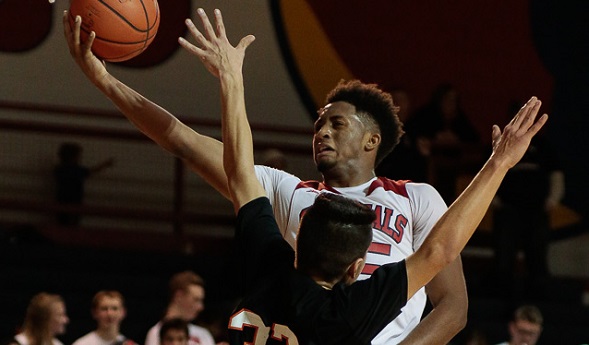
PHOTOS: (Top) Demetri Martin glides around a defender during last week’s win against Grant. (Middle) Martin drives to the hoop as Big Rapids went on to a 65-50 victory. (Photos courtesy of the Big Rapids athletic department.)