


Promising Ypsilanti Aiming for Historic Finish
By
Chip Mundy
Special for Second Half
January 7, 2016
By Chip Mundy
Special for Second Half
YPSILANTI – It was 30 minutes after Ypsilanti Community finished its victory over Flint Hamady on Tuesday, and 7-year-old Jaylon Allen was running around the court like any other ordinary 7-year-old.
 As Ypsilanti basketball coach Steve Brooks watched him on the court, he spoke glowingly of the promise the youngster had in basketball.
“Mark this down, he can run my offense right now, and he’s 7,” Brooks said.
Eleven years ago, Brooks was in the same position, watching a young player with a ton of hope. That player was Corey Allen, older brother of Jaylon and star of Ypsilanti’s unbeaten team that has advanced to the Class A Quarterfinals two of the past three years.
“Corey has been around like that,” Brooks said, comparing the brothers. “At that time, his dad was our middle school coach, so he would go to the middle school practices.
“Corey has been our leading scorer since he hit campus. He started as a freshman, and we had guys like Jaylen Johnson and Janeau Joubert, and he led us in scoring. His first three games were 17, 27 and 25 as a 14-year-old.”
Mutual respect and admiration
The bond between Brooks and Allen has been a special one. Although Brooks is fond of all of his players, he admits that it is not unlike the relationship shared by Michigan State coach Tom Izzo and his star player Mateen Cleaves during Cleaves’ successful career that included an NCAA championship nearly two decades ago.
“He really is my Mateen Cleaves,” Brooks said, “but don’t get me wrong. We go at it. I’m a disciplinarian, and as they get older, they want to do the social things. We had a heart-to-heart last Sunday. He’s a Mr. Basketball candidate, and I needed him to step it up.
“He had kind of deferred to the other guys because he already has a scholarship, and he wants some of the other guys to get seen. I was like, ‘Corey, those other guys depend on you,’ and he’s back to the old Corey.”
Allen showed it Tuesday night against Flint Hamady. After Ypsilanti trailed by one at halftime, Allen broke a tie game in the third quarter with a long 3-pointer, then stole the ball and drove coast-to-coast for a layup and a quick five-point lead. The Grizzlies (5-0) never trailed after that.
“He’s been getting big baskets since I’ve known him,” Brooks said. “He had 45- and 50-point games in middle school, and he has led us in steals, so he’s just not a shooter.”
Allen, a 6-foot-3 guard, has committed to play at the University of Detroit Mercy, and although he admits that he is looking forward to playing in college, he is in no hurry for the high school portion of his career to end.
“Detroit Mercy was like a family when I went on my visit,” Allen said. “They took me in like I was a part of the team. The coach kept it real, and I really liked that, and I liked the players. I played against some of them in AAU circuit, so I know them well.
“But ever since I was in the eighth grade, I’ve wanted to win the state championship for Coach Brooks. All through high school, we’ve been making runs and coming up short. Now this is my senior year, and I’m pushing to make that happen.”
Allen speaks of Brooks much like Brooks speaks of him.
“Coach is a tough guy,” he said. “He wants the best out of all of us, and he pushes us the hardest. That’s why we love him. I love him to death. He’s a father figure to me.”
And vice versa.
“A lot of times he gets the brunt of a lot of stuff because he’s like a son to me,” Brooks said. “The expectations are really high, and the standards are really high for him. He’s a humble kid, and I’m really going to miss him after he leaves.”
Task at hand
Ypsilanti has never won an MHSAA championship in basketball. The team did make it to the Class A Finals in both 1968 and 1969 but lost both times. There was another great run during the late 1970s when the Phoenix won three consecutive Class A Regional titles before losing in the Quarterfinals.
After the 2012-13 school year, Ypsilanti and Willow Run merged to form Ypsilanti Community High School, and the Phoenix became the Grizzlies. That was Allen’s first year in high school and the start of the most recent run of success.
Allen is not only a leader on the court; he is a leader off the court as well. It was something he picked up on as a freshman.
“At first, I wasn’t the type to seek out to be a leader,” he said. “We had a lot of leaders when I was in ninth grade. I was very quiet and took the teaching from them and worked on everything all through my high school career.”
While Allen isn’t a one-man team, he is the one everyone looks up to.
“The kids love him,” Brooks said. “We go as he goes, and I try to explain that to him. Whether he wants it or not, the other guys all look up to him all the way down to the seventh grade. All the kids know who he is, and they respect him.”
Junior guard De’Money Gentry said Allen’s leadership skills are felt both on and off the court.
“He pushes us and makes us do our best all the time,” Gentry said. “If we’re messing up, he just tells us to keep our heads up and keep doing what we need to do.”
Allen is surrounded by a talented team that made it to the Class A Quarterfinals a year ago, losing to eventual champion Detroit Western International. The Grizzlies lost just two players off that team and have even more on the way as injuries have been a problem at the start of the season.
Marquis Smith, star quarterback who is being recruited by such schools as Iowa State, Syracuse and Cincinnati for football, did not play all last season because of a dislocated shoulder but is expected back soon.
“He really is like the spirit of the team,” Brooks said of Smith. “He brings a positive attitude and confidence, and when I’m down, he’s the kind of guy to come into the office and cheer me up.”
Smith attended Willow Run prior to the merger and is excited to be part of such a successful program.
“I like to be part of a positive program,” he said. “I can’t explain how it feels to be winning. It’s the way we click together like a brotherhood. We’re on the same page with each other, and we know what’s happening and what we are capable of doing on the court.”
Junior guard Jamezell Davis has given the team a scoring spark early in the season and should take some of the heat off Allen, and there is plenty of depth waiting to get healthy and eligible.
Starting forward Jalen Maxwell is trying to come back after a concussion, and center Josh Perkins is battling a back injury. Guard Marlin Talley, son of former Mr. Basketball Award winner and University of Michigan player Michael Talley, missed the game Tuesday with an illness.
And then there is guard RayJon Williams-Jackson, a starter from last year who is on crutches after suffering a knee ligament injury in football.
“He does all the tough stuff, so we miss him,” Brooks said. “He does all the dirty work.”
Brooks also anticipates a big addition in a few weeks when 6-foot-5 forward Michael Bruce becomes eligible. Bruce originally attended Willow Run but chose to move on to Belleville after the closure instead of coming to Ypsilanti Community. He will be eligible in two weeks.
“He’s going to make us a different team,” Brooks said. “We will be a real good team. We’ll be a more confident team because he’s real skilled.”
Best kind of wins
Brooks wants to win as much as anybody, but he sees the big picture. The players understand that, too.
“He teaches us how to be better young men off the court,” Allen said.
Brooks calls it “educational athletics.”
“They are great kids; we don’t have any issues,” he said. “They are always well-mannered, they don’t get technical fouls, they don’t talk back to officials or things like that, and I’m really proud of them in that regard.
“It is educational athletics on this level, and that is what some people kind of lose sight of. Of course you want to win, but you want to teach them lessons along the way.”
Brooks, who took over at Ypsilanti in 2003, is relishing the run the Grizzlies are having, and he says the future looks bright – even before the arrival of the 7-year-old prodigy whom Brooks says can run his offense right now.
But he’s not looking that far in advance.
“By then,” Brooks said, “I’ll probably be eating popcorn and be at the point where I can just come out and watch the games.”
 Chip Mundy served as sports editor at the Brooklyn Exponent and Albion Recorder from 1980-86, and then as a reporter and later copy editor at the Jackson Citizen-Patriot from 1986-2011. He also co-authored Michigan Sports Trivia. E-mail him at [email protected] with story ideas for Jackson, Washtenaw, Hillsdale, Lenawee and Monroe counties.
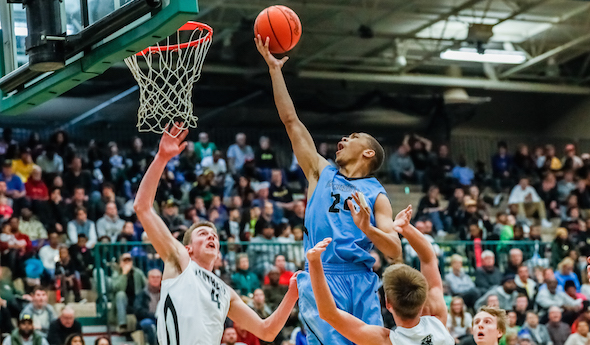
PHOTOS: (Top) Ypsilanti Community’s Corey Allen (5) goes to the basket during Tuesday’s win over Flint Hamady. (Middle) Grizzlies coach Steve Brooks huddles with his team during a break. (Below) Jamezell Davis (3) pushes the ball upcourt during a fastbreak Tuesday. (Photos by Betsy Howell.)
Breslin Bound: Boys Report Week 5
January 9, 2017
By Geoff Kimmerly
Second Half editor
How quickly can a lackluster season become a distant memory?
 Ask a few of the teams we’ve highlighted in this week’s Breslin Bound Boys Report, powered by MI Student Aid.
Two of the eight on our “Watch List” this week have already won more games this winter than in all of 2015-16, and a third team could equal last season’s total by the end of this week.
Week in Review
The countdown of last week’s five most intriguing results:
1. Clarkston 60, Flint Carman-Ainsworth 47 – The Wolves remain undefeated at 8-0 after handing Carman-Ainsworth its first loss (and later in the week doing the same to Walled Lake Western).
2. Detroit U-D Jesuit 71, Romulus 58 – The Cubs finished nonleague play at 5-2 and with one more solid win over a Class A power heading into the Detroit Catholic League schedule.
3. Ann Arbor Skyline 74, Belleville 71 – Skyline is tied for the lead in the Southeastern Conference Red, but handing Belleville its first loss may have surprised a few even though Skyline has broken 70 points five of the last six games.
4. Grand Rapids Forest Hills Central 55, Grand Rapids Forest Hills Northern 51 – This neighborly rivalry game hadn’t meant this much in a while, with both now in the Ottawa-Kent Conference White and Central handing Northern its first loss of the season.
5. Holt 59, Okemos 49 – This gave the Rams an early co-lead with East Lansing in the Capital Area Activities Conference Blue and added to a 4-2 start with those losses by a combined seven points.
Watch List
With an eye toward March, here are two teams in each class making sparks:
CLASS A
Davison (6-1) – After watching the football team make a nice jump in the fall, the basketball team is doing the same coming off a 5-16 finish. The only defeat was to one-loss Carman-Ainsworth.
Bloomfield Hills (6-1) – The Black Hawks are two wins better than at this point a year ago, with their only loss to Orchard Lake St. Mary’s. They should provide a nice challenge to Clarkston in the Oakland Activities Association Red.
CLASS B
Hillsdale (6-0) – The Hornets are always in the mix, and got off to another fast start this winter after ending last year’s 18-win campaign with a three-point loss in their first District game. Last week’s double-overtime win over Onsted might be the best so far.
Wyoming Kelloggsville (5-0) – The Rockets could be in the midst of another of the most significant turnarounds in the state this winter, going 7-15 a year ago but most recently handing a one-point loss to reigning Class C runner-up Grandville Calvin Christian.
CLASS C
Maple City Glen Lake (5-0) – The Lakers opened this season by avenging last year’s season-ending loss to Traverse City St. Francis, and since they’ve played to a first-place tie in the Northwest Conference with rival Frankfort. Thursday opponent Buckley will provide another major test.
Munising (6-0) – After finishing 11-10 and falling in its first postseason game last winter, Munising is more than halfway to a better finish. This start included an avenging of that season-ending loss to Rock Mid-Peninsula and three victories total by five or fewer points.
CLASS D
Bellevue (4-0) – The Broncos have been riding a nice run the last few seasons, winning 18 games a year ago. They already own a win over Climax-Scotts, the team with which they shared the Southern Central Athletic Association West title last winter.
Marcellus (4-1) – The Wildcats also are on the rebound, having already surpassed last season’s three wins. The lone loss was a three-pointer to Constantine during the season’s first week.
Can't-Miss Contests
Be on the lookout for results of these games coming up:
Tuesday – Grand Rapids Christian (4-0) at Wayland (4-1) – These two and Wyoming look like the contenders in the O-K Gold, with Christian one to chase both in the league and Class A statewide.
Tuesday – Bellaire (5-1) at Gaylord St. Mary (5-1) – These two are contenders in the Ski Valley Conference, but also stand to be among Class D’s best from just below the bridge.
Friday – Saginaw (6-1) at Saginaw Arthur Hill (4-2) – One of the oldest rivalries in state history remains one of the best, with this and the Feb. 3 matchup likely to decide the Saginaw Valley League North title winner.
Friday – Holt (4-2) at East Lansing (6-0) – The Trojans have high hopes in Class A this season, but first comes taking care of the CAAC Blue and a strong field including the Rams (also mentioned above).
Saturday – Detroit East English (5-0) vs. Kalamazoo Central (5-0) at Grand Rapids Ottawa Hills – Arguably the top matchup of the Floyd Mayweather Classic, this one pits two of the best in Class A.
PHOTO: Grand Rapids Christian, driving to the basket, downed Holland West Ottawa on Dec. 28 as part of its 4-0 start. (Photo by Tim Reilly.)