

Rice Comes Home to Whiteford Bench
January 22, 2016
By Doug Donnelly
Special for Second Half
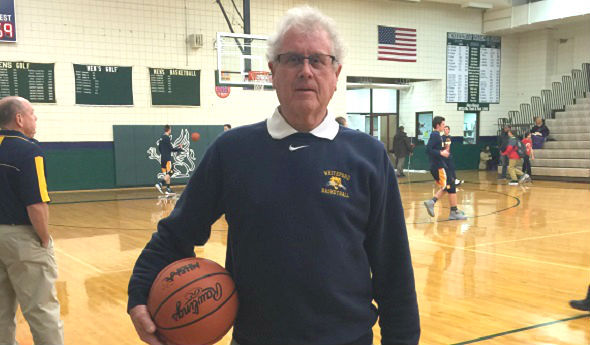
John Rice thought he found the perfect match for his two passions in life – fishing and basketball. By day, he could spend hours fishing off the Florida coast. When the afternoon rolled around, he would hit the gymnasium to coach basketball.
“I would have been perfectly satisfied doing that this winter,” Rice said.
That is, until Rice’s seventh-grade granddaughter Emma called.
“It was last March and we were in Florida and she was back home in Ottawa Lake,” Rice recalls. “She calls me up and says, ‘Grandpa, my team has a tournament that we are playing in and I want you to come watch me. And, I want you to coach my team next year.’”
Rice hung up the phone and told his wife, Sandy, they were headed home.
“We packed our stuff and went home,” Rice said. “It was a couple of weeks earlier than we had planned, but we got home in time for her tournament.”
A couple weeks later, after he agreed to become the seventh-grade girls basketball coach at Whiteford for the 2015-16 season, Bobcat varsity boys coach Jim Ross resigned. Athletic Director Nate Gust – who played for Rice when he was coaching at Whiteford in the early 2000s, asked Rice if he was interested in the varsity job. He decided to take it and is back at the helm of the Bobcats this season – 13 after ending his 30-year coaching career at Whiteford.
“Coaching basketball is something I love to do and, health-wise, I think it keeps me young,” said Rice, who celebrated his 70th birthday last summer. “I still love the game. When Emma asked me to coach her team, I couldn’t say no.”
Rice also couldn’t say no to coaching the varsity boys and helping to return the team to prominence. Whiteford went an uncharacteristic 4-17 in 2014-15 but is off to a 6-4 start under Rice.
“It’s a challenge, but I love challenges,” Rice said. “I enjoyed my time at Whiteford before, and I’m enjoying it now.”
This is his second stint as the head coach of Whiteford, having coached the Bobcats from 1974 to 2003, when he amassed 400 wins and collected eight District and eight league championships.
“The big thing was just getting acclimated to the kids here,” said Rice during a break in practice recently. “Being away so long, I was not able to follow these kids as they progressed through junior high or junior varsity basketball. I had to get to know them, and they have to get to know me. They’ve responded well, but we are still getting to know one another.”
Rice grew up in Bladensburg, Ohio, where he was an honorable mention all-state guard in Ohio’s smallest division in 1961. He was a factory worker, then college student who got his first varsity coaching job in 1969 at Dansville (Ohio) High School. He spent two years there, moved on to Mount Vernon Bible College – known now as Mount Vernon Nazarene – before moving north into Michigan.
He made Whiteford his home – especially the gymnasium just off exit 3 of US-23. His Bobcats won their first District title in his third year and their first Tri-County Conference title in his seventh. By the early 1980s, Rice had a Class D powerhouse. His 1981-82 team went 21-2, and he was named the Class D Coach of the Year by The Associated Press. His Bobcats won five league titles and four District crowns alone during the 1980s. He’s also had a good run of coaching all-state players – no fewer than six Bobcats that he coached earned first or second-team all-state honors.
Rice coached the Bobcats through the 2002-03 season, which happened to be the best in school history. Whiteford won its first 23 games, finished 23-1 and ended the season ranked among the top Class C teams in the state. Soon after the season ended, Rice resigned with 410 wins at Whiteford.
“I just felt the time was right for me to step aside and let someone else coach,” Rice said. “It was time. I felt good about what I had accomplished, and I was leaving the program in good shape. It was a good time.”
Just because Rice wasn’t at Whiteford, however, didn’t mean the coaching bug left him. In the dozen seasons since, he’s coached 11 of them. That includes varsity stints at Ann Arbor Gabriel Richard, Flat Rock and Toledo Bowsher. He’s been the junior varsity head coach at Toledo Woodward, the JV coach at Sylvania Southview and a varsity assistant at Lake Worth Christian in Boynton Beach, Fla., about 45 minutes north of Fort Lauderdale on Florida’s east coast. The only time Rice didn’t coach was one season during which he had back surgery.
“I started the season as an assistant, but decided to focus on my health,” he said. “I went to a specialist and found I needed surgery. Every other year, I’ve coached in some capacity. I’ve coached with a lot of different guys and observed lots of different styles.”
His return to Whiteford has kept him busy. He is officially head coach of both Bobcats middle school girls teams and the varsity boys. Some days, he has practices from 3 p.m. until 7 p.m. He also stops by the girls varsity practice when he can, which itself is nothing new. In addition to all of his years with the Bobcats boys program, he coached the Whiteford JV girls for 32 seasons and the varsity girls for three.
“I’ll practice four straight hours some days,” he said. “It’s a tough transition going from seventh-grade girls to varsity boys. You have to adjust your voice.”
In the first half of the season, the Bobcats have beaten arch-rival Summerfield in overtime, beaten Blissfield and have already passed last season’s team win total despite starting the season with just three seniors and a host of underclassmen – including five sophomores – on the roster.
“One of my philosophies has always been to bring up the underclassmen and build the team that way,” Rice said. “It has worked out very well for my teams at Whiteford and at other schools. When the younger kids get experience, it usually pays off in the end.”
He also has continued his typical high-tempo offense with pressing and trapping on defense.
“That’s the type of basketball that I like to play,” he said. “I haven’t changed my philosophy much. You have to adapt from year-to-year, depending on the kids you have, but the philosophy stays the same.”
The middle school girls start games later this month.
“It’s keeping my young again,” he said.
Rice’s return has been welcomed by the community, especially several of his former players who have stopped by the old gym to catch five minutes of the practices they remember so well or to just say hi before a game. A lot of former players have left comments on Facebook, too. Among the players on his roster now are Cody and Jesse Kiefer. During his first stint at Whiteford, Rice coached both the Kiefers’ parents.
“I’m having fun,” Rice said. “I’m comfortable here. I feel back at home. This has energized me.”
Rice by the numbers
|
VARSITY HEAD COACH |
YRS |
W |
L |
|
|
Danville (Ohio) |
2 |
27 |
12 |
|
|
Ottawa Lake Whiteford |
30 |
410 |
247 |
|
|
Ann Arbor Gabriel Richard |
2 |
13 |
28 |
|
|
Flat Rock |
1 |
4 |
17 |
|
|
Toledo Bowsher (Ohio) |
2 |
9 |
29 |
|
|
Ottawa Lake Whiteford |
1 |
6 |
4 |
* |
|
TOTALS |
38 |
469 |
337 |
|
|
*Through Jan. 21, 2016 |
Undefeated Mio Poised to Build on Bolt Nation's Proud Hoops Tradition
By
Tom Spencer
Special for MHSAA.com
January 20, 2023
Wins, losses and championships may not be what this year’s Mio boys basketball players leave at the top of their footprint when they’re done.
 But they certainly could.
“I’m proud to say these boys have gotten many compliments throughout the last couple of seasons as to how they conduct themselves and represent our basketball program, one another, our school, and our community both on — and off — the court,” said head coach Ty McGregor. “This group’s legacy will be more about their high character than records and titles.”
McGregor knows about leaving a legacy. He scored 32 points to lead the Thunderbolts to the 1989 Class D championship. His scoring in the 78-67 deciding win over Beal City allowed Mio to cap a perfect 28-0 season.
He also knows the legacy, perhaps better than most, of Michigan’s all-time boys career scoring leader, Jay Smith, who led Mio to the 1989 Semifinals and a 24-2 record. Smith and McGregor are brothers-in-law.
Smith, who set the bar while playing before the 3-point line was added to Michigan high school basketball, went on to play and coach at the college level. Smith recently returned to the University of Michigan basketball program as the director of player personnel and development under Juwan Howard.
McGregor went on to play professionally in Europe and coach with Smith at Grand Valley State and Central Michigan. He also squeezed in two years coaching the Thunderbolts before the college coaching and returning to Mio in 2017.
Today’s Thunderbolts leadership — seniors Austin Fox, Gage Long, Nathan Hurst — have helped Mio to an unbeaten start.
They also have the Thunderbolts starting to think of capturing a conference title that has eluded them for 13 years.
“We only have 10 total boys in our high school basketball family, so it’s vital all lead and take ownership,” McGregor said. “Our kids show up in the classroom basketball court, so right there is 80 percent of being successful.
 “We talk about ‘real-life stuff’ a ton, and a big part of what we’re about is always leaving places better than when we found them,” McGregor continued. “These three seniors will most definitely leave our program a better place when their time here is complete, which makes a highly competitive, overly intense, passionate coach like myself smile!”
Fox, averaging 16.4 points per game, Long at 12.4, and Hurst at 10, are the team’s leading scorers. Long leads the team in rebounding, and Fox tops the steal list.
Sophomore Zeke Morris is right behind the seniors in scoring, rebounding, and steals. Junior Hunter Perez leads the team in assists.
Any and all five Thunderbolts on the court at any moment can drive the team’s success, according to McGregor.
“I’ve stated all along, we don’t have a superstar or superstars; we do things by committee,” noted McGregor. “In order for us to be successful in any way, ‘by committee’ is how it has to be done.
“We have five players that on any given night can get us double-digit scoring,” he went on. “Austin Fox, Gage Long and Nathan Hurst clearly do a great job with leadership, but everyone has taken ownership of this team.”
Defending is the team’s top priority, McGregor is quick to point out. His team is currently holding opponents to just 25 points per game.
“We know there will be nights where we will really shoot it in and nights where we can’t throw it in the ocean,” he said. “That’s basketball, but we should never have off nights at the defensive end — that’s all about effort, focus.
“We are holding true to our priorities thus far,” he continued. “This type of defensive success widens our margin for error in other areas that we don’t have as much control over.”
What the Thunderbolts can control is attitude and effort, and MacGregor views that as the key to their success so far: “Our kids’ attitude and effort have been off the charts. It’s vital we always stay on top of those things.”
The postseason is already on the minds of the Thunderbolts, McGregor acknowledged.
“The postseason is clearly the most important part of the season in our minds,” McGregor said. “We want to continue to hold each other accountable and make daily deposits on preparation, commitment, effort, and attitude, which we hope will pay dividends in March.”
Mio’s style of play may not turn heads, but McGregor believes it gets the job done.
 “Unfortunately for our kids and Bolt Nation, their head coach is very black-and-white — he’s not into ‘Top 10’ highlights,” McGregor said. “We play a very fundamental, disciplined style of hoops, doing our best to not over complicate things.
“We’re more about eliminating mistakes than playing high-risk hoops.”
McGregor’s wife Kristi took over coaching the Mio girls basketball program this season. Mio didn’t have enough players last year to field a girls team.
All of the girls who hoped to play last year still have eligibility – and could end up with the top seed in their District.
Coaching at the same school as his wife has been a spectacular experience, the boys coach said. And, it gives them something else to argue about, Ty McGregor joked.
“It is absolutely awesome to have the opportunity to teach the game of life, the game of hoops, and be a part of Bolt Nation alongside my wife, Kristi,” he said. “It gives us the opportunity to discuss, analyze, and assist one another, all in hopes of teaching kids in our small community to dream big, work hard, and commit to something bigger than themselves.”
The Thunderbolt boys, 7-0 overall and 2-0 in the Big Dipper portion of the North Star League, will resume play Tuesday at Posen.
“I don’t look at or take much stock in an unbeaten record this early in the season,” McGregor said. “We don’t even discuss it, as we are more concerned with our daily approach to be better than we were the day/game before.”
 Tom Spencer is a longtime MHSAA-registered basketball and soccer official, and former softball and baseball official, and he also has coached in the northern Lower Peninsula area. He previously has written for the Saginaw News, Bay County Sports Page and Midland Daily News. He can be reached at [email protected] with story ideas for Manistee, Wexford, Missaukee, Roscommon, Ogemaw, Iosco, Alcona, Oscoda, Crawford, Kalkaska, Grand Traverse, Benzie, Leelanau, Antrim, Otsego, Montmorency, Alpena, Presque Isle, Cheboygan, Charlevoix and Emmet counties.
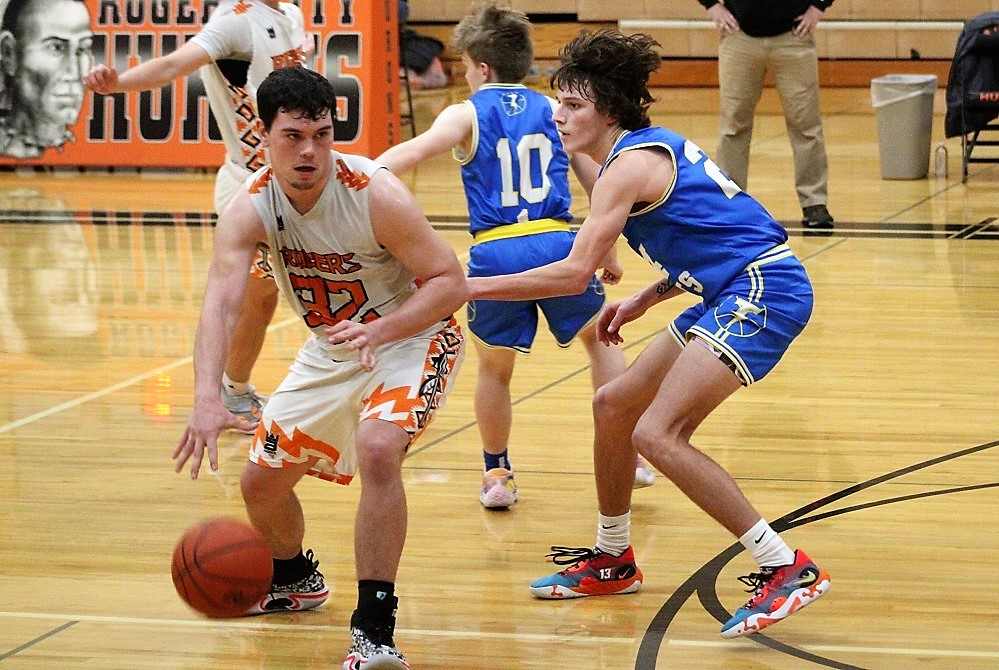
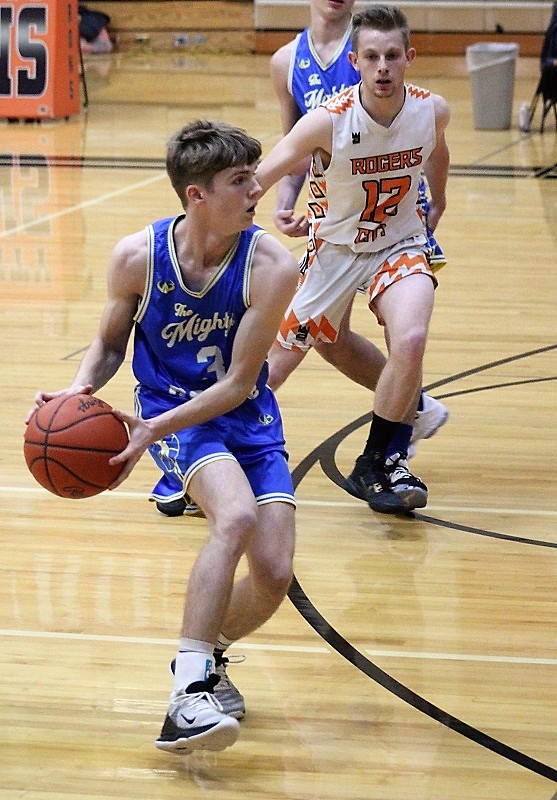
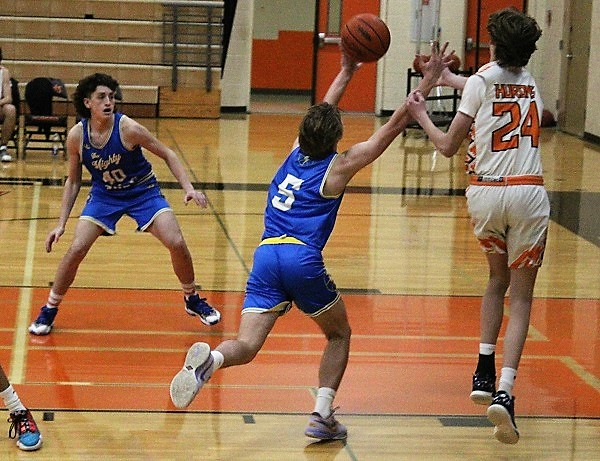
PHOTOS (Top) Mio’s Gage Long (24) defends during a 57-17 win over Rogers City on Tuesday. (Middle) Nathan Hurst (3) looks for an open teammate. (Below) Austin Fox (5) intercepts a pass into the lane. (Photos by Jessi Fox.)