

Rivals Unite for 'Never Forgotten Games'

January 24, 2018

By Dean Holzwarth
Special for Second Half

FENNVILLE – The small West Michigan towns of Fennville and Saugatuck are separated by less than 10 miles, thus sparking a longstanding rivalry that has played out in various sports through the years.

However, for one night, a special event brought the two communities together to help support a worthy cause.

The seventh-annual “Never Forgotten Games” between the neighboring communities were played Friday night at Hope College in honor of Wes Leonard, who died unexpectedly in 2011 after making the game-winning basket in overtime against rival Bridgman.

Leonard, a 16-year-old junior at the time, died from sudden cardiac arrest due to an enlarged heart.

To open the night, Saugatuck’s girls defeated Fennville 55-40. Then, in a back-and-forth affair typical of a rivalry game, Fennville’s boys edged Saugatuck 48-46 and improved to 8-2 on the season.

But Fennville boys basketball coach Joe Rodriguez said the final result paled in comparison to the impact the game had on both schools.

“We circle that game on the calendar because it’s an opportunity to focus your energy on something bigger than us,” he said. “It’s not just a conference game; it’s not just another basketball game or Friday night game. It’s bigger than the game of basketball itself. It’s one of our former players that we look forward to tributing.

“Everyone was there for one reason, and that was to celebrate the legacy of Wes Leonard and to support the cause.”

The two schools joined forces to help make the night a success, including meeting in the days prior to discuss game preparations.

“Some Fennville kids came over to our school and met with some of our kids before to go over cheer and signs and just how we could help out,” Saugatuck boys basketball coach Andy Diaz said. “Our kids showed up early to help set up and help Jocelyn (Leonard, Wes' mother), so it was a real collaborative effort.”

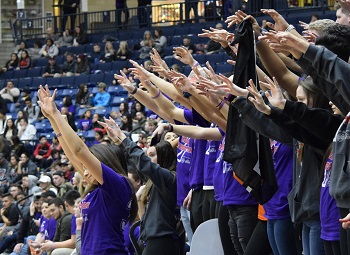
This year Fennville’s student section, recalling some of their experiences taking part in the MHSAA’s “Battle of the Fans” the last two years, invited Saugatuck’s student section to join forces for some cheers during the game. Last week, Fennville student section leaders Kamryn Vandyke, Clay Rosema and Isabella Marquez strategized with Saugatuck’s Reece Schreckengust, Sydney Ayres and Alexa Phillips, designing and planning cheers they could do together.

The schools’ band teachers – Fennville’s Paul Andrews and Saugatuck’s Andrew Holtz – also met and planned the combined bad that played together in the same section for the entirety of Friday’s game.

“Although rival schools, both student bodies have embraced the idea that the cause is an opportunity to be a part of something greater than the game itself,” Fennville athletic director Frank Marietta said. “Both schools are very competitive on the field of play, but there is a positive and strong relationship between the students as a whole. The spirit and heart of the students from each school is what makes it such a great rivalry.”
The close-knit ties between the schools run deep.

“They know each other very well,” Diaz said. “They work at the same places during the summer, and they cross paths all the time. I have a lot of friends in Fennville.”

Rivalry games often are intense and emotional, but this one is different due to the greater significance the night holds.

“That’s the unique part of it,” Rodriguez said. “As a coach you want to talk about how it’s your rivalry game, but this one is a little different. It’s all about the events, and they play a big part in helping.”

 “They are our neighbors, and when we went through (Leonard’s death) they showed a lot of support as a community to Fennville, and I think it’s awesome that they are a part of this game as well.”

Rodriguez said competing against another team in that setting just wouldn’t seem fitting.

“Because we are so close it would be weird if it was another community that we were playing,” he said. “It would feel manufactured, where this is more genuine.”

Diaz said the rivalry took on a different meaning after Leonard’s untimely passing.

“I feel very fortunate to be a part of the best small-school rivalry in the state of Michigan,” he said. “That’s our personal opinion, and when Wes passed, it definitely changed the perspective and narrative of the rivalry, especially on that game night.”

Shortly after Leonard’s tragic death, The Wes Leonard Heart Team was formed. The foundation raises money for automated external defibrillator (AED) awareness and donates AEDs to schools throughout the state.

The mission of the foundation is to honor Wes’s life using a team approach, combining the efforts of his loved ones and other existing foundations in the pursuit of a common goal. The foundation “is committed to honoring the children who have lost their lives to Sudden Cardiac Arrest and preventing other families and friends from feeling the pain of losing their loved ones. With this team approach, we feel we can give others a chance at ‘just one more game.’”

More than 260 AEDs have been put into schools through the foundation, and another 4-6 will be donated with money raised Friday.

The Never Forgotten Game hits close to home for Diaz, whose mother survived a scare almost seven years ago.

“My mom was saved by an AED,” Diaz said. “She had a heart attack in church, and one was used to revive her. They had to shock her twice, and without an AED, she’d be gone.”

Diaz, a Saugatuck graduate who coached against Leonard in football and basketball, hopes the money raised by the game can help others who may encounter the same situation.

“I gave my mom a big hug before that game because an AED saved her life, and maybe this game buys the right AED for a school that saves someone else’s life,” Diaz said. “It just put things into perspective. Obviously, we always want to win the game, but at the end of the day what really matters is the cause and Wes.

“We talked before the game about how this game is bigger than any of them. It’s not about us; it’s not about them. It’s about the entire state of Michigan at this point because of the importance of saving lives.”

Dean Holzwarth covered primarily high school sports for the Grand Rapids Press and MLive for 16 years and more recently served as sports editor of the Ionia Sentinel and as a sports photojournalist for WZZM. Contact him at [email protected] with story ideas for Allegan, Kent and Ottawa counties.

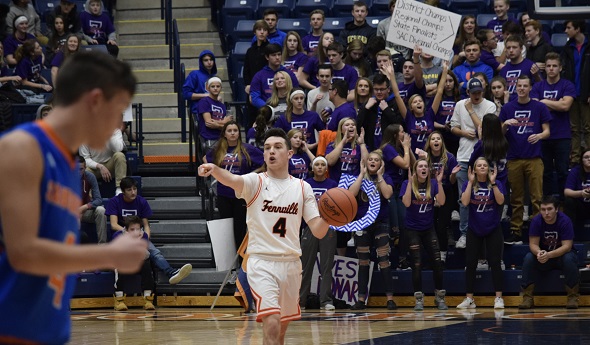
PHOTOS: (Top) Fennville's students cheer as a classmate brings the ball upcourt against Saugatuck on Friday. (Middle) Fennville's student section worked with Saugatuck's to cheer together during the games at Hope College. (Photos by Isabela Marquez/Fennville High School.)

Longtime Coach Researches Photos to Tell Story of Grand Rapids Sports' Past

By Steve Vedder
Special for MHSAA.com

September 16, 2022

GRAND RAPIDS – Bob Schichtel always pauses when he comes across the ancient black and white photo long enough to ponder whatever became of the two youngsters adorned in Grand Rapids Union basketball uniforms.

The posed shot shows two players facing each other in a local gymnasium in a photo apparently taken four days after the Japanese surprise attack on Pearl Harbor in 1941 that launched the country into World War II. Only a handful of fans today would recognize the players' striped, ultra-short shots and simple sleeveless shirts with "Union" emblazed across the front as recognizable basketball uniforms. One holds a battered-looking basketball, while the other looks on. The two players, whose uniform numbers are "4" and "9," aren't really smiling, but still seem as close as any teammates, whether 81 years ago or today.

In fact, it's the look the youngsters share that intrigues Schichtel, whose thankless, pro bono job it is to identify the two players.

"Once you start," said Schichtel, a former longtime Grand Rapids basketball coach, "it's like looking down a deep rabbit hole."

Longtime area coach Bob Schichtel researches hundreds of photos that are part of the Grand Rapids Public Library archive. Schichtel works as a volunteer for the Grand Rapids Public Library trying to identify mostly former Grand Rapids City League basketball players from approximately 1938 through the early fifties. The online photos are mostly from the Robinson Photo Studio Collection taken in conjunction with the Grand Rapids Herald newspaper. The library says the unique collection spans some 950 basketball negatives from the entire Robinson/Herald collection that totals well over 900,000 Grand Rapids photos.

While the work – which amounts to a ton of patience combined with a detective ability – can be exhausting, it's still what Schichtel describes as a labor of love. For example, there's the shot of the two still-unidentified Union players. Schichtel looks at the photo and can't help but wonder whatever happened to the kids. Were they exceptional athletes? Did they leave their marks on Grand Rapids history, whether it was in education, politics, business, industry, the arts or another field? He doesn't even know, as in many photos from this era, whether the two entered the military and thus even survived World War II.

Schichtel has searched everywhere for the answers, but has come up short. Too many times, in fact.

Which isn't to say he'll quit looking or chalk up his research as inconsequential. Schichtel said the foremost reason he spends hours on the project is that many of the athletes he identifies deserve the recognition for achievements far beyond basketball. In many cases former City League basketball, football, baseball, track and tennis athletes became the foundation on which Grand Rapids was built. If Schichtel can uncover an old photo which depicts these youngsters during their high school careers, so much the better, he said.

"It's important to recognize Grand Rapids sports history, and I don't know if we've given enough attention to their past," Schichtel said. "They are what got us here, and I'm a firm believer they need to be recognized for it."

Figuring out that history, however, ranges from, at the least, extremely time consuming to – in too many frustrating cases – virtually impossible. The City League was formed in the late 1920s and featured original schools Grand Rapids Central, Creston, South, Union, Ottawa Hills, Catholic Central and Davis Tech. The league was eventually folded into the Ottawa-Kent Conference in 2008. 

"It was a long, evolving league," Schichtel said.

Schichtel has identified these 1941 Grand Rapids Ottawa Hills basketball players as James Horn (left) and Chuch Reynier. The identification tools available to Schichtel are actually more numerous than most would suspect. For starters, he's formed an impressive database of information by pouring through old City League yearbooks and programs, photos from other collections and microfilm of old newspapers, And then there's also the knowledge gathered by Schichtel himself, a 1968 Grand Rapids Catholic Central graduate. After playing in many old City League gymnasiums, Schichtel went on to compile a 389-197 record in 27 years as the Cougars girls basketball coach. He uses countless City League contacts as both a player and coach to identify athletes. In all, Schichtel taught in the Grand Rapids school system for 34 years.

He also uses the game itself to identify the photos. For instance, he can pinpoint some photos simply by the styles of the uniforms worn by players. He also figures out who is who by other clues such as what the players are doing in the photo. If a player is taking a set shot in the photo, it's likely pre-World War II. The beginnings of the jump shot, or what Schichtel calls "elevation while shooting," is probably mid-1940s. In addition, Schichtel can identify photos through pure basketball athleticism. Players can look a bit awkward in shots from the thirties as compared to players from the late 1940s who were beginning to play with a more obvious flare.

Put all the information together and Schichtel, who has uncovered more than two dozen personal connections to subjects in the photos, believes he has a reasonable shot at identifying them.

Since he signed on with the project, Schichtel figures he's identified about 10 percent of the photos he's viewed. Among the City League athletes he's found shots of Central's John Lavan, who was born in 1890 and played Major League Baseball during the Babe Ruth era and became a military hero who is buried in Arlington National Cemetery; Creston basketball player Roger Wilkins, an assistant United States attorney general during the Watergate hearings; Art Spoelstra of Godwin, a former NBA player and member of the Grand Rapids Hall of Fame; and Grand Rapids native Bill Cutler, who turned a chance post-World War II meeting with then-American League president Will Harridge into a position as commissioner of the Pacific Coast League,

Schichtel said gaining information through photos on the people who became the bedrock of Grand Rapids should be celebrated.

"I think it's a great approach for the community; they shouldn't be forgotten," Schichtel said. "Who else is going to do this? Why do I do it? I see a certain, for lack of a better word, a nobility. These kids played for the love of game, and they became the “Greatest Generation.” These kids did great things. It's not just, 'Well, there's No. 58,’ in a photo.

"You want to know more about them. That's the real intrigue for me."

Schichtel identified Grand Rapids South High’s “Fireman Five” of, from left, Fred Esslair, Lee Morrow, Jack Carroll, Bob Youngberg and Bruce Bigford. Tim Gloege of the Grand Rapids Public Library said the collection of photos – and their identification – is continually growing. As more people log onto the library's website, more people want to either add to the collection or have information that leads to an identification. The library estimates about 1,200 photos are searched monthly. But as time grows, many of the original photos are disintegrating. The library is in a constant state of preservation, Gloege said.

"It's a massive project, and we're working to get as many photos online as possible," he said. "The numbers (of photos) we have are rising pretty significantly as people post them on social media.

"When you think of the past and now, you need to realize these are people, kids who used to play basketball and did other things. The work is hard and very time-intensive, but it brings a whole new dimension to history."

Schichtel said he's "kind of picked the low-hanging fruit" on many of the easy photos to identify. But the work will continue.

"Yes, it can be frustrating," he said. "There are limitations if you want it to be accurate. Sometimes you look at a photo and you know it's not going to happen, and you move on. But this a chance to learn about people who made Grand Rapids what it is. That's important to me."

PHOTOS (Top) Two Grand Rapids Union basketball players stand for a photo taken Dec. 12, 1941. (2) Longtime area coach Bob Schichtel researches hundreds of photos that are part of the Grand Rapids Public Library archive. (3) Schichtel has identified these 1941 Grand Rapids Ottawa Hills basketball players as James Horn (left) and Chuch Reynier. (4) Schichtel identified Grand Rapids South High’s “Fireman Five” of, from left, Fred Esslair, Lee Morrow, Jack Carroll, Bob Youngberg and Bruce Bigford. (Historic photos courtesy of the Grand Rapids Public Library.)