

Romulus Summit Academy Continuing Impressive Climb
By
Tom Markowski
Special for Second Half
March 17, 2021
As a co-founder of Romulus Summit Academy, Leann Hedke was intent on creating an atmosphere conducive to academic achievement.
 Summit opened its doors in Flat Rock in 1996 for grades K-5, soon expanding to K-12 once the school moved to Romulus the following year. According to Hedke, in the last 10 years 100 percent of those graduating were accepted to a college or university.
Also, according to a 2017 report, Summit had the highest graduation rate among charter schools in Michigan and was ranked in the top 50 by graduation rate during the 2015-2016 school year. Summit, rated No. 17, had a graduation rate of 98.58 percent, nearly 20 percent better than the state average of 79.65.
Mission accomplished.
But something was missing: a competitive athletics program. Often a viable athletic program will enhance academics. A competitive athletic program can generate enthusiasm and give students a reason to be proud of their school, in addition to academics.
Summit Academy North High School didn’t sponsor varsity sports until the early 2000s and, frankly, they weren’t very good, particularly in the sports of boys basketball and football. From 2004-2016 the football team boasted three winning seasons and made the playoffs once (2007). Until the 2019-20 season, the most wins the basketball team totaled was 10.
“Our focus has been on the scholar-athlete,” Hedke said. “We focus on academics. Our GPA (grade-point average) requirements are higher than what the (Michigan High School Athletic Association) requires.”
Hedke said there’s been quite of bit of turnover in the coaching ranks in boys basketball over the years. Part of this is due to the lack of success, as far as wins and losses, but some of this can be attributed to the high standards Hedke and her fellow administrators demand. Swearing is taboo, and a coach is expected to be a stickler for discipline, and must adhere to a strict decorum.
With the backing of Summit athletic director William McKoy, veteran coach Mark White, less than a month before the start of the season, was hired in November of 2018. Summit was 9-12 during White’s first season before showing vast improvement last winter finishing 16-4. Highlighting that season was the school’s first division title (within the Charter School Conference) and a spot in a Division 2 District Final against Flat Rock. Summit has never won a District title so this game loomed as the most important in school history.
Then COVID-19 hit, ending the season.
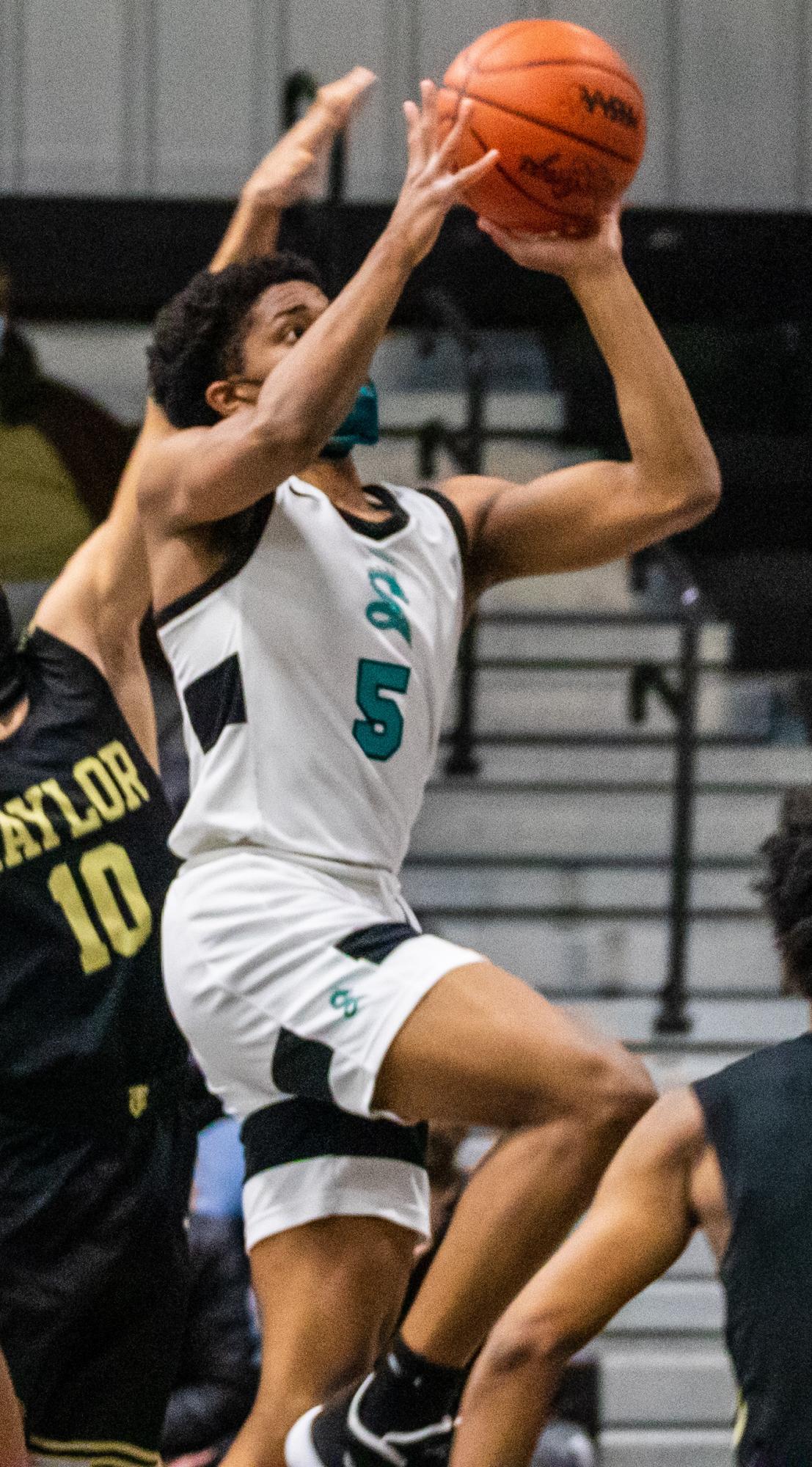 Summit returned four starters from that team and is off to a 15-0 start with the MHSAA Tournament less than a week away. Most of its victories have been by double digits including last Saturday’s 71-53 victory over Taylor, a Division 1 school, and Tuesday’s 72-46 victory over Detroit Community in a conference tournament quarterfinal. Summit’s semifinal is scheduled for Thursday.
Two wins stand out in particular, and both came on the road. Summit defeated Harper Woods Chandler Park Academy, 54-51, on March 1 and then upset No. 3-ranked (in Division 2) Detroit Edison, 49-46, on March 8. Edison’s only other loss this season was to Warren De La Salle Collegiate, a Division 1 school, 72-68. Both Chandler Park and Edison are Charter School Conference members and have had strong programs over the years.
White starts one senior, guard Jamel Johnson, who’s averaging 10 points per game and was selected second-team all-conference. Sophomore James Wright averages 17 points and nine rebounds. White’s top player is junior and three-year starter Orlando Lovejoy, Jr., a 6-2 guard who was selected conference player of the year. His 23 points led Summit in its victory over Community. Lovejoy averages 21 points, 10 rebounds and seven assists per game.
“All of our players got better during the offseason,” Lovejoy said. “(White) is an intense coach. He’s demanding. He’s constantly pushing us. He’s a perfectionist.”
Much of the credit goes to White for the recent success, but one can’t overlook the talented players within the school. Take the recent success of the football program for example. The football team was 0-9 in both 2015 and 2016. The Dragons went 5-4 the next two seasons before finishing 8-3 in 2019, a run which included an 18-12 victory over Redford Union in a Division 4 District opener, the program’s first playoff win. This past regular season was shortened to six games because of the pandemic, and Summit won two playoff games finishing 7-2.
“Summit is an excellent school,” White said. “They’re in line with what I want to be as a coach.
“There are more accolades for a team that hasn’t been that good in the past. (Winning) has never been done before here. I feel the best is yet to come, and not just for the team, but for the school as well. Gaining recognition in basketball helps promote the school. People will find out about how good Summit is as a school.”
Winning is anything but new for White. His first season as a head coach was at his alma mater Detroit Renaissance in 1998. In 2000 Renaissance, which had never played for a Detroit Public School League title, won the PSL defeating Detroit Redford, 41-37, in the championship game. Renaissance won the title again in 2002 and 2003. Renaissance then won two MHSAA Class B titles (2004, 2006) under White.
White left Renaissance after the 2005-06 season to become head coach at Adrian College, another alma mater. He spent seven seasons there before returning to the high school level at River Rouge. White guided River Rouge to the Class B Semifinals in 2017 and 2018.
White said he couldn’t be happier, at this time in his professional life, than he is now at Summit. In addition to his duties as the boys basketball coach, White is also the school’s academic interventionist and assistant athletic director.
 Lovejoy is aware of the success his coach has had at other schools. And even though Summit hasn’t achieved that type of success, he said anything is possible.
“We want to win our conference tournament, a District and Regional title, and the states,” Lovejoy said. “To some that’s farfetched, but it is realistic. We’re with a coach who’s done it before.
“This is special. (Summit) has never won a District, and here we are undefeated. We’re soaking it all in. We want to give the school something to cheer about.”
Lovejoy and his teammates recently gave Hedke a gift from their hearts. It’s a poster, a collage of sorts, with photos of the team in addition to pictures the players painted. This was in response to Hedke being a cancer survivor. She was diagnosed with breast cancer this past November and now is cancer-free.
“Mark is a wonderful coach,” Hedke said. “He focuses on what (the players) do well. He talks about who they are and what they represent. He teaches them to be aware. When I was going through my cancer, he told the players that we’re fighting on the court to win a game. She’s fighting for her life.”
The players have since dedicated their season to Hedke.
 Tom Markowski is a correspondent for the State Champs! Sports Network and previously directed its web coverage. He also covered primarily high school sports for the The Detroit News from 1984-2014, focusing on the Detroit area and contributing to statewide coverage of football and basketball. Contact him at [email protected] with story ideas for Oakland, Macomb and Wayne counties.
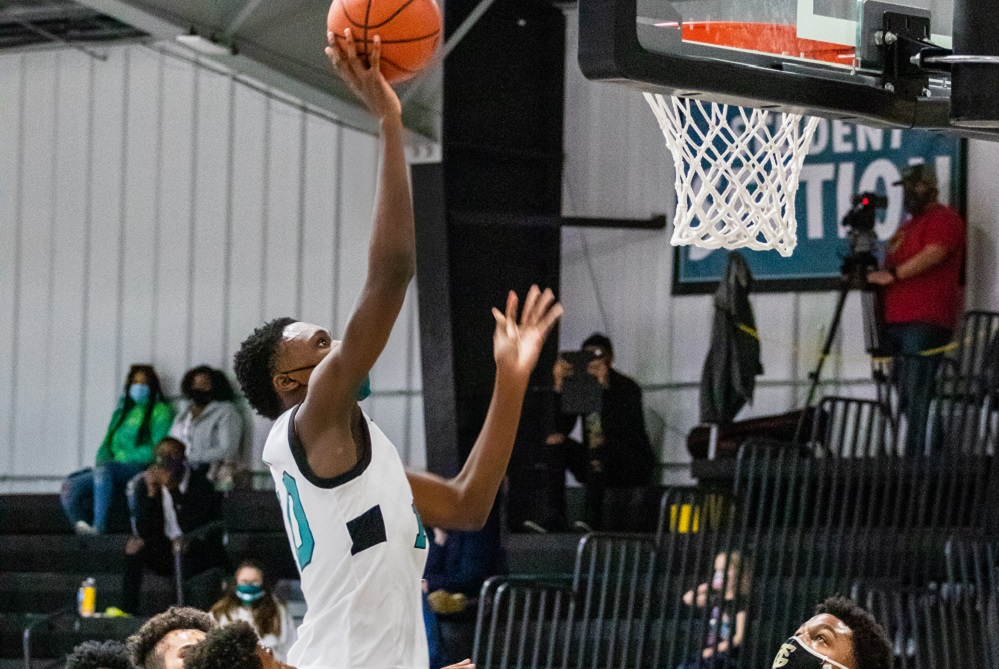
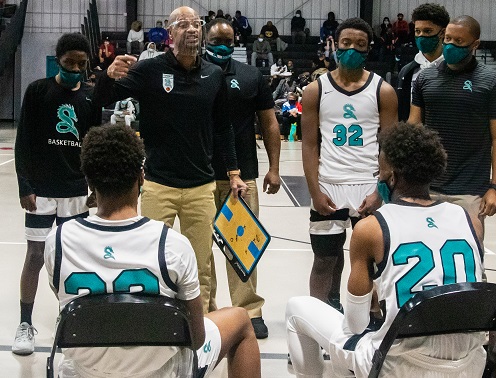
PHOTOS: (Top) Raevon Thomas (10) gets up a shot during Summit Academy’s Senior Night win over Taylor. (Middle) Summit’s Orlando Lovejoy makes a move to the basket Saturday. (Below) Dragons coach Mark White huddles his team. (Photos by Aaron Goodman.)
Saints' Kreski Sets Bar for U.P. Scoring
April 11, 2016
By Dennis Grall
Special for Second Half
Basketball is all about scoring points and stopping teams from scoring.
 Gage Kreski of St. Ignace is one of those rare players who excel on both ends of the floor.
Kreski eclipsed a 51-year-old Upper Peninsula scoring record this season while also establishing himself as a defensive ball hawk. That production helped him become Associated Press Class C Player of the Year in Michigan. He was also a three-time Division 7-8 all-state football selection.
Kreski finished his four-year basketball career with 2,178 points, surpassing the mark of 2,140 points set by Dom (Duke) Jacobetti of Negaunee St. Paul from 1962-65. Kreski also became his school's all-time points leader, topping Krista Clement's 2,060. Steve McDonald was the previous boys pace-setter with 1,972.
Just two years ago, Lexi Gussert of Crystal Falls Forest Park became the all-time girls – and overall – scoring leader in the U.P. with 2,630 points. Allison Bailey of Ewen-Trout Creek had set the previous girls mark of 2,131 points in 1996.
"I was not focused on the record," Kreski said recently while on spring break in Panama Beach, Fla. "My goal was to make it deep into the playoffs."
The Saints (17-4), however, were upset by Boyne City in their Class C District opener.
A 6-foot-3, 195-pound point guard who frequently took his defender inside, Kreski scored 519 points this season. His career points will rank 15th on the MHSAA's career list for that category.
On defense, he set an MHSAA record with 450 career steals (Matt Taylor of Pinckney had 363 through 2000). Kreski also set a single-season record of 137 steals this school year and pulled down more than 900 rebounds during his career.
"I like scoring points, but defense is more important and I liked it a little more because I had to do the job," Kreski said, noting coach Doug Ingalls is a stickler about defense, highlighted by frenetic full-court pressure. "Defense first for sure.You play all-out on defense the whole game and the offense goes from there."
Ingalls also runs an offense similar to what he played under his dad, Jack, at Gladstone High School, using a motion approach – or perhaps freelance to a degree.
"We don't have many sets, but we know how to play basketball," Kreski said.
"For us to be good, he had to score a lot. It was all about winning for him," said Ingalls.
Ingalls admitted Kreski's weakness was shooting, but that he made up for it with a sterling overall game. "He has great instincts and is a very, very good athlete," said Ingalls. "I would get on his case because sometimes he was not aggressive enough going for steals. He has the length, the quickness and is savvy. He can guard anybody.
"He gets to the bucket and gets his points in many different ways. I can't imagine anyone being a better all-around basketball player. He is so good at making the right decision. He passes as well as anybody.”
At a time when perimeter scoring is stressed more and more – think of Steph Curry and other potent sharp shooters – Kreski made fewer than 35 shots beyond the 3-point arc this season.
That was drastically different than the method used by Jacobetti, whose career ended more than 20 years before the 3-point shot was adopted. A wing guard for three years before replacing his graduated brother at the point for his final season, Jacobetti's normal shot was from the perimeter, and usually well past today's 3-point arc.
He estimated perhaps 70 percent of his field goal attempts were outside that line, yet he unbelievably converted about 85 percent of his shots. "I shot basically from outside," Jacobetti said.
During his era, many small-school gyms were tiny, with well below regulation-sized floors that allowed offenses to get the ball into scoring range quickly. The feet of spectators often were on the playing floor, and at some gyms the base line was painted on the wall while the three jump circles were often intertwined. Jacobetti pointed out, "You didn't have much room to run an offense."
In his first game on the varsity as a freshman, Jacobetti scored 22 points and did not miss a field goal or free throw. He averaged about 12 points as a freshman, and then raised it to 22, 28 and 32 points per game, respectively, over his final three seasons.
Asked about a potential career behind the arc, Jacobetti said he has not really thought about it much because it wasn't part of the game at that time. "Wherever you had a shot from, you took it," he said of a fairly simple yet very effective approach.
Jacobetti finished three points ahead of Trout Creek legend Jim Manning, who finished his ended in 1961 with 2,137 points. Jacobetti's career ended in a tournament loss at Pickford and he recalled a Sault Ste. Marie sportswriter informing him after the game that he had just set the Upper Peninsula scoring record.
"I was shocked. I had no idea (about the record)," he said, noting it was not a big deal at the time, perhaps because it was only four years old. "It wasn't talked about a great deal."
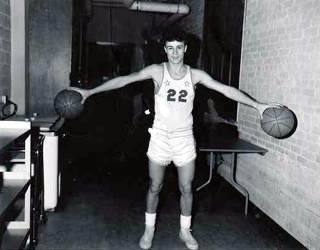 Jacobetti only remembers one time in his career when scoring was stressed. His coach at the time, Gordy LeDuc, told him the offense would run through him in a game at Negaunee's Lakeview Arena. Just a night earlier, Pat Groleau of Nahma scored 48 points and LeDuc said, "Duke, tonight you're going to break the record."
Jacobetti scored 52 points, but he said, "I didn't feel comfortable because everybody was giving me the ball."
Jacobetti and Kreski share the same idea about basketball. Jacobetti said, "It was win or lose, not really about the points." Kreski, in a telephone chat about 30 minutes earlier, said, "I just tried to win the game. It (McDonald's record) was a goal but winning was first, and for us to win games I had to score a little bit."
He knew about McDonald's mark, obviously, but didn't learn about Jacobetti's record until he was within about 300 points. "It was not the most important thing on my mind," he said.
He said Ingalls told him, "We're not going to do anything that we normally don't do. If it happens, it happens."
It happened Feb. 27 when Kreski produced a single-game best 46 points against Pellston.
While Jacobetti's record lasted 51 years, Kreski's could be erased next season. Jason Whitens of two-time defending Class D champion Powers North Central has already amassed 1,409 points. Whitens scored 623 points this season.
"Records are made to be broken," said Jacobetti. "I never expected it to last as long as it did. Give that kid a lot of credit. I am very happy for him. He sure put in a lot of work and a lot of time. It is quite an accomplishment. I realize what it takes. I put in hours and hours myself (much of it on outdoor courts during winter with snow banks towering around the surface), and I know he did."
Ingalls confirmed that opinion. "I'm disappointed that other varsity basketball coaches didn't have the chance to coach him. They would be amazed at how hard he works.
"That work ethic comes from his parents. His dad Paul played football at Northern Michigan University, and his mother Deanna was a basketball player at NMU and was named to the Upper Peninsula Sports Hall of Fame in 2013.
"I have good genes, I guess," Kreski said, noting how both parents have put in time helping him pursue his hoops career. "They never really forced me to play or go work out. They made sure I had a positive attitude and (knew) how to be a good man.
"They have just been awesome in my life. They have had a great impact."
He said Ingalls "has been the man. He did everything for me, and my parents have been there for me all the time. Doug's wife (St. Ignace girls basketball coach Dorene) has pretty much raised me."
Kreski will finish his basketball career at the U.P. All-Star Classic in Marquette on June 18. He will put all his athletic focus on football when he reports to Central Michigan University as an invited walk-on in August. The all-state football player (he played quarterback and defensive back for the Saints) will likely play safety but could also become a wide receiver.
"My body is a little better suited for football," he acknowledged. "To be a point guard in Division I (basketball) you have to be 6-4 and be extremely lightning quick. I'm quick, but not lightning quick."
Just as he has adopted a sensible approach to his athletic future, knowing where he fits and where he may not, Kreski did everything he could to help the Saints before worrying about his personal achievements.
"I'm extremely proud of him and happy for him. I will follow his career at Central," said Jacobetti, who hopes to meet Kreski at the U.P. All-Star Classic.
Top five U.P. boys basketball scorers
2,178 - Gage Kreski, St. Ignace, 2012-2016
2,140 - Dominic Jacobetti, Negaunee St. Paul, 1961-65
2,137 - Jim Manning, Trout Creek, 1957-61
2,086 - Bob Gale, Trout Creek, 1962-66
2,010 - Jim Hammerberg, Baraga, 1992-96
 Denny Grall retired in 2012 after 39 years at the Escanaba Daily Press and four at the Green Bay Press-Gazette, plus 15 months for WLST radio in Escanaba; he served as the Daily Press sports editor from 1970-80 and again from 1984-2012. Grall was inducted into the Upper Peninsula Sports Hall of Fame in 2002 and serves as its executive secretary. E-mail him at [email protected] with story ideas for the Upper Peninsula.
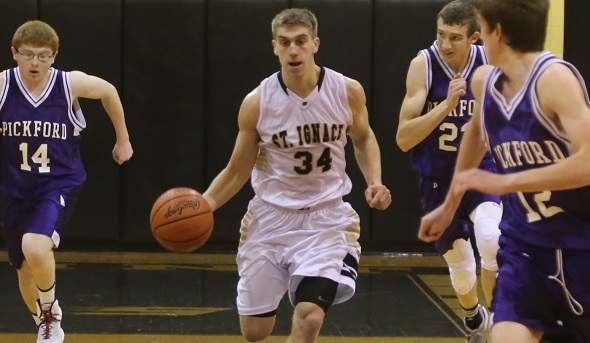
PHOTO: (Top) Gage Kreski pushes the ball upcourt during a game against Pickford in 2015. (Middle) Dom Jacobetti was the previous Upper Peninsula career scoring record holder. (Top photo by Paul Gerard; bottom courtesy of the Upper Peninsula Sports Hall of Fame.)