

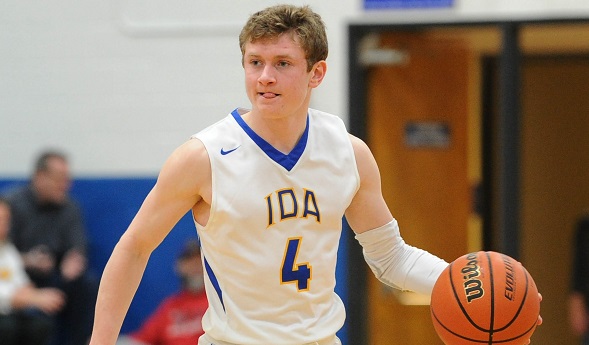
Sampson Goes 'All Out' for 3 Ida Teams
April 23, 2019
By Doug Donnelly
Special for Second Half
IDA – Clay Sampson knows only one speed, whether it’s on the football field, basketball court or baseball diamond – it’s full go, all the time.
 “He has such a passion for the game, no matter what sport,” said his basketball coach, Jared Janssen. “As a coach, you preach all the time about giving it your all for 32 minutes. The thing is, with Clay, he did it. He was always going all out.”
Sampson’s career at Ida High School is winding down, and Bluestreak fans will be sad when he’s no longer putting on a uniform and representing the Class B Monroe County school.
Sports always have been part of his life. His parents were both multiple-sport athletes in high school, as was his older brother, now 21. His younger brother, 15, is following in the same footsteps.
“I played four sports when I was younger,” said Sampson, who is about 5-foot-7, 145 pounds. “I think that’s where it started. I’ve always loved the competition.”
His parents have a deep sports background as well. His mom, Carrie, was a three-sport athlete at Ida and part of the Bluestreaks’ Class C championship softball team in 1989. His dad, Steve, was a Class C champion hurdler and record holder for the Summerfield track & field team in 1990.
“He’s the middle boy of three, and he’s probably our spitfire,” said his mom. “He’s a competitor. He’s a debater, too. I’m sure his teachers would say that. He’s always up for a challenge. He’s always been an intense kid.”
In football, Sampson was Ida’s quarterback, helping the Bluestreaks win 16 games over the past two seasons and extend their consecutive playoff streak to six. He threw for more than 500 yards and ran for more than 400.
“As a mom, I was like, ‘Oh my gosh, I don’t know about him playing quarterback,’ but he just said, ‘Mom, I’m fine,’” said Carrie.
He’s been a four-year varsity baseball player. As a freshman, he drove in the winning run as Ida won the first District baseball title in school history.
Sampson made his biggest impact on the basketball court. He finished this winter as one of the top scorers in Monroe County at 20 points a game and, despite being Ida’s point guard, was third in the county in rebounding at more than seven boards a game. His shooting has improved every season, he said, and this year he made 44 3-pointers. He also knew how to draw a foul. He got to the free throw line 178 times, shooting better than 74 percent from the stripe.
“I was a sad 3-point shooter as a freshman,” Sampson said. “It’s something I worked on all through high school. This year I was better at it. I was able to use my ability to shoot from outside to draw defenders and get to the free throw line. I didn’t go out there and just chuck up 30 shots or something.
 “Coach Janssen sat down with me before the season and told me that we needed a lot of scoring out of me. I knew I had to carry that load.”
Ida went just 1-20 during Sampson’s sophomore season but improved to nine wins the following year. This season, Janssen’s first, the Bluestreaks won 12 games, including back-to-back over Flat Rock and Carleton Airport, two of the three teams that shared the Huron League championship. The second of those wins, against Airport, gave Ida the District title. Sampson scored 28 in that game, including drilling 14 of 19 free throws.
“We started 0-2, but things changed after that,” Sampson said. “We had a lot of fun. No one expected us to win that many games or a District. It was great beating Dundee twice. I know my senior class had never done that, so that was awesome. Winning a District just put a great cap on the season.”
Sampson rarely came off the floor for Ida.
“A lot of people that play that way try and do too much,” Janssen said. “He always seemed to find that good medium. Everything he did helped the team, offensively and defensively. The pace he played at wasn’t too much.”
Sampson, who recently announced he would attend Glen Oaks Community College in Centreville and play basketball, said his parents never pushed sports on him or his brothers. He played in the recreation baseball leagues at Ida beginning in first grade and youth football through the community-sponsored team. He played on travel basketball teams from the time he was 10 years old.
“They introduced sports to me and my siblings, and it’s just always been part of our lives,” he said. “I couldn’t imagine not playing all of the sports that I played in. I don’t understand kids that just play one sport.
“Football is the No. 1 sport that shapes you. It’s a demanding sport. You have to be mentally and physically tough to go through a football season, let alone four. Basketball is probably my favorite, but football is a close second.”
No matter what sport Sampson plays, his family is a big part of it. In addition to his parents being at every game, his aunt, Connie Diesing, has been a strong supporter, sending texts before just about every game and being part of the community following his every play.
“I don’t think she’s ever missed a game,” Sampson said of his aunt.
Sampson is a Bluestreak through and through. The family lives in the house his grandfather grew up in.
“I think my mom is a little more competitive than my dad,” he said. “We joke about them winning state championships or holding records. It’s all in fun. My whole family is so supportive. It’s always reassuring that they have been there the whole time.”
 Doug Donnelly has served as a sports and news reporter and city editor over 25 years, writing for the Daily Chief-Union in Upper Sandusky, Ohio from 1992-1995, the Monroe Evening News from 1995-2012 and the Adrian Daily Telegram since 2013. He's also written a book on high school basketball in Monroe County and compiles record books for various schools in southeast Michigan. E-mail him at [email protected] with story ideas for Jackson, Washtenaw, Hillsdale, Lenawee and Monroe counties.
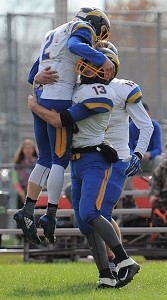
PHOTOS: (Top) Ida’s Clay Sampson directs this offense this winter. (Middle) Sampson (2) is hoisted by a teammate during a playoff win over Dearborn Heights Robichaud on Oct. 26. (Top photo by David E. Phillips; middle courtesy of the Ida football program.)
Senior Leaders, 'Legendary' Coaches Bring Plenty of Experience to Hackett Hoops
By
Pam Shebest
Special for MHSAA.com
January 27, 2026
KALAMAZOO — In their four years on varsity, Leland Berg and Lukas Husovsky have played for three head coaches, plus a fourth with the junior varsity while playing on both teams as freshmen.
 This year, the seniors are ending their Hackett Catholic Prep basketball careers with pair of “crafty veterans” – head coach Dan Hoff and assistant Nib Reisterer.
“It’s definitely been a struggle because every coach has their own way: the way they run practice, games, plays, everything,” Berg said of adjusting to new coaches.
“So from my freshman year, I walked into a program that had been a program a couple years, and then my freshman and sophomore years it totally flipped around.”
Berg, who has signed to play basketball next at Hillsdale College, said Hoff stepped in and brought a new culture.
“Hoff knows exactly what he wants to do,” the 6-foot-5 guard/forward said. “He’s very meticulous, and I feel that order and that tidiness has really cleaned up our team and the culture of Hackett basketball.”
Berg added that there are a lot of small changes, “like what time to show up for games, how practice is run, the kinds of drills we run, the kind of plays we run.
“I know it’s for the better, but it’s been difficult to adjust for me and my teammates.”
During their freshman season, Berg and Husovsky played on both the varsity and junior varsity teams, a challenge for the young athletes.
“It was really an adjustment because everybody had different plays,” the 6-7 Husovsky said. “There were so many plays you had to memorize. Not only was it physically (challenging), but mentally tough.”
Husovsky said that the seniors helped him and Berg as freshmen, and now he sees that as their job with the younger players.
Berg said this season the players are more appreciative of each other.
“When it comes to stuff off the court and personality-wise, we know how everybody is,” he said. “It makes it easier to play with these guys and it’s fun. It makes it a super comfortable team.”
Senior-led on the floor
Berg and Husovsky are two of four senior starters with Cullen McBride, David Verduzco and junior Elijah Brooks rounding out the starting five.
Hoff, who alphabetizes his personal players list by first names, said this is the first time he has no first names past “L”.
“There are four Lukes and two Elijahs out of 12 players,” Hoff laughed.
 Those four are Husovsky, senior Luke Napolitan and juniors Lucas Cosby and Luke Widman. Junior Elijah Nabors is also on the team.
Seniors Keegan McCue and Ezra Rowekamp-Ambs plus junior Joey Gamsho round out the Hackett dozen.
After a tough loss to Kalamazoo Christian on Friday, the Irish take an 8-5 record into a tough Southwestern Athletic Conference Valley matchup against Schoolcraft.
Berg said no matter how the first half goes, this Irish team is unwilling to give up in any game.
“We had a couple of tough games where we got punched in the mouth early and we were down at halftime,” he said. “But most of those games we really found a way to group together and keep on pushing.
“I think that’s the difference between this year’s team and teams in the past. In the past, when we’d get down a lot of points early, the game would be over. Lately, there’s been a change in mentality. That’s super impressive. We don’t give up.”
Hoff said Berg is a “hidden gem” on the team.
“He’s a really good outside shooter,” Hoff said. “His energy. He starts every practice and leads us after every game with our team cheer.
“He leads our stretching. He does a lot of leadership things on the court that people don’t even know about.”
As for Husovsky, Hoff said he brings a lot of athleticism to the post with some really good skills as a shooter.
Brooks said he is comfortable with his role on the team and looks up to the seniors.
“Before games, our seniors are making sure we’re there and in the head space we need to be in,” he said.
Brooks added that he feels he’s a link that “brings everybody together. If my energy’s up, then everybody’s energy is going to be up.”
He also appreciates the new culture Hoff brings to the team.
 “Coach is really fundamentally sound, making sure every step is done precisely and on point,” he said. “Coach is a great listener and a great motivator.”
Hoff appreciates Brooks’ passion for the game.
“Basketball is really big in his life,” Hoff said. “He brings a toughness and a skill set that is demonstrative of how much work he’s put into it.
“He’s really such a capable player and a person whose personality is extremely powerful, and that’s what allows him to be successful at key times and with any team he happens to be on.”
More than 100 years of experience on the bench
Hoff is in his 50th season as a basketball coach, the first 49 including 27 at Mattawan and five at Western Michigan University.
“Most of what I do is in practice,” Hoff said. “During games, players tell me information and I just give them information back.
 "It’s like my classroom experience. When it’s time for a test, it’s time for them to do the test. My job is to prepare them. I find that as liberating for them as for me because I’m not yelling things to them or at them (during games).”
Hoff also said he expects his players to live up to his standards.
“When you have a 3 o’clock start, it’s a 3 o’clock start,” Hoff said. “It’s been a learning curve. I told them, one of my major flaws is I don’t know how to lower my standards so you’re going to have to come to mine.”
Hoff isn’t the only veteran coach at Hackett.
Reisterer is also closing in on 50 years coaching, including several at Hackett with both boys and girls teams.
“Staying around the players keeps us young,” he said. “I’m betting we’re one of the oldest coaching staffs in the state. We’re both 71.
“Dan is the most organized coach I’ve ever been around. He teaches the fundamentals as good or better than anybody I’ve ever come across, and he’s the perfect mentor for any young guys who want to coach.
 Reisterer, who graduated from Hackett in 1971, is also a member of the Irish Athletic Hall of Fame.
“Nib and I’ve known each other since I moved here in 1986,” Hoff said. “He coached as an assistant for me in Mattawan. We coached against each other many, many, many times and we had some really great Hackett-Mattawan rivalries.”
Another assistant also has Hackett ties.
Kevin White, class of 1998, is in his first year as the school’s dean of students.
White also has a lot of experience coaching basketball, most recently at Portage Northern.
“I’ve known Kevin almost since I moved here because he’s been with Nib all these times,” Hoff said. “I knew him when he was at Portage Northern and at (Kalamazoo College).
“He’s an in-school person, which is what an out-of-school coach needs. He’s really good at that. He keeps track of the kids in a healthy way.”
Berg said the team is responding well to a new coaching style.
“We have a legendary coaching staff, a lot of great minds,” he said.
 Pam Shebest served as a sportswriter at the Kalamazoo Gazette from 1985-2009 after 11 years part-time with the Gazette while teaching French and English at White Pigeon High School. She can be reached at [email protected] with story ideas for Calhoun, Kalamazoo and Van Buren counties.
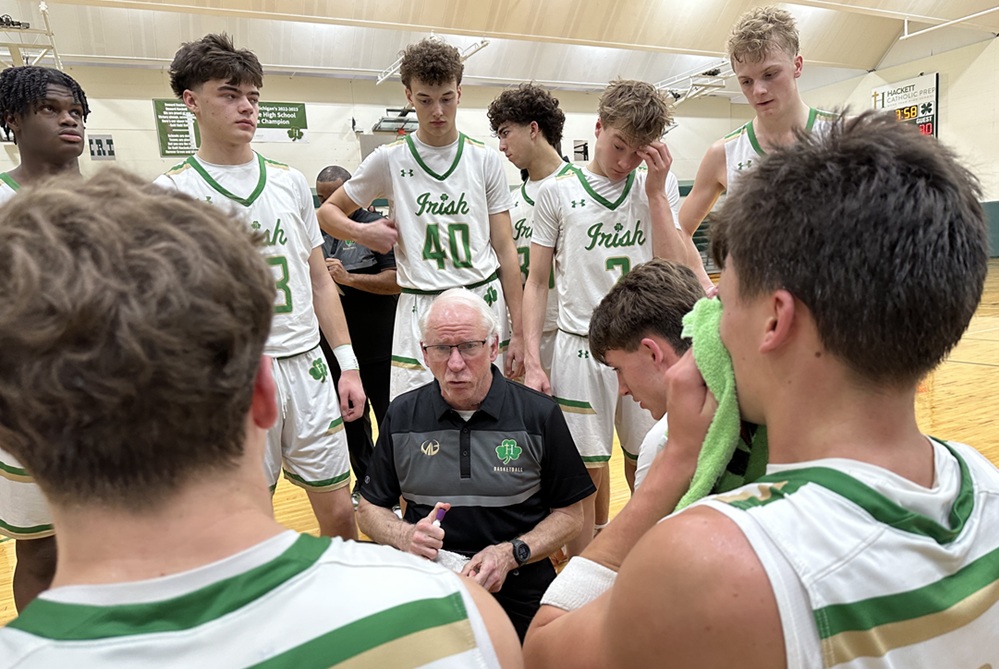
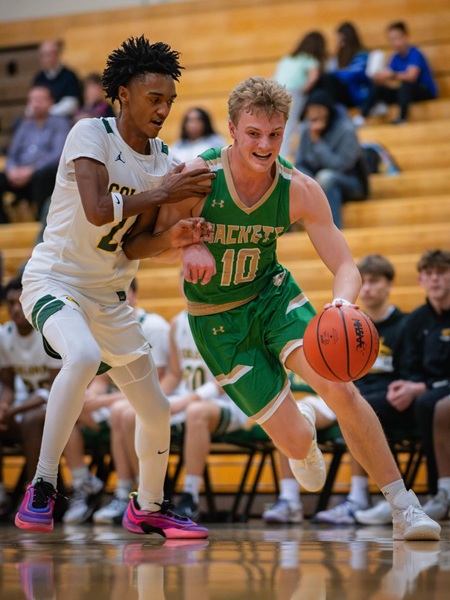
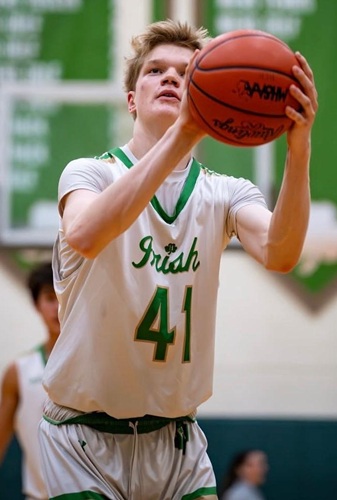
PHOTOS (Top) Hackett Catholic Prep boys basketball head coach Dan Hoff, kneeling, talks with his players during a break this season. (2) Leland Berg (10) makes a move toward the lane against Coloma. (3) Hackett junior Elijah Brooks. (4) Hackett assistant coaches Nib Reisterer, left, and Kevin White. (5) Lukas Husovsky attempts a free throw. (Action shots by Micah Jones. Headshots and huddle photo by Pam Shebest.)