


Sampson Goes 'All Out' for 3 Ida Teams
April 23, 2019
By Doug Donnelly
Special for Second Half
IDA – Clay Sampson knows only one speed, whether it’s on the football field, basketball court or baseball diamond – it’s full go, all the time.
 “He has such a passion for the game, no matter what sport,” said his basketball coach, Jared Janssen. “As a coach, you preach all the time about giving it your all for 32 minutes. The thing is, with Clay, he did it. He was always going all out.”
Sampson’s career at Ida High School is winding down, and Bluestreak fans will be sad when he’s no longer putting on a uniform and representing the Class B Monroe County school.
Sports always have been part of his life. His parents were both multiple-sport athletes in high school, as was his older brother, now 21. His younger brother, 15, is following in the same footsteps.
“I played four sports when I was younger,” said Sampson, who is about 5-foot-7, 145 pounds. “I think that’s where it started. I’ve always loved the competition.”
His parents have a deep sports background as well. His mom, Carrie, was a three-sport athlete at Ida and part of the Bluestreaks’ Class C championship softball team in 1989. His dad, Steve, was a Class C champion hurdler and record holder for the Summerfield track & field team in 1990.
“He’s the middle boy of three, and he’s probably our spitfire,” said his mom. “He’s a competitor. He’s a debater, too. I’m sure his teachers would say that. He’s always up for a challenge. He’s always been an intense kid.”
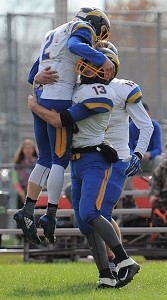
In football, Sampson was Ida’s quarterback, helping the Bluestreaks win 16 games over the past two seasons and extend their consecutive playoff streak to six. He threw for more than 500 yards and ran for more than 400.
“As a mom, I was like, ‘Oh my gosh, I don’t know about him playing quarterback,’ but he just said, ‘Mom, I’m fine,’” said Carrie.
He’s been a four-year varsity baseball player. As a freshman, he drove in the winning run as Ida won the first District baseball title in school history.
Sampson made his biggest impact on the basketball court. He finished this winter as one of the top scorers in Monroe County at 20 points a game and, despite being Ida’s point guard, was third in the county in rebounding at more than seven boards a game. His shooting has improved every season, he said, and this year he made 44 3-pointers. He also knew how to draw a foul. He got to the free throw line 178 times, shooting better than 74 percent from the stripe.
“I was a sad 3-point shooter as a freshman,” Sampson said. “It’s something I worked on all through high school. This year I was better at it. I was able to use my ability to shoot from outside to draw defenders and get to the free throw line. I didn’t go out there and just chuck up 30 shots or something.
 “Coach Janssen sat down with me before the season and told me that we needed a lot of scoring out of me. I knew I had to carry that load.”
Ida went just 1-20 during Sampson’s sophomore season but improved to nine wins the following year. This season, Janssen’s first, the Bluestreaks won 12 games, including back-to-back over Flat Rock and Carleton Airport, two of the three teams that shared the Huron League championship. The second of those wins, against Airport, gave Ida the District title. Sampson scored 28 in that game, including drilling 14 of 19 free throws.
“We started 0-2, but things changed after that,” Sampson said. “We had a lot of fun. No one expected us to win that many games or a District. It was great beating Dundee twice. I know my senior class had never done that, so that was awesome. Winning a District just put a great cap on the season.”
Sampson rarely came off the floor for Ida.
“A lot of people that play that way try and do too much,” Janssen said. “He always seemed to find that good medium. Everything he did helped the team, offensively and defensively. The pace he played at wasn’t too much.”
Sampson, who recently announced he would attend Glen Oaks Community College in Centreville and play basketball, said his parents never pushed sports on him or his brothers. He played in the recreation baseball leagues at Ida beginning in first grade and youth football through the community-sponsored team. He played on travel basketball teams from the time he was 10 years old.
“They introduced sports to me and my siblings, and it’s just always been part of our lives,” he said. “I couldn’t imagine not playing all of the sports that I played in. I don’t understand kids that just play one sport.
“Football is the No. 1 sport that shapes you. It’s a demanding sport. You have to be mentally and physically tough to go through a football season, let alone four. Basketball is probably my favorite, but football is a close second.”
No matter what sport Sampson plays, his family is a big part of it. In addition to his parents being at every game, his aunt, Connie Diesing, has been a strong supporter, sending texts before just about every game and being part of the community following his every play.
“I don’t think she’s ever missed a game,” Sampson said of his aunt.
Sampson is a Bluestreak through and through. The family lives in the house his grandfather grew up in.
“I think my mom is a little more competitive than my dad,” he said. “We joke about them winning state championships or holding records. It’s all in fun. My whole family is so supportive. It’s always reassuring that they have been there the whole time.”
 Doug Donnelly has served as a sports and news reporter and city editor over 25 years, writing for the Daily Chief-Union in Upper Sandusky, Ohio from 1992-1995, the Monroe Evening News from 1995-2012 and the Adrian Daily Telegram since 2013. He's also written a book on high school basketball in Monroe County and compiles record books for various schools in southeast Michigan. E-mail him at [email protected] with story ideas for Jackson, Washtenaw, Hillsdale, Lenawee and Monroe counties.
PHOTOS: (Top) Ida’s Clay Sampson directs this offense this winter. (Middle) Sampson (2) is hoisted by a teammate during a playoff win over Dearborn Heights Robichaud on Oct. 26. (Top photo by David E. Phillips; middle courtesy of the Ida football program.)
'Game Changers' Making Major Strides to Revive Atherton Football
By
Paul Costanzo
Special for MHSAA.com
September 15, 2021
Terrieon Robertson had a choice to make this spring. The Burton Atherton senior could leave his school for an opportunity to play football elsewhere, or he could stay and risk the chance that Atherton’s low numbers would lead to a cancellation of his final season.
 After meeting with new Atherton coach Randy Young, that decision was easy.
“I was planning on leaving toward the end of my junior year, because I didn’t know if football was going to be a thing,” said Robertson, who noted that he didn’t want to leave. “In my head I was like, ‘We’re not going to have enough kids.’ I was working out and getting better, and I planned on transferring. (Young) came in and he graduated from Atherton, he was like ‘Everything is going to be different and better, just trust me.’ I did, and I wouldn’t change a thing.”
Robertson was one of just four players who planned to play football when Young took over the program in June. That number doubled through the summer, and eventually the Wolverines were able to get to 11 players for their first game of the season against Kinde North Huron.
Now, after a 2-1 start, the locker room is overflowing.
“We’re actually out of helmets and uniforms for the kids,” Young said. “I can’t sustain any more new kids.”
Football success has been scarce at Atherton, with the program winning just two games over the previous four seasons. The program has one playoff appearance (2014) and seven winning seasons during the playoff era (since 1975). Young was part of one of those winning seasons during his junior year in 1987.
“I’ve forever followed Atherton," Young said. "Since I graduated, I’ve always kept up with them. It was disheartening to see my school falling by the wayside. My senior year, we were 2-7 and we lost our JV program. It kind of fell down from there.”
 Despite that, Young jumped at the chance to take a job at his alma mater.
“The chance to go back to your high school and possibly change it around – I'm blessed to be back there,” he said. “It felt like with me and my staff, we were up for the task. I’ve worked with most everybody on my staff before. We mesh well. Even through the summer, ever since I left Bentley (as an assistant), we’ve been working toward something like this. We were confident in the work we were going to put in.”
Young’s excitement did not reflect the situation he was entering. As wins dried up and numbers dropped, Atherton moved to 8-player football in 2019, despite having more than 215 students enrolled and hence not being eligible for the postseason. (Only schools with 215 or fewer can qualify for the 8-player playoffs, and Atherton’s count is 254.) That year, the Wolverines were 1-8, and in 2020, they started 0-2 before forfeiting their final two games and ending the season early.
“Oh my goodness, the image has been terrible,” senior Tra’Jen Adams said. “I had a terrible image of it before I even went there. When people play Atherton, they knew it was going to be an easy win. Even before this season, there were so many jokes around Flint. Now, it’s quieted down a little bit, but it’s still there.”
Before changing minds in the area, Young and his players had to change minds in the school. That included Adams, a basketball player the Atherton staff recruited out of their own gym. Like many of the athletes in the school, Adams was also contacted by Robertson, who himself had turned into a recruiter.
“Every single kid that I knew wanted to play or looked like they could play, I contacted them,” Robertson said. “Probably 80 percent of kids on the team right now got a text from me to come out for the team. Some people were like, ‘OK, we’re on the way.’ Most kids didn’t even know football was happening. Some kids were still against Atherton saying that Atherton isn’t good and we shouldn’t play. Once we won the first game, more kids came out. We won the second game, and more kids came out.”
The Wolverines lost their opener against North Huron but impressed their coach and opened some eyes by playing tough against the returning Division 2 semifinalist in the 30-20 defeat.
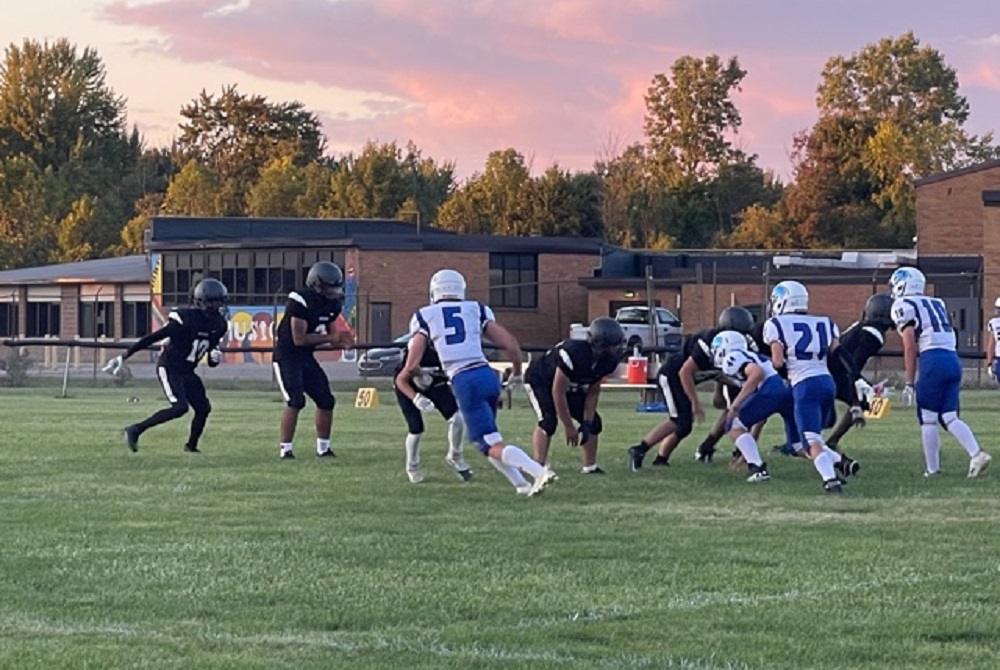
Atherton has rolled in its past two games, defeating International Academy of Flint 44-18 and New Haven Merritt Academy 49-14. As the team racks up wins, the players are putting up huge numbers.
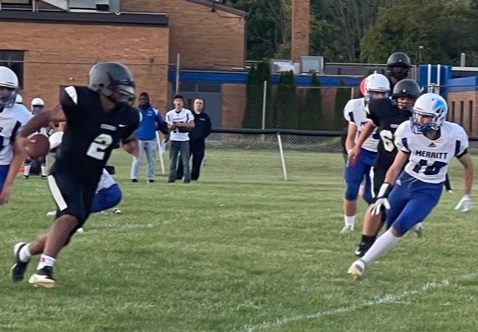
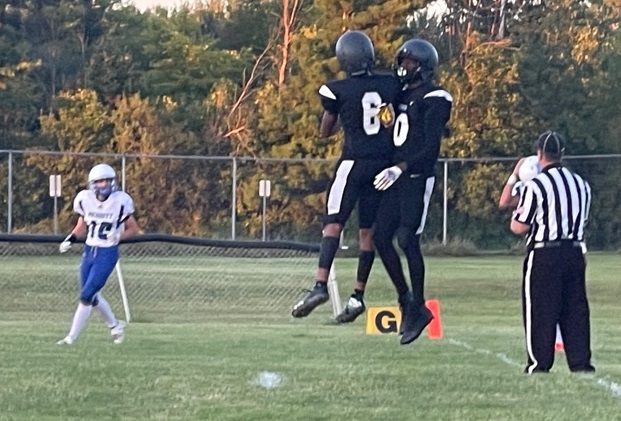 Junior receiver and running back Romiel Clausell is averaging 16.8 yards per touch (386 yards on the ground, 134 receiving) and has seven touchdowns. Robertson has hauled in 12 catches for 143 yards and three touchdowns, and sophomore quarterback Demontrey Davis is 18 of 27 passing for 297 yards and six touchdowns, and has rushed for 215 yards and four scores.
Defensively, the Wolverines are causing plenty of havoc, led by Adams’ seven tackles for loss and four sacks. Clausell (six TFL) and Te’Shawn Stevenson (five TFL) have chipped in as well.
“Every day (they surprise me),” Young said. “Not because they’re not talented, but they’ve grown up. They’ve grown up so much before our eyes. It’s almost like having a child and having them outdo what your expectations for them are. I’m surprised, and every day there’s something new that brings a smile to my face.”
They’re also surprising their classmates and creating an excitement around the program that hasn’t been present for a long time.
“People were really doubting us at first all over social media,” Clausell said. “After our first three games, I haven’t heard anybody talk since. We love to see it, and we hope we can continue it.”
With no postseason available to them, the Wolverines have different goals than most. They play in the North Central Thumb League Stars division, so a league title is a possibility. Of course, to do that, they would need to overcome 8-player powerhouses Morrice and Deckerville, who have each won a Finals title.
But games against that type of competition do give Atherton a chance to prove how far they’ve come.
“We have a lot to prove,” Young said. “We want to prove that we’re worthy of being in a playoff situation. We want to show everybody that we’re not the Atherton you think we are. We’re going to play with something to prove.”
A longterm goal is to get the program back into 11-player football and postseason eligible. Young said that’s probably a couple years away, but with the early success and growth in participation among his underclassmen, that feels attainable.
While Robertson and his classmates won’t be around to experience that, they’ll certainly be remembered as the ones who made it happen.
“Me knowing that I’m a part of that – in 20 years when they say, ‘In 2021, that class, they were the game-changers,” Robertson said. “I’ll keep it as an achievement in my life.”
 Paul Costanzo served as a sportswriter at The Port Huron Times Herald from 2006-15, including three years as lead sportswriter, and prior to that as sports editor at the Hillsdale Daily News from 2005-06. He can be reached at [email protected] with story ideas for Genesee, Lapeer, St. Clair, Sanilac, Huron, Tuscola, Saginaw, Bay, Arenac, Midland and Gladwin counties.
PHOTOS: (Top) Atherton quarterback Demontrey Davis readies for the snap during this season’s win over New Haven Merritt Academy. (Middle) Davis makes a move as a defender approaches. (Below) Terrieon Robertson (6) and Romiel Clausell (10) enjoy a celebratory shoulder bump. (Photos by Mandi Withey.)