

Senior-Dominated Falcons Finish Freeland Careers in Best Way Imaginable
By
Paul Costanzo
Special for MHSAA.com
March 14, 2026
EAST LANSING – Not many teams had a sense of urgency to win it all as big as Freeland’s this season.
And Saturday night, they capped off a run to a title that went well beyond just this year.
Led by its 12 seniors – and two senior student managers – Freeland claimed its first Boys Basketball Finals title, defeating Hudsonville Unity Christian 42-32 in the Division 2 championship game at the Breslin Center.
“To go back home with this big thing (trophy) and do something that no Freeland boys team has ever done, win a state championship, is pretty special,” senior guard Wilson Huckeby said. “Not just for me, but for all these guys, I couldn’t have done it without them.”
Everyone that saw the floor for the Falcons in the Final will graduate, and they’ll go out in the best way they could imagine.
The game started slowly, as the Crusaders led 6-4 after the first quarter with the teams going a combined 4-of-19 from the field.
Some space opened up during the second quarter, but not much, as Unity Christian held a 17-15 lead at the half.
It was Freeland, though, that started to find a groove toward the end of the third quarter and beginning of the fourth, going ahead by 13 with under three minutes to play.
 “In the locker room, you walked in and it was just poised and composed,” Freeland coach John Fattal said. “Everyone knew in that locker room what the second half was going to look like. Everyone knew in our locker room what the belief looked like. Everyone understood that these guys were going to handle pressure, were going to make free throws, they were going to handle everything that Unity Christian threw at them, everything the environment threw at them, and they were just poised and composed the whole second half.”
The run was highlighted by 3-pointers from Tristan Comer and Connor Lasceski on back-to-back possessions, stretching a three-point lead to nine.
“Obviously I’m extremely confident in the shot,” said Comer, a 6-foot-6, 260-pound center who will play offensive line at Michigan State next year. “But I gotta give it to my teammates for setting me up with the perfect pass. I’ve only been able to develop a shot like that because of Coach Fattal and how he runs his practices and how he teaches when to take those shots.”
Comer finished with 12 points and 10 rebounds for the Falcons (26-3), while Huckeby had 12 points, six rebounds and four steals. Senior Cooper Wagner had five points and six assists, and Lasceski had six points.
“Every shot (Huckeby) made was contested,” Unity Christian coach Scott Soodsma said. “We kind of screwed up a little right before half. We went to a zone and all of the sudden I think we forgot and left that kid open. He’s a great player. If you would have told me that Huckeby and Comer had 24 total, one of those could score 24 on their own. So, yeah, it was just one of those nights where I thought our defense didn’t let us down and it was right there. I thought we just weren’t able to put the basketball in the basket.”
Jack Kamminga led Unity Christian (25-4) with 14 points and five rebounds.
Unity Christian lost senior guard Brogan Sherd early in the third quarter to a leg injury. He was carried back to the locker room and returned on crutches to watch the end of the game. Owen VanderWaal was also limited because of an injury.
“We were down a little horsepower and we had a hard time scoring, that was the issue,” Soodsma said. “Those are our top two leading scorers and both of them are down on the bench. I thought Jack really stepped up and made a couple key baskets. (Kyler) Berghuis did a great job on Huckeby fighting over all those screens. But we couldn’t score. If you would have told me we were going to hold them to 42 points, I’m thinking we win that ball game by 10. I thought we’d get to 55, probably. But, tonight, it just wasn’t meant to be.”
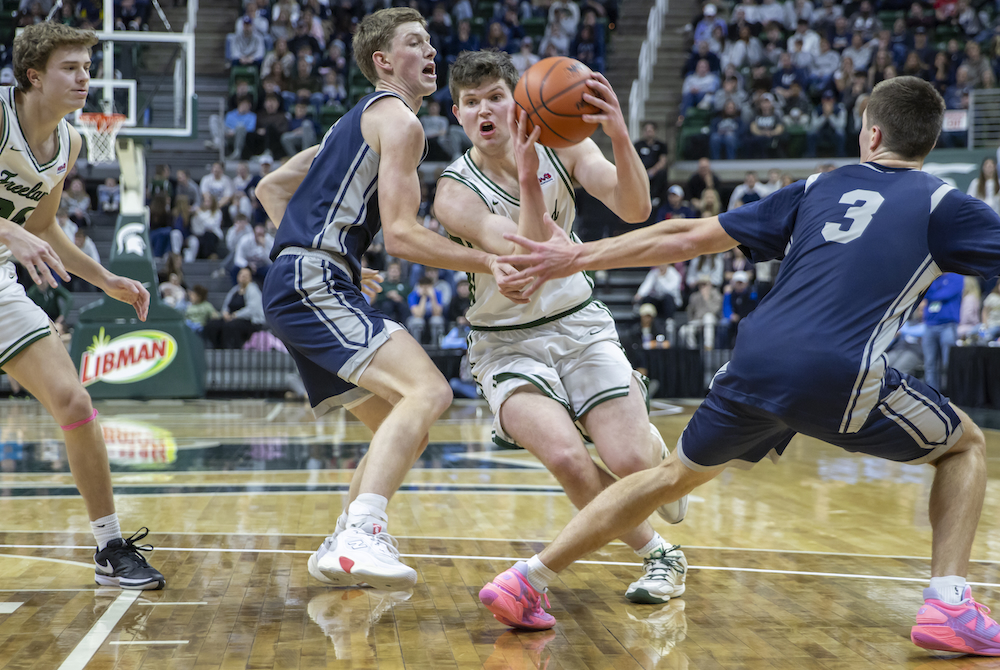
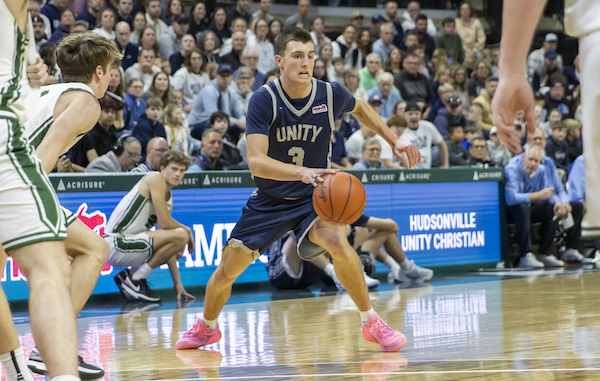
PHOTOS (Top) Freeland’s Wilson Huckeby attempts to cut between a pair of Unity Christian defenders during the Division 2 Final on Saturday. (Middle) Unity’s Kyler Berghuis (3) dribbles into an opening just inside the arc. (Photos by Adam Sheehan/Hockey Weekly Action Photos.)
Hoopfest Returns This Weekend to Jenison
March 21, 2017
By Geoff Kimmerly
Second Half editor
March Magic Hoopfest will return to Jenison Field House for this weekend’s Michigan High School Athletic Association Boys Basketball Finals, marking the eighth championship weekend the event has run concurrent with the games being played at Michigan State University’s Breslin Center.
A number of favorite attractions will return including slam dunk (on lowered rims), 3-point shootout and half-court shot areas where fans can come at any time and participate, and the festivities also will include a court for timed “Around the World” shooting games and another court featuring the Michigan Army National Guard skills challenge. Also returning is the Walk of History, showcasing championship games, life-size photos and display boards from throughout the MHSAA Finals’ near century-long run.
Two Hoopfest center courts will host a number of games throughout the event, including the “JumpBall Jamboree” made up of teams of boys and girls in grades 3-8, and a series of games between Special Olympics Project UNIFY high school teams.
Admission to the March Magic Hoopfest is $2 per person, and fans attending the MHSAA Boys Basketball Semifinals and Finals will be admitted free with their game tickets. Hours on March 23 and 24 will be 2 p.m. to 7 p.m.; the event is open from 10 a.m. to 6 p.m. on March 25. Jenison Field House, site of Hoopfest, also was the site of the MHSAA Boys Basketball Finals for 31 years. To find out more general information about the event, visit the March Magic Hoopfest Website.
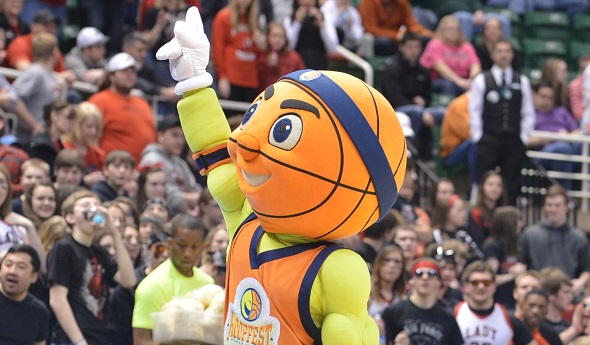
Hoopfest also will be home to Hoopie, the event’s mascot who made his first public appearances during the 2014 MHSAA Finals.
The March Magic Hoopfest is being conducted in partnership between the Greater Lansing Sports Authority (GLSA), a division of the Greater Lansing Convention and Visitors Bureau, and the MHSAA, with vital support coming from the Department of Intercollegiate Athletics at Michigan State University.
“For more than 90 years, basketball teams have ended their seasons at the MHSAA Tournament, and Hoopfest allows fans to share first-hand in the atmosphere that has made this such a historic event,” MHSAA Director of Brand Management Andy Frushour said. “It’s a great stop-over for our fans coming to or leaving the Breslin Center, and it’s also a great place to bring the family for some fun even for those who won’t be attending this weekend’s Finals.”
The Greater Lansing Sports Authority’s mission is to be the leading voice of sports tourism in the Greater Lansing area and to promote economic growth by attracting a diverse range of sporting events to the region. The GLSA strives to enhance the quality of life for area residents through the development of local sports and fitness programs for all ages and supports the continued development and maintenance of safe, high-quality athletic facilities.
“The March Magic Hoopfest sets off a great weekend of MHSAA tournament games and helps create a multi-day event which will involve the Lansing area and thousands of visitors from across the state,” said Mike Price, Executive Director of the Greater Lansing Sports Authority. “If you’re coming to the championships, Hoopfest is a destination to visit before and after the games; and if you’re not coming to the games, Hoopfest is a fun, wholesome, inexpensive, family activity.”
PHOTO: Hoopie entertains the crowd during the 2014 MHSAA Finals.