

Senior's Steal Seals 2nd Straight Title
March 23, 2013
By Bill Khan
Special to Second Half
EAST LANSING — Even on an MHSAA championship basketball team, there’s not always peace and harmony within the ranks.
There are still internal fires to be put out by coaches, whose job descriptions don’t call for pleasing everyone all of the time.
When Jalen Pettes was disappointed with limited playing time early last season, Flint Beecher coach Mike Williams had to talk the then-junior into sticking with the program.
“He had a tough time,” Williams said. “The first seven, eight games, he didn’t play much. He was ready to quit. I had a meeting with he and his mom. I told him, ‘Jalen, if you give me everything I want in practice, I guarantee you that by next year, I’m not going to be able to take you out of the game — period. But you’ve got to bring it.’”
Pettes played sparingly the rest of the season during Beecher’s championship run, but his work ethic in practice forced Williams to keep his promise this season.
Overshadowed by the exploits of Mr. Basketball Monte Morris, Pettes’ tenacious defense is one of the key reasons Beecher is celebrating back-to-back MHSAA Finals championships in boys basketball for the first time.
Pettes’ fifth steal of the game with 2.4 seconds remaining thwarted Laingsburg’s final attempt at springing an upset, as Beecher held on for a 40-39 victory on Saturday at the Breslin Center.
It’s the fifth MHSAA Finals title for the program, which would’ve won three Class B championships in a row from 1985-87 if not for Chris Coles’ miraculous half-court buzzer-beater for Saginaw Buena Vista in
the 1986 Final.
“I love winning it this way,” Williams said. “It’s just that much more gratifying to know that we earned it.”
 Beecher’s success through the years has been predicated upon a stifling defense. Pettes acknowledges that he isn’t going to light up score sheets like Morris, but he became a key contributor to this year’s championship by completely buying in to the Buccaneers’ defensive philosophy.
“I really don’t score a lot,” Pettes said. “I just like to play defense and get stops and let my team do the rest. Defense just comes easy to me. I just like playing defense.”
Once he committed to stick with the team last season, he honed those defensive skills against two of the best guards in the state.
“Jalen had to guard Monte Morris and Antuan Burks all last year in practice,” Williams said. “In order for him to get on the floor last year, he had to play defense in practice. So now you take a year later, he’s four or five inches taller and stronger, and he doesn’t fear anybody, because he’s been guarding Mr. Basketball his whole life.”
Laingsburg (24-3), which received only honorable mention in the final Associated Press rankings, almost sprung a huge upset on the top-ranked Buccaneers (27-1).
The Wolfpack, which led 18-12 in the second quarter, took a 35-34 lead with 5:02 remaining on a free throw by Ryan Wade. Back-to-back scores\ near the basket by Markell Lucas and a driving layup by Morris gave Beecher a 40-35 lead with 2:25 to go.
Shaun McKinney cut the lead to one by hitting two free throws with 2:04 left and a basket with 1:05 remaining.
On Beecher’s next possession, Morris drove to the basket, only to have his shot rejected by Sam Edwards. Laingsburg got the ball, pushed it up the floor and called timeout with 17.5 seconds on the clock.
What followed was a helter-skelter possession which ended when Pettes came up with a loose ball and was fouled with 2.4 seconds left. Pettes sat on the floor clapping his hands, then pumped his fist as he got up.
“When I got that steal, I knew we won the game,” he said.
Pettes missed the front end of a one-and-one, McKinney grabbed the rebound for Laingsburg, but time expired as he heaved a long pass down the floor toward Jake Zielinski.
“My heart goes out to our guys,” Laingsburg coach Greg Mitchell said. “I’m so thankful for their effort. I thought we played really, really good team basketball today. A bounce or two here or there and we’re feeling a little bit better than we are right now.
“This was a team that was not expected to win our league, not expected to win our district, not expected to win our regional, certainly not expected to get here. But we’re a couple points shy of being the state champs. That’s going to be a tough one.”
Beecher won, despite flu-like symptoms that hit Morris and fellow starter Emmanuel Phifier the morning of the game. Morris wasn’t in the game early in the third quarter when Laingsburg turned a 24-19 deficit into a 26-24 lead. He finished with 16 points and two assists, his lowest totals in six career MHSAA tournament games at the Breslin Center. Phifier had only four points.
“You could see that Monte was sick,” Williams said. “He could barely finish the game. But he pulled it out. Without him, we’re not sitting on this podium (as Class C champion) right now. He’s actually too sick to even walk out of the bathroom right now.”
Morris played in the 109th and final game of his Beecher career, breaking the MHSAA record of 108 games played by Flint Powers Catholic’s Patrick Lucas-Perry from 2007-08 to 2010-11. Beecher had a 98-11 record during Morris’ four years, including 55-1 during the last two.
McKinney scored 15 points and Zielinski 14 for Laingsburg.
“Finishing is what we want,” Zielinski said. “We were a couple plays short. We just have to live with the results.”
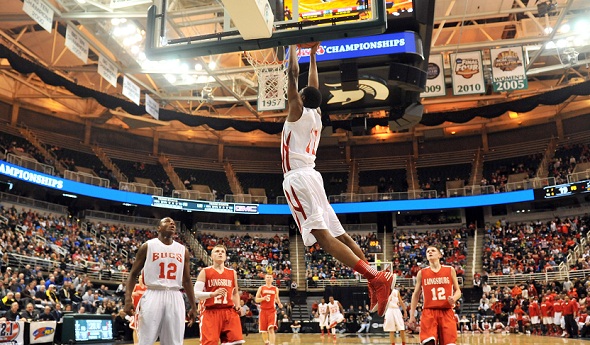
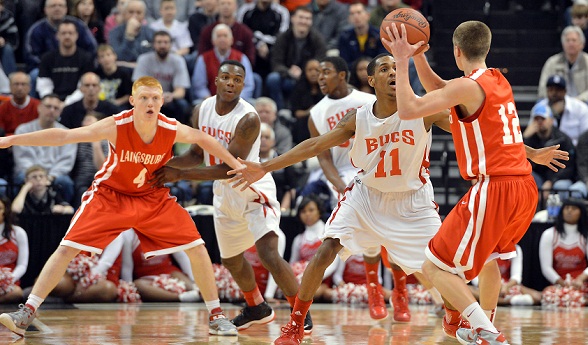
PHOTOS: (Top) Flint Beecher's Monte Morris (11) dunks during Saturday's Class C Final win over Laingsburg. (Middle) Laingsburg's Zach Walker (12) looks to pass to teammate Jake Zielinski (4) while Morris and others defend. (Click to see more at HighSchoolSportsScene.com.)
Jets' Record: Never to be Broken
April 13, 2017
By Dennis Grall
Special for Second Half
ESCANABA - The North Central Jets are champions.
Of the billions of words I've typed on keyboards over the years, none are more appropriate or more true than "The North Central Jets are champions."
 It is more than what they have done on hardwoods and gridirons across the state.
Five MHSAA championships in the past three years underline those six words, but it is how the guys wearing red, black and white uniforms have comported themselves on those playgrounds.
They've done it with class all the way. They display wide smiles – at least where you can see their faces in basketball. They hug themselves and you after the game and thank you for coming and for your support.
They may run you over in football and leap above you in basketball, but that is their job and they have supreme joy in doing it well and getting it done the right way.
No matter who they play or where they play, the result has always been the same, another win. Think of it: They have won 134 games in those two sports, including 26 straight in football and a state-record 83 in basketball, with one lonely defeat over those past four hoops seasons. The title runs included two in 8-player football and the last three in Class D basketball.
The word “lose” is simply not in their vocabulary.
It has been a treat for all of us to watch them go about their business as they share a tremendous skill set and build an incredible legacy that has surpassed anything else in the Upper Peninsula.
Ishpeming football and girls basketball at Carney-Nadeau also have been model programs. And of course Chassell, which won three straight Class D basketball titles and 65 straight games in the 1950s.
It is unlikely North Central's current streak of 83 straight basketball wins will ever be surpassed. Don't forget, Chassell's record lasted 59 years and the Jets are now 18 games beyond that standard.
You can put this record up with Joe DiMaggio's 56-game hitting streak and the 18 majors of Jack Nicklaus as being unbreakable, along with the recently-ended University of Connecticut women's basketball streak of 111 straight wins that is beyond reality.
I don't know what the national high school win streak record is for boys basketball but found that Palmer, Iowa, is only fifth with 103 straight wins from 1986-89. (Editor’s Note: The record belongs to Passaic, NJ, with 159 straight from 1919-25, but no team has won even 85 consecutive since 2003-06.)
Let us just remember how wonderful it has been to be a spectator of this outstanding accomplishment and what it has done for the school, the community and the entire Upper Peninsula.
Thank you Jets. You are champions.
 Denny Grall retired in 2012 after 39 years at the Escanaba Daily Press and four at the Green Bay Press-Gazette, plus 15 months for WLST radio in Escanaba; he served as the Daily Press sports editor from 1970-80 and 1984-2012, and as interim during the 2016-17 school year. Grall was inducted into the Upper Peninsula Sports Hall of Fame in 2002 and serves as its executive secretary. E-mail him at [email protected] with story ideas for the Upper Peninsula.
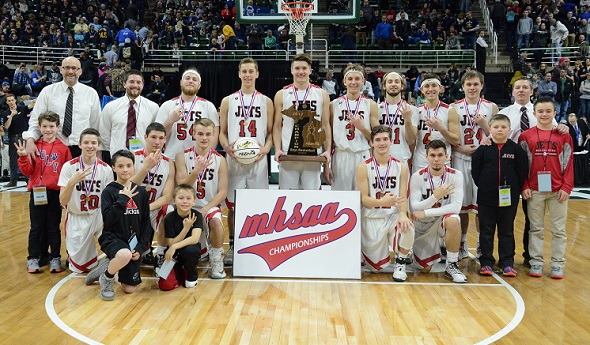
PHOTO: The Powers North Central boys basketball team holds up its Class D championship trophy last month at the Breslin Center.