

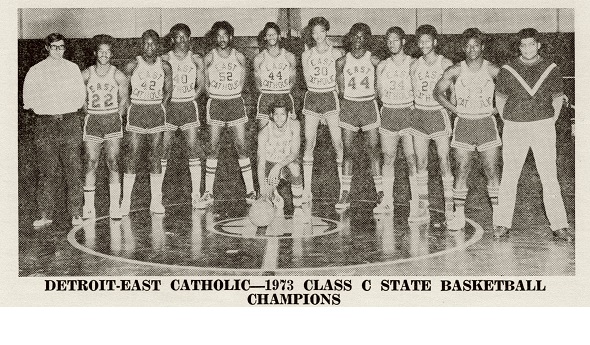
As Soules Guided, East Catholic Reigned
January 31, 2019
By Ron Pesch
Special for Second Half
“I’m surprised to be this far. Some nights we play very good and some nights we play very bad. I just didn’t think we’d be consistent enough to get this far.”
The words were spoken by varsity basketball coach Dave Soules of Detroit East Catholic back in 1973, but, no doubt, could have come from any number of coaches who have found themselves, unexpectedly, somewhere deep into the MHSAA postseason.
It was Soules’ first season in charge of Detroit East Catholic’s varsity, but far from his first year in the building the school occupied.
The Chargers had advanced to the Class B Quarterfinals the previous year, falling to perennial powerhouse River Rouge, 65-64. That East Catholic team was coached by Eugene Dennis Alexander. An all-city player at Detroit Northeastern, Denny Alexander played college ball at Aquinas in Grand Rapids and became only the fourth player in Michigan collegiate history to surpass 2,000 points in a career, joining John Bradley of Lawrence Tech, Dave DeBusschere of the University of Detroit and the University of Michigan’s Cazzie Russell on the list. In May of 1969, at age 23, he was named head coach at East Catholic.
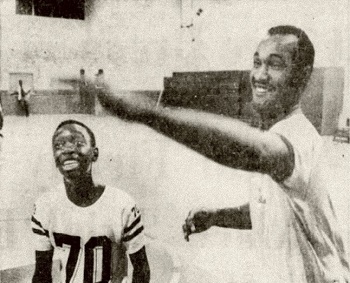 Denny’s brother, Darryl Alexander, was East Catholic’s best ballplayer in 1972. The team streaked to 11 straight victories during the regular season, then squared off in a series of late February games against larger Detroit Public School League teams. The scheduling was designed to ready the squad for the postseason. Losses to Detroit Southeastern (68-47), Detroit Kettering (80-71) and Detroit Northern (59-58) were a means to that end. While the Chargers did not make the Detroit Catholic League tournament, they were ready to do some damage in the Class B MHSAA tournament.
Only a field goal by River Rouge’s Byron Wilson with 26 seconds remaining prevented the Chargers from doing more. East Catholic trailed in the Quarterfinal by as many as 14 points, and made valiant runs to pull within a point on two occasions, but couldn’t upset coach Lofton Greene’s Panthers. Alexander finished with 19 to again lead the Chargers but was lost to fouls with 1:37 remaining in the third period. Trailing 61-53, East Catholic cut it to 61-60 with 1:35 left to play on a Phil Young field goal. Larry Merchant’s pair of free throws again brought the margin to a single point, 65-64 – but with only five seconds left, the Chargers were out of miracles.
River Rouge, on the other hand, was not. The Panthers would advance through the Semifinals and then survive another thriller, escaping with another one-point victory in the title game against Muskegon Heights. That win marked their 12th Class B title in 19 years.
The Chargers finished the season with a 16-7 record. Alexander earned Associated Press Class B all-state honors that season as a senior, averaging 20 points, 13 rebounds and six assists per game. Come the fall, the brothers headed north to Central Michigan University, where Darryl became a prized recruit. In mid-September, CMU president William Boyd announced Denny had been hired as an assistant coach.
In 1977, Denny was interviewed for the head coaching vacancy at Wayne State, and then was named head coach at Xavier University in New Orleans in 1978.
In 1966, with shrinking enrollments driven by flight of parishioners to the suburbs and rapidly changing neighborhood demographics, the Roman Catholic Archdiocese of Detroit directed that four Catholic high schools on Detroit’s east side – St. Catherine, St. Rose, Annunciation, and St. Charles – consolidate into the old St. Catherine building at 4130 Maxwell Street.
The amalgamation was christened Detroit East Catholic, and it opened its doors in the fall of 1967.
But the mergers were simply not enough. Needs for new equipment, combined with increased costs for teacher salaries and legislative changes to funding meant a need to increase tuition to cover expenses. That, in turn, led to even more departures.
 “The East Side Catholic schools ran up a total deficit of over $1 million last year,” said Bishop Thomas J. Gumbleton, vicar general of the archdiocese, announcing additional closings and mergers of high schools and elementary schools planned with the conclusion of the 1968-69 school year.
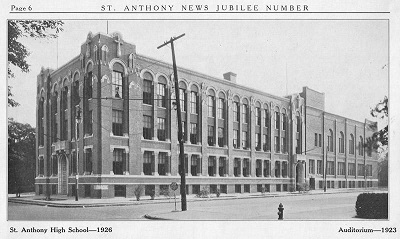
Detroit St. Anthony and Detroit Elizabeth were merged into East Catholic to help address the deficit and exodus. With the changes in the fall of 1969, East Catholic High School was relocated from St. Catherine’s to the St. Anthony building a mile away at the corner of Field and Frederick streets.
Soules had graduated from Dearborn Sacred Heart in 1957 and then the University of Detroit. He was hired as an English teacher at St. Anthony and became the school’s JV basketball coach in 1962. In 1964, he took charge of the varsity team.
“When we merged (into East Catholic) they divvied up the jobs and Dennis got the basketball job,” said Soules in 2005 to Mick McCabe, Detroit Free Press sportswriter. “If I’d have got the job, I’d have lost my mind. I mean literally. The merger was painful. Everybody hated everybody else …”
In May 1972, the Free Press had interviewed Soules about the challenges and the future of the school located at 5206 Field. As an assistant principal, he spoke for those who remained.
“From here, there isn’t any place to go. You close up, and you go out of business. If we keep working at it and keep believing in it, it’s gonna keep going. It has so far. If we close, there’s no inner city Catholic school on the lower east side,” he said.
Raffles, paper drives, lollipop and baked good sales, car washes, fish dinners and dances all contributed to keeping the doors open.
Making a new school community from all of the former had not come easily.
“It was hell. I lost 25 pounds last year. We lost a lot of good staff people. But we came back this year, and, all of a sudden, people could smile at each other in the halls. That’s important. As people got to know each other, they did become friends,” Soules added
With Alexander’s late departure, Soules became the school’s newest varsity basketball coach. At the time, no one knew that he would also be the school’s last.
With the graduation of Darryl Alexander, the expectations of the team, loaded with juniors and sophomores, were limited. Smaller enrollment meant the team had fallen a classification come tournament time. With a 5-3 mark, the Chargers were No. 5 in Hal Schram’s weekly Free Press Class C Top Ten in early January, but had fallen well out of the United Press International’s Top 20 Class C rankings by mid-February with a 12-4 record. The team was quickly eliminated in the annual Detroit Catholic League tournament and, unranked in the final state polls, carried a 12-6 record into the MHSAA postseason. Following District wins over Hamtramck St. Florian – ranked eighth by AP – and Hamtramck St. Ladislaus, Soule’s crew quickly changed the landscape in the opening round of the Class C Regionals.
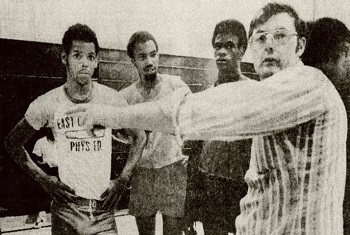 “Just two days into regional play, the tourney is starting to live up to its Pseudonym – ‘March Madness’”, wrote Harry Atkins for The Associated Press.
“The Chargers were given hardly a chance against a talent-rich Dearborn St. Alphonsus team in Class C action,” continued Atkins, “but East Catholic didn’t let Dearborn’s No. 2 ranking scare them as they matched the Arrows basket for basket.” Trailing by six with 1:46 left to play, Larry Merchant’s field goal with 46 seconds left tied the score. “Then Mike Walton hit a free throw with one second on the clock to give East Catholic its upset.”
Mike Woods led the team with 21 points. St. Alphonsus exited the tournament with a 22-2 mark.
On a very snowy evening across Michigan, East Catholic took advantage of its height and survived a 27-point performance by New Haven’s Don Sims to win their Regional and advance to the Quarterfinals of the MHSAA tournament. Merchant scored 10 of the Chargers’ 11 points in the final four minutes to seal the 68-63 win.
Merchant showed off his ball-handling skills dishing out 12 assists in the 71-48 Quarterfinal win over Erie-Mason. Sophomores Greg Guye, a 6-foot-6 center, and Walton, a 6-2 sophomore guard, each pumped in seven field goals, both finishing with 14 points, to lead the Chargers in scoring.
Merchant scored 26, while Walton added 23 – 18 points over his season average – as East Catholic rolled to a 66-55 Semifinal victory over Battle Creek St. Philip to earn a trip to the championship game.
“We had accurate scouting reports on East Catholic,” said St. Philip coach Tom Miller following the game. “They were quick. I knew we were in trouble when we had a fast break – and they had two guys at the other end waiting for us,” Miller told UPI’s Richard Shook, laughing. “At least we got beat by a team that was better than we were.”
The state’s scribes had a week to contemplate the upcoming Final matchups as Michigan’s tournament format of the time injected seven days between the Semifinal and Final rounds. Soules had never won a tournament game as a coach at St. Anthony, and noted his club’s strengths and challenges to the media during the time.
“This is a young team which makes mistakes,” he told Atkins of the AP, “but we don’t quit and we’ve won some games on hustle in the last few minutes. It is difficult to key on one player and beat us, because we have excellent balance.”
In a conversation with Schram he noted that his team had a tendency to work out big leads, then start to get sloppy.
“We’ve never put anyone away yet,” he added. Schram noted that Soules took only half of the 700 tickets allotted East Catholic at the state association. “I won’t sell all that I have. These kids simply don’t have the bread to go running all over the state.”
“I don’t believe many of our students or fans have a great amount of confidence in us,” declared the coach, but emphasized that was not the view of the team. “They want this state title and will fight all the way to win it Saturday.”
By most, if not all accounts, not many others had faith in the Chargers’ chances in the championship matchup.
“St. Stephen lost in the ‘C’ finals in 1972 to Shelby and have their key players returning,” wrote Fred Stabley Jr. in the Lansing State Journal. “Led by 6-5 Elijah Coates and 6-2 Jimmy Beavers, St. Stephen has the size and speed to win it all this year.”
“Every game is a home game for Saginaw St. Stephens,” noted Atkins in his pregame AP write-up. “The Titans have a frenzied following of nearly 1,500 fans at every tournament game and you can bet your last lottery ticket they’ll all be in Ann Arbor for Saturday’s showdown.
 “On paper there’s no way you can pick a favorite … but neither St. Stephens nor East Catholic has been winning on paper … Saginaw, however, has done a slightly better job of it and who can measure how much their loyal throng of well-wishers has contributed to that record.”
“East Catholic won’t make the trip to Ann Arbor for nothing,” wrote Schram, as his alter ego, “The Swami,” on the Saturday of the game. “There’s a trophy for the runnerup.”
Saginaw coach Sam Franz, celebrating his 25th year as a coach, may have been the only skeptic.
“Any team that comes this far has to have something more than luck going for them,” said Franz to Schram.
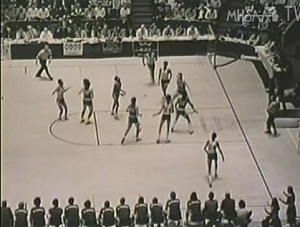
The story of the Final can still be seen in silence today.
“From the late 1940’s to the mid 1970’s the Michigan High School Athletic Association shot portions of the action at its basketball finals on 16mm film,” notes John Johnson, communications director for the MHSAA. “Some of the films only have portions of the second half and the postgame awards; some have most of the action. None of the films have sound.”
One of the surviving films is the 1973 Class C classic. The Chargers blew a 10-point lead late in the third quarter. With 2:29 remaining, the game was tied, 46-46. A free throw gave St. Stephen the lead 47-46 with 2:16 to play.
The final two minutes of film spools out the story, in thrilling – and heartbreaking – detail.
In the days before the possession arrow, jumps for possession could mean the difference between victory and defeat. East Catholic won a possession on a jump ball, but a miss by the Chargers and a defensive rebound by St. Stephen sent the Titans into stall mode. However, a turnover grabbed and converted by Merchant gave the Chargers a 48-47 lead with just over a minute to play.
A pair of free throws by Elijah Coates pushed St. Stephen out front 49-48 with 45 seconds left. Yet with four seconds remaining on the clock, Merchant's 18-foot jumper from left of the key gave the Chargers a 50-49 victory.
The front page of the Free Press shouted the headline, “A Chance to Be Somebody,” with a story representative of the time. Focused on the players and their struggles, the title could have easily applied to the re-start of a coaching career, and a life, which ultimately would become legendary at least on Detroit’s east side.
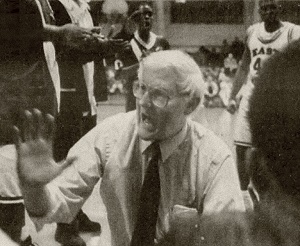 To students, he became famous for a rope of keys around his neck, his pad of detention slips and the substitution of “Hot Dog” or “Baby” for names when trying to keep the halls clear during the school week. Saturday mornings for many included time in “The Jug” serving detention.
“He’s more to East Catholic than just the basketball coach,” Lou Miramonti told Jo-Ann Barnas of the Free Press in 1996. Miramonti, the athletic director at Royal Oak Shrine, knew of whom he spoke. “It’s the most visible thing he does, but it may well be the least important thing that he does at that school and for those kids.”
Soules was assistant principal, disciplinarian, tuition collector, the giver of rides, and one who called students just to make sure homework was getting done. And, of course, the coach that guided the talent that came through the halls of a building that today no longer stands.
Playing witness in 2005 to another sweeping closure of schools by the Detroit archdiocese – one that included the shuttering of East Catholic – Soules discussed a career he never could have predicted.
“I was the right guy who just happened to be in the right place at the right time,” he explained to McCabe as he tried to come to grips with the announced closing. Soules’ coaching career at East Catholic featured 544 wins against 250 defeats over 33 seasons. The Chargers’ athletic cases included eight MHSAA Finals championship trophies won by his teams. To this day, only Greene at River Rouge won more.
An honest, humble and caring individual with a “self-deprecating sense of humor,” he discussed those earliest of days:
“The saddest part is, I was so dumb at the time, we didn’t win it again (over the next two years) … I didn’t know how to deal with the 2-2-1 three-quarter court press (in 1974) … in the semis (in 1975) … we just weren’t ready to play.”
“With some of the kids I had, you didn’t have to be a genius,” he stated. “I’m a lot better coach now than I was then.”
In 2009, Soules passed away after a three-year battle with cancer. His extended family numbered thousands.
The many condolences that followed, and that continue today, are a heartfelt testament to the difference one man can make in a life, both on the court and in the hallways, of an ancient building built with the lofty purpose of education.
 Ron Pesch has taken an active role in researching the history of MHSAA events since 1985 and began writing for MHSAA Finals programs in 1986, adding additional features and "flashbacks" in 1992. He inherited the title of MHSAA historian from the late Dick Kishpaugh following the 1993-94 school year, and resides in Muskegon. Contact him at [email protected] with ideas for historical articles.
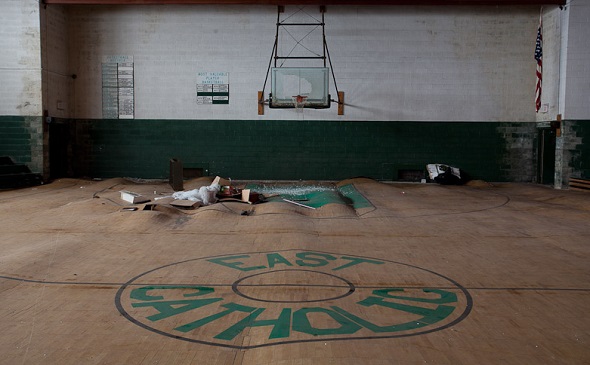
PHOTOS: (Top) The Detroit East Catholic 1973 Class C championship team. (2) Denny Alexander was hired as East Catholic boys basketball coach in 1969. (3) The former Detroit St. Anthony High School. (4) Dave Soules coaches his East Catholic players during the 1973 season. (5) Film survives from the Chargers’ 1973 championship game win over Saginaw St. Stephen. (6) Soules instructs his team during a 1996 game. (7) The Detroit East Catholic gymnasium, after the school’s closure. (Photos gathered by Ron Pesch.)
Breslin Bound: 2025-26 Boys Quarterfinal Preview
By
Geoff Kimmerly
MHSAA.com senior editor
March 10, 2026
One. More. Win.
That’s all that’s needed as 32 boys basketball teams take the floor tonight for Quarterfinals across the state and with a trip to East Lansing and Breslin Center on the line.

Below are quick glances at all 16 matchups. Games tip off at 7 p.m. unless noted. Details on tickets, brackets and more can be found on the Boys Basketball page. To watch all 16 games online, visit the NFHS Network.
“Breslin Bound” is powered by MI Student Aid and based on results and schedules posted for each school at MHSAA.com. (Abbreviations below denote ppg - points per game, rpg - rebounds per game and apg - assists per game.)
Week in Review
The countdown of last week’s five most intriguing results:
1. Grand Rapids Northview 52, East Kentwood 50 Cam Ryans drilled a buzzer-beating 3-pointer to send Grand Rapids Northview (22-4) past East Kentwood (22-3) in a Division 1 Regional Final.
2. Harbor Beach 64, International Academy of Flint 62 (2 OT) Harbor Beach (23-3) won its first Regional title, edging IAF (19-5) in Division 4.
3. Colon 49, Battle Creek St. Philip 40 The Magi (22-4) also clinched their first Regional title, in Division 4, by adding to two regular-season wins over St. Philip (16-9).
4. Onsted 42, Ecorse 40 Onsted (24-2) clinched its first Regional title since 1983, advancing in Division 3 with a close win over Ecorse (19-6).
5. Onekama 46, Traverse City Christian 40 Onekama (17-10) handed Traverse City Christian (25-1) its only loss in a Division 4 Regional Final.
Quarterfinals at a Glance
DIVISION 1
Rockford (22-3) vs. Grand Rapids Northview (22-4) at Hudsonville
These two met Jan. 31 at the 2K26 Showcase, with Rockford winning 48-45. Senior 6-foot-6 forward Jake Bascom is a tough matchup averaging 17.7 points and 7.1 rebounds per game. But so is Northview senior guard Cam Ryans, a Mr. Basketball Award finalist averaging 24.2 points, 7.6 rebounds and 3.3 assists per contest.
Auburn Hills Avondale (25-1) vs. Roseville (19-6) at Detroit Mercy
Avondale is coming off its first Regional title since 2002 with senior forward Jakobe Liford (15.2 ppg, 7.5 rpg) leading three players averaging double-digit scoring. Roseville last won a Regional in 2019 and returns to the season’s final week with junior guard Terrell Owens (17.3 ppg, 3.5 apg, 3.9 spg) setting the pace.
East Lansing (25-1) vs. Ann Arbor Pioneer (21-4) at Lansing Eastern’s Don Johnson Fieldhouse
Reigning Division 1 champion East Lansing celebrated senior guard KJ Torbert winning the Mr. Basketball Award on Monday, and he’s an especially impressive shooter making 52 percent of his shots from the floor – including 39 percent of his 3-point tries – on the way to averaging 25 points per game. Pioneer is back at the Quarterfinals for the first time since 2007, with senior guard Jordan Harrison a potent scorer (18.1 ppg) and distributor (3.9 apg).
Wayne Memorial (23-3) vs. Bloomfield Hills Brother Rice (21-5) at Detroit Mercy, 5:30 p.m.
The Zebras are also playing for a return trip to Breslin after finishing Division 1 runner-up a year ago, and they’re also led by a Mr. Basketball Award finalist in senior guard Jaylohn Allen (23.3 ppg, 6.0 apg). Brother Rice won its second Regional title over the last three seasons, keyed by a high-powered backcourt of senior Greg Grays (14.9 ppg) and freshman Jordan McDaniel (19.3 ppg).
DIVISION 2
Ludington (24-2) vs. Freeland (23-3) at Mount Pleasant
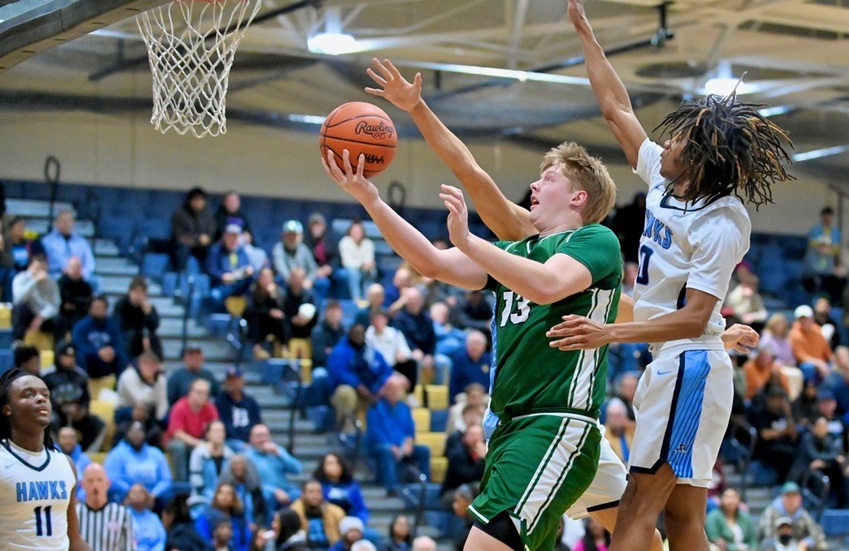
Junior guard Taj Williams (18.8 ppg) and senior forward Cameron Gunsell (18.2 ppg) have led Ludington to the Quarterfinals for the first time since 2017, as the Orioles advanced with a Regional Final win over 2025 semifinalist Kingsford. Freeland has won nine straight games to reach the Quarterfinals for the second consecutive year. Senior guard Wilson Huckeby is making almost 39 percent of his 3-pointers, drilling 81 this season while averaging 18.9 points per game.
Chelsea (20-5) vs. Romulus Summit Academy North (25-1) at Ypsilanti Lincoln, 5:30 p.m.
Summit is one win away from returning to Breslin after finishing Division 2 runner-up a year ago, its only loss to an Ohio opponent and with three players averaging double-digit points per game led by senior guard Jordan Fuller at 15.4. Chelsea has won nine of its last 10 games, with a big one over Lansing Sexton (23-3) in a Regional Final. Freshman Drew Cabana is averaging 21.8 points per game and senior Buck Allen adds 17.4 – and both have made at least 50 3-pointers.
Detroit University Prep (16-9) vs. Detroit Country Day (19-7) at Detroit Renaissance
University Prep has won nine of its last 10 games and edged reigning champion Warren Lincoln by two points in their Regional Final to reach this week. Senior guards Chris Byrd and Maurice Jackson are a 6-5 tandem averaging 19.6 and 14.6 ppg, respectively. Country Day has made a jump from 11-12 a year ago, winning nine of its last 10 games with junior guard Christian Cast (20.9 ppg) and 6-6 junior forward Isaiah Moreno (16.5) setting the pace.
Grand Rapids Catholic Central (20-6) vs. Hudsonville Unity Christian (23-3) at Hamilton
Grand Rapids Catholic Central is playing in its third-straight Quarterfinal and reached the Semifinals a year ago, and can turn to senior guards BB Watkins (14.4 ppg) and Jordan McCoy (15.5 ppg) for scoring punch. Unity Christian has won 19 of its last 20 games, its only defeat during that time against Freeland, and has five players averaging between 7-12 ppg topped by senior guard Brogan Sherd (12.2), who also has made 61 3-pointers.
DIVISION 3
Arts & Technology Academy of Pontiac (17-3) vs. Harbor Beach (23-3) at St. Clair County Community College
ATAP is a game away from a Breslin return as well after finishing Division 3 runner-up last season, and the Lions will take on a first-time Regional champ in Harbor Beach. Sophomore point guard Lewis Lovejoy paced last year’s ATAP run and leads again at 26.5 points and 7.6 assists per game. Senior guard Benson Harper leads three Harbor Beach players scoring in double digits at 17.3 ppg, and he and senior forward Skiler Krus (13.2 ppg) were also among stars on the Pirates’ Division 8 football championship team.
Menominee (22-4) vs. Beal City (24-2) at Boyne City
After a year away, Menominee is playing in its second Quarterfinal in three seasons and third over the last five – in part thanks to avenging a regular-season loss to 2025 semifinalist Ishpeming Westwood in their Regional Semifinal. Senior forward Tanner Theuerkauf quarterbacked the Division 7 football championship team and leads at 17.8 ppg, with senior guard Darren Butler at 15.2. Beal City is playing in its first Quarterfinal since 2013 and has reached 20 wins three straight seasons. Junior guard Cuyler Smith (15 ppg) leads three players averaging at least 11 points per game.
Flint New Standard Academy (20-4) vs. Onsted (24-2) at Ypsilanti Lincoln
New Standard is playing in its second-straight Quarterfinal and with its only losses this season to teams that all reached Regional Finals. Sophomore guard AJ Smith (12.4 ppg) and senior guard Jeffery Turner (12.0) lead four players averaging at least 10 ppg. As noted above, Onsted is back in the season’s final week for the first time in more than four decades, and after just missing with some very strong teams over the last 10 years. Mason Chesser (13.9 ppg) leads four averaging at least nine points per game who have helped the Wildcats push through.
Pewamo-Westphalia (24-2) vs. Schoolcraft (16-10) at Kalamazoo Loy Norrix
These two have met two other times in Quarterfinals this decade, with P-W advancing last season with a 50-45 victory. The Pirates have been regulars at this stage with this their fourth Quarterfinal over the last five seasons. Grady Eklund sets the pace for P-W at 20.7 points and 3.5 assists per game. Senior 6-10 forward Jimmy Miller leads three Schoolcraft players scoring at least 15 ppg with 19.3, plus nine rebounds per contest, and junior guard Kodee Bienz (15.1 ppg) has drilled 68 3-pointers.
DIVISION 4
Dollar Bay (23-2) vs. Pickford (25-0) at Gladstone
These two guarantee at least one Upper Peninsula team will be heading downstate, with Pickford making the attempt after losing a Quarterfinal last year by two points and Dollar Bay seeking its first Breslin trip since 2018. Gunner Bennin averages 19.1 points, 7.4 rebounds, 3.7 steals and 3.5 assists per game for the Panthers. Senior forward Liam Tourtillott (20.2 ppg, 73 3-pointers) and junior guard Baron Colbert (16.9 ppg) are strong perimeter options for Dollar Bay.
Detroit Douglass (19-7) vs. Waterford Our Lady of the Lakes (19-6) at West Bloomfield, 6 p.m.
Douglass has made its run after tying for second in a Detroit Public School League Blue filled at the top with Division 1 teams, and defeated 2025 semifinalist Allen Park Inter-City Baptist in a Regional Semifinal last week. Freshman guard Damani Oliver averages 22.5 ppg and senior guard Jeremiah Thurman adds 16.1. Our Lady started this season 2-4 but has surged since the start of January, with senior center Jack Miller (12.4 ppg, 7.2 rpg) and senior forward Latane Ware (11.3 ppg) pacing a balanced attack.
Colon (22-4) vs. Concord (22-4) at Portage Northern
As noted above, Colon is coming off its first Regional title, and the Magi also defeated league rival Mendon (22-2) in a District Final. Seniors forwards Dalton Williams (22.1 ppg) and Quincy Blair (17.7) lead four players averaging double-digit scoring. Concord is coming off its first Regional title since 1990 and has celebrated senior guard Jett Smith and senior forward Connor Stevens both reaching 1,000 career points this winter.
Onekama (17-10) vs. Wyoming Tri-unity Christian (24-1) at Big Rapids
Onekama stunned previously-undefeated Traverse City Christian with a 46-40 Regional Final win to advance to the season’s final week for the first time since 1997, and the Portagers now get to take on the reigning Division 4 champion Defenders. Center Luke Bradford sets the pace at 15 ppg and is one of three senior starters. Tri-unity has replaced four starters from last season’s title winner, with the lone returner junior center Cody Osbun leading at 12.4 points, 7.8 rebounds and 3.2 assists per game.
MHSAA.com's weekly “Breslin Bound” reports are powered by MI Student Aid, a division within the Department of Lifelong Education, Advancement, and Potential (MiLEAP). MI Student Aid encourages students to pursue postsecondary education by providing access to student financial resources and information. MI Student Aid administers the state’s scholarship and grant programs that help make college Accessible, Affordable and Attainable for you. Click to connect with MI Student Aid and find more information on Facebook and X @mistudentaid.
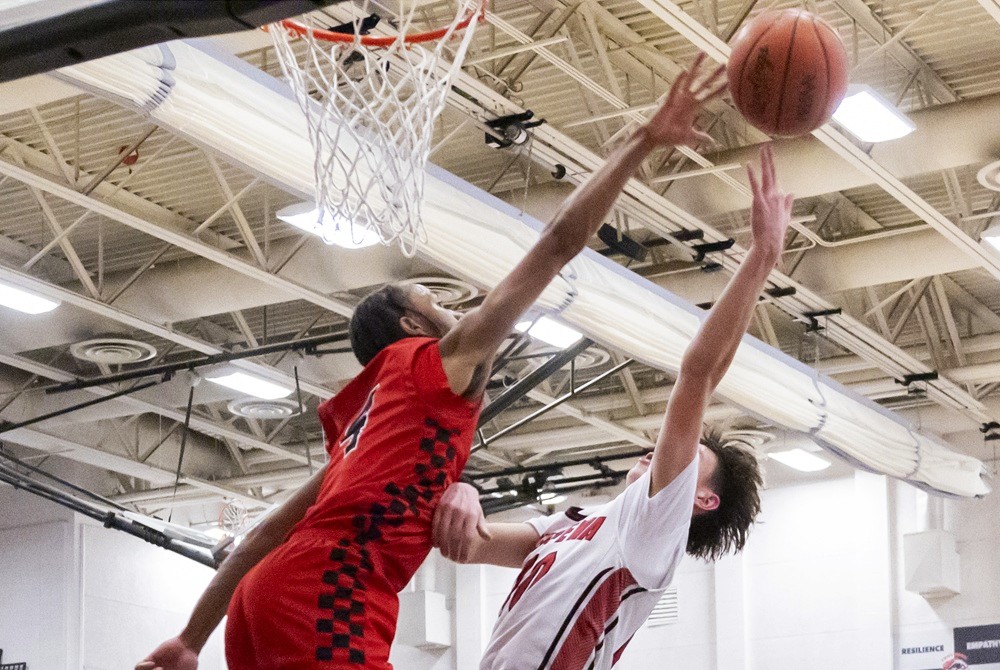
PHOTOS (Top) Roseville’s Terrell Owens (4) blocks a shot during his team’s 71-68 overtime win over Clinton Township Chippewa Valley in last week’s Regional Semifinal. (Middle) Freeland’s Tristan Comer (13) scoops a shot during the Falcons’ Regional Final win over Flint Hamady. (Roseville/Chippewa Valley photo by Adam Sheehan. Freeland/Hamady photo by Terry Lyons.)