

Southeastern Makes Final Minute Count
March 22, 2013
By Geoff Kimmerly
Second Half editor
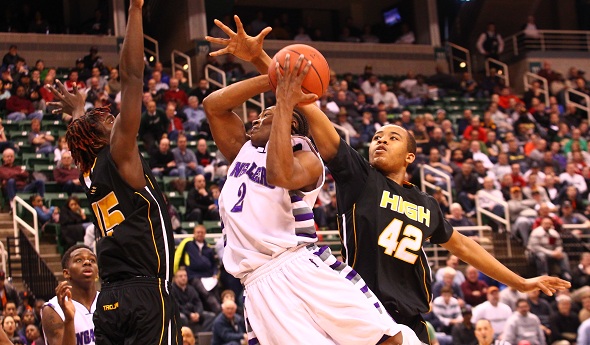
EAST LANSING – Jovone Haynes saw a “weakness,” went after it, and Detroit Southeastern will play Saturday for the MHSAA Class A title.
Simple as that … and not at all.
With his team and reigning champion Saginaw tied and a minute to play in Thursday’s Semifinal, the Jungaleers senior made a steal at halfcourt and found teammate Leonard Harper-Baker for a go-ahead layup on the way to a 51-45 victory.
Four of the Jungaleers’ losses this season – including their 57-56 defeat to Saginaw in December – came down to the game’s final possession. Haynes wouldn’t let this one get to that point.
“I saw he had the ball over his head. I just went at it,” said Haynes of his gutsy last-minute swipe. “I was just confident I could steal the ball.”
 But there’s much more to explain why he and his teammates moved on.
Detroit Southeastern (21-5) will face top-ranked Romulus for the Class A title at noon Saturday. Romulus is playing for its first championship since 1986; Southeastern for its first since 1926 and after finishing runner-up in 2011.
The Jungaleers probably weren’t the Detroit Public School League team expected to reach Breslin Center this winter – not with Detroit Pershing and Cass Tech ranked in Class A and Douglass ranked in Class B.
But Southeastern, an honorable mention in the final poll, benefited from facing them all and despite losing to two of the three.
Haynes and senior Kenyatta Singleton didn’t play in that first Saginaw game, but combined for 19 points, 10 rebounds and eight steals Friday. And they brought security to Southeastern’s offensive attack that was missing in the first matchup; the Jungaleers had only 12 turnovers this time.
“You’re not going to win a state championship in December or January, not in basketball. Us losing (those) four games, who cares?” Southeastern coach George Ward, Jr., said.
“We knew when we got these two on the floor, defensively or offensively, we could make something happen.”
For the first 31 minutes, the teams played to a stalemate. Although the Jungaleers jumped to an 8-0 lead off the opening tip, the margin was never more than four points over the 20 minutes prior to final minute, when Southeastern finished on a 6-0 run.
“They got us sleeping, forced a clean turnover,” Saginaw coach Julian Taylor said. “My guy took his eye off, he was trying to pay attention to the ref, and (Haynes) smacked it out of his hand. Then we had to play from behind, and we made another turnover.”
Junior forward Daryl Bigham led the Jungaleers with 14 points and six rebounds, and Haynes had 13 points.
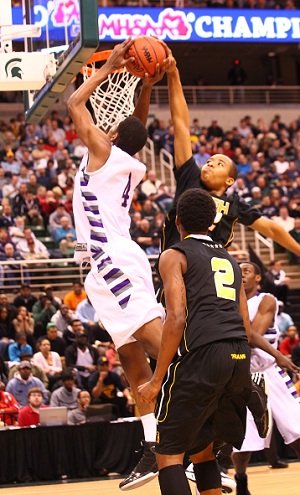
Junior Keyon Addison scored 10 points to lead Saginaw, and 6-foot-6 freshman Algevon Eichelberger had nine blocked shots.
The Trojans entered the postseason ranked No. 6 and finished 23-4.
“It’s just a blessing to be in this position. They fought hard to earn their respect,” said Taylor of his players. “I love all of these guys. They worked their tails off for us. I’m on them to stay humble and stay focused, and I believe they did that. They’ve got nothing to hang their heads for.”
PHOTOS: (Top) Detroit Southeastern's Jovone Haynes (2) drives against Saginaw's Keyon Addison (15) and Algevon Eichelberger (42) on Friday. (Middle) Eichelberger gets one of his nine blocks. (Photos by Hockey Weekly Action Photos.)
Breslin Bound: Boys Report Post-Break
January 8, 2018
By Geoff Kimmerly
Second Half editor
The holiday break across our state is over, and the drive toward March will click into a second gear as most teams this week jump into the heart of league play.
 Today’s Breslin Bound – powered my MI Student Aid – takes a look at a number of contenders that made impressive strides over the last three weeks while classes were out of session, plus gets us back into the regular swing with a look at five games of special note coming up.
These reports are based on results and schedules posted for each school at MHSAA.com – to offer corrections, email me at [email protected].
Week in Review
The countdown of holiday break’s five most intriguing results:
1. Detroit East English 80, Clarkston 71 – East English’s David DeJulius scored 42 points at North Farmington’s Holiday Extravaganza as his team handed reigning Class A champion Clarkston its only loss this season.
2. Grand Rapids Forest Hills Central 72, Wyoming Godwin Heights 68 (OT) – After two losses to open this season, Forest Hills Central has strung together three nice wins with this one over the previously-unbeaten Wolverines at Cornerstone’s tournament the most impressive.
3. Ann Arbor Skyline 74, Belleville 60 – Skyline emerged from a tough holiday schedule still undefeated and having handed possible Class A contender Belleville its third loss.
4. Bridgeport 68, Frankenmuth 54 – The first round between these Class B powers went Bridgeport’s way after last season’s split led to the rivals sharing the Tri-Valley Conference East title while finishing a combined 40-6 overall.
5. River Rouge 52, West Bloomfield 50 (OT) – The Panthers’ perfect start has included two overtime wins including this one over a Lakers team that has two two-point losses and made the Class A Semifinals a year ago.
Watch List
With an eye toward March, here are two teams in each class making sparks:
CLASS A
Grand Haven (7-1) – The Buccaneers also opened 7-1 last season on the way to finishing 18-5, but this start is more impressive. The only loss was by three in double overtime to Spring Lake, which won 19 games last season. And the wins have included Grand Haven’s first over Muskegon since 2012.
Hazel Park (7-0) – There may not be another team that has started more impressively. Coming off 15-8 last season, the Vikings have double-digit wins against Class A powers Detroit East English and U-D Jesuit, an overtime win over Class B standout Detroit Henry Ford and a six-point win over possible Class C contenders Detroit Edison Public School Academy and Pershing (plus another double-digit win over Loyola).
CLASS B
Hillsdale (6-1) – Since opening with a loss to Hanover-Horton, Hillsdale has been rolling. The Hornets followed up a Pat Patterson Tournament championship at Hillsdale College with a 61-44 revenge victory over Onsted – which abruptly ended Hillsdale’s 2016-17 at 21-1 with an upset during last year’s District.
Otsego (5-1) – A slow start last season contributed to an 11-11 finish, but the outlook is better this winter. Otsego’s only loss was to Dowagiac by six during the first week, and the Bulldogs closed December by handing Marshall its only defeat, 80-60.
CLASS C
Detroit Edison Public School Academy (3-3) – DEPSA plays only a few schools its size as part of the Detroit Public School League, and similar experience paid off with a run to the MHSAA Semifinals last season. The wins this winter are over Belleville, Saginaw Arthur Hill and Southfield Christian, and the losses just as impressively have come against U-D Jesuit, Detroit Martin Luther King and Hazel Park.
Kalamazoo Hackett (7-0) – The Irish are another team surely fueled by an early exit last season; they were 19-1 when they fell to Kalamazoo Christian in their first District game. Hackett has a four-point win over reigning Class D runner-up Buckley and gets Christian for the first time this season Friday.
CLASS D
Hillman (6-0) – An MHSAA quarterfinalist last season, Hillman is up to its usual level of regular-season dominance. The Tigers have won all of their games by at least 14 points, with an 18-pointer over Cedarville (5-2) looking like the best so far.
Kingston (6-0) – The Cardinals are halfway to equaling last season’s 12-9 finish and survived their only single-digit scare to win by six over Sandusky on Dec. 20. Kingston followed that with 13 and 28-point wins to claim the Brown City Invitational title.
Can't-Miss Contests
Be on the lookout for results of these games coming up:
Tuesday – Maple City Glen Lake (4-0) at Buckley (2-2) – Reigning Northwest Conference champion Buckley is in third starting the week but gets the two first-place teams back-to-back, Glen Lake followed by also-undefeated Frankfort on Thursday.
Friday – Detroit East English (5-2) at Detroit Edison PSA (3-3) – The PSL East Division 1 is loaded with potential statewide contenders, and these are two with high hopes.
Friday – Canton (7-0) at Wayne Memorial (5-1) – These two lead the Kensington Lakes Activities Association Black, with Wayne’s opening loss to Clarkston the only defeat between them.
Friday – Wyoming Tri-unity Christian (6-0) at Grand Rapids Covenant Christian (5-1) – This will be a major test for the Grand Rapids area’s small-school powers.
Friday – Orchard Lake St. Mary’s (6-1) at Detroit U-D Jesuit (5-2) – This should prove key again as the Eaglets chase the reigning Detroit Catholic League Central champ Cubs.
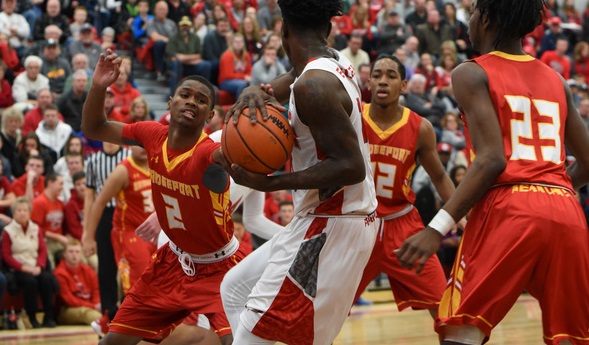
PHOTO: Bridgeport applies defensive pressure during its win over rival Frankenmuth on Friday. (Click for more from HighSchoolSportsScene.com.)