

Southfield Christian Nets 3rd Title Try
March 20, 2014
By Geoff Kimmerly
Second Half editor
EAST LANSING – Lindsay Hunter IV sank his first shot 43 seconds into Thursday’s first Class D Semifinal at the Breslin Center.
And he didn’t stop until top-ranked Southfield Christian had cemented itself in a third straight championship game.
Hunter made 7 of his first 10 shots, missing just one more at the start of the third quarter before leaving the game with 21 points in 14 minutes as his team cruised to a 97-68 victory over Frankfort.
The two-time defending champion Eagles will face Adrian Lenawee Christian in Saturday’s 10 a.m. championship game.
“I just wanted to come out and get a win. I did everything (possible),” Hunter IV said. “It’s been like that all playoffs. I don’t know what’s going on. All of a sudden the swishes flew.”
And not just for Hunter. Southfield Christian (25-1) shot 50 percent from the floor including 41 percent from 3-point range. It took the lead for good 1:08 into the game and led by 14 by the end of the first quarter.
During the first half, when the Eagles' starters played most of the minutes, the team shot 60 percent from the floor and 75 percent from behind the 3-point arc.
Southfield Christian set a Class D Semifinal record for points, scoring two more than Detroit East Catholic did in its 95-65 win over Concord in 1986. Junior guard Bakari Evelyn added 17 points for the Eagles, making 7 of 8 shots from the floor including all three of his 3-point attempts.
 Senior forward Damarco White added seven points, six rebounds and four blocked shots in only 12 minutes. He, Evelyn and Hunter also were main contributors in last season’s championship run, and Hunter and Evelyn played major roles in 2012 as well.
“Especially this year, it’s my last year and I’ve got to play as hard as I can every game because it could be my last,” White said. “I don’t want to let our team lose. Just like last year, I want to play for everybody in the locker room, everybody at my school, so I go out there and do the best I can.”
Frankfort seniors Connor Bradley and Brandon Schaub helped the Panthers to their first Semifinal since 1969, earning a legacy in their school's history. Total, they were part of three District and two Regional titles and “had as good a career as anybody in the history of Frankfort,” Panthers coach Reggie Manville said.
Junior center David Loney led Frankfort with 32 points and 13 rebounds. Schaub added 11 points and sophomore guard Kole Hollenbeck had five assists.
Frankfort finished 20-7 after entering the postseason as an honorable mention in the final Associated Press poll.
“Each year we’ve taken a step forward, from the District to the Regional to the final four, and we still have 10 guys coming back,” Manville added. “We want to take the next step, and yet we realize the next step is a big step. But at the same time, I’ve got confidence in my program that we’ll be there next year.”
Click for a full box score and video from the press conference.
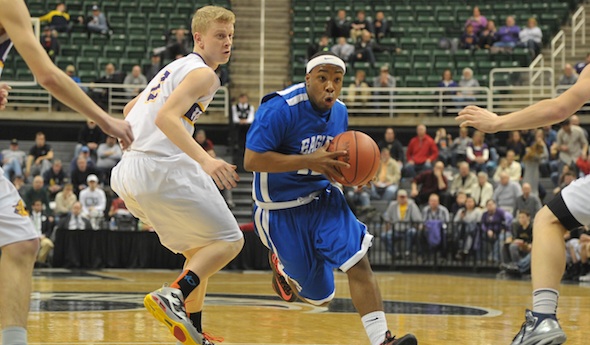
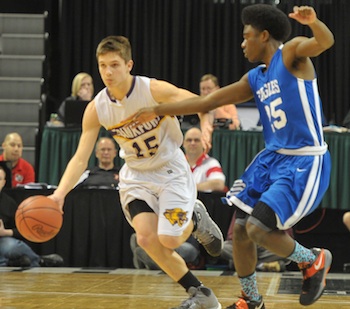
PHOTO: (Top) Southfield Christian's Jalen Bouldes drives to the hoop as Frankfort's Ryan Plumstead defends. (Middle) Frankfort's Kole Hollenbeck works to get past Southfield Christian's Kameron Garner.
HIGHLIGHTS: (1) David Loney got Frankfort out to a 5-1 lead in the Class D Semifinal, hitting this 3-pointer for the first points of the game. He finished with a game-high 32. (2) Lindsay Hunter IV takes a long pass on a fast break and scores as part of an 11-point run for Southfield Christian in the first quarter. Hunter led his team with 21 points.
As Roles Change, Hardy Continues to Shine
By
Tom Markowski
Special for Second Half
February 2, 2017
FARMINGTON HILLS – No matter the role or circumstances, Amauri Hardy finds a way to fit in.
 Hardy, a 6-foot-1 senior guard from North Farmington, has been a starter since his freshman year and is one of the state’s top players. But his journey has not always been smooth.
He averaged 10 points per game his freshman season at Southfield High, then missed all but four games his sophomore season after suffering a strained knee ligament. The injury sidelined Hardy for four months, and in October of his junior year he transferred to North Farmington.
Known as a shoot first, pass second type of player, Hardy would have to change his style to fit into an experienced team that was not short on talent and players who could score.
“I didn’t have to score,” Hardy said. “We had more talent than when I played at Southfield. I had to swallow my ego. It’s something I had to do. (The North Farmington players) knew my game. I knew theirs.
“I was a combo guard last year. I tried to do what was needed. I shared things with Billy (Thomas).”
Hardy and Thomas, a senior last season, teamed to form one of the state’s top backcourts. And their ability to mesh didn’t happen by accident. The two had been friends since elementary school. When they entered high school each went his separate way, but reunited last winter their play (Hardy averaged 22 points ppg; Thomas 18) was instrumental in the Raiders’ run to the school’s first Class A Final appearance.
“We had a great talk when he came to us,” North Farmington coach Todd Negoshian said. “We talked about his goals, where he wanted to get. He didn’t want special treatment. To this day he’s always asking questions. He’s not questioning what we do. He just wants to get better. He really listened, watched and learned.”
Hardy said every day he thinks about what he and his teammates accomplished last season. Their 55-48 victory over host Orchard Lake St. Mary’s in a District Final was a big hurdle on their way to the Breslin Center.
As talented and balanced a team as North Farmington was last season, this season’s has little experience. Hardy is the lone starter returning and the Raiders have been inconsistent, a trait many young teams confront.
 Once again Hardy had to switch gears. In order for his team to be competitive, and as successful as possible, he’s had to assert himself more offensively and be the leader. Hardy is averaging 28.5 points and seven assists per game from the point guard spot, but in most games it hasn’t been enough. What makes those numbers even more impressive is that North Farmington averages just 55 points per game.
North Farmington (4-7) did defeat Southfield Arts & Technology, 76-70, on Jan. 26 for its first victory in the Oakland Activities Association Red. Hardy scored 35 points and had help this time as the other starting senior, Karl Patrick, had 19.
Overall, the Raiders have had a difficult time competing for 32 minutes. In some games they play well for three quarters, then run out of steam leaving Hardy to do much of the heavy lifting. He scored his team’s first 15 points in a 63-58 overtime loss to West Bloomfield on Jan. 20. Hardy finished with a career-high 46.
“I give him credit, the way he leads our guys,” Negoshian said. “He’s toughed through it.
“That’s what I like about him. He’s become a leader. Jacob Joubert and Alex Darden were our leaders last year. He watched and learned.”
Hardy does more than watch. He dedicated himself to the weight room in the offseason and has become a much stronger player, particularly when he goes to the basket. He’s able to ward off defenders more effectively and exhibits great body control.
And it doesn’t hurt that he’s left-handed and gives opponents a less familiar look as they try to lock him down.
Hardy was one of two players from Michigan (along with Jamal Cain of Detroit Cornerstone Health & Technology) and 64 finalists nationally for the McDonald’s All America team (no Michigan players were among 24 eventually chosen). Hardy also has signed with Oklahoma State University and is a possible candidate for the 2017 Mr. Basketball Award.
But on the way to those future opportunities, he’s filling the necessary roles as North Farmington works to elevate from its slow start.
“He’s a great teammate,” Negoshian said. “He cares about the team and the program.”
 Tom Markowski is a columnist and directs website coverage for the State Champs! Sports Network. He previously covered primarily high school sports for the The Detroit News from 1984-2014, focusing on the Detroit area and contributing to statewide coverage of football and basketball. Contact him at [email protected] with story ideas for Oakland, Macomb and Wayne counties.
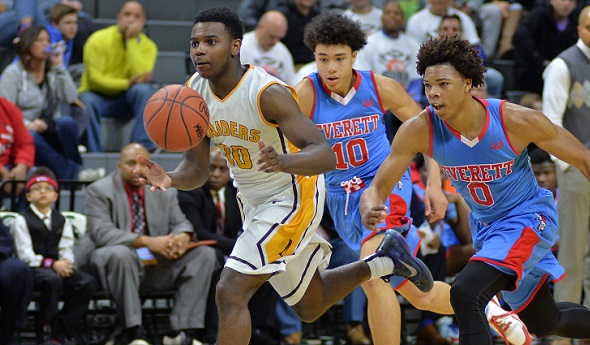
PHOTO: North Farmington's Amauri Hardy (10) pushes the ball upcourt during last season's Class A Semifinal victory over Lansing Everett.