

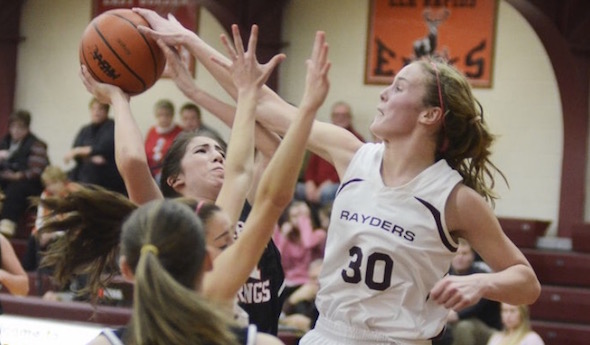
Stuck Family Success Lives On at Charlevoix
February 3, 2017
By Dennis Chase
Special for Second Half
CHARLEVOIX – Elise Stuck burst on to the scene with a 21-point, 11-rebound effort in Charlevoix’s season-opening win over Petoskey.
 That was two months ago, but it was a harbinger of things to come.
Stuck, an athletic 6-foot-1 freshman, has registered seven double-doubles and one triple-double for the 9-4 Rayders, who are trending toward their best season since a 21-win campaign in 2008-09. Charlevoix was 3-19 a year ago.
The Rayders are achieving this with a lineup that features two freshmen and three juniors. Stuck – who “plays everywhere,” including the point – is the leader, averaging 18.7 points and 11 rebounds per game. She had 10 assists in a win over Gaylord last month.
“She’s the real deal,” Charlevoix coach Liz Shaw said. “She’s so fun to watch. She plays well beyond her years. One of her great attributes is passing. She sees the court so well. She makes everybody around her better. As a team, I think that’s why we’ve been so successful. And not only is she a great player, but she’s a great kid.”
Stuck struggled with her shot Wednesday in a 53-47 setback to Class A Traverse City Central. She still finished with 18 points (all in the second half) and eight rebounds. The Rayders could not contain Central junior guard Margot Woughter, who tossed in 27.
Shaw said Stuck’s struggle was an aberration.
“All players struggle, but great players figure it out,” she said.
Stuck, who turned 15 on New Year’s Eve, comes from a basketball family. Her parents, Erica (Hall) and Matt, combined to score nearly 4,100 points during their all-state careers at Manton. In fact, Matt is seventh in MHSAA career scoring with 2,449 points. He went on to play four years at Oakland University and two years professionally overseas. He’s now in his first season as the Charlevoix boys varsity coach. Erica’s 1,649 points rank second all-time at Manton. She’s in the MHSAA record book twice for hitting 15 free throws in a game.
But those feats are seldom discussed now. Their focus is on the present – and their kids.
And the kids keep them busy playing multiple sports. In addition to basketball, Elise competes in volleyball (honorable mention all-state), soccer and track. Her twin brother, Luke, who’s been battling injuries, plays basketball, football and baseball. Caleb, a seventh-grader, is also a basketball player, although baseball is his preferred sport.
“We always wanted them to love sports,” Erica said. “We’re super excited that they share that same passion.
“Otherwise,” she added with a laugh, “I don’t know what we would do.”
Elise is an emerging talent on the court. She’s a difference-maker, even though she’s still learning the nuances of the game. The more experience she gains, the more she’ll improve, her father said.
“I’m a dad and a coach so I always say she’s doing well, but she has a long way to go,” Matt said. “She has a very good athletic skill set. She’s tall, can run, can jump. She’s a good athlete who’s becoming a good basketball player.”
She’s also a leader.
That’s a role Matt didn’t have to take on when he was a freshman at Manton. Although he was a double-digit scorer on a team that reached the Class C Quarterfinals that season, the Rangers’ roster was stocked with strong senior leadership in Jeff Spalding, Cage Butcher and Chris Herndon. Spalding was an all-state guard.
By contrast, Charlevoix has just one senior on its girls roster this season.
“For me, the transition was easier,” Matt said. “I could just go play. Elise has had a bigger impact (as a freshman).”
Others have taken notice. Ron Stremlow, who coached Erica at Manton, compares Elise’s court presence to two former area standouts who went on to play at Michigan State.
“Elise is a Liz Shimek, Jasmine Hines type player,” Stremlow said. “She plays a different position, but she catches your eye as soon as the game starts.”
Stremlow saw Stuck play in a loss last month to unbeaten Kalkaska. He was not the only one impressed.
“Explosive,” Kalkaska coach Dave Dalton said in describing Stuck. “She can drive the ball, take it the length of the court, left or right. She’s big, strong, fast. She can play with her back to the basket. And she’s a really good passer.”
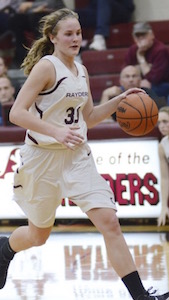 That’s why Shaw utilizes her all over the court, including the point.
“I don’t want to handcuff her,” she said.
Stuck’s game is still a work in progress, particularly on the perimeter. She acknowledges that.
“Coming into the season I had never played point guard or on the outside,” she said. “I was an inside player, and in crunch time I go to my inside game because that’s what I’m used to.
“I worked this summer on being able to take (defenders) one-on-one off the dribble. My outside shooting, shooting off the dribble, shooting under pressure, can definitely get better. That’s something I want to work on.”
Now that her players are settling into roles, Shaw said the Rayders “are getting better and better every game.” Abby Cunningham, a 5-11 freshman, has taken over at center, joining juniors Olivia Jeakle and sisters Rachel and Natalie Nesburg in the lineup. Shaw said last week’s 57-35 win over East Jordan was the team’s most “in sync” game of the season. Jeakle hit two 3-pointers early en route to a 14-point night. Natalie Nesburg chipped in eight points, six rebounds, five steals and five assists while Rachel added seven points, eight rebounds and five assists.
Cunningham is a close friend of Elise’s, and they have helped each other make the transition from middle school to varsity basketball.
“It’s fun to watch them have this kind of success together,” Erica said. “They love their team.”
Shaw is hoping this nucleus can help put Charlevoix girls basketball back on the map.
Charlevoix finished runner-up in the 2004 MHSAA Class C Final to Detroit St. Martin dePorres. That team was coached by Keith Haske, Shaw’s mentor. Haske is now at Traverse City St. Francis, where he led the Gladiators to the Class C Final last season.
Meanwhile, Matt, who runs his own construction company, took over the varsity boys job this season.
“I thought if I can help or contribute in any way,” he said, “why not?”
First, he had to make sure the added responsibilities wouldn’t drastically take away time from watching his kids play.
“Schedule-wise we decided as a family that it would work, that I wouldn’t miss any more games than I would have if I wasn’t coaching,” he said. “On Tuesday nights in our league (Lake Michigan Conference), the boys go one way, the girls the other. We were going to have to divide and conquer anyway.”
Stuck inherited a team short on varsity experience. The Rayders dropped to 3-8 after Wednesday’s night’s 58-45 loss to Gaylord.
But the coach sees improvement. He’s continually stressing fundamentals in practice, giving his players a base to become a better team.
Charlevoix has nine juniors on the varsity, plus a solid group at the JV level, so the future looks promising.
Luke, who has been dealing with kneecap tracking issues and a sprained LCL, returned to JV practice this week. The kneecap problem, he suffered last March, severely curtailed his baseball and football seasons. He was ready to go for basketball, but then sprained his LCL (lateral cruciate ligament) in gym class.
“He’s had a long year,” Matt said.
At 6-2, 210 pounds, Luke is a solidly built forward, whose strengths are rebounding and defense.
“He’s a pretty good leader on the court, too,” his father said. “He knows where everybody needs to be – and he’s pretty vocal. About four or five of those guys play travel ball together. It’s a good group.”
Luke was eager to get back in action.
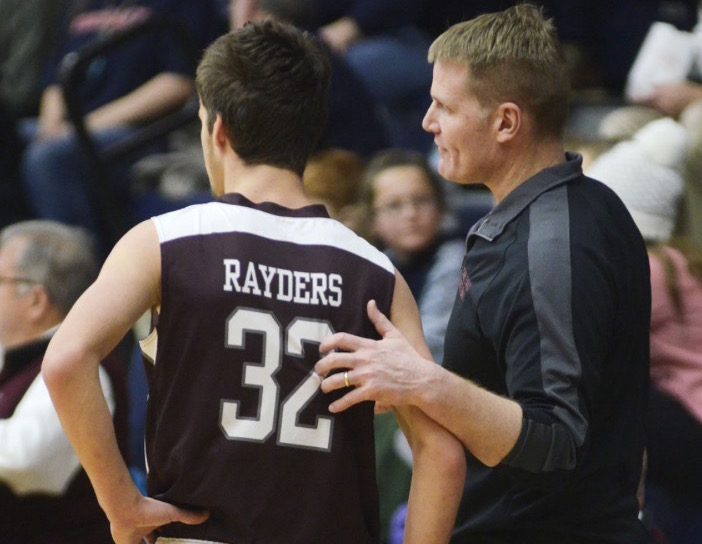 “It was interesting to see the other side of the game (sitting out while injured),” he said. “But it was really (disappointing) to not participate, knowing that you could be out there (contributing).”
Matt and Erica have coached their kids over the years. Both coached the girls 8th grade team last year. Then, Matt and Boyne City’s Randy Calcaterra, a Wayne State grad who played against Matt in college, coached 7th and 8th grade AAU teams that their sons played on.
Getting a handle on that dynamic is not as easy as it sounds, Matt said.
“That’s the hard part of having parents that have played and are coaches,” he said. “Randy and I would always say that coaching is hard, parenting is harder and being a parent-coach is hardest.”
As a parent, Stuck said he’s applies a rule he learned from his father.
“I ask my kids: Do you want me to tell you one thing that you need to work on?” he said. “That’s the rule my dad had when I was going through school. If you want to hear it, I’ll tell you. I apply that same rule. If they want to open it up for more, we discuss more.”
Do they ask?
“They do,” he said.
“Sometimes they might regret it,” he added with a chuckle.
Stuck averaged 24.7 points a game in his 99 varsity starts at Manton. He was coached by Rene LaFreniere.
LaFreniere said the 6-4 Stuck was more than a scorer and rebounder.
“The thing people didn’t realize is that he was such a good passer,” LaFreniere said. “He would get double- and triple-teamed and would always find the open man.”
For as good a ballplayer as he was, LaFreniere said Stuck’s an even better person.
“Special person, incredible parents,” he said. “Humble, never gloated. It was like, ‘I’ve got a job to do.’ And he did it.”
Whereas Matt could use his size in the paint, Erica made her mark from the perimeter.
“She could shoot,” Stremlow said. “Her range was about 25 feet.
“Good upbringing, a coachable player, a team player who understood the game and really pushed herself. When I watch her daughter, I see those similarities.”
Erica, a math teacher in the Ellsworth school system, said the value of hard work was preached when she played.
“People always told me the harder you work, the more determined you are, that will determine how good you end up being,” she said.
The gym is still a home away from home for the Stucks. Countless hours are spent there on a daily basis.
It’s a lifestyle that works for the family. And they wouldn’t want it any other way.
“We don’t think anything of it,” Matt said. “We think of it as a regular day. We enjoy it. That’s all there is to it.”
 Dennis Chase worked 32 years as a sportswriter at the Traverse City Record-Eagle, including as sports editor from 2000-14. He can be reached at [email protected] with story ideas for Manistee, Wexford, Missaukee, Roscommon, Ogemaw, Iosco, Alcona, Oscoda, Crawford, Kalkaska, Grand Traverse, Benzie, Leelanau, Antrim, Otsego, Montmorency, Alpena, Presque Isle, Cheboygan, Charlevoix and Emmet counties.
PHOTOS: (Top) Charlevoix’s Elise Stuck blocks a shot this season, her first in high school. (Middle) The versatile Stuck brings the ball upcourt. (Below) Matt Stuck, right, is Elise’s father and the Charlevoix first-year boys coach. (Photos courtesy of the Petoskey News-Review.)
Breslin Bound: Boys District Preview
March 9, 2020
By Geoff Kimmerly
Second Half editor
If cold and snow send us into the gym every winter with basketball on our minds, the recent warmup (at least downstate) lets us know we’ll be moving to Breslin Center shortly.
 Those who join us at the end of this month will take their first MHSAA Tournament steps this week.
District tournaments tip off all over the state, and again, for the first time, with the top two seeded teams separated on opposite sides of the bracket. Check out “Tracking the Tournament” on MHSAA.com for every matchup from all of them, and see below for some of last week’s most eye-catching scores and three Districts in each division that especially pop off the page.
“Breslin Bound” is powered by MI Student Aid and based on results and schedules posted for each school at MHSAA.com. Send corrections or missing scores to [email protected]. Rankings below are by Michigan Power Rating (MPR).
Week in Review
The countdown of last week’s five most intriguing results:
1. Ann Arbor Huron 64, Ypsilanti Lincoln 54 – This matchup could very well have been a preview of Huron (19-1) meeting Lincoln (17-3) again in this week’s District Final, as explained below. (Lincoln did bounce back to beat Grand Rapids Catholic Central on Thursday.)
2. Orchard Lake St. Mary’s 70, Detroit Cass Tech 65 – The Eaglets (19-1) came out on top in the Operation Friendship matchup of league champions and Division 1 championship hopefuls, with Cass Tech (18-2) also in play for a trip to Breslin.
3. Negaunee 52, Iron Mountain 51 – A last-second basket gave Negaunee (18-2) shares of two conference championships with Iron Mountain, and avenged an 18-point loss to the Mountaineers (19-1) from Jan. 28.
4. Stevensville Lakeshore 53, Portage Central 27 – Lakeshore (16-4) avenged a six-point Jan. 31 loss to Central (16-4) in a big way, and in doing so clinched the Southwestern Michigan Athletic Conference West title outright.
5. Benton Harbor 82, Wyoming 72 – Both finished 18-2 with this final tune-up before the playoffs begin, with Benton Harbor headed into the Division 2 bracket and Wyoming into Division 1.
Districts at a Glance
These could be among our most competitive brackets. Host sites are in bold:
DIVISION 1
Dearborn Fordson
1. River Rouge (19-1), 2. Detroit Cass Tech (18-2), Detroit Western (7-9), Melvindale (6-14), Dearborn Fordson (6-14).
It would take a pretty serious upset for No. 4 River Rouge and No. 9 Cass Tech to not meet in the championship game, and that matchup should be one of the best of the entire Division 1 bracket this month. Rouge was last season’s Division 2 runner-up, falling by three points while in pursuit of its first MHSAA Finals title in this sport since 1999. The Panthers then ended up in Division 1 this season, opened with a 10-point win over Lincoln, and have only an overtime loss to Division 2 contender Grand Rapids Catholic Central on an otherwise perfect ledger. Cass Tech won the Detroit Public School League West and Tournament titles, and its only losses were by one to No. 7 Flint Carman-Ainsworth and in overtime last week to No. 1 Orchard Lake St. Mary’s.
Detroit Martin Luther King
1. Eastpointe (17-3), 2. Hamtramck (16-3), Grosse Pointe South (16-4), Detroit Martin Luther King (13-6), Grosse Pointe North (3-16).
There isn’t an easy path through this District, as Eastpointe opens with North and then would face King, while South and Hamtramck match up in the other semifinal. All four of the anticipated semifinalists are ranked between Nos. 21-30 by MPR. Of Hamtramck’s three losses, two were to River Rouge (see above), while Grosse Pointe South and Eastpointe were league champions within the Macomb Area Conference and King won the PSL East (and also took an early loss to Rouge).
Saline/Eastern Michigan University
1. Ann Arbor Huron (19-1), 2. Ypsilanti Lincoln (17-3), Belleville (16-4), Ann Arbor Pioneer (12-8), Saline (13-7), Ypsilanti Community (9-11).
The first five teams listed above rank among the top 50 in Division 1 MPR, with Huron No. 3 and reigning Division 1 champion Lincoln No. 5. Huron won the Southeastern Conference Red that included Pioneer and Saline, and defeated Lincoln last week 64-54. The Railsplitters, of course, feature super sophomore Emoni Bates, and he’s gone over 60 points this season and can put them on his shoulders at any time. Belleville is almost the forgotten team and shouldn’t be – the Tigers won the Kensington Lakes Activities Association East title and rank No. 27 in Division 1 MPR. The openers at this District are scheduled to be played at Saline, with semifinals and the championship game at EMU.
DIVISION 2
Bridgeport
1. Bridgeport (19-1), 2. Frankenmuth (17-3), Clio (15-5), Caro (7-13), Birch Run (3-17), Mt. Morris (6-14).
Home and mostly unstoppable this season, and ranked No. 3 in all of Division 2, Bridgeport is the presumed favorite. But Clio could provide the Bearcats a mighty challenge in tonight’s opener, and No. 11 Frankenmuth on the other side of the bracket and handed Bridgeport its only loss 43-38 on Feb. 7. Bridgeport still won the Tri-Valley Conference East by a game over the Eagles, and also beat them in last season’s District Final before suffering their only loss of the season the next game against Alma to start the Regional.
Hudsonville Unity Christian
1. Grand Rapids Catholic Central (17-3), 2. Hudsonville Unity Christian (16-4), Allendale (14-6), Grand Rapids West Catholic (10-10), Grand Rapids Wellspring Prep (9-11), Wyoming Lee (4-16).
Three of the top 14 in all of Division 2 MPR top this District – No. 1 GRCC, No. 7 Unity Christian and No. 14 Allendale. Unity Christian is the reigning champion in Division 2 and opens against Allendale, which it defeated by 16 in December. Unity went on to win the Ottawa-Kent Conference Green, while GRCC was first, Allendale second and West Catholic fourth in the O-K Blue. GRCC swept those two, losing this season only to Lincoln, No. 2 Benton Harbor and No. 5 Grand Rapids Christian.
St. Clair
1. Macomb Lutheran North (15-3), 2. Richmond (16-4), St. Clair (14-6), Marine City (15-4), New Haven (12-8), Algonac (20-0).
This intriguing grouping includes a pair of MAC co-champs in Marine City (Bronze) and St. Clair (Gold), and the Blue Water Area Conference and Detroit Catholic League AA runners-up in Richmond and Lutheran North, respectively. There have been just a pair of regular-season meetings among the bunch: Marine City edged St. Clair 43-42 on Dec. 19, while Richmond defeated Marine City 58-47 two days before that. All of the first four teams above are ranked among the top 36 in Division 2, with Lutheran North at No. 12 and Richmond No. 19.
DIVISION 3
Bridgman
1. Niles Brandywine (17-3), 2. Bridgman (15-5), Cassopolis (15-5), Watervliet (7-13), Benton Harbor Countryside Academy (7-11).
Brandywine enters No. 3 overall in Division 3 after winning the Berrien-Cass-St. Joseph Conference Red just ahead of co-runner-up Bridgman. Brandywine won their regular-season matchups by 10 and eight points, but they wouldn’t meet again this week until Friday’s championship game. The Bees tonight must get through Cassopolis, which shared the championship in the Southwest 10 Conference. That’s also a rematch, as Bridgman won a Dec. 28 meeting 70-60. Bridgman also opened this season with a 74-38 win over potential Wednesday opponent Countryside.
Erie Mason
1. Erie Mason (17-3), 2. Blissfield (18-2), Petersburg Summerfield (19-1), Monroe St. Mary Catholic Central (12-8), Ottawa Lake Whiteford (2-18).
It’s possible no District this week has teams sharing more ties. Erie Mason rode one of the top scorers in the state, now-senior Joe Liedel, to last season’s Division 3 Semifinals. The Eagles won the Lenawee County Athletic Association title this season, claiming a second meeting against runner-up Blissfield 62-58 after falling to the Royals 61-59 in their first meeting. Erie Mason is 12-1 over its last 13 games, but that lone defeat came 47-33 to Petersburg Summerfield, which won the Tri-County Conference handily but suffered its lone loss Jan. 16 to Blissfield. Monroe St. Mary, meanwhile, has to be considered a scary darkhorse, just two season’s removed from making the Division 3 Semifinals and co-runner-up this winter in the Huron League with Division 1 Riverview behind Division 2 Flat Rock. SMCC was eliminated in its District opener last season – in overtime by Blissfield. If Mason defeats Whiteford tonight, it will see SMCC on Wednesday, while Summerfield and Blissfield meet Wednesday on the other side of the bracket.
Mancelona
1. Maple City Glen Lake (18-2), 2. Traverse City St. Francis (17-3), Elk Rapids (12-8), Mancelona (15-5).
All four of these contenders are ranked among the top 39 in Division 3 MPR, with No. 6 Glen Lake leading the way but No. 39 Mancelona looking pretty dangerous as a 15-win host. Those two meet on one side Wednesday, while No. 12 St. Francis and No. 36 Elk Rapids tangle for the third time on the other side of the bracket. St. Francis won both regular-season meetings on the way to the Lake Michigan Conference title, while Glen Lake won the Northwest Conference and Mancelona ran third of three superior contenders in the Ski Valley Conference. St. Francis defeated Glen Lake in last year’s District Final 59-44.
DIVISION 4
Brethren
1. Frankfort (15-5), 2. Brethren (16-4), Onekama (11-9), Manistee Catholic Central (12-8), Mesick (6-14), Bear Lake (2-18).
Frankfort finished the regular season No. 19 overall and Brethren at No. 20, and the Panthers finished Division 4 runners-up a year ago. The bracket is set up for those two to meet Friday. But given this season’s first three months, a number of possibilities for this week seem reasonable. Frankfort finished second in the Northwest Conference to Glen Lake, but split with third-place Onekama winning the first meeting by five but losing the second by three. Brethren shared the West Michigan D League title, but opened this season with a 10-point loss to Manistee Catholic Central before winning the rematch by three six weeks later. Mesick split with MCC and nearly upset Brethren, losing by just a point in their Jan. 31 game. MCC and Mesick join Frankfort on one side of the bracket, with Brethren, Bear Lake and Onekama on the other.
Litchfield
1. Camden-Frontier (17-3), 2. Hillsdale Academy (18-2), Litchfield (11-9), Hillsdale Will Carleton Academy (12-6), Tekonsha (4-15), Coldwater Pansophia (0-15).
If all goes as set up, top-seeded Camden-Frontier will get a third chance against Hillsdale Academy after the latter edged C-F by a game to win the Southern Central Athletic Association East championship. They split their regular-season meetings, the Redskins winning the first 67-46 with Hillsdale Academy winning the second 59-37. Litchfield lost to both but did win the SCAA Central. Will Carleton split with Litchfield, losing the first meeting by two and winning the second by 25. Both of those potential upsetters are on Camden-Frontier’s side of the bracket.
Painesdale Jeffers
1. Dollar Bay (18-2), 2. Chassell (16-4), Painesdale Jeffers (14-6), Lake Linden-Hubbell (9-11), Baraga (2-18).
Dollar Bay has reached the Semifinals and Breslin Center two straight seasons, and started this season off with 17 straight wins. But the Blue Bolts fell to both Chassell and Jeffers over the last 10 days, leading those three teams to share the Copper Mountain Conference’s Copper Country championship. That late surge also helped all three rank among the top 33 in Division 4 MPR, Dollar Bay still tops in the group at No. 11. The Blue Bolts play their first game this week against the host Wednesday after Jeffers won their Friday meeting 49-47. Chassell, which split its two regular-season games with Jeffers, has Copper Country fourth-place finisher Lake Linde-Hubbell tonight with sixth-place Baraga awaiting the winner Wednesday.
Second Half’s weekly “Breslin Bound” reports are powered by MI Student Aid, a part of the Office of Postsecondary Financial Planning located within the Michigan Department of Treasury. MI Student Aid encourages students to pursue postsecondary education by providing access to student financial resources and information. MI Student Aid administers the state’s 529 college savings programs (MET/MESP), as well as scholarship and grant programs that help make college Accessible, Affordable and Attainable for you. Connect with MI Student Aid at www.michigan.gov/mistudentaid and find more information on Facebook and Twitter @mistudentaid.
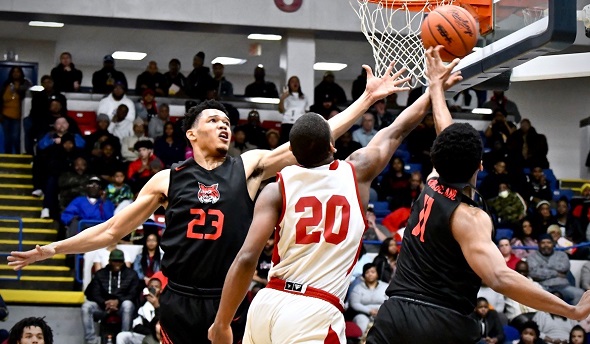
PHOTO: Grand Blanc defeated Flint Beecher 62-55 in a matchup last week of contenders in Divisions 1 and 3, respectively. (Photo by Terry Lyons.)