

#TBT: 'Fennville Flash' Scores 60
By
Geoff Kimmerly
MHSAA.com senior editor
March 12, 2015
"Jordan shoots. He scores."
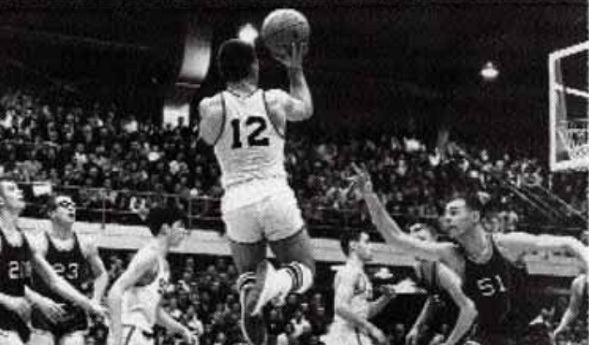
This week marks the 50th anniversary of one of the most incredible feats in MHSAA basketball history. On March 11, 1965, Fennville's Richie Jordan scored 60 points in a Class C Regional Final against Bridgman, a point total that remains an MHSAA Tournament record.
The 5-foot-7 "Fennville Flash" became Michigan's fourth inductee into the National Federation of State High School Association's Hall of Fame in 2001. Below is a video compilation or Jordan clips, with audio from that Regional Final, followed by a report from MHSAA historian Ron Pesch written in 2001.
By Ron Pesch
MHSAA historian
Not long ago, I came across an article written by Hal Schram, the legendary prep journalist for the Detroit Free Press. It was penned during the winter of 1977, and Schram had decided to look back at the history of Michigan high school basketball and pick his top 20 high school players from the past quarter century.
“The Swami” had followed the high school circuit since the 1940s. Schram began with a larger list, paring the roster from 44 to 20. The sportswriter went one step further and decided to single out one member of the squad for the ultimate honor – “the greatest of them all.”
As one would expect, final selections included many of the state's most memorable names: Earvin “Magic” Johnson, Dave DeBusschere, Chet Walker, Spencer Haywood, Ralph Simpson, Rudy Tomjanovich, Campy Russell. Their exploits are legendary, and even the most casual fan of basketball could agree they belong on the list.
However, looking back from the millennium, Schram's choice for state's greatest player is stunning.
“The Swami” himself admitted at the time that his No. 1 pick would surprise many. Hal's top pick never played professionally in either the NBA or ABA. That can be overlooked, as the criteria was simple – the state's greatest prep player. But when I state that Schram's selection played ball at a Class C school, that his teams never advanced to the final rounds of the tournament, and that he stood a mere 5-7½ and weighed only 160 pounds in his prime, most basketball fans shake their heads in disbelief.
But those are only physical attributes. Ask Richie Jordan himself.
Schram's pick as the state's greatest high school ballplayer, Jordan will tell you that it doesn't matter what race, religion or how tall you are. He'll state that anything is possible with imagination and hard work.
Many may dispute Swami's selection, but few will debate Jordan's talents as an all- around athlete. A four-sport star at Fennville High School, he earned 16 letters during his prep career. He is considered by many to be the finest student-athlete ever turned out by the state of Michigan.
The family lived in Bangor when Jordan started school. On the playground one day, Richie wandered over to a high jump pit, where the older kids were practicing their leaps during recess. Much to his delight, he was offered the chance to jump by one of the older kids. The bar was lowered, and Jordan took his shot.
“I easily jumped over the bar and the older kids made comments on how easy I jumped. They kept moving the bar up until it was as high as my head. A crowd started to gather and I cleared the bar. The older kids made me feel real special.”
Before he entered the third grade, the Jordan family moved to Fennville, a small town in west Michigan.
“Fennville was a wonderful place to grow up, and I have the best of memories,” recalled Jordan. “We had a group of kids who played together and loved each other from the 3rd grade on.”
Like so many kids, he imagined himself duplicating the feats of his idols. Many have similar dreams, but few worked as hard as Richie to achieve them.
By the time he reached high school, Jordan had evolved into a stellar all-around athlete. His drive to excel worked around the clock. Through the years he accumulated new sports heroes and studied their movements in his mind.
“I was at the 1962 finals game where (Saginaw High School's) Ernie Thompson scored 42 points against Benton Harbor. I went home and worked on my double clutch for days after that. I loved all those guys and respected their talent,” said Jordan, “but I wanted to be better than all of them.”
His hard work paid off with stellar athletic performances. An all-state halfback in football in his junior year, Jordan averaged a whopping 35.6 points in 16 basketball contests and was a unanimous first-team all-state selection at guard in the winter of 1963. In the spring he excelled on the baseball diamond and in track and field.
Jordan continued his rigid regime of weightlifting and working out. Word of his athletic exploits trickled out of Fennville.
In the fall of 1964 he rushed for 1,246 yards on 86 carries, and tallied 25 touchdowns, to cap an outstanding gridiron career. His total of 5,132 career rushing yards was tops in the state at that time, and the mark still ranks in the top 10.
Again, he reaped all-state accolades. But the basketball court was where the Jordan legend was defined.
His vertical jump was phenomenal, and he could dunk with both hands. Scouts reported that he was lightning fast and excellently coordinated. Early in 1965, the Kalamazoo Gazette sent a photographer to Fennville to snap photos of Jordan for a feature article on the Black Hawks' upcoming cage contest in Kalamazoo against Hackett High School. Fennville entered the game with a 3-1 mark, the only mar a 95-93 loss to Saugatuck in which Jordan scored 54 points.
The newspaper printed a shot of Richie dunking the basketball, and the image caught the imagination of many. An overflow crowd packed the 2,200-seat Irish Gymnasium to watch the matchup. Jordan and his teammates trounced the favored Irish 99-73, as Richie scorched the nets for 47 points. In April of his senior year he was named prep All-American by Coach & Athlete magazine, earning the distinction of “smallest” on the squad. “Weep not for him, however,” stated the article, announcing the honor, “as he can dunk the ball, and with his 44.4 season's scoring average, he has scholarship offers from 58 colleges and universities.”
Richie finished out his unbelievable prep career by batting .550 on the baseball field, and by leading his track team to a third-place finish at the state meet.
On May 20, 1965, the city of Fennville honored the prep hero and his teammates for their outstanding athletic careers and their contribution to the community. Jordan spent two years with the Michigan State basketball program, earning a letter in 1967, then walked away from basketball to concentrate on baseball with the Spartans. Following graduation, he landed a contract with the Pittsburgh Pirates, but a shoulder injury ended his pursuit of a major league career.
Today, the “Fennville Flash” is known as “Mr. Jordan” by his students at Cardinal Mooney High School in Sarasota, Fla. A strength and conditioning coach, daily he preaches the merits of weight training and the benefits of hard work to his students.
Married and the father of three, he has enjoyed coaching and watching his children participate and excel in athletics. He cherishes the memories of his youth and the friends he made along the way.
“All my teammates and I felt very special,” said Jordan, now 53, “but we also were very humbled by the admiration we were shown. We all felt an obligation to our community to conduct ourselves in a way that would reflect kindly on our small town.
I'm still very proud that we all understand that.”
Film Fills In Picture of 'Fennville Flash'
By
Ron Pesch
MHSAA historian
December 28, 2017
We’ve been here before, but not in this way.
The last time was for a retrospective, covering one of the most impressive and awe-inspiring prep careers in Michigan high school history. That time was in print, and included a handful of still images that tried to illustrate the unbelievable.
But this time, the story is in documentary form. It’s woven together from grainy, scratched, faded silent film, a format of capturing memories familiar to thousands of people from generations past, as well as a series of modern-day high-resolution interviews.
Here, the basketball life of the athlete known as the “Fennville Flash” delivers on many levels. Yes, there is a Richie Jordan.
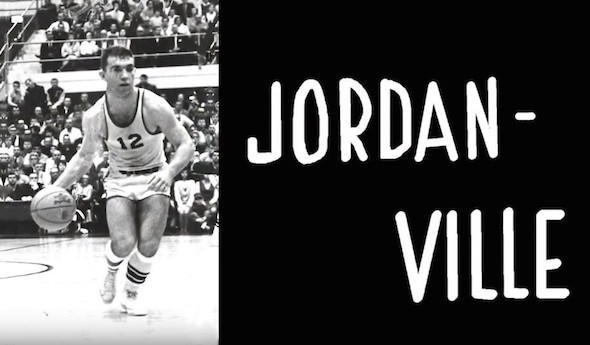
JordanVille, a documentary by John Mooy & Anne Colton, recalls a time when legend spread via word of mouth, newsprint and AM radio.
While it’s hard to comprehend for many today, the exploits of our athletic heroes were formed by “poets in the press box” who sat with pencil and paper, a typewriter, a microphone or a telephone, and described to their audience what they witnessed. On the receiving end, readers and listeners conjured up visualizations based on the facts, phrases and superlatives designed to create an image.
“Traveling left to right on your radio dial” helped listeners feel they were a member of the crowd, seated in the stands, in on the action and a witness to the mayhem. “Packed to the rafters,” reminded fans the importance of what was happening. An exciting game, presented by those with skill, created an event you longed to see. If a broadcast couldn’t be picked up on a transistor or tube radio, the final result might not be known, at the earliest, until the following day’s newspaper arrived.
I’ve told Jordan’s story via the MHSAA before; how he latched on to athletic training, weights and repetition to mold himself into a well-rounded athlete, able to leap to heights unexpected for a kid with a 5-foot-7 frame. The tales of his unfathomable accomplishments slowly leaked beyond the city limits of Fennville into Kalamazoo and greater Southwestern Michigan, then to Detroit. When Detroit Free Press writer Hal Schram relayed Jordan’s feats, the secret traveled across the state and beyond its drawn borders.
From there the legend of Jordan’s accomplishments grew. In Fennville, as in many small towns across the country, the city shut down when a game was played. The Jordan story was so enticing that thousands would travel vast distances to see him play with their own eyes. Today, his single season scoring average of 44.4 points per game during the 1964-65 campaign still remains the top mark in the MHSAA record book.
 JordanVille runs just shy of a half hour. Contained within is insight into the athlete that is challenging to relay in print form. Thanks to access to home movies and a series of interviews with Jordan, former teammates, past opponents and his high school coach, the determination, dedication and drive of a kid who wouldn’t let physical size be a deterrent from achievement radiates from the screen. On display is small town America at its finest, and perspective formed over 50+ years.
For Mooy, it completes a filmmaking journey started six years ago. But the story of Jordan, in his eyes, date back to his school days. Mooy first heard about Jordan as a 7th-grader from a math teacher. A second-team all-St. Joseph Valley League selection, Mooy played at Marcellus High School and scrimmaged against Jordan and the Fennville Blackhawks.
He couldn’t believe his eyes.
“Everyone wanted to see this kid play,” said Mooy in 2011. “He was the first high school player I saw sign an autograph.
Today, with the interviews complete, and the film ready for viewing, Mooy sees more than just a sports story:
“With the benefit of years now passed, I look at the Rich Jordan story with a new respect. JordanVille created a place that was welcoming no matter who you were, or what color your skin happened to be. It was the 1960s. Rich was growing up Jewish, the Civil Rights Movement was in full swing, and the Vietnam War was on everyone's mind. And in Fennville, Michigan, from 1961 to 1965, the Jordan high school years, there were lessons beyond sports being learned by everyone that would last a lifetime. The Jordan household, under the guidance of (his parents) Tuffy and Sylvia Jordan, is where the story begins."
The film speaks of a time that has departed. Competition for our attention was less focused; phones hung on walls or sat on tabletops, communities were tighter, the training table featured peanut butter and chocolate milk instead of protein powder. A city could easily be renamed for a day.
The film also reminds us that those days were far from perfect.
If all goes as planned, the public will see the finished product come the flip of the calendar. In West Michigan, JordanVille is scheduled to show on New Year’s Day at 6 p.m. on WGVU, and will repeat on WGVU-Life at 7:30 p.m., Friday, Jan. 5.
Seek it out, and spread the word, just like in days of old.
 Ron Pesch has taken an active role in researching the history of MHSAA events since 1985 and began writing for MHSAA Finals programs in 1986, adding additional features and "flashbacks" in 1992. He inherited the title of MHSAA historian from the late Dick Kishpaugh following the 1993-94 school year, and resides in Muskegon. Contact him at [email protected] with ideas for historical articles.
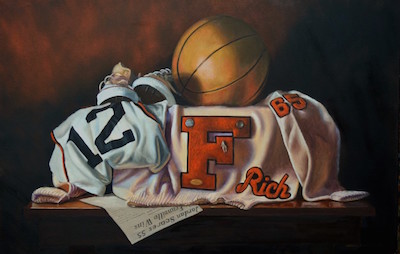
PHOTOS: (Top) Richie Jordan runs Fennville's offense during his thrilling high school career in the 1960s. (Middle) Jordan memorabilia, as captured by Bill Williams.