

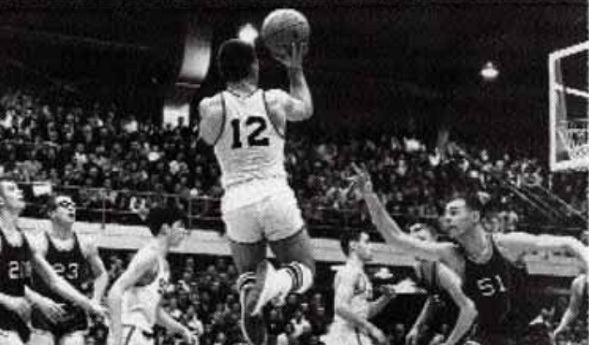
#TBT: 'Fennville Flash' Scores 60
By
Geoff Kimmerly
MHSAA.com senior editor
March 12, 2015
"Jordan shoots. He scores."
This week marks the 50th anniversary of one of the most incredible feats in MHSAA basketball history. On March 11, 1965, Fennville's Richie Jordan scored 60 points in a Class C Regional Final against Bridgman, a point total that remains an MHSAA Tournament record.
The 5-foot-7 "Fennville Flash" became Michigan's fourth inductee into the National Federation of State High School Association's Hall of Fame in 2001. Below is a video compilation or Jordan clips, with audio from that Regional Final, followed by a report from MHSAA historian Ron Pesch written in 2001.
By Ron Pesch
MHSAA historian
Not long ago, I came across an article written by Hal Schram, the legendary prep journalist for the Detroit Free Press. It was penned during the winter of 1977, and Schram had decided to look back at the history of Michigan high school basketball and pick his top 20 high school players from the past quarter century.
“The Swami” had followed the high school circuit since the 1940s. Schram began with a larger list, paring the roster from 44 to 20. The sportswriter went one step further and decided to single out one member of the squad for the ultimate honor – “the greatest of them all.”
As one would expect, final selections included many of the state's most memorable names: Earvin “Magic” Johnson, Dave DeBusschere, Chet Walker, Spencer Haywood, Ralph Simpson, Rudy Tomjanovich, Campy Russell. Their exploits are legendary, and even the most casual fan of basketball could agree they belong on the list.
However, looking back from the millennium, Schram's choice for state's greatest player is stunning.
“The Swami” himself admitted at the time that his No. 1 pick would surprise many. Hal's top pick never played professionally in either the NBA or ABA. That can be overlooked, as the criteria was simple – the state's greatest prep player. But when I state that Schram's selection played ball at a Class C school, that his teams never advanced to the final rounds of the tournament, and that he stood a mere 5-7½ and weighed only 160 pounds in his prime, most basketball fans shake their heads in disbelief.
But those are only physical attributes. Ask Richie Jordan himself.
Schram's pick as the state's greatest high school ballplayer, Jordan will tell you that it doesn't matter what race, religion or how tall you are. He'll state that anything is possible with imagination and hard work.
Many may dispute Swami's selection, but few will debate Jordan's talents as an all- around athlete. A four-sport star at Fennville High School, he earned 16 letters during his prep career. He is considered by many to be the finest student-athlete ever turned out by the state of Michigan.
The family lived in Bangor when Jordan started school. On the playground one day, Richie wandered over to a high jump pit, where the older kids were practicing their leaps during recess. Much to his delight, he was offered the chance to jump by one of the older kids. The bar was lowered, and Jordan took his shot.
“I easily jumped over the bar and the older kids made comments on how easy I jumped. They kept moving the bar up until it was as high as my head. A crowd started to gather and I cleared the bar. The older kids made me feel real special.”
Before he entered the third grade, the Jordan family moved to Fennville, a small town in west Michigan.
“Fennville was a wonderful place to grow up, and I have the best of memories,” recalled Jordan. “We had a group of kids who played together and loved each other from the 3rd grade on.”
Like so many kids, he imagined himself duplicating the feats of his idols. Many have similar dreams, but few worked as hard as Richie to achieve them.
By the time he reached high school, Jordan had evolved into a stellar all-around athlete. His drive to excel worked around the clock. Through the years he accumulated new sports heroes and studied their movements in his mind.
“I was at the 1962 finals game where (Saginaw High School's) Ernie Thompson scored 42 points against Benton Harbor. I went home and worked on my double clutch for days after that. I loved all those guys and respected their talent,” said Jordan, “but I wanted to be better than all of them.”
His hard work paid off with stellar athletic performances. An all-state halfback in football in his junior year, Jordan averaged a whopping 35.6 points in 16 basketball contests and was a unanimous first-team all-state selection at guard in the winter of 1963. In the spring he excelled on the baseball diamond and in track and field.
Jordan continued his rigid regime of weightlifting and working out. Word of his athletic exploits trickled out of Fennville.
In the fall of 1964 he rushed for 1,246 yards on 86 carries, and tallied 25 touchdowns, to cap an outstanding gridiron career. His total of 5,132 career rushing yards was tops in the state at that time, and the mark still ranks in the top 10.
Again, he reaped all-state accolades. But the basketball court was where the Jordan legend was defined.
His vertical jump was phenomenal, and he could dunk with both hands. Scouts reported that he was lightning fast and excellently coordinated. Early in 1965, the Kalamazoo Gazette sent a photographer to Fennville to snap photos of Jordan for a feature article on the Black Hawks' upcoming cage contest in Kalamazoo against Hackett High School. Fennville entered the game with a 3-1 mark, the only mar a 95-93 loss to Saugatuck in which Jordan scored 54 points.
The newspaper printed a shot of Richie dunking the basketball, and the image caught the imagination of many. An overflow crowd packed the 2,200-seat Irish Gymnasium to watch the matchup. Jordan and his teammates trounced the favored Irish 99-73, as Richie scorched the nets for 47 points. In April of his senior year he was named prep All-American by Coach & Athlete magazine, earning the distinction of “smallest” on the squad. “Weep not for him, however,” stated the article, announcing the honor, “as he can dunk the ball, and with his 44.4 season's scoring average, he has scholarship offers from 58 colleges and universities.”
Richie finished out his unbelievable prep career by batting .550 on the baseball field, and by leading his track team to a third-place finish at the state meet.
On May 20, 1965, the city of Fennville honored the prep hero and his teammates for their outstanding athletic careers and their contribution to the community. Jordan spent two years with the Michigan State basketball program, earning a letter in 1967, then walked away from basketball to concentrate on baseball with the Spartans. Following graduation, he landed a contract with the Pittsburgh Pirates, but a shoulder injury ended his pursuit of a major league career.
Today, the “Fennville Flash” is known as “Mr. Jordan” by his students at Cardinal Mooney High School in Sarasota, Fla. A strength and conditioning coach, daily he preaches the merits of weight training and the benefits of hard work to his students.
Married and the father of three, he has enjoyed coaching and watching his children participate and excel in athletics. He cherishes the memories of his youth and the friends he made along the way.
“All my teammates and I felt very special,” said Jordan, now 53, “but we also were very humbled by the admiration we were shown. We all felt an obligation to our community to conduct ourselves in a way that would reflect kindly on our small town.
I'm still very proud that we all understand that.”
Data Dig Continues for Hoops Histories
March 7, 2017
By Ron Pesch
Special for Second Half
There is a list – well actually two – that sit, unfinished, among the “1,001 Projects I’d Like to Complete Before I Die.”
I became the caretaker of these lists back when I inherited the title “Historian for the MHSAA” in 1993.
The original lists contained the scores of all MHSAA Quarterfinal, Semifinal and Final round games for the MHSAA boys and girls basketball tournaments since their origin.
From the 1930s into the late 1960s, the MHSAA tournament game-day program was generally nothing more than a single sheet document, containing tournament brackets and team rosters for the qualifiers.
 In 1969, the program saw a redesign by Lansing sports personality Tim Staudt and premiered at the MHSAA Tournament. Sold for 50 cents, it included a list of “Past Michigan State Champions” containing the names of the winning teams and those schools’ basketball coaches for each of the four classes. The publication also included a couple of articles from Dick Kishpaugh, the author of the champions list. Kishpaugh was identified as “Sports Information Director at Kalamazoo College and … perhaps the most knowledgeable historian on Michigan high school basketball.”
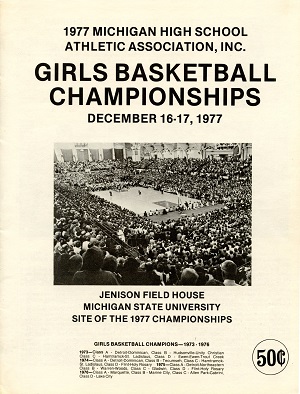
With the start of the Girls Basketball Tournament in 1973, a similar program design was followed.
Those lists were faithfully updated and published in the game-day programs in the same format until the 1987-88 school year, when the souvenir publications were expanded. For the first time, a list containing opponents and final scores of the boys and girls championship games was now available to the general public.
Among the first tasks I chose to approach when I assumed the duties of MHSAA historian was to chase more information.
Since Kishpaugh’s lists had game scores for the three final rounds of the tournament, and names of the championship coaches, I thought I would try to leave my mark. I began chasing down the names of coaches for the runner-up, as well as final win-loss records for both schools. And while I was at it, I decided to see what I could find for teams that made the Quarterfinals and Semifinals.
Hundreds of hours have gone into adding to and maintaining the lists, and much progress has been made. Yet, some 20+ years later, I’m still trying to fill holes in the data.
The Basketball Coaches Association of Michigan helped spread the word, notifying its membership of the project. Web pages were created for both the boys and girls to show teams still missing information.
 The pursuit has led to friendships, and fascinating stories, documents and images. The late Walter Michael, who had attended the MHSAA Finals for more than 60 years, donated a cache of MHSAA tournament programs from the 1940s through the 1960s that filled in the names of many high school coaches. Del Newell, a sports writer from the Kalamazoo Gazette, knocked out most of the Kalamazoo schools early in my search. Bill Khan, then of the Flint Journal sports department, filled in a large number of missing names and records from the Flint area. The recently retired “Son of Swami,” better known as Mick McCabe, contributed by including the win-loss records of the quarterfinalists in his annual tournament prognostication columns for the Detroit Free Press.
Numerous coaches around the state sent e-mails and letters with the names and records for their predecessors. Prep basketball fans and former players sent along offerings. Rob Madsen from Mt. Pleasant became a huge contributor, and sent regular updates to both lists. He focused on some of the state’s smallest schools, including many from the Upper Peninsula.
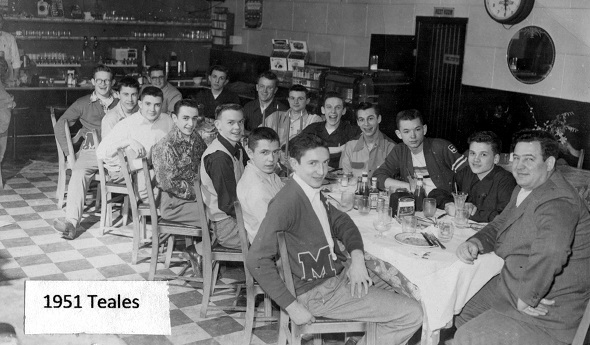
Leon Westover sent the win-loss record for little Marlette, 1951 Class C runner-up, as well as one of my favorite photos from that golden era of prep sports. Marlette had “waltzed through the Mid-Thumb League and district, regional and quarter-final tournament games,” wrote Fred J. Vincent of the Port Huron Times-Herald. Marlette slipped past Stanton 41-37 to advance to the Class C title game against unbeaten Detroit St. Andrew.
“Just one game too many …,” continued Vincent, writing from East Lansing’s Jenison Field House following the title game. “That just about explains the one-sided beating Marlette absorbed in the state class C high school basketball final here Saturday afternoon. The final score was 52-26. … One of the smallest teams, physically, in the tournament, it seemed that the Raiders were just worn out.”
Yet, that night, the team was celebrated like the hometown heroes they really were.
 Westover’s photo shows the Red Raiders on the night of the Final, gathered at Teale’s Restaurant in Marlette. The clock indicates its 11:30. The owner, George Teale, has opened up his restaurant for the team to cook them steaks in honor of their achievement. Coach Nieland "Tommy" Thompson and his 22-2 squad look happy, ready to celebrate a long season.
At tournament time, these lists help answer media requests that arise.
Question: When was the last time two undefeated teams met for an MHSAA Finals championship?
Answer: 2003-Class A for the girls. Detroit Martin Luther King topped Flint Northern 58-53. 1971-Class C for the boys. Shelby downed Stockbridge 71-57.
Question: What coach had the longest span between championship game appearances?
Answer: Eddie Powers, coach of Detroit Northern, went 34 years between his Class A championship team in 1930 and his runner-up squad in 1964. The mark is asterisked, however, as the Detroit Public School League chose to stop participation in the annual state tournament from 1931 through 1961. Saginaw’s Larry Laeding went 20 years between winning the 1942 Class A championship and his squad’s 1962 Class A title. Maple City Glen Lake coach Don Miller went 19 seasons between the school’s 1977 Class D title and its 1996 runner-up finish, also in Class D.
For the girls, both Mary Cicerone at Bloomfield Hills Marian and Carl Wayer at Ashley went 16 seasons between appearances. While Cicerone’s Marian teams have made seven visits to the Finals and have won six Class A titles, 16 years elapsed between Marian’s 1998 and 2014 Class A championships. Marian then captured a second consecutive title in 2015. Coach Wayer advance two teams to the title game. Ashley finished as runner-up in Class D in 1980 and again in Class D in 1996. The loss in 1996 came in overtime, and was the only defeat for Ashley that season.
Michigan’s high school basketball tournaments are an experience shared, mostly unchanged, since their beginnings. At the end of the regular season, everyone qualifies for the madness. Yet in the end, only four teams finish as champions. The path mimics the magical trail taken by fathers, grandfathers and great grandfathers, mothers and grandmothers. Qualifying for the Quarterfinals is still a huge triumph, as the round brings together only 32 teams from a field of more than 700 boys teams and more than 650 girls teams.
In my eyes, these lists emphasize that remarkable, undiluted achievement. In a world consumed with trophies and the number “1,” perhaps it is time to step back and celebrate this rare journey.
Click for Ron Pesch's data "Needs Lists" for girls basketball and boys basketball.
 Ron Pesch has taken an active role in researching the history of MHSAA events since 1985 and began writing for MHSAA Finals programs in 1986, adding additional features and "flashbacks" in 1992. He inherited the title of MHSAA historian from the late Dick Kishpaugh following the 1993-94 school year, and resides in Muskegon. Contact him at [email protected] with ideas for historical articles.
PHOTOS: (Top) Marlette's 1951 boys basketball team gathers for dinner at a local restaurant after the Class C Final. (Middle top) The 1969 Boys Finals saw the addition of updated tournament programs. (Middle below) The 1977 Girls Finals program told of the teams that would meet at Jenison Field House. (Below) The 1947 Boys Finals program was among many that helped fill in data gaps from the early years of the tournament. (Photos provided by Ron Pesch.)