

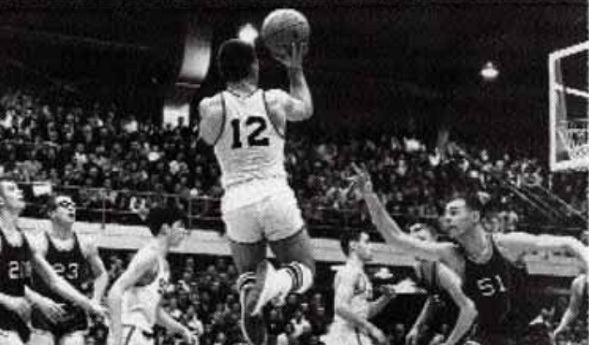
#TBT: 'Fennville Flash' Scores 60
By
Geoff Kimmerly
MHSAA.com senior editor
March 12, 2015
"Jordan shoots. He scores."
This week marks the 50th anniversary of one of the most incredible feats in MHSAA basketball history. On March 11, 1965, Fennville's Richie Jordan scored 60 points in a Class C Regional Final against Bridgman, a point total that remains an MHSAA Tournament record.
The 5-foot-7 "Fennville Flash" became Michigan's fourth inductee into the National Federation of State High School Association's Hall of Fame in 2001. Below is a video compilation or Jordan clips, with audio from that Regional Final, followed by a report from MHSAA historian Ron Pesch written in 2001.
By Ron Pesch
MHSAA historian
Not long ago, I came across an article written by Hal Schram, the legendary prep journalist for the Detroit Free Press. It was penned during the winter of 1977, and Schram had decided to look back at the history of Michigan high school basketball and pick his top 20 high school players from the past quarter century.
“The Swami” had followed the high school circuit since the 1940s. Schram began with a larger list, paring the roster from 44 to 20. The sportswriter went one step further and decided to single out one member of the squad for the ultimate honor – “the greatest of them all.”
As one would expect, final selections included many of the state's most memorable names: Earvin “Magic” Johnson, Dave DeBusschere, Chet Walker, Spencer Haywood, Ralph Simpson, Rudy Tomjanovich, Campy Russell. Their exploits are legendary, and even the most casual fan of basketball could agree they belong on the list.
However, looking back from the millennium, Schram's choice for state's greatest player is stunning.
“The Swami” himself admitted at the time that his No. 1 pick would surprise many. Hal's top pick never played professionally in either the NBA or ABA. That can be overlooked, as the criteria was simple – the state's greatest prep player. But when I state that Schram's selection played ball at a Class C school, that his teams never advanced to the final rounds of the tournament, and that he stood a mere 5-7½ and weighed only 160 pounds in his prime, most basketball fans shake their heads in disbelief.
But those are only physical attributes. Ask Richie Jordan himself.
Schram's pick as the state's greatest high school ballplayer, Jordan will tell you that it doesn't matter what race, religion or how tall you are. He'll state that anything is possible with imagination and hard work.
Many may dispute Swami's selection, but few will debate Jordan's talents as an all- around athlete. A four-sport star at Fennville High School, he earned 16 letters during his prep career. He is considered by many to be the finest student-athlete ever turned out by the state of Michigan.
The family lived in Bangor when Jordan started school. On the playground one day, Richie wandered over to a high jump pit, where the older kids were practicing their leaps during recess. Much to his delight, he was offered the chance to jump by one of the older kids. The bar was lowered, and Jordan took his shot.
“I easily jumped over the bar and the older kids made comments on how easy I jumped. They kept moving the bar up until it was as high as my head. A crowd started to gather and I cleared the bar. The older kids made me feel real special.”
Before he entered the third grade, the Jordan family moved to Fennville, a small town in west Michigan.
“Fennville was a wonderful place to grow up, and I have the best of memories,” recalled Jordan. “We had a group of kids who played together and loved each other from the 3rd grade on.”
Like so many kids, he imagined himself duplicating the feats of his idols. Many have similar dreams, but few worked as hard as Richie to achieve them.
By the time he reached high school, Jordan had evolved into a stellar all-around athlete. His drive to excel worked around the clock. Through the years he accumulated new sports heroes and studied their movements in his mind.
“I was at the 1962 finals game where (Saginaw High School's) Ernie Thompson scored 42 points against Benton Harbor. I went home and worked on my double clutch for days after that. I loved all those guys and respected their talent,” said Jordan, “but I wanted to be better than all of them.”
His hard work paid off with stellar athletic performances. An all-state halfback in football in his junior year, Jordan averaged a whopping 35.6 points in 16 basketball contests and was a unanimous first-team all-state selection at guard in the winter of 1963. In the spring he excelled on the baseball diamond and in track and field.
Jordan continued his rigid regime of weightlifting and working out. Word of his athletic exploits trickled out of Fennville.
In the fall of 1964 he rushed for 1,246 yards on 86 carries, and tallied 25 touchdowns, to cap an outstanding gridiron career. His total of 5,132 career rushing yards was tops in the state at that time, and the mark still ranks in the top 10.
Again, he reaped all-state accolades. But the basketball court was where the Jordan legend was defined.
His vertical jump was phenomenal, and he could dunk with both hands. Scouts reported that he was lightning fast and excellently coordinated. Early in 1965, the Kalamazoo Gazette sent a photographer to Fennville to snap photos of Jordan for a feature article on the Black Hawks' upcoming cage contest in Kalamazoo against Hackett High School. Fennville entered the game with a 3-1 mark, the only mar a 95-93 loss to Saugatuck in which Jordan scored 54 points.
The newspaper printed a shot of Richie dunking the basketball, and the image caught the imagination of many. An overflow crowd packed the 2,200-seat Irish Gymnasium to watch the matchup. Jordan and his teammates trounced the favored Irish 99-73, as Richie scorched the nets for 47 points. In April of his senior year he was named prep All-American by Coach & Athlete magazine, earning the distinction of “smallest” on the squad. “Weep not for him, however,” stated the article, announcing the honor, “as he can dunk the ball, and with his 44.4 season's scoring average, he has scholarship offers from 58 colleges and universities.”
Richie finished out his unbelievable prep career by batting .550 on the baseball field, and by leading his track team to a third-place finish at the state meet.
On May 20, 1965, the city of Fennville honored the prep hero and his teammates for their outstanding athletic careers and their contribution to the community. Jordan spent two years with the Michigan State basketball program, earning a letter in 1967, then walked away from basketball to concentrate on baseball with the Spartans. Following graduation, he landed a contract with the Pittsburgh Pirates, but a shoulder injury ended his pursuit of a major league career.
Today, the “Fennville Flash” is known as “Mr. Jordan” by his students at Cardinal Mooney High School in Sarasota, Fla. A strength and conditioning coach, daily he preaches the merits of weight training and the benefits of hard work to his students.
Married and the father of three, he has enjoyed coaching and watching his children participate and excel in athletics. He cherishes the memories of his youth and the friends he made along the way.
“All my teammates and I felt very special,” said Jordan, now 53, “but we also were very humbled by the admiration we were shown. We all felt an obligation to our community to conduct ourselves in a way that would reflect kindly on our small town.
I'm still very proud that we all understand that.”
Erik O, Legend on the Microphone
By
Geoff Kimmerly
MHSAA.com senior editor
March 21, 2013
One of Erik O. Furseth’s favorite moments every March – perhaps the one he looks forward to most – comes during the hour before each MHSAA Basketball Semifinal.
From his familiar seat on press row, Furseth has called hundreds of Michigan State University and MHSAA Finals basketball games.
But the opportunity for high school teams to play at Breslin Center is not lost on him, especially as he watches players and fans enter the arena for the first time.
“(It’s) the kind of awe that overtakes people when they come there,” Furseth explained earlier this month. “The enthusiasm reflected on the kids there and so on.
“What a thrill for those kids to come and play a ballgame there.”
Now imagine Furseth saying this with the voice that’s become legendary to generations of basketball fans across this state.
Furseth, 82, has been a member of the MSU basketball family for more than 60 years. A player first, he since served as the homecourt voice of MSU basketball from 1968-02 and MSU football from 1971-98, and this weekend is continuing a run of calling MHSAA Boys Basketball Finals that began more than four decades ago while those games still were played at Jenison Field House.
Some of his phrases are on ready recall for those who have sat in his audience.
“The clock is correct and official.”
“Yesssss … on the basket!”
“Heeeee gets the bonus.”
Last weekend, Furseth also called his sixth MHSAA Girls Basketball Finals, and he’s announced MHSAA football championship games since their days at the Pontiac Silverdome and Baseball Finals for a decade. Furseth also just finished his third season as voice of Traverse City St. Francis football and girls and boys basketball.
“Erik is able to make that job not just a game, but an event,” St. Francis athletic director Tom Hardy said. “To have somebody of his caliber, with his recognition, in a small gym in Traverse City … whether there are 100 people or it's standing room only, it’s so great to know the professionalism of that is taken care of. He just understands kids.”
Furseth moved from East Lansing to Traverse City 18 years ago. That he would find his way to the microphone in his new hometown makes sense. But that it became the tool of his trade the last half-century certainly would be considered a detour from his original plan when Furseth turned down a chance to play football for Woody Hayes so he could study forestry in East Lansing.
Life-changing moments
“Erik O. on the radio” was the voice of Lansing rock-n-roll radio during the 1950s and 60s.
“He was the number one disc jockey in this area before they were called disc jockeys,” said Lansing WILX sports director Tim Staudt, who grew up in East Lansing and has worked in mid-Michigan television for four decades and as a daily radio host for 20 years.
“He has the all-time greatest voice, and obviously it's held up to this day.”
Furseth grew up in Cleveland Heights, Ohio, and got to know Hayes while the soon-to-be-legendary coach was finishing his tenure at Denison University. Hayes hoped Furseth, a high school football standout, would become part of the coach’s first recruiting class after taking the job at Miami (Ohio) before the 1949 season.
But Furseth, who had vacationed in Michigan growing up, was drawn to MSU’s forestry program. So he made a trip to campus – picked up by then-assistant Duffy Daugherty for a visit with head coach Biggie Munn – and was sold on coming to East Lansing instead.
It didn’t take long for his future to turn in an unplanned direction.
Furseth was injured his first fall with the Spartans, and he never played a down of college football. But at that time, MSU sent all freshmen who had played high school basketball a card encouraging them to try out for the Spartans’ freshman hoops team. Furseth, also a 6-foot-3 post player in high school, not only made that MSU team but played three seasons on the varsity under another future coaching legend – Pete Newell, who would go on to lead teams to NCAA and Olympic championships. Furseth played in MSU’s first Big Ten game, against Northwestern in 1951.
 It was during sophomore year that Furseth’s academic future also changed lanes. Forestry students were required to take a soil science class offered only during the winter and from 3-5 p.m. – a conflict with Furseth’s basketball commitments. He dropped the class, dropped the major, and as a junior switched course of study to communications.
MSU basketball’s announcer at that time, Larry Friedmeyer, was among a few who took note of Furseth’s deep and authoritative tone, and suggested he audition for the campus’ WKAR radio station. Furseth was hired at 75 cents an hour to host a few nights each week of “The Concert Call,” a classical music program, and later that year joined local station WILS to read the evening news. After serving in the Air Force, Furseth returned to WILS – and a star was born.
Furseth was a DJ for WILS for 14 years. On Saturdays for a decade, he hosted dances at the Lansing Civic Center that drew 1,000 teenagers a night – and one evening, included a surprise drum performance by a famous student at the local Michigan School for the Blind, known then as Little Stevie Wonder.
Furseth later managed WILS from 1956-68. “Being the manager made it no fun anymore,” Furseth noted.
He left for a job outside of radio. But the fun returned when his announcing career began.
Erik O on the microphone
The “O,” by the way, stands for Olaf. Furseth’s parents are from Norway. “Erik O” was a smooth radio name early in his career when he was filling in for mentor Dave Froh – “Erik O for Dave Froh” – so it stuck.
In his role at a basketball game, Erik O admittedly doesn’t see much of it – at least, as a fan might. He can say his top three MSU players during his time as announcer were Scott Skiles, Magic Johnson and Johnny Green. But for the most part, Furseth focuses on the factual information he must supply with every substitution, foul and break.
He found that winning formula long ago.
“He’s just a nice guy – and nice guys don’t usually last on the air as long,” said Lansing sports radio personality Earle Robinson, who recently retired after 39 years at WKAR. “He’s always had good relationships and such a pleasant personality.”
“You’d never know he was a basketball player or anything. He’s very free of any ego, very helpful to people and generous of his time,” said longtime MSU men’s basketball broadcaster Gus Ganakas, who formerly coached the Spartans from 1969-76 and was an assistant on Furseth’s freshman team.
“And particularly in basketball, he knew what he was doing. He’s a former player and has a background as an athlete, and he has a pleasing voice. I’ve always admired him because of his devotion to what he’s doing.”
High school sports are high on that list.
Furseth enjoys announcing the seventh and eighth grade football teams that play at Traverse City’s Thurlby Field – “They think they’re big time,” he said – and finds it incredible how much the high school teams can improve over the course of a season.
He relishes the camaraderie he sees at Class C St. Francis, and wishes he’d attended a similarly-small school himself. To a player who was wearing his former number, he said, “You’re wearing my number. Do it right.” And the St. Francis boys basketball team felt at home at Breslin Center in 2012, when it finished runner-up to Flint Beecher while a familiar voice called the action.
Furseth recalled earlier this month. “Really, for me, high school (sports) exemplifies the development of our kids athletically and in many other ways. You learn a lot of things in athletics.”
“When I think about my life, to think something I started led to doing this; I’m thrilled that it happened,” Furseth said of returning to another Finals. “It’s always been a great thrill for me to do it.”
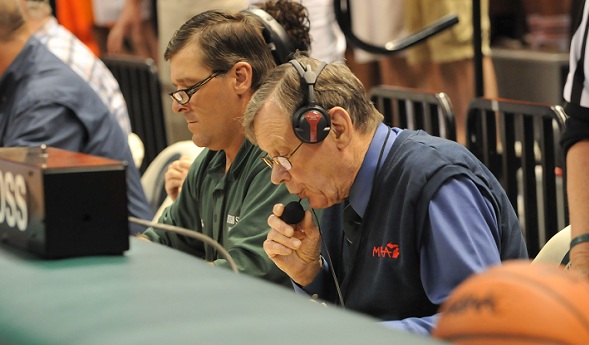
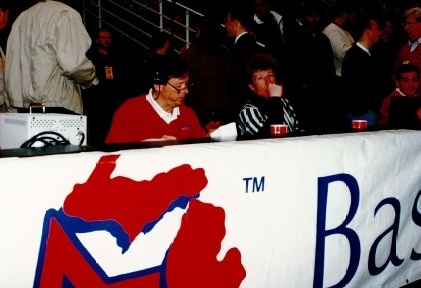
PHOTOS: (Top) Erik O. Furseth calls the Saginaw/Rockford Class A Boys Basketball Final last season at Breslin Center. (Middle) Furseth prepares to call another game during the 1999 Boys Finals weekend at Breslin.