

#TBT: Sticks’ Record 50 Still Stands
April 10, 2014
By Geoff Kimmerly
Second Half editor
Last month marked the 58th anniversary of the longest-standing individual record in MHSAA Basketball Finals history.
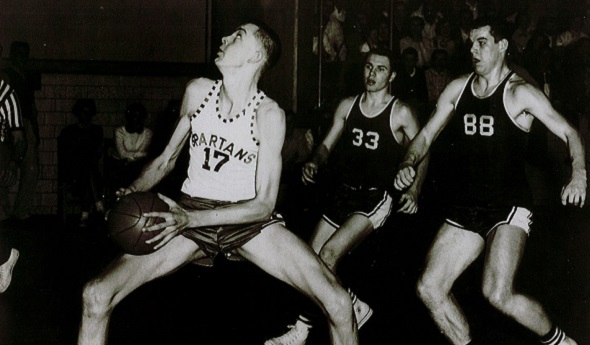
In 1956, Battle Creek Lakeview center Bob “Sticks” Bolton scored 50 points in a Quarterfinal against Kalamazoo State High School. His points remain the most scored during the final round of the tournament – Quarterfinal-Semifinal-Final.
What follows are edited excerpts from a piece in the MHSAA archives written by former Battle Creek Enquirer reporter Allen Palmeri:
The date was March 21, 1956, and seating capacity in the Hastings High School gymnasium had been expanded to 2,000 this Wednesday night in anticipation of a marvelous Class B Quarterfinal basketball game between two sizzling teams.
New bleachers beckoned behind both goals as Battle Creek Lakeview, 18-2 with a 16-game winning streak, prepared to battle Kalamazoo State High, 19-2 with a 17-game winning streak.
The bleachers weren’t sufficient. About 2,500 fans were able to shoehorn their way in, ringing the court and leaving others in the school’s hallways and out on the sidewalk as one of the most spectacular individual efforts in MHSAA Boys Basketball Tournament history was about to unfold.
In one corner was Lakeview center Bob “Sticks” Bolton, a 6-9 rod of fury. In the other corner was State High’s mountain range of a front line, with peaks standing 6-6, 6-6 and 6-5.
“We looked forward to the game with quite confidence, because we really respected them for the tremendous team they had,” Bolton recalled in 1996. “We knew it was going to be a battle royale because of their size.”
The game within a game of one-on-three was no contest as Bolton simply pulverized the peaks. He poured in 50 points in a 90-73 Lakeview victory, setting a final round record for single game scoring that has withstood decades of assaults by the likes of Ralph Simpson, Spencer Haywood, Earvin Johnson, Jay and Sam Vincent, Antoine Joubert, Jay Smith, Mark Brown and Chris Webber.
***
(He scored) 12, 20, 10 and 8 points through four quarters against State High. He was particularly impressive in the second quarter, when he wound up scoring 20 of his team’s 21 points. Overall, he sank 17 of 27 shots from the field and 16 of 20 from the free throw line.
Though State High took the brunt of Bolton’s blows during the tournament, his effort throughout Lakeview’s run was just as spectacular. ... When Marshall tried to stall away the district opener, Bolton had to settle for 18 points in 40-20 victory. In an 80-58 win over Albion for the district championship, he punched in with a 34-point effort.
In carrying Lakeview to its first regional title, Bolton went ballistic, pumping in 42 points against Three Rivers and a school-record 46 points against an East Lansing team coached by Gus Ganakas. He then went out and topped that in the quarterfinal.
In the semifinals two days later, Bolton was whistled to the sideline with 25 points with a little over half the game played, fouling out in a 74-69 loss to eventual champion Stephenson. Opposing center Mel Peterson, who went on to play for Wheaton College and the NBA’s Baltimore Bullets, had scored 21 points when Bolton fouled out.
Though the memory of that game is painful, he fondly recalls his five-game scoring spree as “lifting my game to a higher level as the competition got tougher and tougher. Praise the Lord for that!”
***
Bolton went on to play collegiately at Western Michigan University, where he cracked the 1,000-point barrier, set a school rebounding record and outscored future NBA Hall of Famer Nate Thurmond on two of three occasions. After his college career, in a semi-pro championship game, he managed to outplay another Hall of Fame center, Walt Bellamy.
But his passion for basketball was never the same after high school. His dedication, vigor and enthusiasm gradually shifted towards the ministry.
At the time of this writing, Bolton served in Marquette, as pastor and administrator of Bethesda Baptist Church and Bethesda Baptist School. He died in 2008.
PHOTO: Bob "Sticks" Bolton dropped 46 points on East Lansing in a 1956 Class A Regional championship game. He followed that with a record 50 points in the Quarterfinal.
A Year Older, Buckley Sets Aspirations High
December 15, 2016
By Dennis Chase
Special for Second Half
BUCKLEY – The Buckley Bears are hoping pizza parties become a regular occurrence this winter.
 As an incentive to improve defensively, Buckley basketball coach Blair Moss is rewarding his players with pizza parties if they can hold opponents under 40 points.
Through three games, all impressive wins, the Bears have earned one party, beating McBain Northern Michigan Christian 86-39 last Thursday.
“He (Moss) knows we can put up points in a hurry,” junior standout Denver Cade said, “but he wants to see us lock down the other team.”
So far, added emphasis on the team’s man-to-man defense seems to be working. The up-tempo Bears are averaging 92 points offensively, and surrendering 49.
“I know we can score,” Moss said. “That’s not the problem. The problem is locking it down on defense. On nights we’re not making our shots, we’re going to need to have stops (on defense). Since summer, that’s what I’ve been preaching. We’ve talked about it and worked hard on it.”
Focusing on that facet of the game is a priority because Buckley has high aspirations after making a run to the MHSAA Class D Regional Finals last March with a lineup comprised of four sophomores and a freshman. The Bears nearly won the Regional, taking Bellaire to the wire – the teams were tied at 55 with just over a minute to go – before losing 61-57.
“We were young and, as a coach, you wonder how your players are going to handle that kind of pressure,” Moss said. “We threw the ball away in the last couple minutes and that really hurt us. That’s being young. But I think we’ve learned from that.”
That loss became a motivator for the Bears.
“We used it as fuel,” junior Austin Harris said. “We started working even harder after that.”
In the months that followed, players hit the weight room and were in the gym as often as possible. Three starters were heavily involved with AAU. In addition, Moss set up a busy summer schedule that had the Bears traveling all over the state. They competed in scrimmages at Northwood University, Central Michigan University, Ferris State University, as well as local gyms, including Cadillac, where they saw two of the north’s best teams in McBain and Manton. All told, Buckley played nearly 40 games, almost all against larger schools.
“Playing that type of competition has helped prepare us for what’s ahead,” Cade said.
The 6-foot-3 Cade is listed as one of the top 100 players in the state by the Detroit Free Press. He’s off to a solid start, averaging 26 points and eight rebounds a game.
“He’s a winner,” Moss said. “He’s my general on the floor.”
The 6-foot-3 Harris is talented as well. He’s averaging 18 points, eight rebounds and eight assists. He registered a triple-double in Tuesday’s 100-59 win over Suttons Bay. Harris plays on the wing, but also moves to the point on occasion. Moss would like to play him strictly on the wing to increase his scoring opportunities and balance the floor with Cade on the opposite wing.
Cade and Harris are joined in the lineup by juniors Joey Weber and Brock Beeman and sophomore Ridge Beeman. Weber, who also plays the point, and Ridge Beeman average 11 points; Brock Beeman averages nine per game.
 All four juniors were on varsity as freshmen.
“You might get one of these groups every 10 years or so,” Moss said. “You’re just so thankful. They’re all so coachable – and they’re just as good in the classroom as they are on the court. They’ve been playing together since they could walk. They’re in the gym all the time. Their basketball IQ is very high.
“How many coaches start four freshmen at the high school level? I knew we were going to take our lumps that year. We were not very physical, but I knew we were talented enough that we could be in every game.”
The Bears finished 11-11 in 2014-15 and improved to 16-7 a year ago. They now have their sights set higher, starting with winning the Northwest Conference.
“It’s not going to be easy,” Cade warned.
Frankfort, heading into Thursday night’s game, has won 26 league games in a row and returns two top players in juniors Jaylon Rogers and Matt Loney. Glen Lake - bolstered by Lake City transfer Cade Peterson, the quarterback on the Lakers’ MHSAA Finals football team – is 2-0 and seems primed for a breakout campaign. And then there’s Benzie Central, which has given Buckley fits in recent seasons.
“This is the toughest I’ve seen this league,” Frankfort coach Reggie Manville said. “And what’s really scary is that all those teams at the top of the league have most of their starters coming back next season.”
Moss previously coached the Benzie Central varsity for seven seasons. After stepping down, he took two years off from coaching and then re-emerged at Buckley. He’s now in his fourth season.
“I still had that drive, that urge to coach,” he said. “I missed working with kids. I missed the camaraderie with the coaches.”
Todd Kulawiak, the elementary school principal at Buckley, reached out to Moss. The two have a connection – they were former standouts at Benzie under coach Will Lynch and are the two all-time leading scorers in school history. Kulawiak was also an all-state distance runner under Blair’s father, Pete.
Although the Bears struggled the first couple years under Moss, the coach could see what he had coming. Now he’s pushing that group, and himself, so they can reach their potential.
“We’re very capable if we keep focused, keep our heads on straight and keep working hard,” he said.
That drive to improve was a major reason he put together such an aggressive schedule in the summer. He wanted his team to face quality competition, and he was pleased with the results.
“It seemed like we were getting better all the time,” he said.
As an offshoot, Moss also wanted to get his players exposure, especially in camps at college venues.
“They deserve it,” he said. “I want (college coaches) to see our kids. It’s like I told Denver’s father, ‘You’re talking $100,000 for a college education. If he puts the time in now, bingo.’”
Buckley is not particularly big – “We’re mostly a five-guard lineup,” Cade said – so the Bears like to use their athleticism and push tempo.
“With Coach Moss, it’s go, go, go,” Cade said. “If the (MHSAA) had a shot clock, we would be one of the teams that would benefit from it the most because we find a way to get quick, quality shots.”
Opposing coaches have noticed.
“They’re extremely good shooters from the perimeter, and that sets up their offense,” Manville said. “You have to defend that shot. Now, they’re all starting to penetrate to the basket and dish, which makes them more difficult to guard. And if you want to help defend, you’ve got a problem.
“The other problem is they run. They want to score a lot of points. They scored 100 points Tuesday night. Scoring 100 is difficult nowadays. They must have been really efficient. And they’re getting better defensively. I know that’s something they’re working on.”
If Buckley needs size, the Bears can turn to 6-5 Nick Kuhn, who is still developing his game. He had eight points off the bench in a season-opening 91-50 win over Bear Lake.
Buckley’s ability to score, combined with its game experience and chemistry, gives the Bears a good base. But there’s another strength that’s just as important to the team’s success, Harris said.
“Our team has a lot of heart,” he said. “We play really, really hard.”
So now the goal is to play off those strengths while continuing to work on other aspects, like defense. It could make the difference in winning a league title and advancing along the March Madness tournament trail.
“Everybody at that next level can score,” Harris said. “It really comes down to who can play defense.”
 Dennis Chase worked 32 years as a sportswriter at the Traverse City Record-Eagle, including as sports editor from 2000-14. He can be reached at [email protected] with story ideas for Manistee, Wexford, Missaukee, Roscommon, Ogemaw, Iosco, Alcona, Oscoda, Crawford, Kalkaska, Grand Traverse, Benzie, Leelanau, Antrim, Otsego, Montmorency, Alpena, Presque Isle, Cheboygan, Charlevoix and Emmet counties.
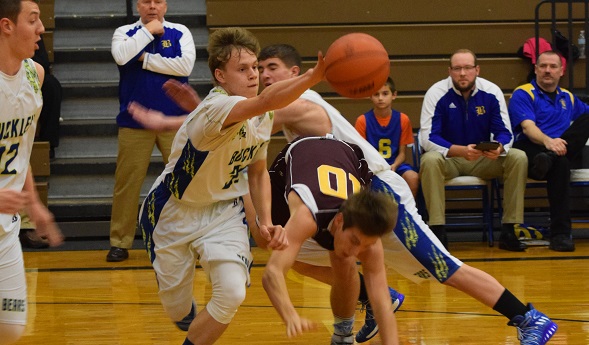
PHOTOS: (Top) Buckley’s Ridge Beeman (30) works to gather a loose ball against McBain Northern Michigan Christian on Dec. 8. (Middle) Joey Weber (5) blocks off a driving Bobcats player during the 86-39 win. (Photos courtesy of the Buckley athletic department.)