

Team-First Comets Charting Perfect Path
By
Wes Morgan
Special for MHSAA.com
February 6, 2018
When Coloma varsity boys basketball coach Paul Marfia was asked to dissect the Comets’ undefeated season up to this point, he said the bruises his players consider badges of honor tell most of the story.
 The Comets, who are tied for 9th in The Associated Press’ Class B state rankings, may not be the most athletic or talented team on the west side of the state. But their tenacity, toughness, heart and unselfishness have propelled them to a 13-0 overall record and 8-0 mark in the Southwestern Athletic Conference’s Lakeshore division.
The program hasn’t won a conference championship since 2004 and now is positioned end that drought, having already pulled off confidence-fortifying wins over SAC Valley powers Kalamazoo Christian (12-1) and Kalamazoo Hackett Catholic Prep (12-2) after trailing the latter by as many as 16 in the third quarter.
This winter has been the culmination of five years of Marfia preaching that, in the words of Aristotle, the whole is greater than the sum of its parts. Of course, junior point guard Zach Goodline, who’s averaging 27 points per game this year and adding to the program’s career points record with every bucket, plays a particularly big part for the Comets.
“We know if we don’t play the way we should play, we can take a loss,” Goodline said. “But it’s nice finally winning a bunch of games.”
As do a host of others, including a core group of seven seniors, some of whom were on varsity in 2015-16 and experienced a five-win season. They endured some hard knocks.
“It’s a process; I’m an Italian and I grew up as a farmer. I know things take time, and it’s not done in a day,” said Marfia, who experienced a 13-9 first campaign at Coloma in 2013-14 with a solid senior class, though he started from scratch in Year 2. “I was actually finding kids in the hallway. ‘Hey, I heard you used to play in the seventh grade. Why don’t you be my power forward?’
“There wasn’t a culture there. In the past it was there. But it’s been a long time since then. There was a big dip because of the culture and understanding what it means to play basketball the right way and understanding what that commitment is. It’s starting to go in the right direction, and this group of seniors are the ones that are committed to that.”
It was only a couple years ago the Comets were hopelessly lost on the defensive end, sometimes showing as many as six different looks in a game in a desperate effort to find something effective.
 Now Coloma sticks mostly to man-to-man and the basic principles of “attitude and effort,” holding opponents under 47 points per game.
Four-year varsity player Levi Wilkens is certainly committed, and he’s going to make sure everyone in a Coloma jersey is as well. Wilkens was asked to shoot less last year and focus on leading the team defensively. It took him a while to accept that role, he said, and now he revels in it.
“I think I’ve matured a lot more,” Wilkens said. “We’re going chapter by chapter. We’re on chapter 13. We don’t look ahead, and we focus on each team.”
“It’s awesome to see,” Marfia said. “Here’s a kid who was all-conference and only averaged 2.5 points per game. Levi is a kid who’s been a captain, a point guard and a defensive kid. I’ve never seen a kid score zero points in a game and yet control a game as much as he does.”
Just a few hours after being interviewed for this story, Wilkens left Monday’s game at Niles Brandywine in the first quarter with a broken nose and a gash that required 16 stitches.
“He’s a tough kid,” Marfia said of Wilkens after the Comets held on for a 73-65 victory. “He had a face for radio anyways. He’ll be back tougher and uglier than ever. He understands that’s what separates us from the other team.”
Seven players have scored in double figures this year for Coloma, proving they’re just as unrelenting on the offensive end of the floor. Goodline fouled out with a minute left against Brandywine after scoring 19 points. Junior forward Phillip Caldwell shouldered a bigger load and finished with a career-high 27. Prior to the contest, Caldwell was averaging eight points per game.
Sophomore forward Michael Dancer worked his way into the starting rotation and produced 72 rebounds, 15 blocks and 5.5 points per game prior to the matchup with Brandywine. Senior Robbie Schroeder is the team’s center and is averaging just a hair under 10 points per game with a disruptive presence on the defensive side.
“We’re focusing on the big goal and working toward one thing,” Schroeder said. “We’re not all good scorers like Zach, so we realize if we want to win, we have to do our part on the defensive end. That’s what we believe in.”
Senior Chris Brown has been an invaluable sixth man for the Comets, and fellow classmates Tevon Blazier, Brendan Lute, Willie Donald and Adam Hearn have helped reshape the culture.
“It’s been a long journey,” Hearn said. “I’ve been playing with some of these kids since third or fourth grade and have seen everybody grow. Coming together as one and being a solid team is amazing.”
“You have to have kids that understand what it means to be part of a team,” Marfia said. “I see that in these kids. They play the way you want them to.”
 Wes Morgan has reported for the Kalamazoo Gazette, ESPN and ESPNChicago.com, 247Sports and Blue & Gold Illustrated over the last 12 years and is the publisher of JoeInsider.com. He can be reached at [email protected] with story ideas for Berrien, Cass, St. Joseph and Branch counties.
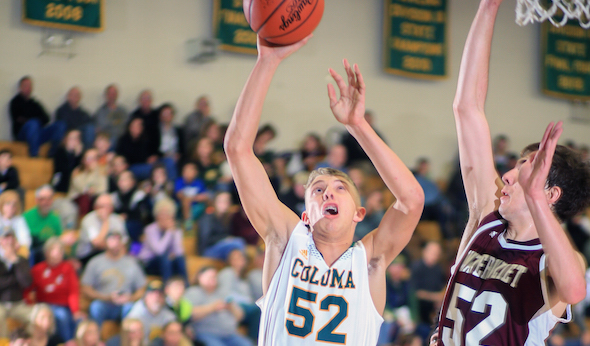
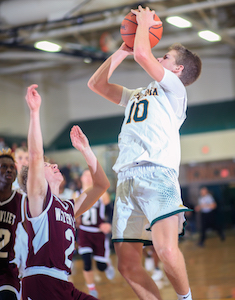
PHOTOS: (Top) Coloma's Robbie Schroeder puts up a shot in the post against Watervliet. (Middle) Leading scorer Zach Goodline elevates for a jumper for the Comets. (Photos courtesy of the Coloma athletic department.)
Clarkston Earns 1st Shot at Dream Finish
March 24, 2017
By Geoff Kimmerly
Second Half editor
EAST LANSING – Dan Fife dreamed of playing for an MHSAA basketball championship at Jenison Field House while a student at Clarkston 50 years ago.
Thursday afternoon, the current Wolves made similar dreams come true – and offered their coach that opportunity he never was able to achieve as a player.
Clarkston’s 78-35 win over league rival West Bloomfield in Friday’s first Class A Semifinal earned the program its first appearance in an MHSAA boys basketball championship game.
The Wolves have had piles of success under Fife, the fourth winningest coach in state hoops history with 676 wins since taking over the program before the 1982-83 season. He’s led Clarkston to 30 District and 12 Regional titles, with Friday’s Semifinal the second during his tenure.
“Coach Fife, I don’t think he’ll admit how much it means to him. But it’s everyone’s goal at the beginning of every season; your ultimate goal is to finish out with a win,” Clarkston junior guard Foster Loyer said. “For Coach Fife, and the community of Clarkston, that would just mean the world to all of us, just motivate us to keep working even more.”
Clarkston (26-1), which entered the postseason tied for No. 3 in The Associated Press’ final regular-season Class A poll, will finish this season against Grand Rapids Christian at noon Saturday at the Breslin Center.
The Semifinal was the third ever in Wolves history. And the rare opportunity to advance to Saturday came with an even rarer opportunity to face a familiar opponent in this late round of the tournament.
Clarkston had beaten West Bloomfield (17-9) by 11 and seven during the regular season on the way to winning the Oakland Activities Association Red championship; the Lakers tied for third in the league.
And they knew what to expect from Loyer, a junior already committed to play at Michigan State. But it didn’t help much this time.
 Loyer’s first shot of the game, an attempted layup, sailed over the rim. His second shot, a 3-pointer, touched nothing but net.
Making 10 of 17 shots from the floor and 5 of 8 3-pointers, Loyer finished with 32 points, to go with seven assists. Senior forward Dylan Alderson added 27 points, and sophomore center Taylor Currie had 10 points and 16 rebounds as Clarkston hit 57 percent of its shots from the floor – including an incredible 69 percent during a first quarter that ended with the Wolves carrying a 24-13 lead.
Clarkston took an 18-point advantage into halftime.
Senior guard Kevin McAdoo led the Lakers with 22 points, but as a team they made only 22 percent of their shots from the floor, and had just one steal as Clarkston had only four turnovers but 17 assists.
“It’s a tough one to swallow today, especially with the ride we were on to get here,” said seventh-year West Bloomfield coach Jeremy Denha. “What a fun, fun time to get here with the ups and downs and the way the kids battled. We hadn’t sniffed a District Final, let alone a District title, since I’d been here – we hadn’t won one since 2003. For us to make this magical run, get to Breslin, play Clarkston a third time … yeah, the outcome is disappointing, but it’s about the journey too.”
Fife has been on a lot of these trips. So he'd likely quickly agree with his OAA colleague. And especially with how this journey has a chance to end for the first time.
“I’m not worried about what it means to me. I have an expectation; I’ve always had one no matter what I’m doing. If I’m playing something, I’m going to compete,” Fife said. “The reality is, I dreamed of playing in the state championship when I was in high school. I wanted to get to Jenison. That was always my dream, and I’m just trying to instill in the kids to have the same dream – to play basketball and get to this point. They’ll remember this day the rest of their lives, and tomorrow’s game, regardless of what happens.”
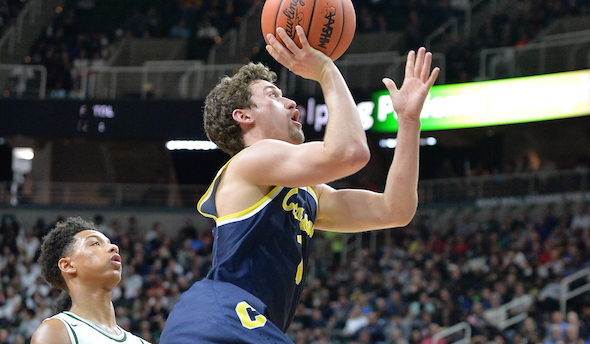
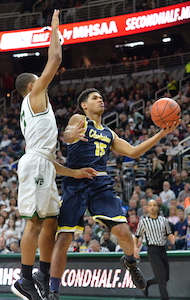
PHOTOS: (Top) Clarkston’s Foster Loyer breaks past West Bloomfield defenders to get a shot up during Friday’s first Class A Semifinal. (Middle) The Wolves’ Tieler Houston (15) gets position on West Bloomfield’s Daniel Wrack.