

Thumb Rivals Honor Connor 'One Last Time'
By
Paul Costanzo
Special for MHSAA.com
February 28, 2017
Jay Burton said one of his biggest fears after his son Connor passed away in 2009 was that he would be forgotten.
 But eight years after his death, the memory of Connor Burton is as strong as ever in Marlette and Brown City, the two communities he managed to make a big impact on during his 10 years on Earth.
“Any parent that’s lost a child, one of the biggest fears is that your child will be forgotten,” Jay Burton said. “They never are, but that’s any parent’s fear. But he’ll be a part of this community for the rest of our lives.”
This past Friday, the two schools met in Marlette for the eighth and final Team Connor Classic, a game that has celebrated Connor’s life since the year after it ended. On this night, Marlette came away with a 49-40 victory, winning the game for the eighth straight time in what would have been Connor’s senior year.
“It’s a good time to call it quits,” Jay Burton said.
Connor’s life
On Thursday, April 16, 2009, Connor went to his gymnastics and baseball practices before shooting baskets outside his house until the sun set and he could no longer see the hoop.
It was a typical day for the energetic 10-year-old, who was described by many as a gym rat and a lover of all sports.
“Whatever sport was in season, he would be ready to play,” said Connor’s uncle Tony Burton, Brown City’s athletic director and former boys basketball coach. “During the winter, basketball was something that was a high priority with him. Obviously, he got taken from us too soon, but he sure loved sports.”
He was good at them, too. His friend Hunter Kelly, now a senior on Marlette’s boys basketball team, said Connor was a better basketball player than most of their friends when they were young.
 In the Thumb, Burtons and basketball are synonymous, and Connor seemed poised to be the next in that line – even if he was coming through the Marlette program and not the Brown City one his uncle was leading and for which his cousins had starred. Connor was even a manager, along with his cousin Caleb Muxlow (who is a senior on this year’s Brown City team), for his uncle’s team.
On Friday, April 17, 2009, Connor, who it would be found suffered from Long QT – a heart rhythm disorder – passed away less than 24 hours after shooting his last shot.
“Basically the electrical system in the heart, which tells it to beat, his wasn’t running correctly,” Jay Burton said. “The thing about it was, you would have never known. … I went (into Connor’s room that morning) and the only weird thing he said to me was, ‘Dad, why did you open the door so fast?’
“I didn’t think anything of it, I flicked his light on, and when I came back he hadn’t made it out of bed. He had cardiac arrest.”
A tradition is born
The following basketball season, the Team Connor Classic was born, and the two communities that Connor loved showed their love for him. There were tributes and tears, and a great basketball rivalry was all of a sudden elevated to another level.
“It’s always been a good game between Brown City and Marlette,” Tony Burton said. “We border each other, we’re in the same county, so it’s usually a pretty good game when we play, regardless of records. It means a lot, and for both teams when we play each other, we want to win. But when the game’s over we still have our friendships and our associations with each other.”
While they compete for bragging rights, and often for Greater Thumb Conference East championships, Marlette and Brown City actually have a long history of coming together for good causes.
“Us and Marlette, we have a great relationship,” Brown City High School principal Neil Kohler said. “We do the pink out game in football every other year at our place, we do the Team Connor game. We did a basketball game last year where both teams gathered water for the Flint crisis. So, it’s probably our biggest rival, but also our biggest partnership. When they came to our place about three weeks ago our local rotary did a pancake dinner and had about 400 people come in from Marlette hospice to raise money. The two communities really come together.”
The Team Connor game has a different feeling than most tribute games because of its unique connection of the family to two tight-knit communities.
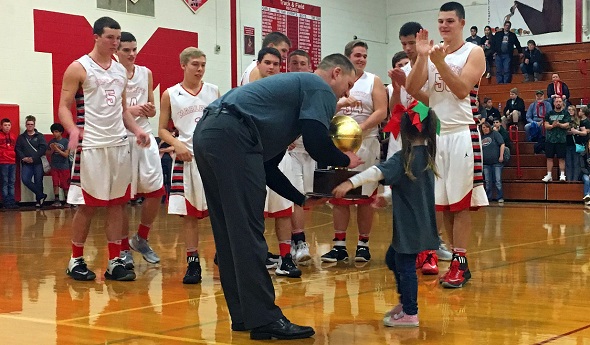
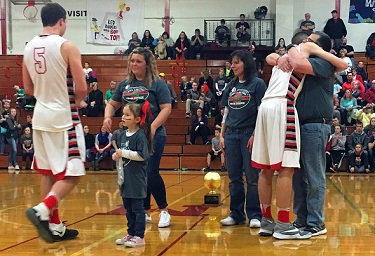
That was apparent in the latest edition, as Connor’s family – his father, his mother Sue, and his sisters Lindsey and Annie – were given a signed basketball from the Brown City community, and a bouquet of flowers and a blanket tiled with memories from all eight Team Connor Classics from the Marlette community. After the game, the family handed out medals to each player on both teams, receiving from them many long, heartfelt hugs.
It’s not easy for the family, especially in a year when Connor would have been the one on the court with his classmates enjoying a season that has seen the Red Raiders go 18-1 and clinch the GTC East title.
“This is only the second game I’ve watched the Marlette boys play (this season),” Jay Burton said. “I can’t watch them. I see Hunter Kelly; the kid stands a foot taller than me. What would Connor have been? He’s the 10-year-old in front of me and all of his friends are 18 getting ready to graduate high school.
 “Caleb Muxlow, his cousin who plays for Brown City, I can go watch simply because he’s family. But this is only the second time I’ve seen (Marlette) play. It just hurts too much.”
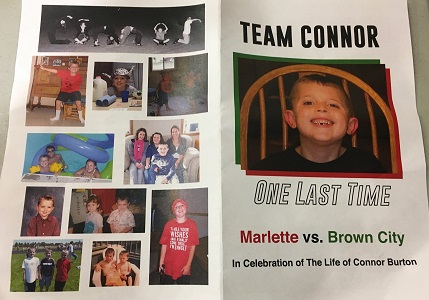
Each team came out for warm-ups in the same Team Connor shirts, which combined the green of Brown City and the red of Marlette, and read “One Last Time.” They sat on the court before the game to watch the presentations and a slideshow of photos from Connor’s life and Team Connor Classics past, and stood with one another during the national anthem.
“I think this one was a special night mainly because these were his classmates,” Marlette coach Chris Storm said. “The rivalry has gotten stronger and stronger between us. It was there because of the league before, but it adds a lot of pressure to both teams and you could see that in the game.
“But it means a lot to see how many people come out for the event. The pastor comes back; he’s been out of the area for three years. It’s a great environment for kids to play high school basketball. It’s a District or a Regional feel almost on a regular-season night.”
As the game tipped off, Marlette took the court with four players. It’s a newer, but impactful tradition that was added in the years Connor would have been playing in the game.
“It was quite a surprise (the first year),” Jay Burton said.
It’s a sign that Connor is certainly not forgotten, and while the Team Connor Classic may be going away, anyone who played in one, coached one or simply attended one, will never forget it.
“It means that we’re remembering a great kid that would have given a lot more to his community if he had more time,” Kelly said. “It shows that us as a senior class, the way we represent ourselves as a team and a community, is reflecting who he was. It means a lot because he would have been a senior this year, he probably would have been playing with us. He was better than me, he was better than a lot of these kids, so he probably would have been starting, too.
“So it means a lot to play in remembrance of him, because he’s missing out on all these memories.”
 Paul Costanzo served as a sportswriter at The Port Huron Times Herald from 2006-15, including three years as lead sportswriter, and prior to that as sports editor at the Hillsdale Daily News from 2005-06. He can be reached at [email protected] with story ideas for Genesee, Lapeer, St. Clair, Sanilac, Huron, Tuscola, Saginaw, Bay, Arenac, Midland and Gladwin counties.
PHOTOS: (Top) Annie Burton, Connor Burton’s younger sister, presents Marlette boys basketball coach Chris Storm with the “Team Connor Classic” trophy after Friday’s game. (Middle) Hunter Kelly hugs Connor’s father Jay Burton as the family welcomes both teams' players. (Below) The game program from the night celebrated Connor Burton’s life and legacy. (Photos by Paul Costanzo.)
Hoopfest Returns This Weekend to Jenison
March 21, 2017
By Geoff Kimmerly
Second Half editor
March Magic Hoopfest will return to Jenison Field House for this weekend’s Michigan High School Athletic Association Boys Basketball Finals, marking the eighth championship weekend the event has run concurrent with the games being played at Michigan State University’s Breslin Center.
A number of favorite attractions will return including slam dunk (on lowered rims), 3-point shootout and half-court shot areas where fans can come at any time and participate, and the festivities also will include a court for timed “Around the World” shooting games and another court featuring the Michigan Army National Guard skills challenge. Also returning is the Walk of History, showcasing championship games, life-size photos and display boards from throughout the MHSAA Finals’ near century-long run.
Two Hoopfest center courts will host a number of games throughout the event, including the “JumpBall Jamboree” made up of teams of boys and girls in grades 3-8, and a series of games between Special Olympics Project UNIFY high school teams.
Admission to the March Magic Hoopfest is $2 per person, and fans attending the MHSAA Boys Basketball Semifinals and Finals will be admitted free with their game tickets. Hours on March 23 and 24 will be 2 p.m. to 7 p.m.; the event is open from 10 a.m. to 6 p.m. on March 25. Jenison Field House, site of Hoopfest, also was the site of the MHSAA Boys Basketball Finals for 31 years. To find out more general information about the event, visit the March Magic Hoopfest Website.
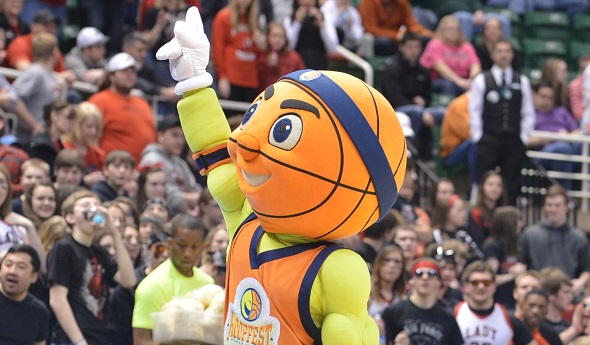
Hoopfest also will be home to Hoopie, the event’s mascot who made his first public appearances during the 2014 MHSAA Finals.
The March Magic Hoopfest is being conducted in partnership between the Greater Lansing Sports Authority (GLSA), a division of the Greater Lansing Convention and Visitors Bureau, and the MHSAA, with vital support coming from the Department of Intercollegiate Athletics at Michigan State University.
“For more than 90 years, basketball teams have ended their seasons at the MHSAA Tournament, and Hoopfest allows fans to share first-hand in the atmosphere that has made this such a historic event,” MHSAA Director of Brand Management Andy Frushour said. “It’s a great stop-over for our fans coming to or leaving the Breslin Center, and it’s also a great place to bring the family for some fun even for those who won’t be attending this weekend’s Finals.”
The Greater Lansing Sports Authority’s mission is to be the leading voice of sports tourism in the Greater Lansing area and to promote economic growth by attracting a diverse range of sporting events to the region. The GLSA strives to enhance the quality of life for area residents through the development of local sports and fitness programs for all ages and supports the continued development and maintenance of safe, high-quality athletic facilities.
“The March Magic Hoopfest sets off a great weekend of MHSAA tournament games and helps create a multi-day event which will involve the Lansing area and thousands of visitors from across the state,” said Mike Price, Executive Director of the Greater Lansing Sports Authority. “If you’re coming to the championships, Hoopfest is a destination to visit before and after the games; and if you’re not coming to the games, Hoopfest is a fun, wholesome, inexpensive, family activity.”
PHOTO: Hoopie entertains the crowd during the 2014 MHSAA Finals.