

Tiger Pride Returns at Muskegon Heights
February 3, 2016
By Tom Kendra
Special for Second Half
It’s hard to overstate the importance of basketball to a community like Muskegon Heights.
 On one hand, a bunch of kids playing a game in a gym seems like a low priority, almost trivial in a town whose violent crime rates and percentage of residents living in poverty are among the highest in Michigan.
But on the other hand, the “Tiger Pride” that is on display each time Heights alumnus Dell Stewart and his team of 13 players take the court – and the returning crowd of community members who are getting back on the bandwagon as the wins continue to pile up – could provide the spark to create real change in this beleaguered West Michigan town.
“Basketball has always been a source of pride in this community,” said Stewart, a 1989 Muskegon Heights graduate, who is in his fourth year as the Tigers’ head coach.
“Basketball and all sports almost ended here completely four years ago, but we weathered the storm. We’re back. And we want to be a source of hope and pride.”
The school is now known as the Muskegon Heights Academy, a public charter school which replaced the debt-ridden Heights district in 2012, but the basketball standards are as high as they have ever been in a community which boasts six MHSAA championships – 1954, 1956, 1957, 1974, 1978 and 1979.
Heights has its sights set on another banner after taking its high-energy show on the road Saturday night and improving to 10-1 with a convincing 55-45 victory over perennial power and longtime rival Benton Harbor, which was ranked No. 10 in the state in Class B.
The Tigers beat the “downstate Tigers” on Saturday with their trademark full-court pressure defense and multiple offensive weapons – and now should finally get a spot in the Top 10 of this week’s Class C Associated Press state poll.
Underclassmen led the way in Heights’ big win, with junior point guard Antoine Jones scoring 18 points and junior Serinus Daniels and sophomore DeCarri Brown each grabbing 10 rebounds.
 The energy of the team starts with the backcourt trio of Jones and his twin brother, Anthony, and senior captain Anthony Gordon. The starters inside are 6-foot-3 sophomore center Kieshon Watson and senior forward Deondre Wilson, but Daniels (a 6-6 junior) and Brown also see plenty of minutes.
“The thing I like about this team is that every game it seems like we have a different leading scorer,” said Stewart, who is assisted on the Tigers’ bench by his younger brother, Terry, a sharpshooter on the 1993 Heights team that lost to Saginaw Buena Vista in the Class B championship game. “We don’t have a lot of size, but we make up for that in different ways. We have the pieces of the puzzle to make a run.”
The win at Benton Harbor was just the latest impressive road victory for the Tigers, who turned some heads with big tournament wins in December over Southfield at Grand Rapids Ottawa Hills and Lansing Sexton at Battle Creek Central. Heights also handed host Kalamazoo Phoenix its first loss on Jan. 22.
Fans at home are starting to take notice – and come back.
When “the storm” Stewart referred to made landfall in 2012, a state-appointed emergency manager had taken over and there was uncertainty about whether the district would exist for the upcoming school year, let alone have a sports program.
That uncertainty led coach Keith Guy and high-profile players such as DeShaun Thrower (the state’s Mr. Basketball in 2014) and Joeviair Kennedy (now playing at Western Michigan University) to go to neighboring Muskegon High School – and many longtime Heights fans went with them. Soon, the traditional football school was now the place to be for basketball as well, as Thrower and Kennedy were joined by 6-9 Deyonta Davis (now at Michigan State) for an undefeated season and Class A championship in 2014.
Almost forgotten was the county’s traditional basketball power, Muskegon Heights.
Amidst all the new-found Big Reds’ basketball hoopla, Heights basketball picked up the pieces. With longtime administrators Glen Metcalf (athletic director) and Jerry Harris (faculty manager) leading the way, Heights was able to lure Stewart away from his job as head coach at Reeths-Puffer and back home to be head basketball coach and dean of students. His first order of business was to convince kids that they did not need to transfer to find basketball success.
 Stewart’s words were backed up by results in 2014, when the Tigers made a run all the way to the Class C Semifinals at Michigan State’s Breslin Center, where they lost to Pewamo-Westphalia.
“I looked up in the stands and saw some of the old fans coming back and even people I hadn’t seen in 15 years, people who were starving to be part of something positive in Muskegon Heights,” said Stewart.
The problem has been that for every step up, there have been two steps back in terms of the Heights’ image.
One month after the Tigers made it to the Breslin in 2014, starting center Marquis Gresham was murdered in a drive-by shooting. Last fall, Heights was back in the news for the wrong reasons, when a home football game against Muskegon Catholic Central was cancelled after a shooting earlier that day.
Those incidents weigh heavy on all of the town’s residents, but they seem 1,000 miles away, at least briefly, when the Tigers work their magic on the basketball court.
One of those Tigers having plenty of fun is junior forward Keshawn Gresham, Marquis’s little brother, who is one of 10 underclassmen on the Tigers’ 13-player varsity roster.
As he laughs and jokes with his teammates, as a big throng of community residents cheer on in support, one fact is apparent:
Basketball is more than just a game in Muskegon Heights.
 Tom Kendra worked 23 years at The Muskegon Chronicle, including five as assistant sports editor and the final six as sports editor through 2011. E-mail him at [email protected] with story ideas for Muskegon, Oceana, Mason, Lake, Oceola, Mecosta and Newaygo counties.
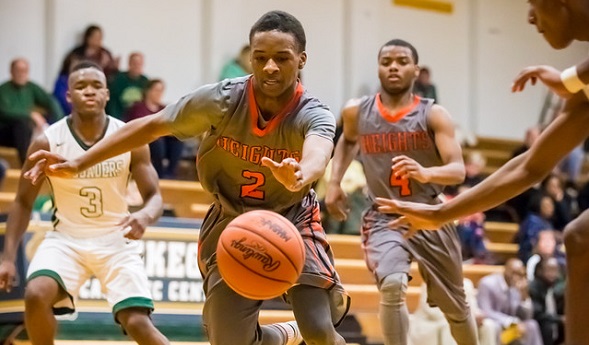
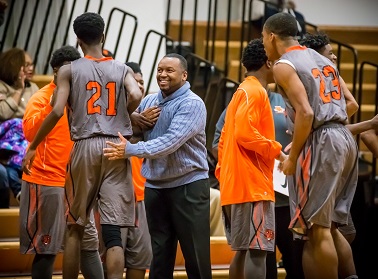
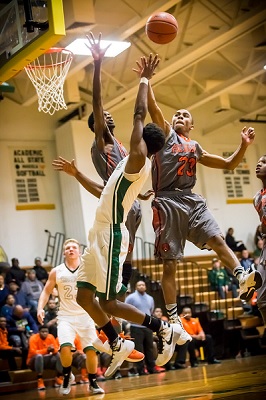
PHOTOS: (Top) Muskegon Heights junior point guard Antoine Jones drives up the court during a 70-47 win at Muskegon Catholic Central on Jan. 26. (Middle) Muskegon Heights coach Dell Stewart congratulates junior forward Serinus Daniels after a block on one end and a bucket on the other during the win over MCC. (Below) Muskegon Heights' Joe Moore (right) and Serinus Daniels (left) defend Muskegon Catholic's Christian Martinez. (Photos by Tim Reilly.)
Esler Pilots DeLaSalle Back to Final Week
By
Tom Markowski
Special for Second Half
March 19, 2018
WARREN – There isn’t much that Greg Esler hasn’t seen or experienced as a coach and as a father.
 Through it all he’s learned to take nothing for granted, in life and as a coach.
Esler, 63, coached St. Clair Shores Lake Shore to its first and only MHSAA boys basketball title in 1994, in Class B. That team was led by Travis Conlan, who finished second in the voting for Mr. Basketball that season. Conlan would go on to play at University of Michigan, one of a number of Esler-coached players who went on to the college – and for some – professional ranks.
Esler is in his 31st season as a head coach, with the last 24 at Warren DeLaSalle. Twenty-one times the Pilots have won a District title with Esler on the bench. In 2007, DeLaSalle reached a Class A Semifinal for just the second time in school history, as it lost to Manny Harris and Detroit Redford 56-50. (Note: In addition to two Class A Semifinal appearances, DeLaSalle also reached a Class B Final in 1982).
Consistency has been a hallmark of Esler’s programs, and even after all these years a fire burns in his stomach. He’s retained a burning desire to compete and to win. As the years have piled up, Esler has become more appreciative of the success his program has achieved and the experiences gained.
So when DeLaSalle defeated Macomb Dakota, 56-51, in a Regional Final last Wednesday, there was reason to celebrate. As good as DeLaSalle has been recently, it hadn’t won a Regional title since 2010. The Pilots have been to the Detroit Catholic League final each of the last three seasons and have won five District titles since 2010 including the last three. But the end of last season stung more than most. DeLaSalle reached a Regional Final and then lost to Troy, 48-40, in an ugly game where the Pilots shot less than 30 percent from the field.
Most of that team is back as the Pilots head into the final week of this season. Esler has nine seniors including two of the top players in the league in point guard Justin Fischer and guard-forward Luke Pfromm, the starting quarterback on the Division 2 championship football team.
Esler started coaching at Warren St. Anne grade school in 1983, then went to DeLaSalle for three seasons beginning in 1985 under then-coach Gary Buslepp. Esler got his shot as a head coach in 1987 at Lake Shore and quickly made that program relevant. Lake Shore reached the Class B Semifinals in 1993 before losing to coach Norwaine Reed and Saginaw Buena Vista.
Esler took over the DeLaSalle program at the start of the 1994-95 season. His career record stands at 530-216 heading into tonight’s Class A Quarterfinal against Detroit U-D Jesuit.
“We instilled a system here,” he said. “The first thing is to have your players in condition. Second is defense. I’ve always stressed defense. And third, and maybe this should be first, is talent. We’ve always had really good players here. And the players we’ve had want to get better.”
What often goes unnoticed in a basketball program is the work of the assistant coaches. Esler has been blessed with loyal and knowledgeable assistants. His top assistant is Tom Mehl, who played for Esler for two seasons at Lake Shore. Mehl was on staff for Esler’s last four seasons at Lake Shore and has been with Esler every step of the way at DeLaSalle.
Jeff Becker is in his 13th season as an assistant, and another, Dave Grauzer, recently left the program and now is an assistant at Traverse City West.
 “Surrounding yourself with good people is at the top of the list,” Esler said. “One thing about Tom, there’s no one I’ve seen who can go to a game to scout and pick up something no one else would see. Like a player who takes two dribbles before driving to his right or left. For Becker, it’s organization. He works well with the kids, and he’s got the post players. Mehl has the guards.
“Over the years I’ve listened. Listened to other coaches. I don’t have all the answers. I talk to Steve Hall at (Detroit) Cass Tech all the time. He’s been a great friend over the years.”
This team has a closeness not always seen. The fact that there are nine seniors is one reason. Esler points out that he’s been with this group for more than 100 days this season, and when you’re around a group that long tempers can flare – so it’s important to keep the present in perspective and realize they all want to reach the same goal.
“We do a lot of things outside of basketball,” Esler said. “Last week four of my captains read to the students at (St. Clair Shores) St. Germaine grade school. My wife, Renee, is a fourth and fifth grade teacher there, and it’s way for the players to interact with the younger students.
“I read an article recently on (Michigan) coach (John) Beilein and how the game has changed. The kids have changed. We watch game film but not like we used to. Their attention span isn’t like it used to be. The technology now, with Facebook and texting, it’s unbelievable. We might watch film for 20 minutes where we used to watch for hours.
“My players will tell you, I love the practices much more than they do. Games are like taking a test. If you didn’t win, maybe you failed at some area that cost you. They love each other and they do a good job of listening. All five starters have scored 20 points or more in a game this season. And they don’t get rattled. We were down four to Dakota with four minutes to go and Pfromm came to me in the huddle and said, ‘Don’t worry coach. We got this.’ I can see why they won a state title in football.”
Fischer has matured significantly as a leader and force offensively. A three-year starter, he has signed with Lake Superior State.
Fischer came into the program as a skinny 5-foot-10 freshman. By the time he was a junior, he had grown five inches. Now he’s 6-4 and weighs 185 pounds.
“I was a pass-first guard as a sophomore,” he said. “I’ve worked on my shooting, just working on my total game.
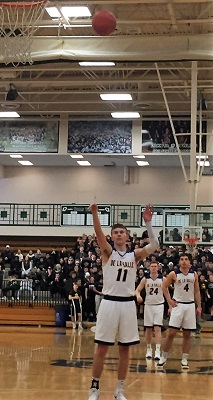
“We were pumped up for that Dakota game. We got the crowd going crazy. We were down and Luke hit a couple of 3s. I had a dunk and hit four free throws late.”
DeLaSalle (18-7) will play Catholic League Central rival Detroit U-D Jesuit (22-3) next. The Class A Quarterfinal will be played Tuesday at 5 p.m. at Calihan Hall, the site of the Catholic League final. Jesuit won that game, 71-64. In fact, Fischer has lost nine consecutive games to U-D as a varsity player.
He shouldn’t feel alone. DeLaSalle hasn’t defeated U-D since 2014 when the teams tied for the Catholic League Central regular-season title – a streak of 14 straight defeats to the Cubs. U-D won this season’s meetings 64-45, 59-57 and 64-55.
Esler keeps U-D recent domination of his program on the light side.
“I’ve said I’d have to coach until 2031 to get to .500 against them,” he said.
 Tom Markowski is a columnist and directs website coverage for the State Champs! Sports Network. He previously covered primarily high school sports for the The Detroit News from 1984-2014, focusing on the Detroit area and contributing to statewide coverage of football and basketball. Contact him at [email protected] with story ideas for Oakland, Macomb and Wayne counties.
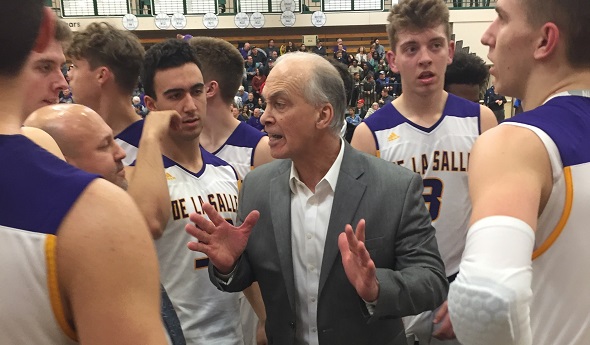
PHOTOS: (Top) Warren DeLaSalle coach Greg Esler talks things over during his team’s Regional Final win against Macomb Dakota. (Middle) Justin Fischer launches a free throw during the 56-51 victory.